
Datsun 240Z Buyer's Guide
Definitive buyer's guide for the 1970-1973 Datsun 240Z. Frame rust hotspots, L24 engine identification, original specification verification, and current market pricing for survivors and restorations.

The Datsun 240Z is the car that changed how Americans thought about Japanese performance. Launched in 1969 for the 1970 model year at a sticker price of $3,526, it offered Jaguar E-Type styling, BMW 2002 driving dynamics, and Toyota reliability — for half the price of any of them. Today, clean original 240Zs sell for sums that would have shocked enthusiasts ten years ago, and the supply of unrestored survivors continues to shrink.
What Made the 240Z Important
When the 240Z arrived in American showrooms in late 1969, the affordable sports car market was dominated by aging British roadsters — MGB, Triumph TR6, Spitfire — that were charming but unreliable. The 240Z offered a fundamentally different proposition: modern engineering, six-cylinder smoothness, four-wheel independent suspension, and Japanese build quality at a price competitive with the British cars and dramatically below the Italians and Germans.
Year-by-Year Differences
1970 (Series I)
The original year. Distinguishing features include the early-style instrument cluster with separate gauges, the chrome window surround trim, and "240Z" badging on the rear hatch in a specific font that changed in later years. Series I cars are the most collectible and command 10-15% premium over equivalent later cars.
1971-1972
Refined production. The 1971 model added the optional five-speed manual (rare in the US — most cars are four-speeds). 1972 brought minor trim changes. These years offer the best balance of original character and refined drivability.
1973
The end of the original 240Z. Federal emissions and bumper regulations changed the front bumper height in mid-year, and the L24 engine got revised cam timing and ignition for emissions compliance. 1973 cars lose a few horsepower compared to earlier cars but are otherwise identical in driving feel.
The Engine: L24 Inline-Six
The 2.4-liter L24 inline-six is one of the most overlooked engineering achievements of its era. It was designed for the 240Z but went on to power successful Datsun and Nissan cars for decades. The basic block design appeared in trucks and other models well into the 1980s.
| Specification | Value |
|---|---|
| Displacement | 2,393 cc (146 cu in) |
| Configuration | SOHC inline-six, 2 valves per cylinder |
| Carburetion | Twin SU-style Hitachi sidedraft (1970-72) |
| Compression | 9.0:1 (1970-72), 8.8:1 (1973) |
| Output | 151 hp @ 5,600 rpm (1970-72) |
| Redline | 7,000 rpm |
What makes the L24 special isn't peak output — it's the linear, smooth power delivery. The engine pulls cleanly from 1,500 rpm to redline with no flat spots, no peaky cam, no surge. It's the kind of engine that feels at home both at 35 mph in city traffic and at 6,000 rpm on a mountain road.
"I bought my 1972 240Z in 2014 because I wanted to understand the appeal beyond the obvious styling. After ten years of driving and rebuilding it, I'm convinced the L24 is the most honest-feeling six-cylinder I've ever experienced. It rewards smooth inputs, punishes ham-fisted driving, and never asks for more than basic mechanical attention. That's a kind of engineering integrity that's increasingly rare."
— Emily Chen
What Goes Wrong
Rust Is the Killer
The 240Z's unibody construction means rust isn't a cosmetic issue — it's structural. The rear strut towers, the floor pans, the rocker panels, the rear quarters where they meet the wheel arches, and the rear hatch frame are all critical areas. Rust in these zones is expensive to repair properly because the unibody requires careful welding and panel alignment.
Electrical Gremlins
Forty-five-year-old wiring is forty-five-year-old wiring. Original harnesses commonly fail at the dashboard cluster ground, the headlight relay system, and the tail light circuit. Budget for at least a partial harness replacement and a new fuse box on any 240Z you buy.
Carb Tuning
The original twin SUs (or Hitachi sidedrafts) work brilliantly when tuned correctly and frustratingly when neglected. Most surviving 240Zs need a carb rebuild and synchronization to run their best. A specialist will charge $800-$1,500 for a proper rebuild and tune; the difference in driving experience is night-and-day.
Buying Strategy
The strongest strategy in the current 240Z market is to find a documented, rust-free survivor in the $35,000-$55,000 range and own it as a long-term holding. These cars have appreciated steadily for over a decade and the supply of clean originals continues to shrink.
Project-grade cars (rough but complete) at $12,000-$22,000 are tempting but require honest math. A proper restoration runs $45,000-$85,000, putting you at $60,000-$110,000 all-in for a car worth $50,000-$80,000 finished. Restoration economics work only if you genuinely want the build experience and the specific car.
The smart-money entry point in the broader Z-car family is actually the 280Z (1975-1978). Federal regulations made these cars heavier and slower than the 240Z, but they got fuel injection (much better drivability), better brakes, and updated safety equipment. Clean 280Zs trade for $15,000-$28,000 — a fraction of equivalent 240Z money for a comparable driving experience and similar collector trajectory.
Browse Datsun 240Z listings
 Dealer
 United States
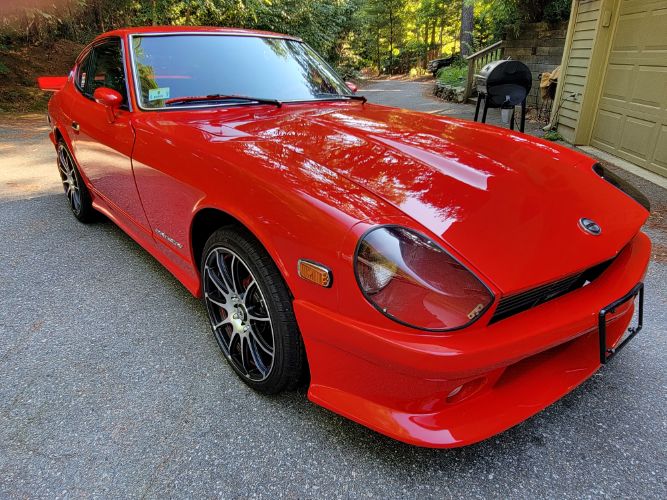
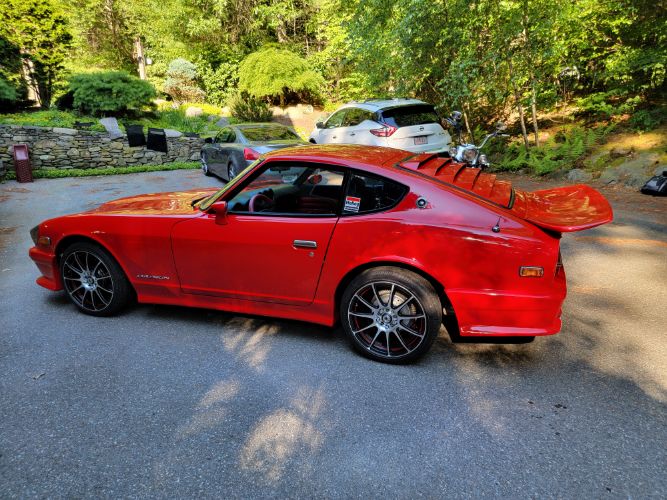
1973 Datsun 240Z
 Dealer
United States
Dealer
United States
1973 Datsun 240Z
What to Look For
Frame and floor first. Floor pans on 240Zs rust through to the underside in coastal and salt-belt climates. Look at the floors with carpet pulled. The rear strut towers are a critical structural area — rust here means the rear suspension can deflect under load. Pop the hatch and inspect the spare-tire well.Unibody integrity is the second concern. Squeeze the rocker panels firmly. They should be rigid. If they flex, the rocker panels are rusted out and supporting essentially nothing.
Engine condition. The L24 is a 2.4-liter SOHC inline-six with two valves per cylinder and twin SU carburetors. It should idle smoothly at 700-800 rpm, run cleanly through the rev range to 6,500 rpm, and have no smoke at any RPM. Compression should be 145-165 PSI across all six cylinders. Timing chain rattle on cold start is a tensioner that needs replacement — minor.
VIN and HLS30 numbering. Original US-market 240Zs are HLS30-prefixed (the "L" for left-hand-drive, "S" for sports). Check the dashboard plate and the engine bay tag for matching numbers and original color codes.
Pre-Purchase Checklist
-
Inspect rear strut towers
Critical structural rust area. Open rear hatch, remove spare-tire cover, examine inner wheel wells with flashlight. Rust here = walk away. -
Pull carpet, check floor pans
Both driver and passenger sides. Floor pans rot from underneath. Patch panels welded over original rust = future failure. -
Squeeze rocker panels firmly
Should be rigid. Flex = rotted out and structural compromise. Major repair if damaged. -
Verify VIN matches numbers
Dashboard HLS30 plate, engine bay tag, engine block stamping (behind distributor). All four must match for matching-numbers claim. -
Compression test all six cylinders
Should read 145-165 PSI uniformly. Variance >15% between cylinders = head gasket or ring problem. -
Listen for timing chain rattle
Cold start rattle is normal (tensioner). Constant rattle through driving = chain stretch, requires replacement. -
Check carburetor synchronization
SUs should be balanced and tuned. Check throttle response, idle smoothness, off-idle pickup. -
Test all electrical functions
Headlights, tail lights, gauges, turn signals, fuel gauge, wipers, hatch latch. Multiple failures = harness replacement coming. -
Examine rear differential
R180 differential. Check for whining noise on deceleration, broken stub axles, leaking pinion seal. -
Document with HD photos
Every panel, frame, undercarriage, engine bay, interior, and identifying tag/stamp. Build the case before you wire money.
Common Issues
240Zs rust everywhere. Rear quarters, front fenders, floor pans, frame rails, rocker panels, and especially the rear hatch area where rainwater collects. The infamous "rear strut tower rust" is structural — repair is expensive and a deal-breaker on otherwise rough cars.Mechanically, the L24 inline-six is bulletproof, but the SU carburetors (or Hitachi flat-tops on later cars) commonly need rebuilds. The four-speed manual is robust; the 1971-1972 five-speed (rare, US market) is more desirable. Differentials are weak in stock form — broken R180 axles are a known issue.
Electrical issues are universal. Forty-five-year-old wiring harnesses fail in predictable spots: the dashboard cluster ground, the headlight relay system, and the tail light circuit. Plan to replace at least the engine bay harness and fuse box on any car you buy.
More 240Z for sale
 Dealer
United States
Dealer
United States
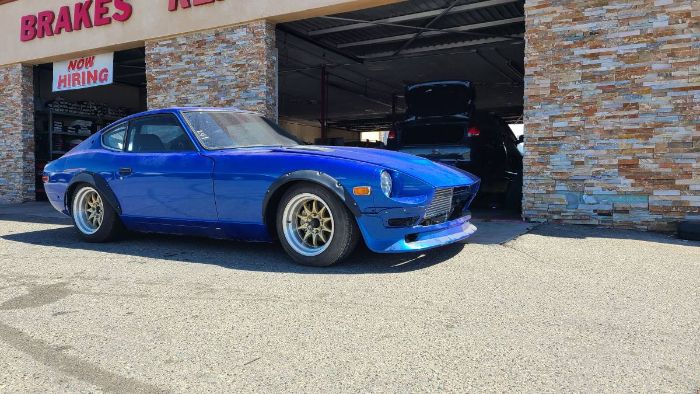
1974 Datsun 240Z
 Dealer
United States
Dealer
United States
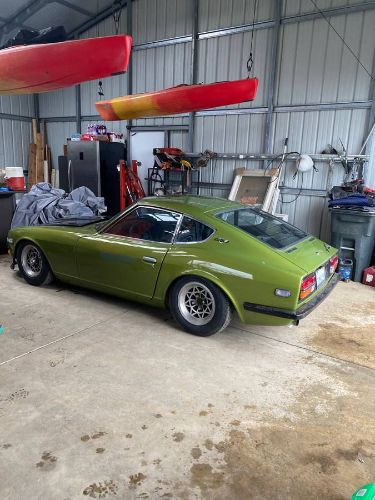
1970 Datsun 240Z
Pricing Guide
240Z values have moved aggressively from 2015 forward. A driver-quality 1970-1973 240Z in solid mechanical condition with normal cosmetic wear runs $28,000-$45,000. Concours-grade restorations of well-documented original cars: $65,000-$110,000. The first-year 1970 cars ("Series I") with their distinctive interior trim and chrome bumpers are the most desirable; they command 10-15% premium over equivalent 1971-1973 cars.High-end documented examples are now in the six-figure range. The November 2021 Bonhams sale of a 1972 240Z restored by Datsun Heritage Collection in Tokyo set a record at $310,000 — but that's a outlier. The realistic top-end for a typical numbers-matching, professionally restored, low-mileage 240Z is $110,000-$140,000.
Project cars (running but rough) start around $12,000-$22,000. Stripped roller candidates are $5,000-$10,000, but rust restoration is expensive — $15,000-$30,000 in body and floor work alone before paint.
Fun Facts
The 240Z's design was driven by Yutaka Katayama ("Mr. K"), the head of Nissan USA, who recognized that the American sports car market wanted something more refined than a British roadster but more affordable than a Porsche or Jaguar. The car was sold as the Datsun 240Z in the US market and as the Nissan Fairlady Z in Japan.The original sticker price in 1970 was $3,526 — about $28,000 in 2024 dollars. A new Porsche 911T was $6,990 the same year, and a Jaguar E-Type was around $5,500.
Only 16,215 cars were sold in the US in calendar 1970. By 1973, US sales had grown to 95,200 units, and the 240Z had transformed Datsun from an obscure import brand into a genuine American sports car contender.
Frequently Asked Questions
Ready to find your 240Z?
Browse 6+ active Datsun 240Z listings on Classic Cars Arena.
View Listings →