
Classic Ford F-100 Buyer's Guide
Definitive buyer's guide for classic Ford F100 1953-1983. Generation breakdown, frame and cab inspection, FE and Windsor V8 identification, restomod vs original pricing, current market.

The Ford F100 was the lighter half-ton of Ford's F-Series pickup line from 1953 through 1983, and across thirty years of production it became one of the foundational classic American trucks. From the iconic 1953-1956 first-generation cars (the "Effie" with the toothy grille) to the 1957-1960 second-gen, the slab-side 1961-1966 third-gen, the 1967-1972 "bumpsides," the 1973-1979 "dentsides," and the 1980-1983 final-generation cars, every era has its own buyer profile and its own pitfalls. Don't buy somebody else's project — the frame and the cab are non-negotiable. Either buy a finished truck or buy a clean rust-free truck and build it yourself. The middle ground is where most first-time buyers lose serious money in this market.
Overview
The F100 ran for 30 years across six distinct generations, and each era has its own buyer profile and its own collector trajectory. The 1953-1956 first-generation "Effie" trucks are the most desirable; the 1957-1960 cars are increasingly collected; the 1961-1966 unibody and conventional trucks have unique structural concerns; the 1967-1972 "bumpside" trucks are the most popular restomod base; the 1973-1979 "dentside" trucks are the breakout appreciation segment; and the 1980-1983 final-generation trucks remain the bargain entry. Understanding which F100 era is yours is the first step toward smart buying.
Generations Worth Knowing
First Generation: Effie (1953-1956)
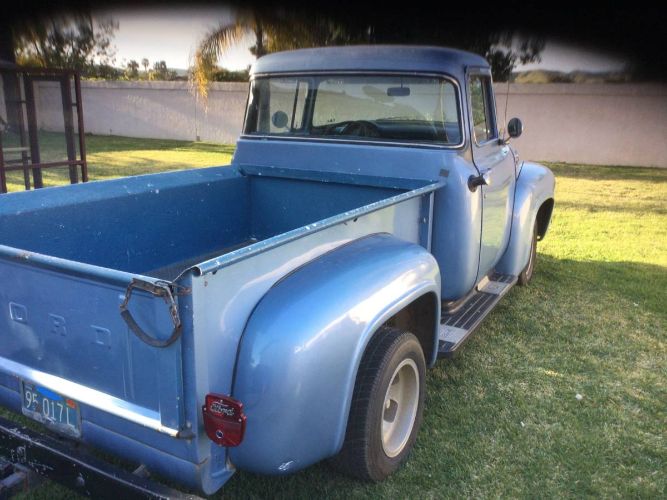
The original. F-Series redesign brought the modern F100 nameplate, the iconic toothy grille (especially 1953-1955), and the foundation of every F100 to follow. Engine options included the 215 inline-six (base) and the Y-block 239/256/272 V8. The 1956 model is widely considered the peak of first-generation styling — driver-quality cars run $28,000-$48,000 today.
Second Generation (1957-1960)
Modern styling, hooded headlights, and the introduction of the Twin I-Beam front suspension as an option (1957+). The 1957 launch year is the most desirable. Driver-quality cars run $22,000-$42,000 — a smart-money entry into pre-bumpside F100 ownership.
Third Generation (1961-1966)
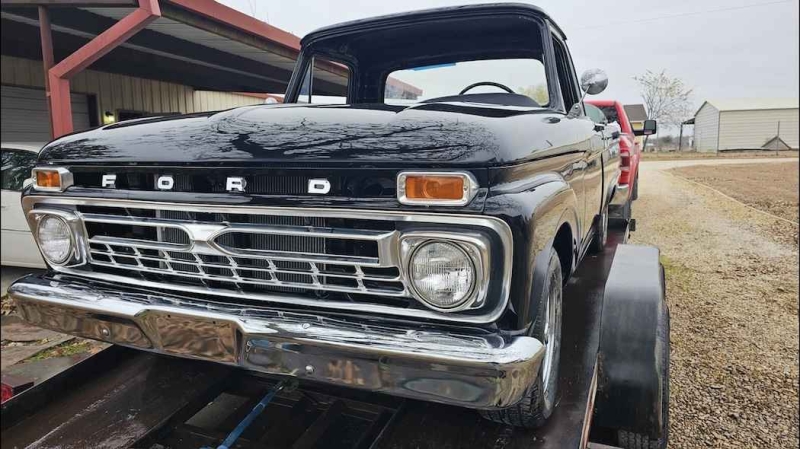
Slab-side styling, available in unibody (1961-1963) and conventional cab/bed (1964-1966) configurations. The unibody trucks are now collected for their unusual short production run; conventional 1964-1966 cars are the more practical choice. Driver-quality cars run $18,000-$35,000 across both configurations.
Fourth Generation: Bumpside (1967-1972)
The 1967 redesign brought sharper styling with the iconic bumpside crease running the length of the bedside. The 1967-1968 small-bumper trucks are the most desirable; 1972 brought the larger Federal-mandated 5-mph bumper. Driver-quality cars run $22,000-$42,000, with restomod builds at $55,000-$95,000+.
Fifth Generation: Dentside (1973-1979)
The 1973 redesign brought squared-off styling with the indented "dented" lower bedside crease. Engine options included the 300 inline-six, 302 Windsor, 351 Windsor, 351 Cleveland, and 460 (in F250+ only). Dentside F100s have appreciated dramatically since 2018 — driver-quality cars run $18,000-$35,000.
Sixth Generation (1980-1983)
Modern styling matching the F-Series of the era. Smaller bumpers, refined interior, and updated emissions equipment. Final years of the F100 designation before Ford renamed the lineup to F-150 (1984+). Bargain entry into modern classic Ford truck ownership at $12,000-$25,000.
What to Look For (in person)
Frame and Cab Inspection
The frame and the cab are non-negotiable. Crawl under the truck with a flashlight. Probe the perimeter frame at the rear cross-member, cab mount points, and front horns. Pull the floor mats and inspect floor pans. Look at the cab corners from outside and from inside through the kick panels. Cab corner rust is universal on driver-quality F100s.
Engine Verification
Cross-reference the VIN engine code with the actual block casting number. The Y-block 239/256/272 (1953-1962), FE-series 352/360/390 (1958-1976), and 351 W/C (1969-1979) all have specific casting numbers. The most desirable engine for collectors is the 390 FE in 1967-1976 trucks; for restomod builders, the 351 Windsor or 351 Cleveland.
Pricing Tiers
| Tier | Description | Price Range (2024) |
|---|---|---|
| Driver | 1973-1983 dentside or 6th-gen F100, decent paint, runs and drives, light cosmetic wear | $15,000-$32,000 |
| Survivor | 1957-1972 F100 with original drivetrain and original paint, documented mileage | $28,000-$50,000 |
| Concours | Documented 1953-1956 Effie or 1967-1968 small-bumper bumpside, frame-off restoration | $55,000-$120,000+ |
Common Pitfalls
The biggest pitfall in F100 buying is paying premium money for a truck with hidden frame or cab corner rust. Demand a thorough underside inspection on a lift before purchase. Run a strong magnet over cab corners and rocker panels — body filler is non-magnetic.
The second pitfall is half-finished restomod builds. F100 restomod is a popular hobby and many trucks on the market are partial builds with parts in boxes and incomplete work. Don't buy somebody else's project — either buy a finished truck where the work is documented and verified, or buy a clean rust-free truck and build it yourself.
"The best advice I can give a first-time F100 buyer is the same I give for any classic truck purchase: don't buy somebody else's project. The frame and the cab are non-negotiable. Either buy a finished truck where the work is documented and verified, or buy a clean rust-free truck and build it yourself. The middle ground — a half-finished build with parts in boxes — is where most first-time buyers lose serious money in this market. The market premium for a finished, documented F100 versus a project truck with the same parts list is real, and it pays for itself in saved time and avoided headaches."
— Robert Halloran
Final Verdict
The F100 market rewards documentation, frame integrity, and patience. The 1953-1956 Effie cars are blue-chip investments. The 1967-1972 bumpside era is the most popular restomod base with strong parts support. The 1973-1979 dentside era has appreciated dramatically since 2018. The 1980-1983 final generation remains the bargain entry into modern-classic Ford truck ownership.
For new buyers, start with a 1973-1979 dentside F100 with the 302 or 351W small-block and the C4 or C6 automatic. They're the most affordable proper F100, parts support is excellent, and the dentside era is increasingly collectible. From there, the upgrade path is clear: 1967-1972 bumpside, then 1957-1960 second-generation, then 1953-1956 Effie. Patience and frame inspection beat impulse buys every time in this market.
Browse Ford F-100 listings
 Dealer
 United States
1961 Ford F-100
What to Look For
Frame inspection is the first non-negotiable on any F100. Crawl under the truck with a flashlight. Probe the perimeter frame at the rear cross-member, the cab mount points, and the front horns. Solid steel resists; rotten metal flakes. Frame replacement on an F100 is $8,000-$18,000 for proper professional work — verify the frame is solid before considering any cosmetic or mechanical concerns.The frame and the cab are non-negotiable. Cab corner rust is universal on driver-quality F100s — verify how much before purchase. Cab corners are reproduction parts available for $200-$500 per pair, but installation requires skilled bodywork and proper rust removal. A truck with bondo over rotten cab corners is a 5-year time bomb.
Bed inspection is the second non-negotiable for any pickup truck. Lift the bed mat or any bed liner installed and inspect the bed floor with strong light. The bed floor on an F100 is a stamped steel pan that rusts from above (cargo wear) and below (water intrusion). Rust through is universal on cars used as actual working trucks; cars used as cruisers tend to have better-preserved beds.
For 1967-1979 cars, the cowl seam where the windshield base meets the firewall is a critical rust point. Water collects there and rots downward into the cab and forward into the firewall. Pull the dashboard pad and inspect the cowl from inside the cab if practical. Cowl rust is one of the more expensive F100 repairs — $2,500-$5,500 for proper professional work.
Engine verification by casting numbers is essential. The Y-block (1953-1962), FE-series (1958-1976), and 351 W/C (1969-1979) all have specific casting numbers. Cross-reference the VIN engine code (5th digit on 1968+ cars) with the actual block casting number. Replacement engines are common — original numbers add value but aren't critical for driver-quality cars.
Pre-Purchase Checklist
-
Inspect frame at rear cross-member and cab mounts
Probe with screwdriver. Solid steel resists; rotten metal flakes. Frame replacement = $8,000-$18,000. -
Examine cab corners from outside and inside
Visible from inside through kick panels. Cab corner rust universal on driver-quality F100s. -
Lift bed mat and inspect bed floor
Universal rust point on working trucks. Rust through = $2,000-$4,500 sheet metal repair. -
Check rocker panels and floor pans
Pull floor mats. Both driver and passenger sides. Standard rust zones across all generations. -
For unibody trucks (1961-1963), inspect bed-to-cab seam
Structural rust here is essentially unrepairable. Critical inspection point on unibody-only generation. -
Examine cowl seam at windshield base
Where windshield meets firewall. Cowl rust drains into cab and rots floor pans. $2,500-$5,500 repair. -
Cross-reference VIN engine code with block casting
5th digit of VIN (1968+) = engine code. Casting numbers verify Y-block, FE, or 351 W/C originality. -
Verify Twin I-Beam front suspension condition (1965+)
Worn bushings cause front-end wandering. $800-$1,800 to rebuild properly. -
Test drive on highway and back roads
Listen for differential whine, transmission slip, brake pulsation, steering wander. Drive at least 30 minutes. -
Document with photos before purchase
Every panel, frame rail, engine bay, undercarriage, tags. Build the case before you wire money.
Common Issues
F100 rust patterns vary by generation but follow predictable patterns. The cab corners (lower section behind the doors), the rocker panels, the floor pans, the cab mount points to the frame, the lower fenders, and the bed floor are all standard rust zones across all generations. The frame rusts at the rear cross-member, at the body mount points, and inside boxed frame sections — water gets in but doesn't drain out, rotting from inside.1953-1956 first-generation cars (the iconic Effie) have specific rust concerns at the running board mounts, the fender attachment points, and the cab-to-bed gap. 1961-1966 third-generation cars (the unibody trucks of 1961-1963, then the conventional cab/bed of 1964-1966) have unique structural issues — unibody trucks rot the bed-to-cab seam from inside.
1967-1979 "bumpside" and "dentside" cars are the most popular F100 era for restomod builds and have the strongest parts support. Common issues include burnt valves on cars run with poor ignition timing, leaky timing covers, worn front kingpins (heavy-duty axle option), and tired Holley or Autolite carburetors. The Ford 9-inch rear axle is essentially indestructible; the C4 and C6 automatics are similarly bulletproof.
Mechanically, the F100 used a wide range of engines. Inline-six options (215, 223, 240, 300) are bulletproof and underpowered. The Y-block 239/256/272 V8 (1953-1962) is robust. The FE-series 352, 360, 390 V8 (1958-1976) is the most common F100 V8 and the most desirable. The 351 Windsor and 351 Cleveland V8s (1969-1979) are similarly robust.
More F-100 for sale
 Dealer
United States
Dealer
United States
1956 Ford F-100
 Dealer
United States
Dealer
United States
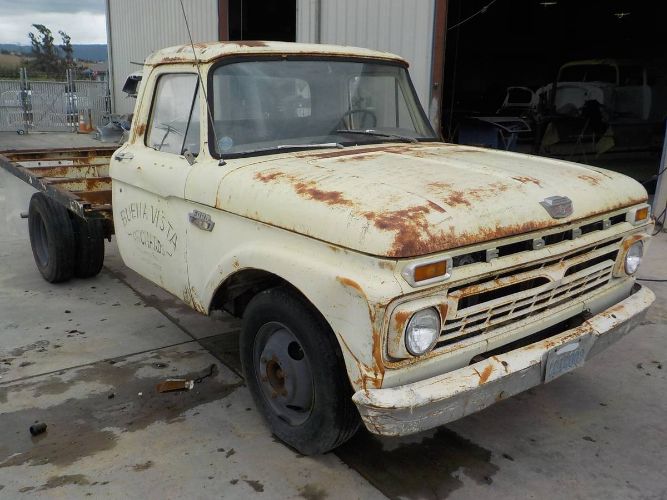
1959 Ford F-100
Pricing Guide
1953-1956 first-generation F100s (the "Effie") are the most desirable era. Driver-quality cars run $28,000-$48,000 today. Restomod 1953-1956 trucks (with modern drivetrains and brakes): $45,000-$95,000. Documented original-paint, low-mileage cars: $55,000-$95,000.1957-1960 second-generation cars: driver-quality cars run $22,000-$42,000. The 1957 model (the launch of the modern style) is the most desirable year of this generation.
1961-1966 third-generation cars (unibody 1961-1963, conventional 1964-1966): driver-quality cars run $18,000-$35,000. Unibody trucks are increasingly collected for their unusual configuration but rust concerns limit value.
1967-1972 "bumpside" F100s are the breakout segment of the past five years. Driver-quality cars run $22,000-$42,000, with restomod builds reaching $55,000-$95,000+. The 1967-1968 cars with the small bumper are the most desirable years.
1973-1979 "dentside" F100s have appreciated dramatically since 2018. Driver-quality cars run $18,000-$35,000, with restomod builds at $45,000-$85,000. The 1976-1979 cars are particularly popular for cosmetic restomod builds.
1980-1983 final-generation F100s remain the bargain entry: $12,000-$25,000 for driver-quality cars. The 1980 redesign brought the modern bigger F-Series styling.
Project F100s start around $8,000-$18,000 across most generations. Stripped roller candidates: $3,500-$8,000. Either buy a finished truck or buy a clean rust-free truck and build it yourself.
Fun Facts
The F100 designation began in 1953 with the redesigned F-Series replacing the original 1948-1952 F-1 nameplate. Ford's product planners chose the "F100" to indicate the half-ton (1/2-ton) payload class within the new F-Series numbering scheme: F100 (half-ton), F250 (three-quarter-ton), F350 (one-ton). The naming convention has remained essentially unchanged through Ford's modern F-Series production.The 1961-1963 unibody F100 was a bold experiment — Ford built the cab and bed as a single welded unibody structure rather than as separate components. The configuration improved aerodynamics and reduced manufacturing costs but proved problematic for working trucks (frame flex caused bed-side dimensional issues), and Ford reverted to conventional cab/bed construction for 1964. Documented unibody F100s are now collected for their unusual configuration and short production run.
The "bumpside" and "dentside" nicknames for the 1967-1972 and 1973-1979 F100 generations didn't exist when the trucks were new — they're enthusiast-coined terms adopted in the 2000s when these generations entered the collector market. Bumpside refers to the raised crease running the length of the bedside that gives the truck its name; dentside refers to the indented or "dented" lower bedside crease that distinguishes the 1973-1979 generation.
Frequently Asked Questions
Ready to find your F-100?
Browse 6+ active Ford F-100 listings on Classic Cars Arena.
View Listings →