
Datsun 510 Buyer's Guide
Definitive buyer's guide for Datsun 510 1968-1973. Rust hotspots, L16 engine identification, BRE racing pedigree, two-door coupe vs four-door sedan, current market pricing for survivors.

The Datsun 510 was nicknamed the "poor man's BMW 2002" when it launched in 1968 — a label that captured both its underdog appeal and its genuine engineering merit. With independent rear suspension (a class-leading feature in 1968), the bulletproof L-series inline-four, and a chassis that responded brilliantly to performance modification, the 510 became the foundation of Brock Racing Enterprises' Trans-Am dominance in 1971-1972 and a perennial favorite of road racing enthusiasts. Today, clean original 510s have appreciated dramatically as the JDM collector market matures, and documented BRE-spec cars represent some of the most concentrated value in the vintage import market.
Overview
The Datsun 510 launched in 1968 as Nissan's challenger to the European compact sport sedan segment, and the engineering that went into the car has aged remarkably well. Independent rear suspension (rare in mass-market sedans of the era), the bulletproof L-series inline-four, and a chassis that responded brilliantly to performance modification combined to create a giant-killer reputation that still defines the 510 in collector circles today. Approached this with an engineer's eye, the 510 represents one of the most fully-developed mass-market sport sedans of the late 1960s — and BRE's Trans-Am dominance in 1971-1972 cemented its racing credibility on the world stage.
Generations Worth Knowing
Early 510 (1968-1970)
The launch era. The L13 (1.3L) and L14 (1.4L) engines powered base cars in some markets; the L16 (1.6L SOHC, 96 hp) was the standard US-market engine and the most desirable variant. Body styles included 2-door sedan, 4-door sedan, and 5-door wagon. Federal emissions equipment was minimal in 1968-1969, increasing slightly for 1970. Driver-quality 1968-1970 cars represent the simplest and most refined original 510 ownership experience.
Mid 510 (1971-1972)
The 1971 model year brought the introduction of the 2-door coupe (called "Bluebird Coupe" in some markets) — a uniquely-styled fastback variant that became the most desirable 510 body style. Driver-quality 1971-1972 2-door coupes run $30,000-$50,000, with documented original-paint examples reaching $60,000+. Mechanically these cars are very similar to early 510s with slightly tightened emissions equipment.
Late 510 (1973)
The final 510 production year saw the introduction of the L18 engine (1.8L SOHC, 105 hp) replacing the L16. Federal emissions equipment increased significantly. The 1973 cars are mechanically less desirable than 1968-1972 cars but offer slightly more torque and remain affordable entry points into 510 ownership.
What to Look For (in person)
Structural Rust Inspection
510 rust is the structural killer for any car that lived in salt-belt or coastal climates. Pull the carpet at all four corners and inspect the floor pans. Pull the rear seat (it lifts out without tools) and inspect the rear shock towers from underneath the rear seat assembly. Inspect the front strut towers from inside the engine bay. Examine the rear wheel arches and rocker panels with strong light and a magnet. Perforation in any structural area means $5,000-$15,000 in proper professional repair.
Engine and Drivetrain Verification
The L-series engine number is stamped on a flat pad on the right side of the block (passenger side on LHD cars). The original L16 number prefix is L1610XXX or similar. Cross-reference against the dashboard data plate and the original color code. Mismatched engines (L18 in a 1968-1972 car, or non-original L-series swaps) reduce value 10-20% on driver-quality cars.
Body Style Verification
The 510 was offered in 2-door sedan, 4-door sedan, 5-door wagon, and (1971-1973 only) 2-door coupe configurations. The 2-door coupe with its unique fastback roofline is dramatically more valuable than the 2-door sedan. Verify body code from the chassis tag and visual inspection of the roofline. The 2-door sedan has a notchback roofline; the coupe has a fastback profile.
Pricing Tiers
| Tier | Description | Price Range (2024) |
|---|---|---|
| Driver | 1968-1972 4-door sedan or 1973 2-door sedan with L16/L18, decent paint, original interior with wear | $15,000-$28,000 |
| Survivor | 1971-1972 2-door coupe or original 5-door wagon, original paint, documented mileage | $32,000-$55,000 |
| Concours | Documented BRE-team campaign car or concours-grade original 2-door coupe with full documentation | $60,000-$300,000+ |
Common Pitfalls
The biggest pitfall in 510 buying is paying premium money for a car with hidden structural rust. The unibody construction means rear shock tower rust isn't merely a cosmetic concern — it's structural and expensive to repair properly. Demand a thorough rear-shock-tower inspection by lifting the rear seat before purchase.
The second pitfall is BRE tribute cars sold as authentic team cars. Original BRE-team campaign cars from the 1971-1972 Trans-Am 2.5 Challenge are extraordinarily rare and well-documented in the BRE registry. Any car claiming team-car provenance without documentation traceable to the BRE registry should be assumed to be a tribute build until proven otherwise.
"Approached this with an engineer's eye, the 510 is one of the most fully-developed mass-market sport sedans of the late 1960s. Documented every nut and bolt during the restoration of my own 2-door coupe, I came to appreciate why these cars have such loyalty among vintage import enthusiasts — the chassis dynamics, the bulletproof L-series engine, and the genuine racing pedigree combine to support continued price strength. The car rewards smooth inputs and patient ownership. Spend the time on proper rust inspection before purchase rather than discovering structural issues during restoration."
— Emily Chen
Final Verdict
The 510 market rewards documentation, structural integrity, and patience. 2-door coupes (1971-1973 only) are the most desirable body style and have appreciated steadily for the past decade. 5-door wagons have appreciated faster than sedans since 2018 driven by surf-culture and adventure-vehicle demand. Driver-quality 4-door sedans remain the smart-money entry into 510 ownership at $15,000-$28,000.
For new buyers, start with a 1968-1972 4-door sedan with the L16 engine and the 4-speed manual. They're the most affordable proper 510, parts support is excellent through specialist suppliers, and the chassis dynamics are essentially identical to more desirable body styles. From there, the upgrade path is clear: 5-door wagon, then 1971-1973 2-door coupe, then BRE-tribute build, then original BRE-spec restoration. Patience and proper rust inspection beat impulse buys every time in this market.
Browse Datsun 510 listings
 Dealer
 United States
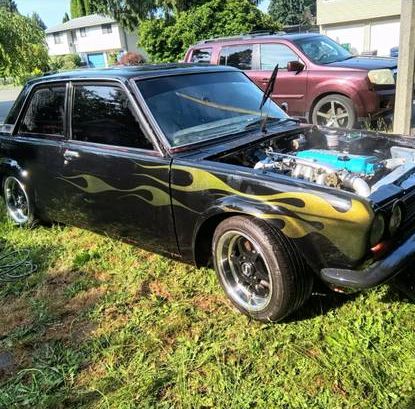
1972 Datsun 510
 Dealer
United States
Dealer
United States
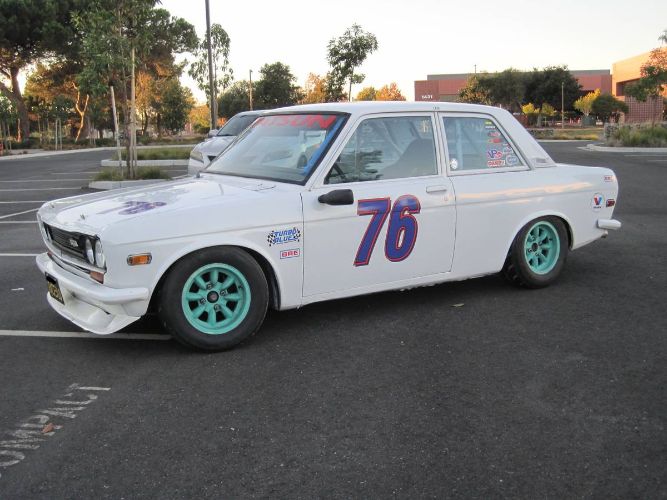
1972 Datsun 510
What to Look For
VIN authentication is the first stop. The 1968-1972 510 used the chassis number prefix HLB510 (left-hand-drive) or PL510 (right-hand-drive). The 1973 model year added emissions controls and is identified by different VIN prefix. The dashboard data plate should match the engine bay VIN tag and the engine block stamping.Structural rust inspection is the second non-negotiable. Lift the carpet at all four corners and inspect the floor pans for perforation. Pull the rear seat and inspect the rear shock towers from underneath the rear seat assembly — this is the most critical structural rust point on any 510. Inspect the front strut towers from inside the engine bay (with the strut covers removed if necessary). Examine the rear wheel arches and rocker panels with strong light and a magnet.
For body styles, the 510 was offered in four configurations: 2-door sedan, 4-door sedan, 5-door wagon, and the rare 2-door coupe (1971-1973 only, called "Bluebird Coupe" in some markets). The 2-door coupe is dramatically more desirable than the 2-door sedan or 4-door sedan in the current collector market — $8,000-$15,000 premium for an equivalent-condition 2-door coupe.
For BRE-spec or BRE-themed cars, verify the documentation. The Brock Racing Enterprises 510s campaigned by Peter Brock in 1971-1972 SCCA Trans-Am 2.5 Challenge are well-documented; replicas and tribute cars exist. Original BRE team cars (only a handful exist) trade for $150,000-$300,000+ when documented; tribute cars built to BRE specification trade for $25,000-$55,000 depending on quality.
Documented every nut and bolt during inspection. Photograph every angle, every interior detail, every engine bay component. Build a comprehensive case file before purchase. Engineering-analytical inspection beats casual diligence at every price point in the 510 market.
Pre-Purchase Checklist
-
Verify chassis number against data plate and engine VIN tag
Dashboard data plate, engine bay VIN tag, and engine block stamping must all agree. -
Pull rear seat and inspect rear shock towers
Most critical structural rust point on any 510. Invisible from outside the car. Mandatory inspection. -
Inspect front strut towers from engine bay
Remove strut covers if necessary. Rust here compromises front suspension geometry. -
Pull carpet and check floor pans all corners
Both driver and passenger sides, front and rear footwells. Floor pans rot from underneath. -
Magnet test rear wheel arches and rockers
Body filler is non-magnetic. Driver-quality cars universally have filler. -
Verify body style code on chassis tag
2-door coupe with fastback roofline is dramatically more valuable than 2-door sedan with notchback profile. -
Check L-series engine number against original spec
Stamped on flat pad on right side of block. Mismatched engines reduce value 10-20%. -
Test Hitachi sidedraft carburetor synchronization
Should idle smoothly at 700-800 rpm and pull cleanly through rev range. -
Compression test all four cylinders
Should read 145-170 PSI uniformly. L-series engines are durable but valve seat recession is known issue. -
Verify BRE documentation if claimed
Original BRE team cars traceable through BRE registry. Tribute builds reduce value vs authentic team cars.
Common Issues
510 rust is universal and aggressive. The unibody construction means rust isn't merely cosmetic — it's structural. Critical rust zones include the rear wheel arches (lower section, where the rear quarter meets the wheel well), the rocker panels (under the doors), the floor pans, the rear shock towers, the front strut towers, the trunk floor, and the spare tire well. The rear strut tower rust is particularly insidious because it's invisible from outside the car and structurally compromises the rear suspension geometry.Mechanically, the L-series inline-four (L13, L14, L16, L18) is exceptionally durable when maintained. The L16 (1.6L SOHC, 96 hp) is the most common engine in 1968-1972 cars; the L18 (1.8L SOHC, 105 hp) appeared in 1973 and offers slightly more torque. Common issues include valve seat recession (use lead-replacement additives or convert to hardened seats during rebuild), worn timing chain tensioners, and burnt valves on cars run with poor ignition timing. Compression should read 145-170 PSI uniformly.
The twin Hitachi SU-style sidedraft carburetors require careful synchronization but work brilliantly when set up correctly. The 4-speed manual transmission is robust; the optional 5-speed (rare on US-market cars) is more desirable. The R180 differential (or R200 on some variants) is durable but stub axles can break under hard launches with sticky tires.
Electrical issues are the universal classic-car concerns. Original wiring is brittle 50+ years on, and many cars have been rewired during restoration. The original instrument cluster fails predictably; reproduction parts are available but not always period-correct.
Pricing Guide
1968-1972 4-door sedan 510s remain the bargain entry into vintage Datsun ownership. Driver-quality 4-door cars run $15,000-$28,000. Solid 5-door wagons run $18,000-$32,000 — wagons have appreciated faster than sedans since 2018 due to surf-culture and adventure-vehicle demand.2-door sedan 510s run $22,000-$38,000 for driver-quality cars. The 1971-1973 2-door coupe (the more rakish body style with the unique fastback roofline) runs $32,000-$55,000 for driver-quality examples. Documented original-paint, low-mileage 2-door coupes: $45,000-$75,000.
BRE-tribute cars built to Brock Racing Enterprises specification (BRE colors, BRE wheels, performance modifications) run $25,000-$55,000 depending on quality of build and documentation. Original BRE-team campaign cars from the 1971-1972 Trans-Am 2.5 Challenge trade in the high six-figure range when documented and verified.
Project cars (running but rough) start around $8,000-$15,000 for 4-door sedans and $15,000-$25,000 for 2-door coupes. Stripped roller candidates can be had for $3,500-$8,000, but rust restoration on a 510 typically runs $15,000-$30,000 in body work alone before paint. Buy finished cars from competent specialists.
Fun Facts
The Datsun 510 was developed under chief engineer Teruo Uchino with deliberate inspiration from the BMW 1600/2002. Independent rear suspension was a feature unheard of in mass-market sedans at this price point, and the result was a car that out-handled most contemporaries despite its modest engine output. The "poor man's BMW 2002" nickname captured both the engineering similarity and the dramatic price advantage.Peter Brock (former GM stylist who later founded Brock Racing Enterprises) campaigned 510s in the SCCA Trans-Am 2.5 Challenge in 1971-1972, winning the manufacturer's championship both years. The BRE 510s in their iconic red-white-blue livery became some of the most recognizable American sports car racing icons of the era and established the 510's reputation as a giant-killer on road courses.
The Datsun 510 was actually called the Bluebird in Japanese-market and most international markets — "510" was specifically the US-market designation, derived from the chassis code. Japanese-market Bluebirds had different trim, different engines (including the SSS twin-carb hot variant with the L16 engine), and right-hand-drive — making JDM imports notably different from US-market cars and increasingly desirable to specialist collectors.
Frequently Asked Questions