When Enzo Ferrari called the Jaguar E-Type "the most beautiful car ever made" at its 1961 Geneva debut, he was acknowledging what every observer of post-war automotive design has had to concede: this is one of the rare cars that achieves genuine sculpture in production form. Across thirteen years and three series (1961-1974), the E-Type combined competition-derived monocoque construction, the legendary XK6 inline-six (and later the V12), and an aesthetic so confident that the original Series 1 cars are now permanent fixtures of the Museum of Modern Art's design collection. For collectors entering the E-Type market today, the appeal is genuine — but the structural and mechanical pitfalls are equally genuine, and require careful navigation.
Common Issues
E-Type rust is the structural killer for any car that has lived in salt-belt or coastal climates. The monocoque body construction means rust isn't merely cosmetic — it's structural. Critical rust zones include the inner sills (under the door frames), the floor pans, the rear hatch frame on coupes, the front bonnet (especially around the headlight buckets), the rear bulkhead behind the seats, and the tail panel. Series 1 cars are particularly vulnerable because they pre-date any galvanization or rust-proofing protocols.
Mechanically, the XK6 inline-six (3.8L on 1961-1964 cars, 4.2L on 1965-1971 cars) is exceptionally durable when maintained. The triple SU carburetors require careful synchronization but work brilliantly when set up correctly. The Moss four-speed gearbox (1961-1964) is non-synchronized on first gear and feels archaic; the all-synchromesh four-speed (1965+) is dramatically better. The V12 (1971-1974) is the more controversial engine — magnificent when running correctly, but expensive to maintain and prone to overheating in stop-and-go traffic.
Electrical issues are the well-known Lucas concerns: original wiring is brittle, the SU electric fuel pumps fail (replace with modern Facet pumps as preventive maintenance), and the dashboard gauges read inconsistently. Original Lucas distributors with mechanical advance can be rebuilt to better-than-new specification by specialists, but ignition systems on neglected cars are a common source of running problems.
What to Look For
Jaguar Heritage Trust documentation is the gold-standard verification for any E-Type. The Heritage Certificate ($200 from the Jaguar Daimler Heritage Trust) confirms the original specification of the car: chassis number, engine number, gearbox number, paint color, interior color, and delivery destination. For any E-Type priced over $80,000, the Heritage Certificate is essential.
Monocoque structural inspection is the first non-negotiable. Lift the carpet at the driver and passenger footwells. Inspect the inner sills with a flashlight from underneath the car (particularly difficult to see — bring a mechanic's mirror). Inspect the rear hatch frame on coupes (lift the carpet in the rear cargo area). Inspect the front bulkhead and the rear bulkhead. Perforation in any of these areas is structural and expensive — proper repair on an E-Type with significant structural rust runs $30,000-$80,000.
Engine and gearbox number verification is the second-tier authentication. The XK6 engine number is stamped on a flat pad on the right side of the block (passenger side on left-hand-drive cars). The V12 engine number is stamped on the bell housing. Cross-reference both against the Heritage Certificate.
Matching numbers (chassis, engine, gearbox, body) is essential for any E-Type priced over $120,000. Series 1 cars (especially flat-floor 1961-1962 cars and outside-bonnet-latch cars) command significant premiums when fully matching-numbers. Cars with replacement engines or gearboxes should be priced 20-35% below comparable matching-numbers examples.
For flat-floor cars (1961-1962), verify the original specification details: outside bonnet latches, welted seats, and external bonnet hinges. These details add 15-25% premium when present and original.
Price Guide
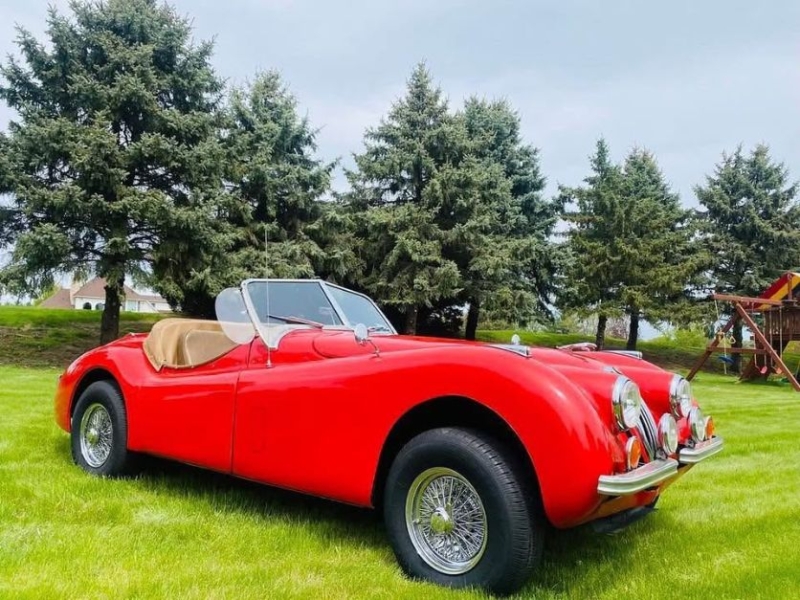
Series 1 (1961-1968) is the most desirable E-Type generation. Driver-quality 4.2L Series 1 roadsters run $120,000-$220,000. Flat-floor 1961-1962 cars (the rarest production variant): $220,000-$420,000 for documented examples. Documented Series 1 coupes are dramatically more affordable than equivalent roadsters — $95,000-$160,000 for solid drivers, with the trade-off being slightly less practical interior space.
Series 2 (1968-1971) cars are the bargain entry into E-Type ownership. Federal regulations brought taller, less-attractive bumpers, larger taillights, and emissions-restricted engines. Driver-quality Series 2 roadsters run $80,000-$130,000; coupes run $60,000-$95,000.
Series 3 V12 (1971-1974) cars are the most controversial. The 5.3L V12 makes 272 hp and produces a magnificent sound, but the cars handle slightly less well than the lighter inline-six cars and require significantly more maintenance. Driver-quality Series 3 roadsters run $70,000-$120,000; the rare 2+2 coupes run $45,000-$80,000. Documented original V12 cars in concours condition: $140,000-$220,000.
Project cars (running but rough) start around $35,000 for Series 2 cars and $55,000-$90,000 for Series 1 cars. Stripped roller candidates can be had for $20,000-$40,000, but rust restoration on an E-Type typically runs $40,000-$120,000 in body and structural repair alone before paint. Buy finished cars from competent specialists.
Did You Know?
The E-Type was developed from the D-Type Le Mans race car that won at Le Mans in 1955, 1956, and 1957. The monocoque construction, the front double-wishbone suspension, and the rear independent suspension all derive directly from racing engineering — making the E-Type the rare production car that genuinely traces its lineage to a Le Mans winner.
The 1961 Geneva launch was a near-disaster for Jaguar. The press demonstration roadster (chassis 850008) had been driven non-stop from Coventry to Geneva by test driver Norman Dewis, arriving with no preparation time before Enzo Ferrari and other journalists arrived for press demonstrations. Dewis later said he was "so tired I could hardly remember my own name" but the car performed flawlessly and the launch became one of the most celebrated automotive debuts in history.
The Series 1 4.2L cars (1965-1968) are widely considered the optimum E-Type from an engineering and driving standpoint. The 4.2L XK6 produces more torque than the original 3.8L, the all-synchromesh gearbox is dramatically better than the original Moss gearbox, the cooling system was redesigned for better hot-weather operation, and the brakes were upgraded. They are also approximately 5-10% cheaper than equivalent 3.8L Series 1 cars in the current market.