
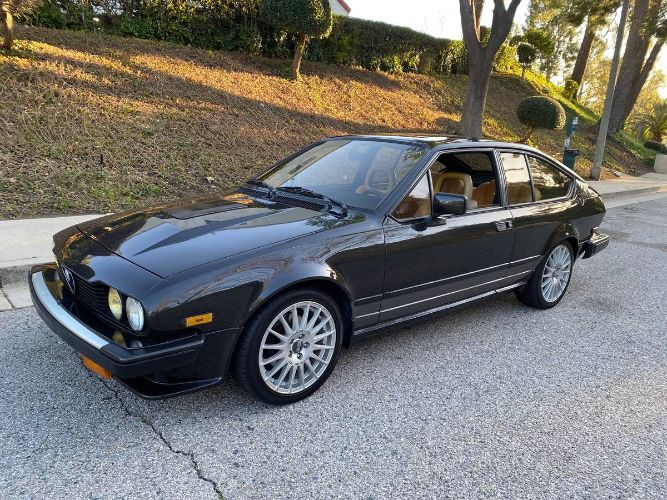
How much is an Alfa Romeo GTV6 worth in 2026?

I came to the GTV6 through the Alfa Romeo twin-cam family and found something different: a car designed around a brand-new engine architecture that Alfa Romeo would build in various forms for another 30 years. The Busso V6 — named for its designer, Giuseppe Busso — is one of the finest-sounding engines ever produced by a mainstream manufacturer. The GTV6 wraps it in Giugiaro coachwork and a transaxle layout that gives genuinely balanced handling. The market has not fully priced this in yet.
The Busso V6 Engine
The 2.5-litre SOHC 60-degree V6 in the GTV6 produced 160 hp in European specification — modest by current standards, transformative in the context of 1981. The engine's character lives in its sound: a complex, harmonic exhaust note that changes character between 2,500 and 6,500 rpm in a way that makes every gear change an event. The SOHC layout uses a single cam per bank — not the twin-cam setup of the classic Alfa four-cylinders — but the head design produces excellent breathing through a 60-degree bank angle that allows better port geometry than a conventional 90-degree V6.
Transaxle Layout
The GTV6's gearbox is mounted at the rear, connected to the engine by a torque tube — giving 50/50 front/rear weight distribution that the standard Spider and GTV could not achieve. This layout makes the GTV6 the better-handling Alfa of its era despite carrying a heavier drivetrain. The trade-off is that the torque tube mounts and differential require periodic attention — they are not common failure points on properly maintained cars, but should be inspected on any purchase candidate.
2026 Pricing
- Driver quality, higher mileage, some cosmetic issues: $12,000–$20,000
- Clean, sorted, recent mechanical work: $20,000–$30,000
- Concours-quality, original paint, documented history: $30,000–$38,000
- Balocco edition (limited-run special, 1983): add 15–25%
What to Inspect
Rust attacks the GTV6 in predictable locations: rear wheel arches, floor pans, the rear subframe mounting area, and the sill panels beneath the door apertures. A car with solid structure in these areas is the foundation of a good ownership experience. The Spica injection system on US-market cars (actually Bosch L-Jetronic on later GTV6s) should be verified for correct calibration — a properly tuned injection system starts easily and runs cleanly at all temperatures. Timing belt replacement at 30,000-mile intervals is non-negotiable.
"The Busso V6 in the GTV6 is genuinely one of the ten best-sounding engines I have encountered in 20 years of driving and evaluating classics. The market hasn't caught up to what that engine represents yet."
— Emily Chen
Browse current listings
 Dealer
 United States