
How much is an Auburn 851 Boattail Speedster worth in 2026?

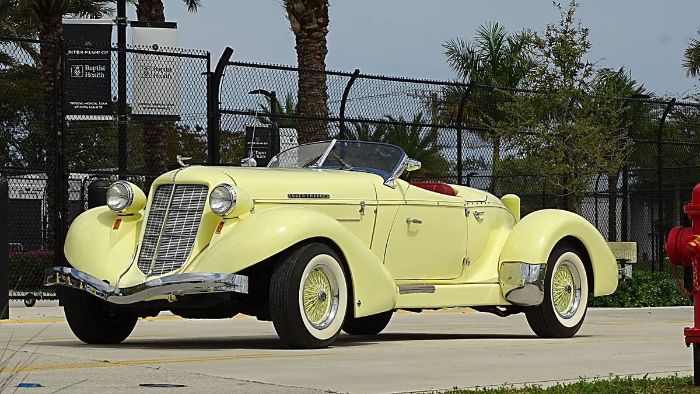
Among the marque registries, no American automobile of the Classic Era demonstrates more clearly the gap between a correctly authenticated original and a well-executed replica than the Auburn Boattail Speedster. The replica industry has been producing convincing Speedster reproductions for sixty years — on Chevrolet, Ford, and various custom chassis — and the market has seen enough of them to create a healthy skepticism about every car presented without documentation.
Gordon Buehrig's Design
Gordon Buehrig designed the 851 Speedster in 1934–1935, working under the pressure of Cord Corporation's financial difficulties to produce a car of maximum visual drama at minimum engineering cost. The Speedster used the standard Auburn 851 chassis, elongated and lowered, with a pontoon-fender body that flows into the distinctive tapered tail. The supercharged Lycoming straight-eight engine produced 150 hp — enough for genuine performance by 1935 standards — and each car left Auburn, Indiana with a metal dashboard plaque reading: "This car has been tested and timed at the Auburn factory to exceed 100 miles per hour." Every Speedster was factory-tested and certified at 100 mph before delivery. The plaque is a physical authentication point: it should be present on every genuine Speedster.
| Model | Year | Engine | Power | 2026 Value |
|---|---|---|---|---|
| Auburn 851 Speedster | 1935 | 4.6L supercharged Lycoming straight-eight | 150 hp | $280,000–$600,000 |
| Auburn 852 Speedster | 1936 | 4.6L supercharged Lycoming straight-eight | 150 hp | $260,000–$550,000 |
| Auburn 8-98A Speedster (unsupercharged) | 1934–1935 | 4.6L Lycoming straight-eight | 115 hp | $120,000–$240,000 |
Replicas and Authentication
The replica Auburn Speedster has been produced by kit car builders and custom coachbuilders continuously since the 1960s, using donor chassis from Chevrolet, Ford, and various contemporary platforms. Some replicas are beautifully executed; none is a genuine Auburn. The authentication framework for any original: the ACD Club (Auburn Cord Duesenberg Club) maintains the definitive registry of surviving originals; the VIN plate format and location is specific to Auburn production; the 100 mph certification plaque should be present; and the Lycoming straight-eight engine serial should correspond to factory records. From a concours judging perspective, a replica presented as an original is immediately disqualified — and a buyer who pays original prices for a replica has no meaningful recourse.
"The Auburn Speedster is the car that proved American coachwork could be as artistically ambitious as anything from Touring or Figoni et Falaschi — at a price that Cord Corporation needed to sell. Gordon Buehrig did not compromise. The result is still the most dramatic pre-war American automobile in any collection. Authenticate it properly, and you own a piece of irreplaceable industrial art."
— Sarah Whitfield
Browse current listings
 Dealer
 United States