What's the difference between a Ford 289, 302, and 351?

Ford's small-block Windsor family is one of the most important engine lineages in American automotive history — compact, light, and responsive, it powered everything from compact Falcons to Shelby race cars. Understanding the differences between the three main displacement variants matters both for ownership and for authentication.
The 289 (1963–1967)
The 289 cubic inch (4.74L) displaced through a 4.00″ bore and 2.87″ stroke. It replaced the 221 and 260 small blocks and became the definitive Ford performance engine of the mid-1960s. Variants:
- 289 2V (C-code): 200 hp, base two-barrel
- 289 4V (A-code): 225 hp, four-barrel
- 289 Hi-Po (K-code): 271 hp, solid lifters, high-compression — the factory performance engine
The K-code is the collectible variant: it powered the 1965–1966 Shelby GT350 and the early Cobras. Authentication requires the correct block casting (C5AE) and valve cover markings.
The 302 (1968–2001)
The 302 (5.0L) is a bored version of the 289 — same stroke (2.87″), larger bore (4.00″ → 4.00″ with different casting). Wait — actually the 302 shares the 289's 4.00″ bore but uses a 3.00″ stroke vs the 289's 2.87″. The extra 13 cubic inches shows up as improved low-end torque without sacrificing the 289's high-revving character. The 302 Boss (1969–1970) is the performance pinnacle — tunnel-port heads, solid lifters, 290 hp factory rating that dynos consistently higher.
The 351 Windsor (1969–1996)
The 351W uses the same block architecture but with a taller deck height to accommodate a longer 3.50″ stroke, producing 351 cubic inches (5.75L). The result is more torque than either the 289 or 302 — useful in larger, heavier cars and trucks. Important: the 351 Cleveland (1970–1974) is a different engine with canted-valve heads and should not be confused with the Windsor. Cleveland heads flow better at high RPM; Windsor heads are more practical for street use.
Parts Cross-Compatibility
289, 302, and 351W share many external dimensions — bellhousing patterns, accessory mounting, and intake manifold bolt patterns — but the 351W's taller deck means 351W intakes don't fit 289/302 blocks. Cams, pistons, and cranks are generally not interchangeable between displacement families.
Browse current listings
 Dealer
 United States
1955 Ford Customline
 Dealer
United States
Dealer
United States
1956 Ford Customline
 Dealer
United States
Dealer
United States
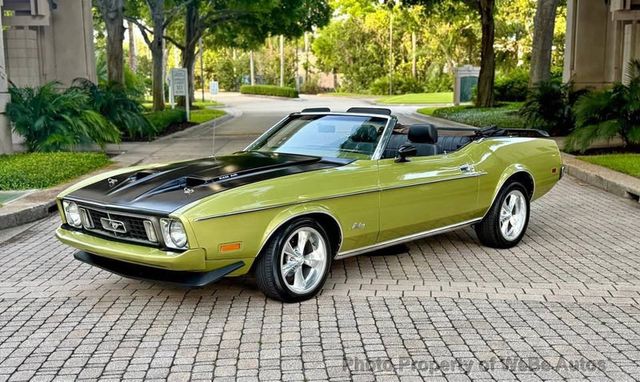
1973 Ford Mustang
 Dealer
United States
Dealer
United States