
Classic Toyota Land Cruiser Buyer's Guide (FJ40 / FJ55 / FJ60 / FJ62)
The Toyota Land Cruiser's FJ-series generation is arguably the most capable and reliable 4x4 ever mass-produced. Buying one right requires understanding which rust is cosmetic, which is structural, and which generation fits your use case.

I approached my first Toyota Land Cruiser the way I approach every potential project: with a flashlight, a screwdriver, and a healthy skepticism about anything the seller told me. What I found was a vehicle engineered to a standard of mechanical integrity I hadn't encountered before — overbuilt axles, a bulletproof inline-six, and a simplicity of design that made every system accessible and rebuildable. That first FJ40 taught me why United Nations field teams, Australian outback farmers, and California trail enthusiasts all converged on the same truck. The challenge isn't whether to buy one — it's buying the right one, at the right price, in a market that has moved sharply upward.
History & Generations
Toyota introduced the Land Cruiser FJ series in the early 1950s as a military-derived utility vehicle and began exporting it seriously by the mid-1960s. For collectors in North America, four generations define the classic era.
FJ40 (1960–1984): The Iconic One
The boxy, short-wheelbase FJ40 is the model that defines the Land Cruiser name in the popular imagination. Powered by Toyota's 2F inline-six (258 cubic inches, 135 horsepower in U.S.-spec trim), it combined genuine off-road capability with enough mechanical simplicity that it could be serviced with basic tools in remote locations worldwide. The FJ40 came as a convertible soft-top, removable hardtop, or fixed-roof variant. Part-time 4WD with a dedicated low-range transfer case made it genuinely capable on any terrain. Production ended in 1984 for the U.S. market as emissions regulations increased costs.
FJ55 (1967–1987): The Station Wagon
Built on a longer wheelbase and fitted with a full station wagon body, the FJ55 used the same mechanicals as the FJ40 with dramatically more interior space. It was Toyota's answer to the International Travelall and Chevy Suburban of its era — a family-hauling, trail-capable wagon. The FJ55 is chronically undervalued relative to the FJ40 and represents the best value in the Land Cruiser collector market today. Rising interest from buyers who want the capability without the FJ40 price is changing that, but slowly.
FJ60 / FJ62 (1981–1990): Modern Luxury Meets Bulletproof
The FJ60 introduced more road-car comfort — better seats, improved HVAC, optional air conditioning — while retaining the same proven running gear. The FJ62, produced from 1987 to 1990, was the culmination of the series: Toyota added fuel injection (the 3F-E engine), a five-speed manual option, and the most refined interior of the generation. The FJ62 is the best daily driver of the classic Land Cruisers, the most comfortable, and increasingly, the most sought-after among buyers who want to actually use their truck.
Years to Target
- FJ40, 1975–1983: The sweet spot — all smog equipment simplified vs. later models, best parts availability, most common for restoration.
- FJ40, 1960–1966: Earliest examples command premiums and are increasingly rare; values highest but also most scrutiny required.
- FJ62, 1987–1990: Best-driving of all classic Land Cruisers; fuel injection eliminates the carburetor complexity of earlier engines.
- FJ55, 1967–1972: Most undervalued generation — early examples with minimal rust are rising steadily.
- Avoid FJ60s with high mileage and unknown service history — the carbureted 3F engine on these has a head-cracking tendency when maintenance is deferred.
What to Look For in Person
Rust is the single most important variable in any Land Cruiser purchase, and it's the area where photos routinely lie. The frame is the first priority: crawl underneath and inspect the full length, paying particular attention to the sections immediately behind the rear wheels, the crossmembers, and the frame horns at the front. Surface rust that cleans up to solid metal is acceptable. Pitting that accepts a screwdriver tip under pressure is structural and expensive to repair properly. A rotted frame on an FJ40 can cost $8,000–$15,000 to repair correctly at a qualified shop.
Floor pans rust from the inside out. Pull back the carpet or floor mats and look at the bare metal. Repairs here are common and not necessarily deal-breakers, but assess the quality of any previous work carefully — thin sheet metal welded over existing rot will fail again. The rocker panels and lower door skins are secondary rust areas; check the bottom inch of every door.
Start the engine from cold. The 2F and 3F inline-sixes should idle smoothly and quietly within 30 seconds of a cold start. A persistent knock that goes away after warmup is usually a hydraulic lifter — manageable. A knock that persists at operating temperature is bottom-end wear and a signal to budget for a rebuild. Drive the truck: verify that 4WD engagement works in both high and low range and that the transfer case shifts without grinding.
| Generation | Engine | Power | Production |
|---|---|---|---|
| FJ40 | 2F inline-six, 258 ci | 135 hp (US-spec) | 1960–1984 |
| FJ55 | 2F inline-six, 258 ci | 135 hp | 1967–1987 |
| FJ60 | 3F inline-six, 241 ci | 135 hp (carbureted) | 1981–1987 |
| FJ62 | 3F-E inline-six, 241 ci | 155 hp (fuel injected) | 1987–1990 |
"I documented every nut and bolt on my first FJ40 restoration — and what I found under thirty years of accumulated repairs was an object lesson in Toyota's engineering philosophy. Every component was overspecified relative to its job. The axle shafts, the transfer case gears, the steering knuckle design — all heavier than necessary for a passenger car of this weight. That's why these trucks are still running in places where replacement parts don't exist. They were built to be fixed with what's on hand."
— Emily Chen
Market Outlook
FJ40 values have appreciated dramatically over the past decade, driven by the overlanding movement and a generation of buyers who grew up watching these trucks on trails. A solid, running project FJ40 that would have sold for $8,000 in 2015 now trades at $22,000–$35,000. Restored examples in show condition range from $55,000 to well over $100,000 for documented early cars. The FJ55 has followed a similar curve, lagging by about five years — project wagons are still available in the $12,000–$20,000 range, but that window is closing.
The FJ62 offers a different value proposition: the most capable daily driver in the classic lineup, with fuel injection and modern amenities, at prices still below the FJ40's stratosphere. Clean driver examples trade at $18,000–$30,000; fully sorted, well-documented FJ62s reach $40,000–$55,000. Hagerty has listed the FJ40 on its Bull Market list for multiple consecutive years, and that momentum shows no sign of reversing.
Browse Toyota Land Cruiser listings
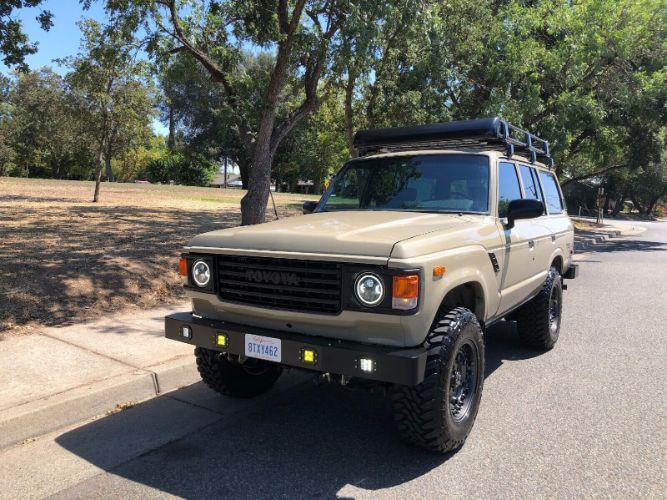 Dealer
 United States
1983 Toyota Land Cruiser
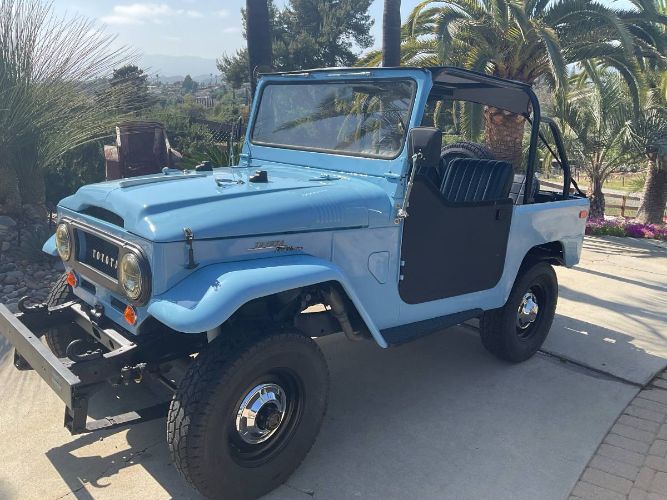 Dealer
United States
Dealer
United States
1967 Toyota Land Cruiser
What to Look For
Frame inspection is non-negotiable — bring a long screwdriver and probe the full frame, especially behind the rear wheels and along the crossmembers. Soft metal or holes mean structural repair before the truck is safe to drive off-road. Check floor pans with carpet pulled back; assess the quality of any previous repair work carefully. Inspect the front axle knuckle seals for leaks — a weeping knuckle is normal and manageable, but a truck with both knuckles dried out has been running low on gear oil. Pull the differential fill plugs if possible and check gear oil level and condition — milky fluid means water intrusion, usually from a failed axle seal. Verify 4WD engagement: high range, low range, and 4x4 lock should all engage without grinding or hesitation. Check the transfer case for leaks. On FJ60/62 models, check for oil leaks at the valve cover and timing chain cover — common as gaskets age. Inspect body-mount bushings, which compress over time and allow the body to shift on the frame.Pre-Purchase Checklist
-
Frame probing
Probe full frame with long screwdriver — especially behind rear wheels and crossmembers -
Floor pan condition
Pull carpet and mats, inspect metal, assess quality of any previous repairs -
4WD engagement
Test all 4WD modes: 2H, 4H, 4L — must engage without grinding or hesitation -
Compression test
Cold compression on all cylinders — consistent readings above 130 psi expected -
Cooling system
Check temperature at operating temp, inspect for leaks, verify thermostat function -
Axle knuckle seals
Inspect front knuckle seals for leaks; check gear oil level and condition in differentials -
Transfer case
Inspect for leaks and verify smooth operation through all range positions -
Rocker panels / lower doors
Inspect bottom inch of all doors and rocker panel surfaces for rust penetration -
Engine oil condition
Check dipstick for milky or frothy oil — indicates coolant intrusion (cracked head) -
Body mount bushings
Inspect rubber body-mount bushings for compression and deterioration -
Cold start behavior
Should fire quickly, idle cleanly within 30 seconds — rough cold idle suggests carb issue (FJ40/55/60) -
Documentation
Request service records, previous title history, and any restoration receipts
Common Issues
Frame rust is the Land Cruiser's primary structural vulnerability and the first thing to assess. The section behind the rear wheels is where salt, mud, and moisture accumulate longest and where failure begins. Cracked cylinder heads are the second most serious issue — caused by overheating, which is usually caused by deferred cooling system service. A compression test will reveal an already-cracked head; a coolant system pressure test will reveal leaks before they cause damage. The 2F carburetor on FJ40 and FJ55 models requires periodic rebuilding and tuning — a properly sorted carb runs cleanly, but a neglected one causes stumbling, poor cold starts, and rich running that washes cylinder walls with fuel. Front axle birfield joints (constant-velocity joints in the steering knuckles) wear and develop play — replacement is a significant job but parts are readily available. Rear main seals on the 2F and 3F engines commonly develop slow leaks after high mileage. Interior rust on floor pans is almost universal on trucks stored in wet climates; assess severity carefully.More Land Cruiser for sale
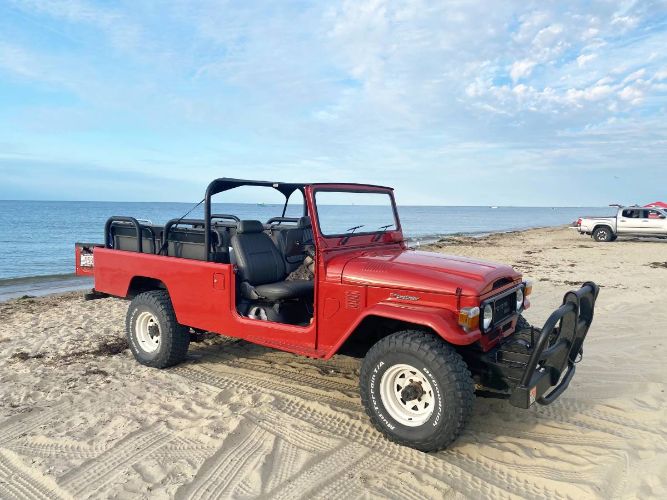 Dealer
United States
Dealer
United States
1980 Toyota Land Cruiser
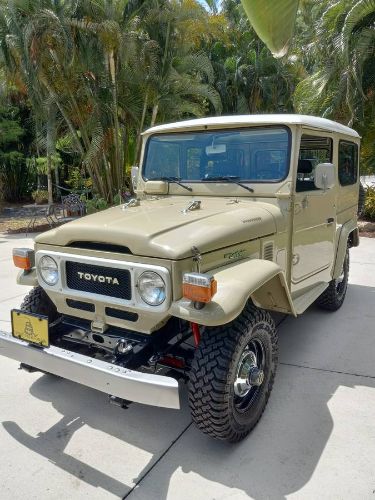 Dealer
United States
Dealer
United States
1979 Toyota Land Cruiser
Pricing Guide
FJ40 values have risen sharply since 2018. As of 2025: project/running FJ40 trades at $22,000–$35,000 depending on body condition; restored driver-quality FJ40 runs $45,000–$70,000; show-quality concours FJ40 reaches $90,000–$130,000 for well-documented early examples. FJ55 station wagons lag behind by roughly 40%: projects at $12,000–$20,000, restored examples at $28,000–$45,000. FJ62 is the value play: clean drivers at $18,000–$28,000, fully sorted at $35,000–$50,000. Avoid paying FJ40 prices for a truck with a compromised frame — frame restoration alone costs $8,000–$15,000 at a quality shop and is never fully invisible. Rust-free California or Arizona examples command meaningful premiums and are generally worth it.Fun Facts
The FJ40 Land Cruiser was used by the Australian Army, the New Zealand Army, and dozens of national police forces across Africa and Asia. Toyota's own reliability data from fleet operators in developing countries showed FJ40s routinely reaching 300,000 miles on original drivetrains with basic maintenance. Grateful Dead guitarist Jerry Garcia owned and used multiple FJ40s. The Land Cruiser nameplate is Toyota's longest-running model, introduced in 1951 and still in production today. Hagerty has listed the FJ40 on its annual Bull Market appreciating-collectibles list for four consecutive years.Frequently Asked Questions
Ready to find your Land Cruiser?
Browse 6+ active Toyota Land Cruiser listings on Classic Cars Arena.
View Listings →