
What numbers-matching actually means for a Mustang
When collectors and appraisers talk about a numbers-matching classic Mustangs, they are describing a car whose major drivetrain components, specifically the engine, transmission, and rear axle, can be documented as the original factory-installed units for that particular vehicle. The phrase sounds simple, but verifying it on a first-generation Mustang requires reading several different stampings and tags in concert, each one a separate thread in a documentary web that Ford wove from Dearborn.
Understanding the system matters because the value gap between a documented numbers-matching Mustang and an equally clean example with a correct-type but non-original engine can be tens of thousands of dollars at auction. Knowing how to read the evidence protects buyers and gives sellers a credible story to tell.
The VIN and what Ford stamped from it
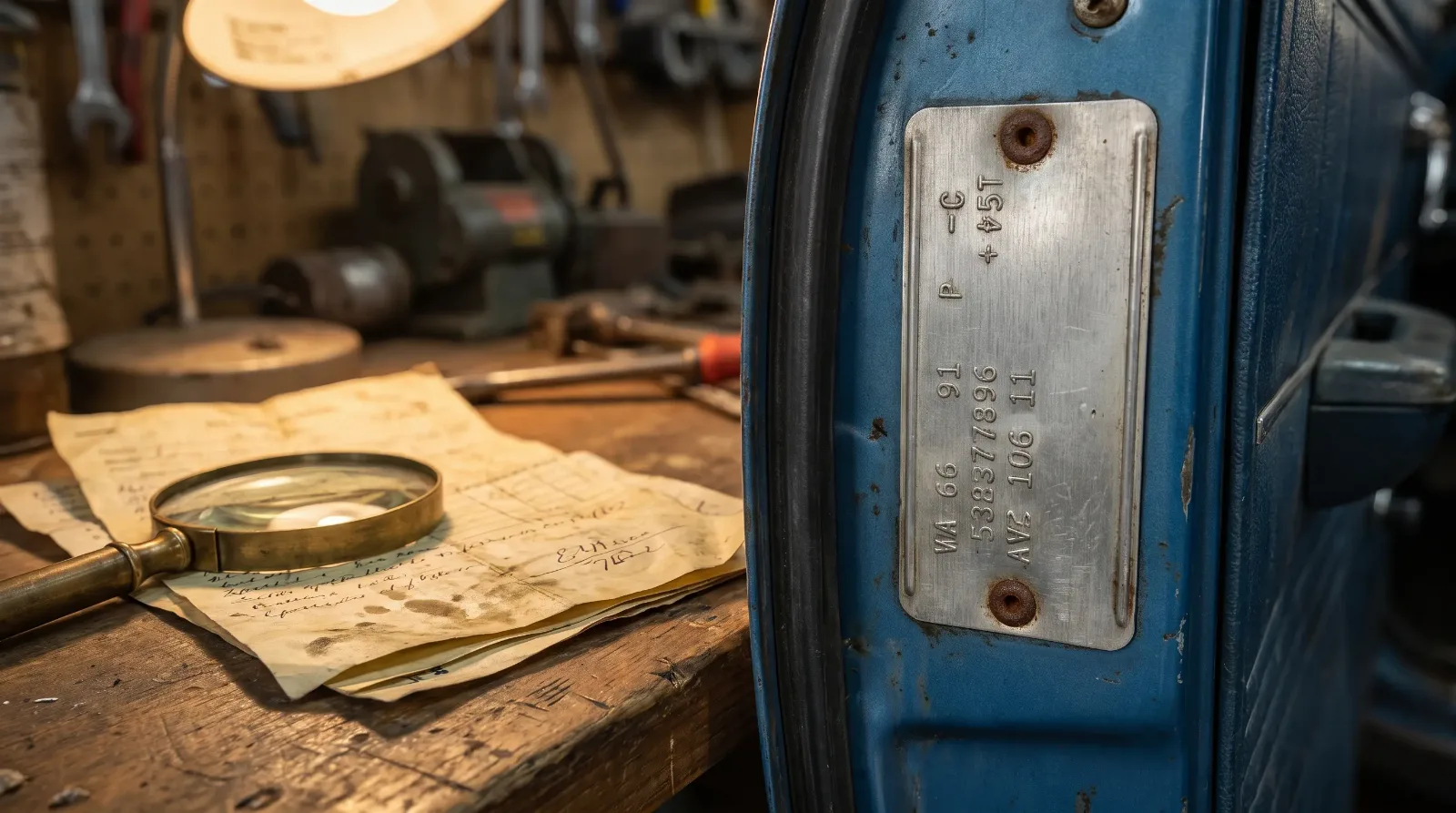
Every 1965 through 1973 Mustang carries a Vehicle Identification Number on a riveted tag on the driver-side dash, visible through the windshield. Beginning in 1968, most (though not all) Ford assembly plants applied a partial derivative of that VIN directly to the engine block as a secondary identification stamp. This practice is central to numbers-matching verification, but it is important to understand its limits: Ford's approach differed sharply from General Motors, and through the early years of the first generation most Mustang small-blocks were not VIN-stamped at all.
This is where Ford's practice is widely misunderstood, and where overstated claims do real damage to buyers. For 1964½ through 1967, Ford did not stamp a serial number on production small-blocks at all. The one notable exception was the high-performance K-code 289 (the HiPo), whose blocks were stamped with the car's serial number from the factory. For everyone else, a 1965 or 1966 Mustang block has no VIN-derived stamp to compare, which is precisely why date codes and casting numbers, covered below, do the heavy lifting on early cars.
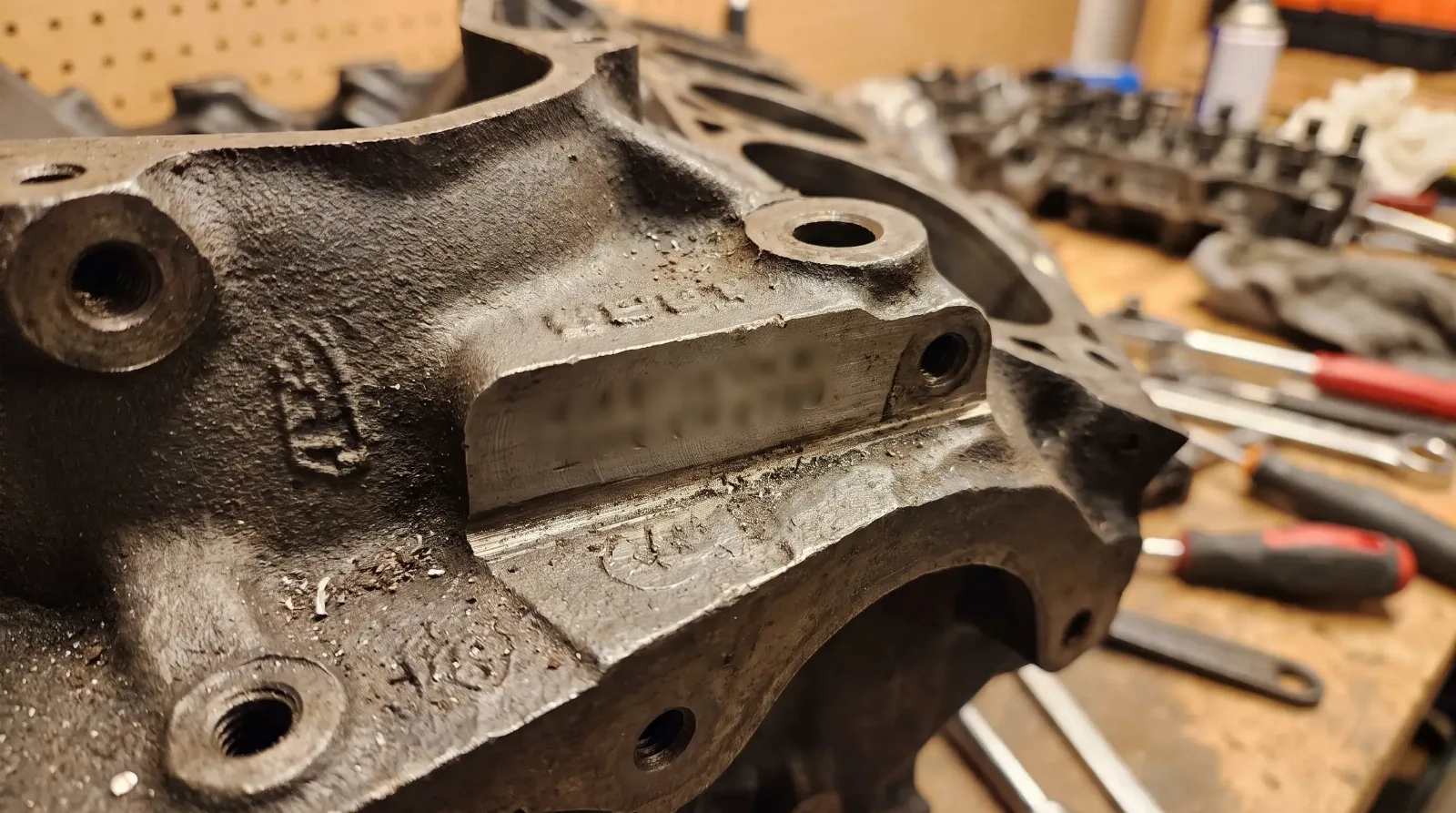
Starting in 1968, most plants began stamping a partial VIN on a flat machined pad at the rear of the block, on the passenger-side bank near the parting line between the block and head, not on a front pad above the oil filter. The stamping is a short derivative rather than the full VIN: a single digit for the model year, a letter for the assembly plant, and the sequential production number (for example, a San Jose car might read "8R" followed by its sequence). Because the stamps were applied by hand, many blocks show only a partial impression with several digits faint or missing, and coverage during these years reached only roughly half to two-thirds of cars. The absence of a stamp on a 1968-and-later block is therefore suggestive but not by itself proof of a replacement.
Separately from any VIN stamp, every block also carries a raised casting number, typically found on the rear of the block above the starter on the passenger side. The casting number identifies the part, but it is not a reliable date on its own, since a casting number could run a year or two ahead of or behind actual production. The casting date code adjacent to it, discussed next, is the dependable indicator of when the block was actually poured.
On big-block applications such as the 428 Cobra Jet, which arrived in 1968, the partial VIN follows the same year-and-plant derivative pattern, though the exact pad varies with the block family. Because hand-stamping and partial impressions are common, verification on a 428-equipped car should be cross-referenced against a Marti Report or equivalent documentation, which reconstructs the car's build record from surviving Ford production data.
Date codes and why sequence matters
Beyond the VIN derivative stamp, every major cast component on a Mustang carries a casting date code, and this is where authentication becomes genuinely investigative. Ford cast engine blocks, heads, intake manifolds, water pumps, and other parts in advance of final assembly. Those castings carry date codes in a standardized format: a letter for the month (A through M, skipping I), a one- or two-digit number for the day, and a single digit for the year.
The critical rule is straightforward: a component's casting date must precede the car's assembly date. A block cast in late September of 1967 in a car assembled in October 1967 is consistent. A block cast in January 1968 installed in a car assembled in October 1967 is physically impossible and immediately flags a replacement. Restorers who understand this sometimes seek out period-correct replacement blocks, but even a correct-type block with a plausible date code will not match the VIN stamp of the original unit, and a trained inspector will identify it.
The window between casting date and assembly date also provides a cross-check. Blocks and heads typically cleared the foundry a few weeks before the car rolled off the line, commonly cited as roughly two to six weeks. A component cast the day before assembly is suspicious, suggesting a rush replacement rather than normal production flow. An original drivetrain will show a comfortable lead time across all its major cast pieces.
Transmission, rear axle, and how replacements get detected
Numbers-matching authentication on a Mustang extends beyond the engine. Ford identified transmissions through a combination of a tag or casting on the case itself and, on some manual gearboxes, a stamped pad near the shifter boss. The Toploader four-speed, the most desirable manual transmission in high-performance Mustangs, carries a build date code on the case. A correctly matched Toploader should show a build date that falls between the engine casting date and the car's final assembly date, consistent with normal production sequencing.
The rear axle is identified by a metal tag retained under one of the bolts on the axle's center section. This tag encodes the axle ratio, the plant of manufacture, and the build date. On a numbers-matching car, this tag should be present and legible, and its date should again precede final assembly. For a Mustang equipped from the factory with a 3.91 or 4.11 Traction-Lok axle behind a high-output 289 or a 428 Cobra Jet, the presence of the original axle tag with correct ratio and date is meaningful documentation, particularly given how often rear ends were swapped during the muscle-car era. Ford did not stamp a VIN derivative onto the rear axle housing, so the tag is the primary documentary evidence for the axle.
The most common challenge in engine authentication is distinguishing an original block from a period-correct or visually convincing replacement. Several detection methods are used in combination.
First, on a 1968-or-later car that should carry a stamp, the partial VIN on the block is examined for consistency with the dash VIN. Inspectors compare not just the digits but the character size, the stamping depth, and the font style. Because the factory stamps were themselves hand-applied and often partial, this comparison is interpretive rather than absolute, but a block restamped after the fact will frequently show uneven depth, inconsistent character spacing, or a font that does not match known examples from that plant and model year. Some counterfeit stamps are sophisticated, and on pre-1968 cars there is no factory stamp to compare at all, which is why the casting-date analysis below carries most of the weight.
Second, the casting date on the block is compared against the documented build date. A Marti Report, available for most Mustangs through the Marti Auto Works database compiled from surviving Ford production records, states the scheduled assembly week for the car. An engine block with a casting date after that week cannot be original.
Third, the entire cast date picture across engine block, cylinder heads, intake manifold, and other components is checked for internal consistency. Original factory assemblies show coherent date sequences. A car assembled from parts sourced at different times, even if all components are period-correct, will often show an implausible scatter of dates.
"The stamp itself is only one piece of the puzzle. I've seen restamps that fooled a casual buyer, but the casting dates on the heads told the real story the moment you read them in sequence."
— Tom Ramirez
Why numbers-matching status commands a premium
The authentication process described above explains why a documented numbers-matching Mustang, particularly a high-option example such as a 1968 Mustang GT with the 428 Cobra Jet or a 1969 Boss 302, commands prices substantially above otherwise comparable non-matching cars. The premium reflects scarcity, documentation, and confidence.
Original drivetrain components on high-performance Mustangs were replaced at high rates during the cars' working lives. Engines were rebuilt and bored, transmissions were swapped when gears broke, and rear axles were changed to accommodate different driving needs. A car that has survived decades with its original drivetrain components intact and verifiable represents a genuine rarity, not a marketing claim.
For a more detailed walkthrough of decoding Mustang build sheets, door tags, and other factory documentation, the broader guide to Mustang authentication covers the full paper trail from the warranty plate to the broadcast sheet.
Collectors approaching the market should treat numbers-matching claims with appropriate skepticism and require documentation rather than seller assurances. A Marti Report, legible casting dates that sequence correctly, and, on 1968-and-later cars, a matching partial VIN stamp that passes visual inspection represent the minimum evidentiary standard; on earlier cars the casting and date-code picture must stand in for the stamp Ford never applied. Cars that meet that standard are worth the premium. Those that do not are still potentially excellent Mustangs, but they should be priced accordingly.
Sources and notes
This article is intended as general guidance for enthusiasts. Stamping practices, pad locations, and tag formats varied by model year, assembly plant, and engine family, and individual cars can deviate from the norms described here. Always confirm a specific car against factory documentation such as a Marti Report and, where the stakes warrant it, an in-person inspection by a recognized marque expert before relying on any numbers-matching claim.
- Classic Car Restoration Club — Early Mustang Engine Numbers: confirms Ford did not use engine serial numbers on mid-1960s production small-blocks, that partial-VIN stamping began around 1968 and reached only a portion of cars, and that the K-code HiPo 289 was stamped from the factory.
- FastbackStack — How to Decode Your 1965–1970 Mustang Engine Block Number: casting number versus date code, why the date code is the reliable indicator of manufacture, and the rear-of-block stamp location for 1968-and-later cars.
- ClassicMustang.com — Engine Block & Cylinder Head Casting Numbers: casting number location on the block and the relationship between casting numbers and casting dates.
- Ford Classics — Date Codes: the Ford casting date-code format (year digit, month letter with "I" skipped, day) used to validate that a component predates the build date.
- ClassicMustang.com — Toploaders Decoded: the Toploader identification tag on the main case and the separate casting date codes on the housing and tailshaft.
- Ford Truck Enthusiasts — Decoding the Ford 9-inch Axle Tag: how the rear axle tag (retained under a center-section bolt) encodes ratio, plant, and build date.