
Classic Jeep Wrangler Buyer's Guide
Definitive buyer's guide for classic Jeep Wrangler 1987-2006. YJ and TJ generations, frame and tub inspection, drivetrain identification, current pricing for survivors and resto-mods.

The Jeep Wrangler launched for 1987 as the successor to the legendary CJ-series — the original civilian descendant of the WWII military Willys MB. Across nineteen years of classic-era production (1987-2006) and two distinct generations (YJ and TJ), the Wrangler defined modern American off-road utility vehicle ownership. The 1987-1995 YJ generation introduced the first Wrangler with its distinctive square headlights. The 1997-2006 TJ generation returned to round headlights and brought coil-spring suspension that dramatically improved both on-road and off-road performance. Don't buy somebody else's project — the frame and the tub are non-negotiable. Jeep Wranglers see real off-road duty for real owners, and the surviving examples that haven't been beaten on the trail command genuine respect — and increasingly genuine money.
Overview
The classic Wrangler market splits into two distinct eras: the 1987-1995 YJ generation and the 1997-2006 TJ generation. (No Wrangler was produced for 1996 — Chrysler was retooling between platforms.) Each generation has its own buyer profile, its own pitfalls, and its own collector trajectory. The TJ Rubicon (2003-2006) is the most desirable single Wrangler variant. Don't buy somebody else's project — the frame and the tub are non-negotiable on any Wrangler.
Generations Worth Knowing
YJ Wrangler (1987-1995)
The first Wrangler generation. Recognized by its distinctive rectangular (square) headlights — the only Wrangler ever produced with non-round headlights. Engine options included the 2.5L inline-four (base) and the 4.2L inline-six (1987-1990, replaced by the legendary 4.0L for 1991-1995). Leaf-spring suspension at all four corners. Driver-quality YJ Wranglers run $10,000-$22,000 today.
TJ Wrangler (1997-2006)
The 1997 redesign returned to round headlights and brought coil-spring suspension at all four corners (replacing the YJ's leaf springs). The 4.0L inline-six was standard; the 2.5L (later replaced by 2.4L) inline-four remained the base option. The 2003-2006 Rubicon trim brought serious off-road equipment — Dana 44 front and rear axles, dual locking differentials, lower-range Rock-Trac transfer case. Driver-quality TJs run $14,000-$30,000.
What to Look For (in person)
Frame Inspection
The frame and the tub are non-negotiable on any Wrangler. The YJ frame and TJ frame both rust at the body mount points and the rear shackle mounts. Probe with a flashlight and screwdriver from underneath. Frame swap on a Wrangler is $4,000-$10,000 in parts and labor — verify the frame is solid before paying for any cosmetic or mechanical work.
Tub Inspection
Lift the floor mats and inspect the tub floor pans with strong light. Pull the rear seat (lifts out without tools on most Wranglers) and inspect the rear cargo floor. The tub on a Wrangler is a stamped steel structure that rusts from above (water intrusion through soft top seams) and below (mud and water). Reproduction floor pans are available for $300-$700, but installation requires skilled bodywork.
Drivetrain Verification
Cross-reference the engine code with the actual engine. The 4.0L AMC inline-six (1991-2006) is the legendary durable engine — commonly exceeding 250,000 miles. The 4.2L (1987-1990) is similar but with lower output. The 2.5L and 2.4L four-cylinders are reliable but underpowered for serious off-road use. Test transfer case engagement, front axle operation, and rear axle for whining.
Pricing Tiers
| Tier | Description | Price Range (2024) |
|---|---|---|
| Driver | 1987-1995 YJ Wrangler base or Sahara, decent paint, runs and drives, light cosmetic wear | $10,000-$22,000 |
| Survivor | 1997-2006 TJ Wrangler with original drivetrain and original paint, low miles, complete service history | $18,000-$35,000 |
| Concours | Documented 2003-2006 Rubicon TJ original-condition, complete documentation, low miles | $35,000-$60,000+ |
Common Pitfalls
The biggest pitfall in Wrangler buying is paying premium money for a frame or tub with hidden rust. Demand a thorough underside inspection on a lift before purchase. Don't buy somebody else's project — half-finished resto-mod builds with parts in boxes are where most first-time buyers lose money.
The second pitfall is paying Rubicon money for a base TJ with cosmetic Rubicon trim added. Verify the Dana 44 axles, dual lockers, and Rock-Trac transfer case before paying premium money.
"Wranglers see real off-road duty for real owners. The frame and the tub are non-negotiable. Don't buy somebody else's project. Either buy a finished Wrangler where the work is documented and verified, or buy a clean rust-free truck and build it yourself. The market premium for a documented Rubicon TJ versus a base TJ with cosmetic Rubicon trim is real — $10,000-$15,000 — and that's real money worth verifying before you wire payment."
— Robert Halloran
Final Verdict
The Wrangler market rewards documentation, frame integrity, and patience. Rubicon TJs (2003-2006) are blue-chip investments with steady appreciation. Driver-quality TJ and YJ Wranglers represent the smart-money entry into modern Jeep ownership. Both YJ and TJ generations have strong aftermarket parts support and active enthusiast communities.
For new buyers, start with a 1997-2002 TJ Wrangler with the 4.0L inline-six and the 5-speed manual. They're the most affordable proper TJ, parts support is excellent, and the cars serve as comfortable on-road daily drivers and capable off-road weekend trucks. From there, the upgrade path is clear: 2003-2006 TJ, then Rubicon TJ, then back to YJ for budget-conscious collectors.
Browse Jeep Wrangler listings
 Dealer
 United States
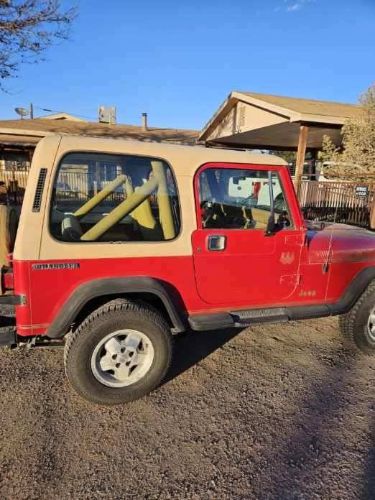
1988 Jeep Wrangler
 Dealer
United States
Dealer
United States
1991 Jeep Wrangler
What to Look For
Frame inspection is the first non-negotiable on any Wrangler. Crawl under the truck with a flashlight. Probe the frame at the body mount points, the rear shackle mounts, and the front frame horns. Solid steel resists; rotten metal flakes. Frame swap on a Wrangler is $4,000-$10,000 in parts and labor — verify the frame is solid before paying for any cosmetic or mechanical concerns.The frame and the tub are non-negotiable. Lift the floor mats and inspect the tub floor pans. Pull the rear seat and inspect the rear cargo floor. Examine the fender flares and the body-to-frame seam. Reproduction floor pans are available, but installation requires skilled bodywork.
For Rubicon TJ claims (2003-2006 only), verify the Dana 44 front and rear axles (look for the Dana 44 casting number on both axle housings), the dual locking differentials (front and rear lockers), the NV241OR Rock-Trac transfer case (look for the Rubicon-specific shift pattern), and the original 31-inch Goodyear MT/R tires (or replacement equivalent). Many TJs have been retrimmed cosmetically with Rubicon decals — the actual Rubicon equipment must be present.
For YJ Wranglers (1987-1995), verify the engine. The 4.2L inline-six (1987-1990) was replaced by the 4.0L inline-six for 1991-1995. The 4.0L is dramatically superior and significantly more desirable. The 2.5L inline-four was the base engine; verify which engine your prospective Wrangler has.
Test 4WD engagement on a test drive. Manual hubs (early YJ) or NP231 transfer case should engage cleanly. Verify the front axle engages and disengages smoothly, the transfer case shifts smoothly between 2H, 4H, and 4L, and the rear axle rotates without grinding or whining.
For 4WD use evaluation, check the Dana 30 front axle u-joints (click sound on tight turns indicates wear), the Dana 35 (or Dana 44) rear axle for whining, and the front and rear leaf springs (YJ) or coil springs (TJ) for sag.
Document the truck. Photograph every panel, every frame rail, every body mount, every engine bay component, every axle housing, and every identifying tag. Build the case before you wire money.
Pre-Purchase Checklist
-
Inspect frame at body mount points
YJ and TJ frames rust at body mount points. Frame swap = $4,000-$10,000 in parts and labor. -
Probe frame at rear cross-member and shackle mounts
Rear shackle mounts are critical structural areas. Rust here compromises rear suspension. -
Inspect tub floor pans and rocker panels
Pull floor mats. Tub floor rusts from underneath. Reproduction floor pans available but installation requires skilled bodywork. -
Examine fender flares and front floor
Mud and water collect at fender attachment points. Front floor commonly rotten on neglected examples. -
Verify VIN engine code matches block
4.0L inline-six (most common), 2.5L four-cylinder, or 4.2L inline-six (1987-1990 YJ only). -
Test 4WD engagement on test drive
Manual hubs (early YJ) or NP231 transfer case engagement should be smooth. Failed transfer case = $1,500-$3,000. -
Check Dana 30 front axle u-joints
Front axle u-joints fail with off-road use. Click-click sound on tight turns. -
Inspect Dana 35 (or Dana 44) rear axle
Dana 35 (standard on most YJ/TJ) is weak under modified power. Dana 44 (Rubicon, optional) is stronger. -
Check soft top and hardtop condition
Soft tops fade and tear over years. Hardtops add value when present and undamaged. -
For Rubicon claims (TJ 2003-2006), verify Dana 44 axles
Rubicon-specific Dana 44 front and rear axles, locking diffs, low-range transfer case.
Common Issues
Wrangler rust patterns are universal across YJ and TJ generations. The frame rusts at body mount points, rear shackle mounts, and inside boxed frame sections. The tub rusts at floor pans, rear cargo floor, fender attachment points, and the tub-to-fender seams. The body-to-frame seal allows water to penetrate during off-road use, accelerating rust significantly.Mechanically, the 4.0L AMC inline-six (1991-2006) is the legendary durable engine — commonly exceeding 250,000 miles with proper service. The 4.2L inline-six (1987-1990) is similar but produces lower power. The 2.5L and 2.4L inline-four engines are reliable but underpowered. Common issues include valve cover gasket leaks, exhaust manifold cracking on 4.0L engines (a known weak point), tired ignition components, and worn timing chain on high-mileage engines.
The AX-15 5-speed manual transmission (TJ standard) is robust. The AW-4 automatic is reliable. The NP231 transfer case is durable; the NV241OR Rock-Trac transfer case (Rubicon) is heavier-duty. Common issues include leaky transmission seals, worn input shaft splines, and tired transfer case shifter linkage.
Front axle u-joints (Dana 30 standard) wear with off-road use. Click-click sound on tight turns indicates worn u-joints — replacement is straightforward. The Dana 35 rear axle (standard on most YJ/TJ) is weak under modified power; the Dana 44 (Rubicon, optional on some configurations) is significantly stronger. Many off-road-modified Wranglers have aftermarket axle upgrades.
Soft tops fade and tear over years of UV exposure. Hardtops are durable but heavy and require careful storage when removed. Both top systems require periodic seal replacement to prevent water intrusion. Cars with both original soft top and original hardtop in good condition command 5-10% premium.
Electrical issues are generally minor on Wranglers. The instrument cluster commonly fails on TJ models — replacement is reasonably straightforward through specialist suppliers. The blower motor resistor on TJ climate systems commonly fails ($25 part, easy fix).
More Wrangler for sale
 Dealer
United States
Dealer
United States
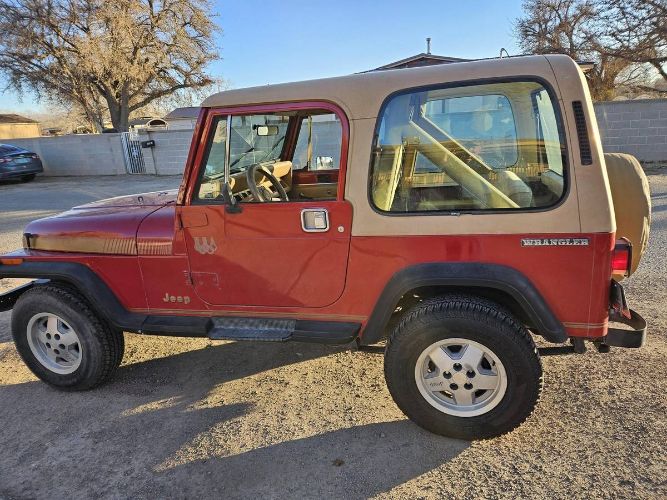
1988 Jeep Wrangler
 Dealer
United States
Dealer
United States
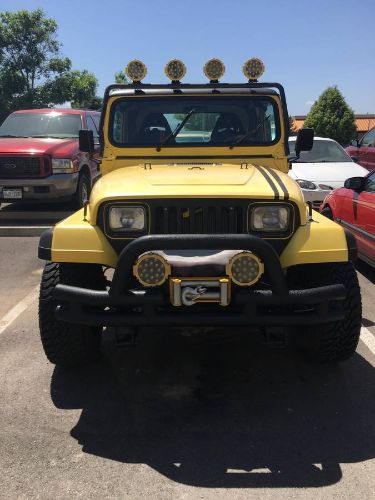
1988 Jeep Wrangler
Pricing Guide
1987-1990 YJ Wranglers (with 4.2L inline-six): driver-quality cars run $9,000-$18,000. The 4.2L is significantly less desirable than the 4.0L that replaced it — these YJs represent the bargain entry into Wrangler ownership.1991-1995 YJ Wranglers (with 4.0L inline-six): driver-quality cars run $12,000-$22,000. The 1991-1995 YJ Sahara (with khaki interior and full doors) commands $15,000-$28,000. Documented original-paint, low-mileage YJs: $20,000-$35,000.
1997-2002 TJ Wranglers: driver-quality cars run $14,000-$28,000. The 1997-2002 TJ Sahara is most desirable. Documented original cars: $22,000-$38,000.
2003-2006 TJ Wranglers: driver-quality cars run $16,000-$32,000. The 2003-2006 TJ Sahara: $20,000-$36,000. Documented original cars: $25,000-$45,000.
2003-2006 TJ Wrangler Rubicon: driver-quality cars run $20,000-$38,000. Documented original Rubicon TJs with low miles: $35,000-$55,000+. The Rubicon is dramatically more desirable than equivalent base TJs and commands premium pricing.
Long-wheelbase Wranglers (TJ Unlimited, 2004-2006) command modest premium over equivalent two-door TJs. The TJ Unlimited Rubicon (2005-2006) is the most desirable variant of this configuration.
Modified Wranglers (lifted suspension, larger tires, aftermarket axles) trade based on quality of build and parts. Recognized-builder builds command premium; hobby builds typically trade at parts cost. From a collector perspective, original-condition unmodified Wranglers consistently outperform heavily-modified examples in long-term appreciation.
Project Wranglers start around $5,000-$12,000 for YJ and $8,000-$18,000 for TJ. Stripped roller candidates: $2,500-$6,000. Frame restoration alone runs $4,000-$10,000.
Fun Facts
The Jeep Wrangler launched for 1987 as a direct replacement for the CJ-7 (which had been in production since 1976). Chrysler (which had acquired AMC and Jeep in 1987 for $1.5 billion) faced significant pressure to update the CJ platform — federal regulators had cited rollover safety concerns about the CJ design, and Chrysler's product planners decided to launch an all-new platform rather than continue refining the CJ. The Wrangler name was chosen to evoke ruggedness and Western utility.The square headlights of the YJ Wrangler (1987-1995) were a deliberate styling differentiation from the round-headlight CJ. AMC designers chose square headlights to signal that the YJ was a new platform rather than a CJ refresh. Enthusiast pushback was significant — Jeep enthusiasts had associated round headlights with Jeep heritage since 1941 — and Chrysler returned to round headlights for the 1997 TJ Wrangler. The YJ remains the only Wrangler ever produced with square headlights.
The 4.0L AMC inline-six engine (1991-2006) is widely regarded as one of the most durable engines in American automotive history. The basic 4.0L architecture traces directly to AMC's 1964 Tornado engine — over forty years of continuous development produced an engine that commonly exceeded 250,000 miles with proper service. Chrysler retained the 4.0L architecture through the 2006 model year despite acquiring AMC in 1987 — testimony to the engine's exceptional design integrity. The 4.0L is among the most actively-collected American six-cylinder engines for its combination of durability and parts support.
Frequently Asked Questions
Ready to find your Wrangler?
Browse 6+ active Jeep Wrangler listings on Classic Cars Arena.
View Listings →