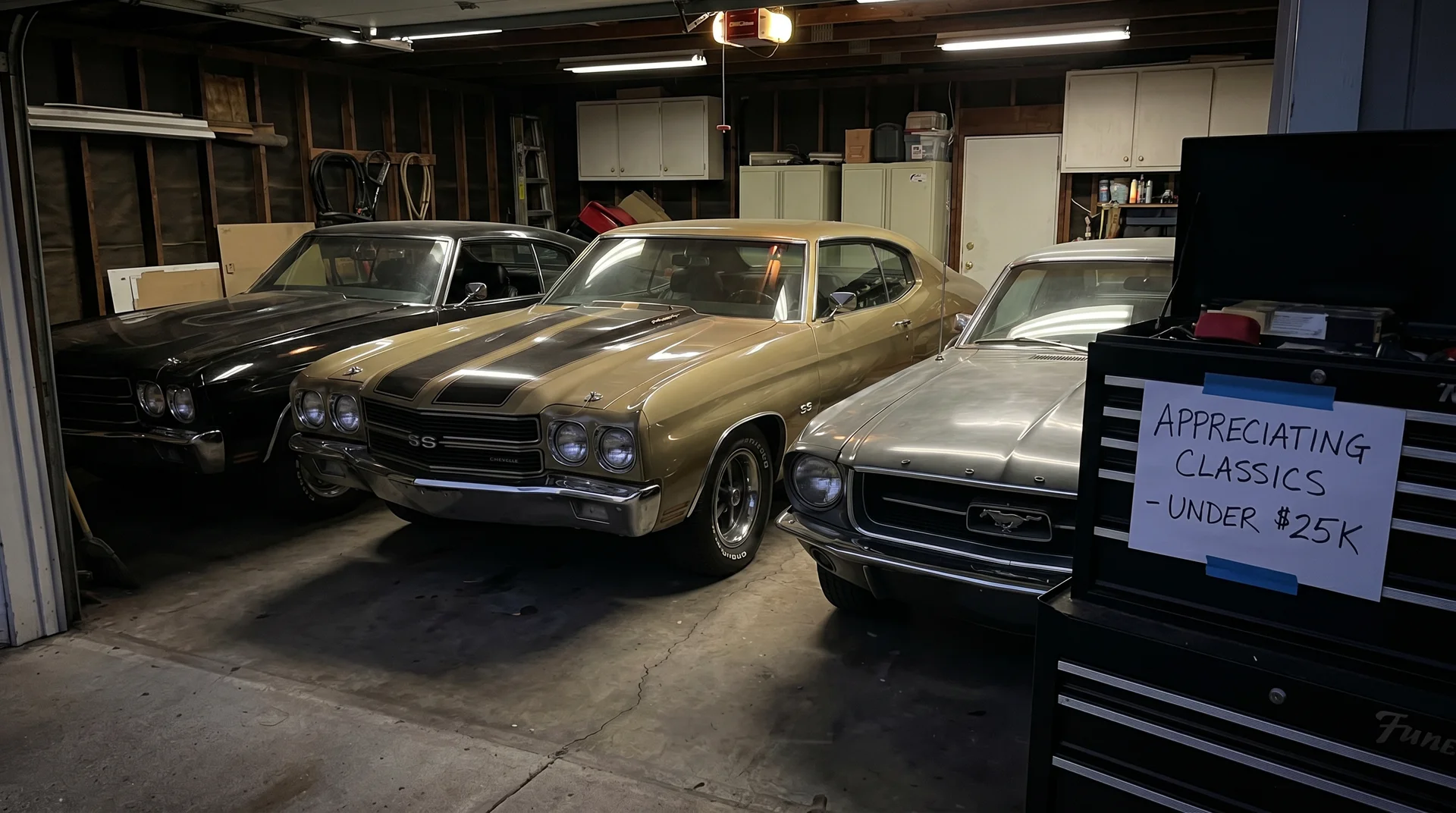

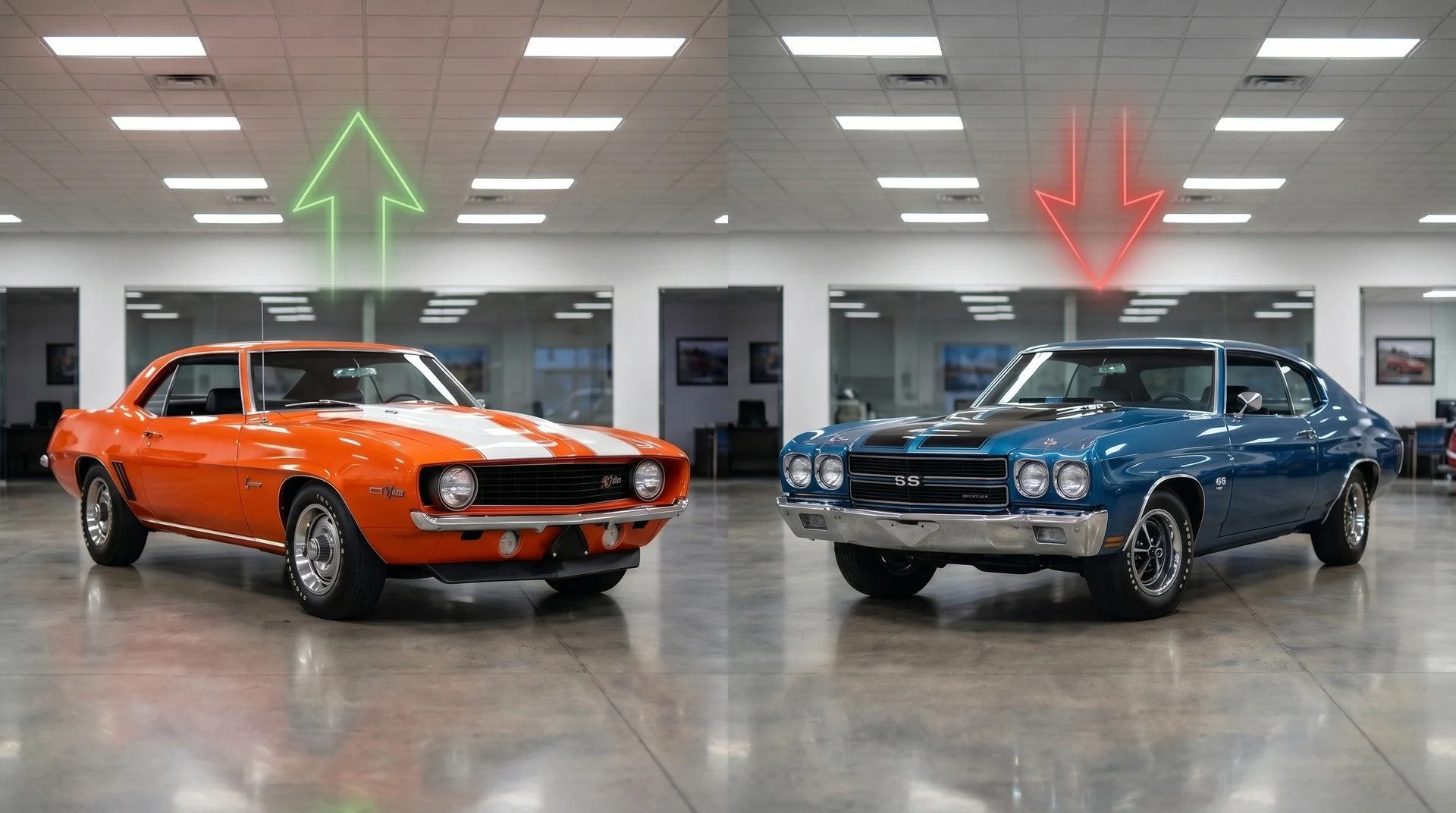
The classic car market has been through the wringer. After the pandemic surge pushed prices to almost absurd levels, the correction hit hard — broad categories dropped 15–25% from their 2022 peaks, and a lot of sellers spent eighteen months watching their cars hammer well below expectation. But here's what I'm seeing as we roll into summer 2026: the panic is over. The market isn't dead. It's just gotten honest.
And honestly? That's better for serious buyers.
Is the Classic Car Market Actually Stabilizing in 2026?
The short answer is yes — but not evenly, and not everywhere.
What's stabilizing is the documented, provenance-correct end of the market. What's still soft is everything else: undocumented drivers, clones, cars that rode the pandemic wave without real fundamentals. The classic car market in 2026 is pricing with discipline for the first time in years, and if you know what to look for, that's genuinely good news.
I've been tracking auction results and car valuations closely, and the bifurcation is real. Correct cars are finding their floor. Cars that never deserved their 2022 prices are still correcting. That separation is healthy — it's how any serious collector car market should function.
The correction isn't over everywhere. But the freefall is.
What Is Hagerty's 2026 Bull Market List — And Why Should You Care?
Every year, Hagerty publishes its bull market list — the collector cars they believe are positioned for appreciation. Hagerty's 2026 list is worth reading carefully, because it breaks from tradition in a meaningful way.
For the first time, the 2026 bull market list includes modern enthusiast cars alongside the traditional post-war classics. Hagerty says this reflects a real generational shift in collecting — a new generation of collectors is entering the car market, and their emotional reference points are completely different from the baby boomers who grew up worshipping '60s muscle. The boomer collecting wave built the muscle car market into what it is. The next wave is building something different.
Hagerty's market rating data backs this up. Movement in the '90s and '00s categories would have looked impossible five years ago. When Hagerty flags a segment, auction results tend to follow within two or three quarters — that's a pattern worth paying attention to.
Which Classic Cars Are Actually Increasing in Value Right Now?
Let me get specific, because vague market commentary helps nobody.
First-generation muscle cars with clear documentation are the clearest win in today's market. At the spring 2026 Barrett-Jackson Palm Beach event, documented 1969 Chevrolet Camaro Z/28s with correct build sheets averaged $87,000 — up roughly 12% from the same show in 2024. Mustang with verified Marti reports, Chevrolet cars with NCRS documentation, Chrysler broadcast sheets on Hemi cars — all showing meaningful increase in value compared to 2025 levels. The pattern is consistent: paper separates the cars that are rising from the cars that aren't.
Original-condition survivor cars are the other standout. Originality has become the real premium. A 1970 Dodge Challenger with factory paint that's 40% intact but 100% matching is a more interesting car to serious buyers than a freshly painted clone with mixed provenance. The collector community has genuinely shifted on this — original beats pretty, every time, in today's market.
Pre-war American cars below $50,000 are quietly building too. Collectors in their 40s and 50s who were priced out of post-war muscle are discovering that a correct 1936 Ford with a flathead V8 is a compelling driver at $35,000. Watch this segment in the second half of 2026.
Are Classic Car Prices Dropping — Or Just Correcting?
Car prices dropping in 2026 is a headline that keeps circulating, and it's both true and misleading at the same time.
Yes, classic car prices dropping in the undocumented, driver-quality muscle segment is real. A 1970 Chevelle SS with a recent frame-off restoration but no build sheet is selling 30–40% below comparable documented cars. That hurts if you own one. But a car that was never properly documented probably shouldn't have commanded those prices to begin with — the car market in 2022 wasn't rational, and the correction is painful but fair.
The cars genuinely cooling are mostly cars that rode the pandemic wave on hype alone. Modern muscle from the early 2000s — Mustang Cobras, SRT-10 Vipers — gave most of their gains back. Clones in any category are under serious pressure. The collector car market has become appropriately skeptical, and that skepticism isn't going away.
The actual classic car market — significant cars with real automotive history, documented originals, proper survivors — isn't dropping. It's consolidating. If you're making buying decisions right now, that distinction matters more than any headline.
Modern Classics: Why '90s and '00s Cars Are Having Their Moment
The 2000s are gaining ground in the collector world, and this isn't a fad. It's demographics doing what demographics do.
The Porsche Carrera GT. The BMW M5 in E39 form. The Alfa Romeo GTV. The Mazda Miata in its first generation. The Toyota Supra. The Skyline GT-R. These are the cars that a specific generation of enthusiasts grew up dreaming about, and that generation is now in their early-to-mid 40s with real money and real nostalgia. Modern classics from the '90s and early 2000s are hitting the intersection of accessibility and desirability at exactly the right moment.
What ties them together? Manual transmissions. Analog driving feel with limited electronic interference. Modern speed without the numbing effects of too many driver aids. The Volkswagen Golf GTI — especially MK4 and MK5 — fits this pattern too. Hot hatches as a category are seeing genuine movement in current market data. The enthusiasm is driven by passion, not speculation, which tends to be a more durable foundation for price appreciation than flipping mentality.
Online auctions have made it easier to find these cars. They've also made it easier to overpay for a bad one. Know what you're buying before you bid.
The Chevrolet Z06, Mustang, and American Muscle That Remain Strong
American muscle isn't dead. Not even close. But you have to be specific about which cars, and why.
The C6 Chevrolet Corvette Z06 deserves serious attention right now. It's a V8, 505-horsepower, genuinely analog sports car that can still be purchased for under $30,000. That's remarkable performance per dollar by any standard — and Hagerty's valuation data suggests it has found its floor. Sold prices for clean, low-mileage examples have been surprisingly consistent through the broader market correction.
The Mustang GT — clean, low-mileage, unmolested examples from 2007–2009 — is showing similar stability. These are fun to drive, mechanically well-understood by any competent shop, and genuinely hard to find in unmodified condition. For the car owner who wants something enjoyable to use while also potentially appreciating, that combination is hard to beat. Mustang remains strong at the enthusiast end of the market.
For traditional American muscle, the spread between documented and undocumented has never been wider. A real Hemi car with factory broadcast sheet commands a massive premium over an engine-swapped lookalike. Buy the documentation. Every single time.
Japanese Performance Cars: Skyline GT-R, Toyota Supra, and the Cars Worth Watching
Japanese performance cars are playing by different rules right now, and it's worth understanding why.
The Skyline GT-R — R32, R33, R34 — has been building steadily for years. The 25-year import rule has driven some of this, but the cultural cachet is real and global. These are significant cars in automotive history, and their collector base is serious, international, and growing. Auction results for clean examples have held up through the broader correction better than most American muscle categories.
The Toyota Supra MK4 and Alfa Romeo GTV are following parallel trajectories. Ferrari and Porsche collectors have always understood scarcity. The Japanese performance cars segment is learning that lesson now — supply of clean, unmolested examples is finite, and the demand from a younger generation of collectors isn't going anywhere. Mercedes-Benz SL models from the same era are also worth a hard look. Mercedes makes some of the most overlooked collector cars on the market right now, and market value on the right examples has clear room to run.
What Do Barrett-Jackson and Mecum Auction Results Actually Tell Us?
Auction results are the ground truth of the collector car market. Everything else is opinion.
Barrett-Jackson's spring 2026 events set a cautiously optimistic tone. Sell-through rates were solid, premium lots performed well, and the car scene at Palm Beach felt different from the subdued atmosphere of 2024 and 2025. The Mecum Indianapolis auction in June 2026 is the real signal for the second half of the year — Indy is where the volume is, where the mid-market ($30,000–$80,000) gets properly priced by actual buyers spending actual money.
If sell-through rates at Indy come in above 70% and hammer prices hold within 5% of pre-auction estimates, the correction is effectively over. If sell-through falls below 60%, expect another quiet autumn. Those two numbers will tell you more about market trends in the classic car world than any analyst commentary written before the auction happens.
My own read: stabilization through summer, with documented cars performing well and undocumented cars remaining soft. The inventory of truly correct, period-correct collector cars is genuinely finite. That scarcity is the long-term thesis for this entire car world, and it hasn't changed.
How to Use Car Valuations to Make Smarter Buying Decisions
Hagerty's valuation tool is the industry standard for good reason — it's updated from real transaction data and gives you a condition-based range that's actually useful. But no tool can account for documentation quality, regional demand, or the difference between a matching-numbers car and a correct-appearing substitute. Car valuations are a starting point. They're not a finish line.
Use Hagerty as your baseline. Cross-reference with recent online auctions for comparable cars. Look at sold prices, not asking prices — the asking price tells you what a seller hopes for, the sold price tells you what today's market actually believes. Subscribe to a solid newsletter: Hagerty's weekly market updates track auction results and car valuations in near real time, and that data is your edge in a market where most buyers are still operating on gut feeling.
For the collector in 2026: document everything, buy quality over quantity, and don't chase the category. Chase the specific car. The car market this year rewards patience and specificity like it hasn't in a long time.
Key Takeaways
- Documented cars command a 30–40% premium over comparable undocumented examples — the spread has never been wider and shows no sign of closing
- Originality beats pretty — survivor cars with honest patina consistently outperform restored examples in the same price range
- Hagerty's 2026 bull market list includes modern enthusiast cars for the first time — '90s and '00s vehicles are now legitimate collector targets, not just enthusiast cars
- The C6 Corvette Z06 offers exceptional performance per dollar and appears to have found its floor — worth watching closely
- Japanese performance cars (Supra, Skyline GT-R) and European models (Porsche Carrera GT, Alfa Romeo GTV, Mercedes-Benz SL) are holding strong independent of American muscle trends
- Clones and undocumented cars remain soft — don't expect that to reverse in the second half of 2026
- Watch Mecum Indianapolis sell-through rates — above 70% means the correction is over; below 60% means another quiet autumn ahead
- Use Hagerty valuations as your floor, then verify against recent sold prices from actual auctions before making any offer
- Manual transmissions, analog feel, and limited electronic interference are the common thread in what's appreciating among modern classics
- The long-term thesis — finite supply of correct, documented collector cars — remains intact and unchanged