
Mercedes-Benz 560 SL Buyer's Guide (1986–1989)
The 560 SL is the pinnacle of the R107 generation — the most powerful, the most refined, and the last expression of a roadster formula Mercedes refined over 18 years. Values have climbed steadily as buyers realize what they missed. The timing chain guides are the one thing that can turn this into an expensive surprise.

I've always found the R107 SL fascinating from an engineering standpoint. Mercedes built the same basic car from 1971 through 1989 and kept making it genuinely better every year — not through dramatic redesigns, but through continuous refinement. The 560 SL that closed out the generation in 1989 is a categorically better car than the 350 SL that opened it in 1971, even though they're visually similar. The M117 5.6-liter engine is smooth and characterful in a way that later V8s rarely achieve. The market has figured this out, and prices have responded accordingly. Condition and service history are everything — a well-documented 560 SL is a different asset class from one with unknown maintenance.
The R107 SL Generation
The R107 SL entered production in 1971 as the replacement for the W113 "Pagoda" SL, which had run from 1963 to 1971. Where the Pagoda was a compact, precise sports car, the R107 was larger, more powerful, and more explicitly luxurious — a grand touring roadster rather than a sports car. It would remain in production for 18 years, making it the longest-lived SL generation in Mercedes history.
Evolution to the 560 SL
The R107 went through multiple displacement and equipment revisions over its production life. US-market cars received the 450 SL and 450 SLC through the mid-1970s, then the 380 SL from 1981, and finally the 560 SL from 1986 through the end of production in 1989. The 560 SL's M117 5.6-liter V8 produced 227 horsepower (SAE net) in US specification — the most powerful R107 offered in America. European versions were rated higher.
The M117 Engine — Strengths and the Critical Weakness
The M117 5.6-liter SOHC V8 is a magnificent engine in operation — silky smooth, effortlessly torquey, with a throttle response that feels calibrated rather than mechanical. In a car weighing around 3,600 pounds, 227 horsepower provides relaxed performance rather than excitement, which is entirely consistent with what this car is.
The critical technical issue is the timing chain guide system. The M117 uses plastic timing chain guides that become brittle with age and heat cycles. When a guide fails, the chain can contact the timing cover, creating metal debris that circulates through the oil system — a catastrophic failure mode. The repair requires engine-out work and runs $3,000–$6,000 at a qualified independent shop. Any 560 SL without documented timing chain guide replacement in the last 50,000 miles or 15 years should be priced to include this service.
What to Inspect
Timing chain guide status is the first question — ask directly and request documentation. A seller who doesn't know the service history of this specific item is a seller whose car needs to be priced accordingly. Check the oil for metal particles by running a magnet through a sample on a white cloth — any metallic debris is a red flag. Listen for any rattling from the engine on cold start, which can indicate a loose chain.
The M117 cooling system requires full attention: hoses, the thermostat, and the expansion tank (which becomes brittle and can crack, causing sudden coolant loss and overheating). Overheating accelerates head gasket and timing guide deterioration. The soft top mechanism should operate smoothly in both directions without hesitation or binding. Check all roof seals for deterioration that would allow water intrusion.
| Specification | Detail |
|---|---|
| Engine | M117 5.6L SOHC V8, 227 hp (US) |
| Transmission | 4-speed automatic (722.3 series) |
| Wheelbase | 96.9 inches |
| Curb weight | ~3,600 lbs |
| Production | 1986–1989 (US market) |
| Critical service | Timing chain guide replacement (plastic guides) |
"The timing chain guides are the one thing I always ask about before I ask anything else on a 560 SL. It's not a reason to avoid the car — it's a reason to know the car's history. A 560 SL with documented guide replacement, correct cooling system service, and a good interior is a genuinely refined automobile that appreciates steadily. An undocumented one is a car that might be fine or might be one heat cycle away from a serious problem. The documentation tells you which one you're buying."
— Emily Chen
Pricing & Market
Driver-quality 560 SL with reasonable service history: $18,000–$28,000. Show-quality with full documentation, correct hardtop, and excellent interior: $35,000–$50,000. Exceptional low-mileage, single-owner documented examples have exceeded $60,000 at major auction. The 560 SL commands a 20–30% premium over the 380 SL (slug: 380-sl) at equivalent condition — the M117 engine premium is real and reflects both the performance difference and the final-year collectibility.
Browse Mercedes-Benz 560 SL listings
 Dealer
 United States
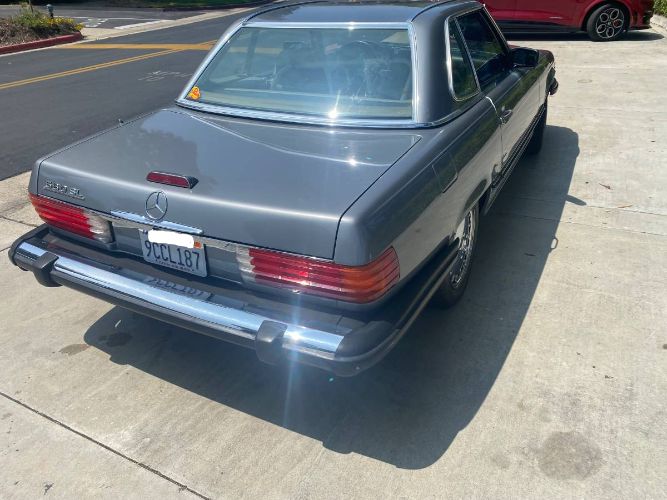
1988 Mercedes-Benz 560 SL
 Dealer
United States
Dealer
United States
1987 Mercedes-Benz 560 SL
What to Look For
Timing chain guide service history — ask directly and request documentation. Check oil for metallic debris by wiping on white cloth with magnet. Listen for chain rattle on cold start. Cooling system condition: inspect hoses for softness, check plastic expansion tank for hairline cracks, verify thermostat function. Soft top operation — cycle fully and check for binding. All roof seals for water intrusion evidence (stains on headliner). Automatic transmission shift quality and fluid condition (burnt smell = service overdue). Interior condition assessment — cracked leather on dash and door panels is a major restoration cost. Hardtop presence and condition — missing hardtop reduces value $1,500–$3,000. Request full service documentation.Pre-Purchase Checklist
-
Timing chain guide history
Request documentation of guide replacement — essential before any pricing -
Oil metal particle check
Wipe oil on white cloth with magnet — metallic debris = chain/guide damage -
Cold start chain listen
Listen for chain rattle on cold start — indicates loose or worn guide -
Expansion tank inspection
Check plastic coolant expansion tank for hairline cracks — failure causes sudden coolant loss -
Cooling hose condition
Squeeze all hoses — hard/brittle hoses need immediate replacement -
Soft top operation
Cycle top fully in both directions — check for binding or hydraulic hesitation -
Roof seal condition
Inspect all seals for deterioration, check headliner for water stain evidence -
Interior leather assessment
Check dash and door panels for cracking/shrinking — restoration cost $4,000–$8,000 -
Hardtop presence
Verify original hardtop is present — missing unit reduces value $1,500–$3,000 -
Transmission fluid
Check ATF for burnt smell and correct level — burnt fluid indicates service overdue -
Service documentation
Request full service records — documented cars are significantly more valuable
Common Issues
Timing chain guide failure is the defining risk of R107 M117 ownership — plastic guides become brittle over time and can fail without warning, causing chain contact with the timing cover and metal debris circulation. Cooling system deterioration: the plastic expansion tank cracks with age causing sudden coolant loss; hoses harden and fail; overheating accelerates guide and gasket problems. Automatic transmission service intervals are frequently exceeded on neglected cars. Interior deterioration — MB-Tex vinyl ages better than leather; leather dashboards and door panels crack and shrink with UV exposure. Soft top hydraulic cylinder leaks cause top operation failure. Electrical gremlins from aging wiring insulation, particularly in the convertible top circuit.More 560 SL for sale
 Dealer
United States
Dealer
United States
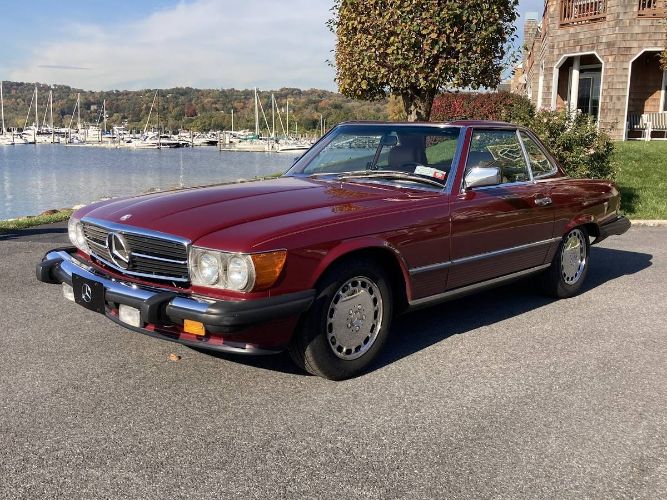
1986 Mercedes-Benz 560 SL
 Dealer
United States
Dealer
United States
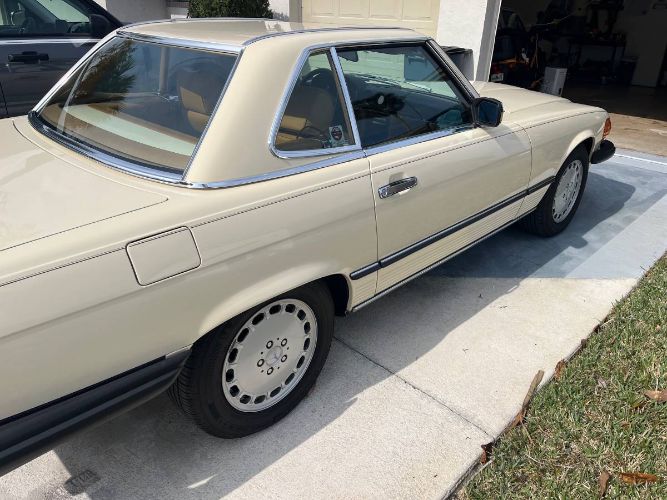
1988 Mercedes-Benz 560 SL
Pricing Guide
Driver quality with reasonable history: $18,000–$28,000. Show quality with full documentation and excellent interior: $35,000–$50,000. Low-mileage documented examples: $55,000–$65,000+. The 380 SL (slug: 380-sl) is the same car with the smaller 3.8L engine and trades 20–30% below equivalent 560 SL prices. Factor in timing chain guide replacement ($3,000–$6,000) if undocumented. Interior restoration if leather is cracked: $4,000–$8,000. A correctly priced 560 SL should reflect known service needs.Fun Facts
The R107 SL was the personal vehicle of choice for European royalty, film stars, and executives for nearly two decades — Princess Grace of Monaco, Sophia Loren, and numerous heads of state owned them. Mercedes built 237,287 R107 SLs over 18 years, a production record that stood until the R129 generation surpassed it. The 560 SL was the most powerful R107 SL sold in the United States when it launched in 1986, a fact easy to forget given its boulevard-cruiser reputation today.Frequently Asked Questions
Ready to find your 560 SL?
Browse 6+ active Mercedes-Benz 560 SL listings on Classic Cars Arena.
View Listings →