The Volkswagen Beetle is the single most-produced single-platform automobile in history — over 21.5 million units across more than 60 years of continuous production worldwide. Approached this with an engineer's eye, the Beetle represents one of the most fully-developed mass-market designs of the 20th century, with the basic air-cooled rear-engine layout remaining functionally unchanged from 1938 launch through Mexican production ending in 2003. For collectors entering the air-cooled VW market today, the Beetle offers exceptional parts support, an active international community, and pricing that has remained accessible across most variants. This guide covers what every buyer should verify before purchasing a US-market 1949-1979 Beetle, with particular attention to year-specific details that drive collector value.
Common Issues
Beetle rust follows predictable patterns across all production years. The floor pan (a flat steel platform that supports the entire body and unibody) is the structural killer — rust through the floor pan compromises chassis integrity and requires either replacement ($1,500-$3,500 in parts plus 20-40 hours labor) or complete chassis swap. The heater channels (longitudinal box-section structures running under the doors that route heat from the engine forward to the cabin) are similarly critical and similarly prone to rust through.
Other rust zones include the lower fenders behind the front wheels, the rear quarter panels (lower section, behind the rear wheels), the running boards, the front trunk floor, the battery box (under the rear seat), and the spare tire well. Documented every nut and bolt during inspection — the unibody construction means each rust point compounds with others.
Mechanically, the air-cooled flat-four (1131cc, 1192cc, 1285cc, 1493cc, 1584cc across various years) is exceptionally durable but has known weak points. Common issues include leaky pushrod tubes (every Beetle leaks oil to some degree — universal characteristic), worn valve guides causing oil consumption, broken valve springs on cars run hard, and worn timing gears. The transaxle (combining transmission and differential) is robust but the synchros wear on cars driven with poor technique. The 4-speed manual is standard; the rare semi-automatic stick-shift (1968+, optional) requires specialist knowledge to maintain.
Electrical issues vary by era. Pre-1967 cars used 6-volt positive-ground systems — original 6V components are increasingly difficult to source. From 1967 forward, 12V negative-ground systems became standard. Many 6V cars have been converted to 12V — verify the conversion was done properly.
What to Look For
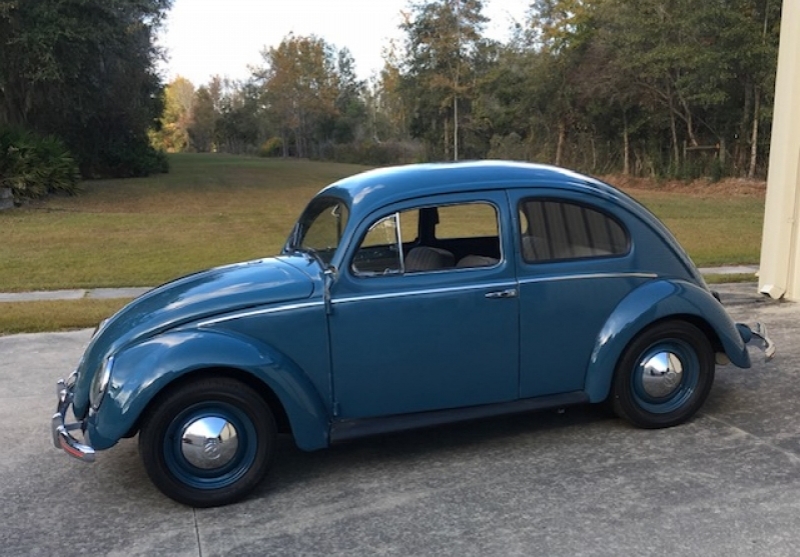
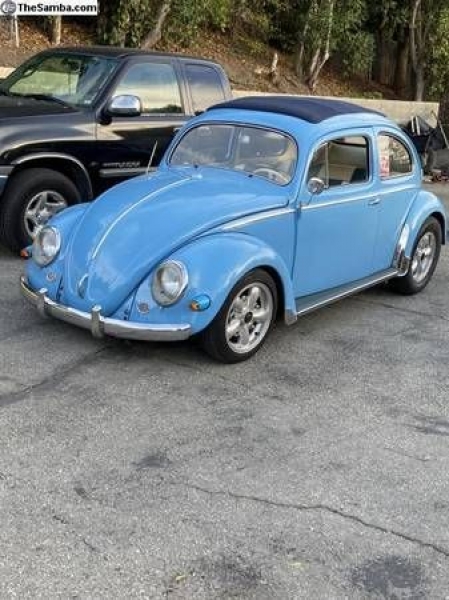
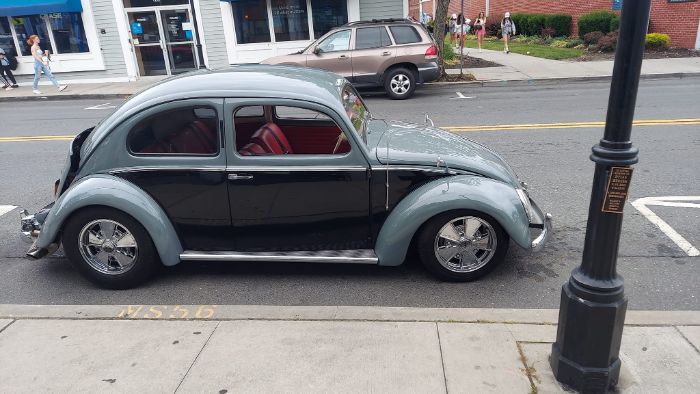
Year-specific identification is the first stop. Beetle production saw constant minor revisions across 30+ years of US-market sales, and each year has its own collector character. The most desirable years are 1957 (final "oval window" cars before the larger rear glass), 1967 (last year of the 6V system, sloping headlights, bumper-mounted turn signals), and 1968 (first year of vertical headlights, 12V system, but retaining the smaller bumpers).
Floor pan inspection is the second non-negotiable. Pull the rear seat (lifts out without tools) and inspect the floor pan from above. Lift the front carpet and inspect the front floor pan. Crawl underneath and probe the floor pan with a screwdriver. Solid steel resists; rotten metal flakes. Most cars on the market have at least some floor pan rust — verify how much before purchase.
Heater channel inspection is the third non-negotiable. The heater channels run longitudinally under each door and are critical structural elements. Inspect from underneath the car with strong light. Push down on the body where it meets the running boards — flex indicates rotten heater channels and structural compromise. Replacement is $1,200-$2,500 per side in parts plus 15-25 hours of labor.
Engine and transaxle verification: the engine number is stamped on a flat pad on the engine case (in front of the generator/alternator pulley). The transaxle number is stamped on the case, visible from underneath the car. Cross-reference both against original delivery records (where available). Many Beetles have replacement engines — Volkswagen produced and sold replacement engines as standard service items, and original numbers-matching cars carry 10-20% premium over equivalent replacement-engine cars.
Document the car. Photograph every panel, every chassis number stamping, every engine bay component. Engineering-analytical inspection beats casual diligence at every price point in the Beetle market.
Price Guide
Beetle pricing varies dramatically by year and condition. Driver-quality 1968-1977 standard Beetles run $12,000-$22,000 today. 1978-1979 final-US-production-year Beetles (sold as Convertible only after 1977 sedan production ended in the US): $15,000-$28,000 for convertibles.
Early Beetles command significant premium pricing. Driver-quality 1949-1953 split-window cars (the rarest production variant): $45,000-$120,000+ depending on condition and originality. 1953-1957 oval-window cars: $25,000-$55,000 for solid drivers. 1958-1964 cars: $15,000-$28,000.
The 1965-1967 cars represent the optimum combination of pre-Federal-bumper styling with refined drivetrain. Driver-quality cars run $14,000-$25,000. The 1967-only configuration (with the unique sloping headlights, vertical-headlight successor in 1968, and 6V system) is increasingly collected.
Convertibles add $5,000-$15,000 to equivalent sedan pricing across all years. Karmann-built convertibles (1949-1979) are dramatically more desirable than coachbuilt aftermarket conversions.
Documented original-paint, low-mileage cars across all years command 25-40% premium over equivalent restorations. The unrestored survivor in original livery is consistently preferable to the freshly-restored car of unknown provenance from a documentation standpoint.
Project Beetles remain extraordinarily affordable: $3,500-$10,000 for running but rough cars across most years. Stripped roller candidates: $1,500-$5,000. The strong parts support and active marque community mean Beetle restoration costs are dramatically lower than equivalent post-war American or European classic restoration — $10,000-$25,000 for proper driver-quality refresh on a complete car.
Did You Know?
The Beetle was developed under Ferdinand Porsche in 1934-1938 as the original "people's car" (Volkswagen) for Adolf Hitler's Germany. The first prototypes were tested in 1936-1937, and the Wolfsburg factory was completed in 1938. Civilian production was halted by World War II — only a handful of pre-war Beetles were actually delivered to customers. Mass production resumed in 1945 under British military oversight, and exports to the US began in 1949.
The Beetle was the best-selling single-platform automobile in the world for nearly four decades. By 1972, total Beetle production had exceeded the Ford Model T's all-time production record. Production continued in Mexico through July 2003, with the final "Última Edición" Mexican Beetles selling for premium prices to collectors entering air-cooled VW ownership for the first time.
The iconic 1957 Beetle commercial "Lemon" — created by the Doyle Dane Bernbach advertising agency — is widely credited with launching modern automotive advertising. The campaign deliberately positioned the Beetle's plain styling, slow performance, and unusual design as virtues rather than weaknesses, and within five years the campaign had transformed the Beetle from quirky import to mainstream American transportation. The 1959 "Think Small" advertisement is now permanently displayed in the Museum of Modern Art.

 Dealer
 United States
 Dealer
 Dealer