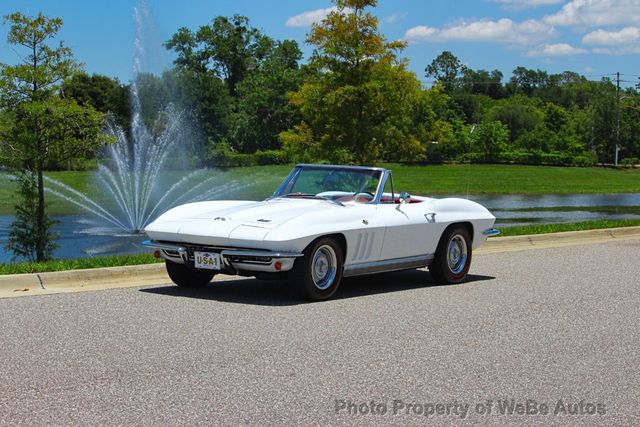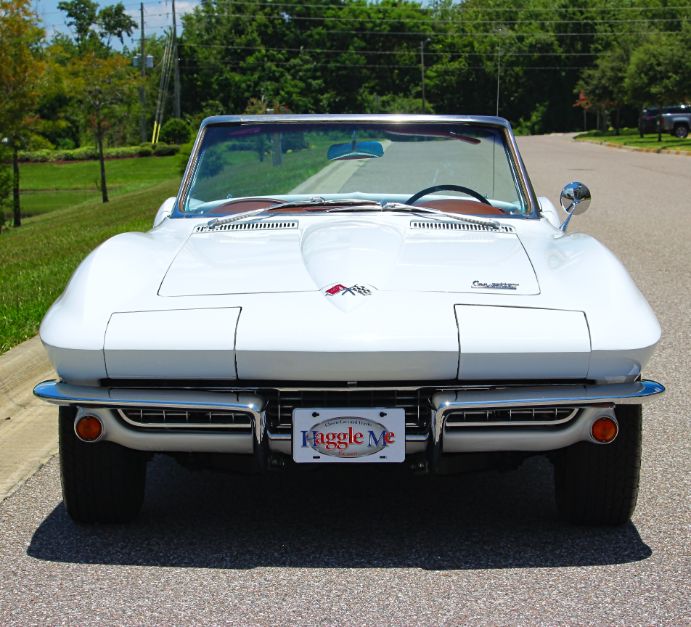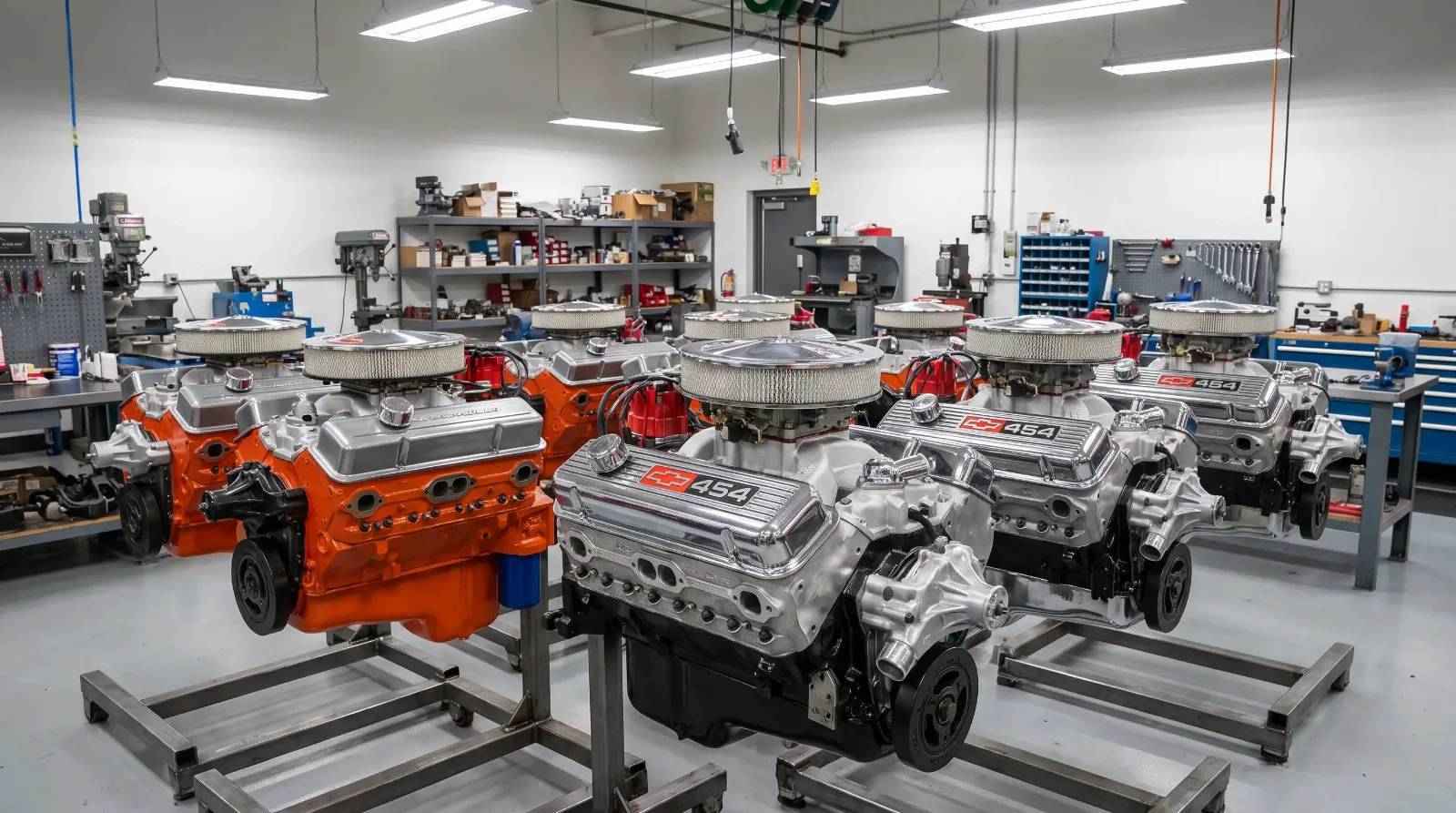
From 396 to 427: The Bore That Changed Everything
In the mid-1960s, the American muscle car wars were fought in cubic inches. Every manufacturer understood that displacement was the quickest advertisement a car could carry — stamped on a badge, announced in a brochure, argued about in every diner parking lot from Hoboken to Bakersfield. When Chevrolet engineers bored the Mark IV big-block from 396 to 427 cubic inches for the 1966 model year, they weren't simply updating a specification. They were issuing a statement.
The 1965 Corvette's 396-cubic-inch introduction had already proven that the C2 Sting Ray could absorb a big-block without collapsing under the weight of its own ambition. But 396 was never the destination. The Mark IV architecture — a clean-sheet design Chevrolet engineers had developed alongside the Corvette's Sting Ray body — had been sized from the beginning with more room to breathe. Boring the cylinders from 4.094 inches to 4.251 inches, while keeping the same 3.76-inch stroke, yielded 427 cubic inches. The block, the heads, the rotating assembly: all carried over in their essential form. What changed was the displacement, and with it, everything a driver felt through the seat of their pants.
The 1966 Engine Lineup: A Menu of Menace
For 1966, Chevrolet offered the 427 in two distinct states of tune, along with carry-over small-block options for buyers who preferred handling finesse over straight-line drama. The choice was genuinely meaningful — not merely a matter of horsepower numbers, but of character, temperament, and intended use.
| RPO Code | Displacement | Horsepower | Carburetion |
|---|---|---|---|
| L75 | 327 ci | 250 hp | Single 4-barrel |
| L79 | 327 ci | 350 hp | Single Holley 4-barrel |
| L36 | 427 ci | 390 hp | Single Holley 4-barrel |
| L72 | 427 ci | 425 hp | Single Holley 4-barrel (solid lifters, 11.0:1 compression) |
The L36 was the gentleman's big-block — hydraulic lifters, a single Holley four-barrel, 390 horses delivered in a broad, accessible torque curve that made the car feel effortless rather than savage. Road testers of the era noted that the L36 could be driven with genuine daily-driver docility, which was not something anyone said about its sibling.
The L72 was another animal entirely. Solid lifters, 11.0:1 compression, a high-flow intake manifold, and a larger Holley four-barrel brought the factory rating to 425 horsepower — a number most contemporary observers suspected was conservative. The solid-lifter camshaft meant the engine wanted to rev, needed to be revved, and made its best power well above where casual traffic demanded. It was a track tool wearing a license plate.
Worth noting in any honest accounting of 1966: the famous three-deuce (three two-barrel carburetors) setup that many enthusiasts associate with the era's 427 Corvette — the L71 rated at 435 hp — did not arrive until the 1967 model year. The 1966 lineup was strictly single-carburetor territory on the big-block, regardless of what period advertising and later mythology sometimes suggested.
Weight, Balance, and the Price of Torque
There is no free lunch in automotive physics, and the 427 Corvette made this point with memorable directness. The big-block weighed roughly 100 pounds more than the small-block it displaced in the engine bay, and that weight sat almost entirely ahead of the front axle centerline. The consequences were predictable in theory and occasionally dramatic in practice.
Where the 327-cubic-inch Corvette — particularly the L79 350-horsepower version — was celebrated by road testers for its near-neutral handling balance and willingness to rotate through corners, the 427 variants exhibited pronounced understeer. Push into a corner too early, trail brake too aggressively, and the nose wanted to wash wide. The car communicated its limits clearly enough, but they were different limits than drivers accustomed to the small-block version expected.
Tire technology in 1966 was not keeping pace with engine development. The redline tires available as options — wider and stickier than the bias-ply street rubber of just a few years earlier — helped, but they could not fully compensate for the mass redistribution that came with the 427. Experienced drivers learned to work with the big-block's natural tendencies: enter corners conservatively, use the enormous mid-corner torque to rotate the car on exit, and respect the longer stopping distances that came with additional weight over the front axle.
None of this was a fatal flaw. It was a characteristic — one that rewarded a different kind of driver, demanded respect, and gave the car a personality distinct from its smaller-engined sibling. The C2 Sting Ray body remained one of the most aerodynamically conscious shapes in American production, and even laden with the big-block, the 427 Corvette cut through air with an efficiency that its contemporary competitors struggled to match.
Against the Best in the World
The 1966 sports car market was not short of serious machinery, and the 427 Corvette found itself benchmarked against genuinely formidable competition. Two names appeared most frequently in period comparisons: the Shelby Cobra 427 and the Ferrari 275 GTB.
The Shelby Cobra 427 — Carroll Shelby's ultimate expression of the Anglo-American big-block formula — was in many respects a more extreme machine. Lighter, more aerodynamically raw, powered by Ford's side-oiler 427 FE-series engine, the Cobra could post straight-line acceleration figures that the Corvette could not match. Contemporary road tests in publications like Car and Driver and Road & Track documented Cobra 427 quarter-mile times in the low 12-second range — performance that put it in another category for drag racing purposes.
But the Cobra existed in a narrow performance envelope. It was not a car that rewarded daily use, offered meaningful luggage space, or provided the refinement that Corvette customers had come to expect. The 427 Corvette, by contrast, could be driven to a race track, run competitive lap times, and driven home. It had a proper top (in coupe form, at minimum), effective heating, and a level of mechanical sophistication that the essentially hand-built Cobra never approached.
"The Ferrari gives you the sensation of driving a very sophisticated racing car that is also civilized enough for the road. The Corvette gives you the sensation of driving a very fast road car that is also usable on a race track. These are not the same thing, and both have their devotees for exactly that reason."
— Road & Track, comparative test, 1966
The Ferrari 275 GTB represented a philosophically different approach to performance. Its 3.3-liter V12, producing around 280 horsepower in standard form, made the Corvette's 427 look almost crude by comparison in raw engineering terms — dry-sump lubrication, twin overhead camshafts per bank, a beautifully fabricated tubular chassis. In cornering balance and tactile feedback, the Ferrari was the teacher and the Corvette the student.
Yet the 427 Corvette's advantage was equally real: it was faster in a straight line, dramatically cheaper, available to anyone who could afford a relatively modest premium over a base Chevrolet, and backed by the largest dealer network in America. The Ferrari required a trip to a specialist, command of Italian, or at minimum command of the prices Italian suppliers charged for parts. The Corvette required a trip to the local Chevy dealer and a checkbook that was full but not extraordinary.
In period SCCA competition, the 427 Corvette proved capable of running at the front of production classes, particularly when the L72 engine was tuned to its limits within the rules. The C2 generation's competition pedigree, established with the 1963 introduction, gave the 427 a platform that had already been proven at Sebring, Daytona, and countless regional events.
The 427 Badge and What It Still Means
Numbers acquire meaning beyond their mathematics when enough people care about them. 427 is one of those numbers in American automotive culture — a figure that carries weight (sometimes literally) beyond what cubic-inch displacement alone could justify.
Part of the 427's cachet derives from context. It appeared at a moment when the horsepower race was running at its most intense, when insurance companies were beginning to take notice of what Detroit was producing, and when the Muscle Car era was still young enough that the boundaries of the possible seemed genuinely open. The 427 Corvette was not the fastest car in the world in 1966, but it was arguably the best performance value available — the car that delivered the most usable speed for the most accessible price in the most complete package.
Part of its lasting significance is simply that 1966 was a pivot point. The L88 option that followed for 1967 — the factory-acknowledged near-racing engine that Chevrolet actively discouraged street buyers from ordering, that came with no radio, no heater, and a compression ratio that demanded aviation fuel — made the L72 look positively civilized in retrospect. But the L72 was the engine that proved the Mark IV architecture could deliver real racing performance in a street-legal package, and that proof set the stage for everything that followed.
The 427 Corvette also arrived at a moment of cultural resonance that mathematics alone cannot explain. Rock music was changing. Space exploration was accelerating. The velocity of American cultural confidence in 1966 was enormous, and the 427 Corvette felt like a physical expression of that confidence — more power than most drivers could use, delivered in a shape that was still among the most beautiful on American roads, at a price that made European performance machines look extravagant by comparison.
Collectors have not forgotten any of this. Documented L72 Corvettes from 1966 — matching-numbers cars with their solid-lifter 425-horsepower engines intact — command premiums that reflect both the genuine rarity of well-preserved examples and the symbolic weight that the 427 badge continues to carry. The numbers have always mattered in this world. But the story behind them matters just as much.