A Complete Reinvention: The C2 Corvette Sting Ray Breaks From Its Past
When Chevrolet unveiled the 1963 Corvette, it did not arrive as an evolution of the car that had come before. It arrived as a repudiation. The first-generation Corvette — the C1, which had established the nameplate through nine sometimes-turbulent years — had grown into a capable but compromised machine. Its live rear axle, inherited from passenger car practice, limited handling on demanding roads. Its 102-inch wheelbase produced a long, blunt profile. And for all its visual drama, the C1 had never quite convinced European sports car rivals that Chevrolet was playing in their league.
The C2 Corvette Sting Ray changed that calculus entirely. In a single model year, Chevrolet introduced an independent rear suspension, a shorter and stiffer ladder-type frame, a completely new body, and a new name — Sting Ray — that would become one of the most evocative in American automotive history. The 1963 redesign was not an update. It was a declaration of intent.
Bill Mitchell and the Design That Changed Everything
To understand how the C2 came to look the way it did, you have to understand Bill Mitchell. When Harley Earl retired from General Motors in 1958, Mitchell inherited leadership of the GM Design Staff — and with it, one of the most powerful creative positions in the American automobile industry. Earl had shaped the Corvette's birth with broad, expressive lines drawn from postwar optimism. Mitchell's aesthetic was sharper, more predatory, more European in its tension.
Mitchell's direct inspiration for the C2 was a race car he had campaigned personally: the XP-87 Stingray, a private SCCA racer he ran in 1959 and 1960 using a chassis built from Corvette SS components. Mitchell had acquired the chassis from GM and funded the racing effort out of his own pocket — technically outside official company channels, though hardly a secret. The Stingray racer's long hood, recessed cockpit, and tapered tail gave Mitchell a working canvas to refine ideas he would eventually translate into production.
The result was a body of startling coherence. Hidden headlights — a first for the Corvette — gave the nose a clean, uninterrupted line when the lamps were stowed. The fenders rose in muscular shoulders above the wheel arches. The roofline of the new coupe body style tapered elegantly toward the rear. And bisecting that rear window, running from roof to decklid, was the feature that would define the car's legacy: a spine of bodywork splitting the glass into two separate panes.
That spine was Mitchell's idea, and he defended it with the tenacity of a man who understood that great design sometimes requires overruling the practical objections of engineers. The story of the 1963 split-window Corvette is inseparable from the story of Mitchell's vision — and from the story of his losing battle to keep it beyond a single year.
"The split window was not a styling quirk or an afterthought — it was the structural expression of the entire car's design philosophy. Mitchell was telling you, in glass and steel, that this Corvette had a spine. The tragedy is that it lasted one year. The irony is that its brevity is exactly why we still talk about it sixty years later."
— Tom Ramirez
The 1963 Model: Coupe, Convertible, and the Z06
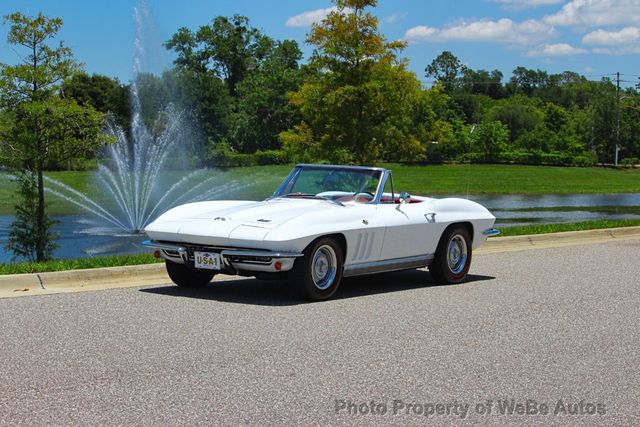
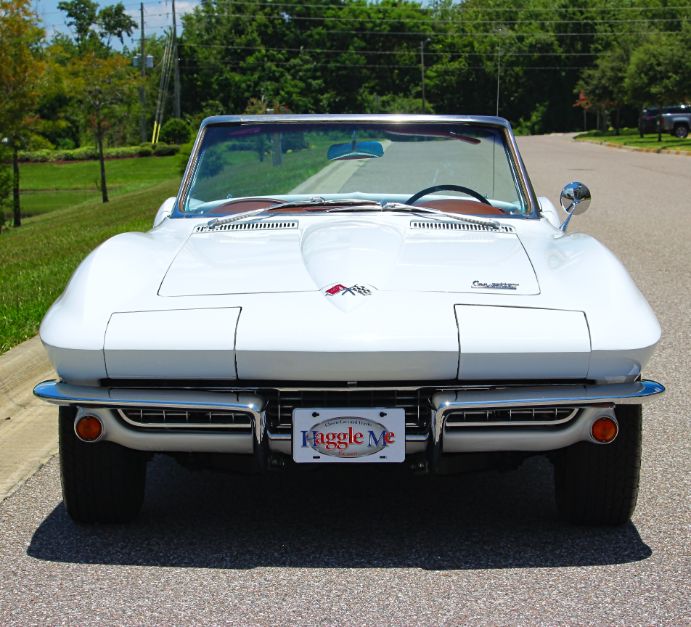
For the first time in Corvette history, buyers in 1963 could choose between two distinct body styles: the new fastback coupe with its split rear window, or a convertible that retained the open-air tradition of every Corvette that had preceded it. The coupe was the more technically novel of the two — its steel roof and fixed rear glass gave it greater structural rigidity, and the hidden headlight mechanism required a more complex front fascia than the convertible's simpler arrangement.
Production for 1963 came to 10,594 coupes and 10,919 convertibles, a near-even split that reflected genuine buyer enthusiasm for both configurations. The interior had been redesigned along with everything else: a new dashboard placed the instruments in a more driver-focused arrangement, with the tachometer positioned prominently in the center of the cluster.
Beneath the dramatic bodywork, the engine lineup drew from the 327 cubic-inch small-block V8 that had served the late C1 well. Buyers could specify outputs ranging from 250 horsepower in base carbureted form, through 300 and 340 horsepower versions with progressive carburetion and cam specifications, up to 360 horsepower with the Rochester fuel injection system — the same "fuelie" option that had made the late C1 a genuine performance landmark. A separate 375-horsepower fuel-injected variant represented the absolute peak of 1963 Corvette performance.
For the most serious buyers, Chevrolet offered the Z06 Special Performance Equipment package. The Z06 combined heavy-duty brakes with sintered metallic linings, a larger 36.5-gallon fuel tank for endurance racing, a Positraction limited-slip differential, a larger front anti-roll bar, and stiffer springs and shocks. Period accounts suggest the Z06 was conceived with Daytona and Sebring in mind as much as any public road, and a small but determined group of private teams did campaign Z06-equipped 1963 Corvettes in period competition.
The Engineering Leap: Independent Rear Suspension and a New Frame
Of all the changes the C2 introduced, the independent rear suspension represented the most significant departure from Corvette tradition — and the most consequential step toward the car's long-term competitive credibility. Every Corvette built from 1953 through 1962 had used a solid rear axle, a robust and simple arrangement but one that imposed a fundamental handling compromise: when one rear wheel encountered a bump, it affected the geometry of the opposite wheel.
The C2's independent rear suspension used a single transverse leaf spring mounted to a fixed differential housing, with U-jointed halfshafts transmitting power to each rear wheel independently. The system allowed each rear wheel to react to road surface changes without influencing its counterpart — a transformation in handling behavior that road testers of the period noted immediately. The new setup reduced unsprung weight at the rear and allowed the suspension geometry to be tuned for handling rather than compromised for axle clearance.
The frame itself was new as well. The C2 used a ladder-type chassis with a narrower central section than the C1, which allowed the seats to sit lower in the body and improved the car's center of gravity. The wheelbase was shortened from 102 inches to 98 inches — a reduction that, combined with the shorter overall length, gave the C2 a tighter, more responsive character than its predecessor. Early road tests in publications of the period commented on the transformation in steering feedback and cornering behavior that the new platform delivered.
The combination of independent rear suspension and a stiffer, shorter chassis finally gave Chevrolet's engineers the foundation they needed to answer European critics. The C2 Corvette Sting Ray could be discussed in the same breath as the Jaguar E-Type and the Ferrari 250 GT in a way that no previous Corvette had fully earned.
The Middle Years: 1964 Through 1966
The 1964 Corvette arrived with changes that were, in some respects, subtractions as much as additions. The split rear window was gone, replaced by a single-pane rear window that improved rearward visibility but robbed the coupe of its most distinctive feature. Duntov's argument had prevailed, and Mitchell reportedly never fully accepted the outcome. The false hood vents that had decorated the 1963 hood were also removed, giving the 1964 a somewhat cleaner profile.
But the engine options expanded. The 1964 lineup again offered the 327 small-block in multiple states of tune, with fuel injection still available at the top of the range. Refinements to the suspension calibration improved on the 1963 car's already-strong handling. Production climbed to approximately 22,000 units across both body styles as the market responded to the C2's established reputation.
The 1965 model year brought two changes of historic significance. First, four-wheel disc brakes replaced the drum brakes that had been standard on C2s since 1963 — a change that brought the Corvette's stopping capability in line with its acceleration. Second, and perhaps more dramatically, Chevrolet offered a big-block V8 in a Corvette for the first time. The 396 cubic-inch Mark IV V8, available in 425-horsepower form, transformed the Corvette's character. Where the high-revving small-block 327 rewarded a driver willing to work through the gears, the big-block delivered crushing torque from low rpm — a different kind of performance, and one that a substantial segment of the American market found deeply appealing.
By 1966, the big-block had grown to 427 cubic inches and was available in outputs of 390 and 425 horsepower. Production reached approximately 27,720 units — the highest annual total the C2 generation would achieve — reflecting both the model's maturity and the broad appeal of the expanding engine lineup. Examples from this era remain among the most actively traded C2s on the market today, with big-block 1966 convertibles consistently attracting collector interest.
C2 Corvette Sting Ray: Year-by-Year Specifications
| Year | Top Engine Option | Peak HP | Coupe Production | Convertible Production | Notable Feature |
|---|---|---|---|---|---|
| 1963 | 327 ci V8 (Fuel Injection) | 375 hp | 10,594 | 10,919 | Split rear window; Z06 package; IRS introduced |
| 1964 | 327 ci V8 (Fuel Injection) | 375 hp | 8,304 | 13,925 | Split window removed; suspension refinements |
| 1965 | 396 ci V8 (Big Block) | 425 hp | 8,186 | 15,376 | Four-wheel disc brakes; first big-block Corvette |
| 1966 | 427 ci V8 | 425 hp | 9,958 | 17,762 | 427 replaces 396; highest C2 production year |
| 1967 | 427 ci V8 (L88) | 430 hp (rated) | 8,504 | 14,436 | L88 option; cleanest C2 styling; final year |
1967: The Last and Arguably the Finest C2
The 1967 Corvette occupies a particular place in collector esteem that no simple production statistic can fully explain. Many who have studied the C2 generation closely consider the final year the purest expression of the design — the year when every element of the car's appearance had been refined to its most resolved state, and before the heavier, wider C3 that would succeed it arrived in 1968. The 1967's exterior was marked by cleaner rocker panel moldings, five functional front fender vents (replacing the non-functional arrangement of earlier years), and a general tidying of detail that gave the car a composed, purposeful appearance.
The engine options for 1967 were the most extensive in C2 history. At the top of the range sat the L88, a 427 cubic-inch big-block officially rated at 430 horsepower — a number that period accounts strongly suggest understated the engine's actual output, reportedly closer to 550 horsepower in production form. GM is understood to have downrated the L88 deliberately, apparently concerned that accurate horsepower figures would discourage buyers from insuring or registering the car for street use. The L88 required premium fuel, produced almost no low-rpm torque, and was genuinely unsuitable for daily driving. Only 20 were reportedly built for 1967, making L88-equipped examples among the rarest and most valuable C2s in existence.
The more accessible performance choice for 1967 was the 435-horsepower tri-carb 427, fed by three two-barrel carburetors on an aluminum intake manifold. This engine delivered serious performance in a package that remained at least nominally street-functional, and it accounts for a meaningful share of the serious collector interest in 1967 Corvettes today.
Total 1967 production came to 22,940 units. The relatively lower number compared to 1966's peak reflects in part the deliberate restraint of a model year that Chevrolet knew was the last of a generation. The Sting Ray name itself would disappear from Corvette badging with the arrival of the C3 — though it would return in later decades — making 1967 the final year of the original Sting Ray era.
Racing Legacy and Cultural Standing
The C2 Corvette's competition record is more complicated than its cultural image sometimes suggests. The car was not a dominant force in international GT racing in the way that the contemporary Ferrari 250 GTO or Shelby Cobra could claim. But it was a genuine competitor, and in American road racing it established the Corvette's credentials with a seriousness that the C1's racing efforts had only partially achieved.
Grand Sport Corvettes — lightweight, purpose-built competition cars developed in 1963 under Zora Arkus-Duntov before a GM racing ban halted the program — ran at Daytona, Sebring, and Nassau, and demonstrated that the C2's basic architecture could support genuine racing development. Only five Grand Sports were completed before the program was shut down, but their existence and their results in period competition established a lineage that Corvette's motorsport identity would draw on for decades.
The cultural impact of the C2 was less equivocal than its racing record. The split-window 1963 coupe became, within a few years of its introduction, one of the most immediately recognized automobile shapes in American life. Its image appeared on magazine covers, model kits, posters, and eventually in the earliest stirrings of what would become the classic car collecting movement. The C2 appeared at exactly the moment when the American automotive imagination was most receptive to a domestic sports car that could claim genuine sophistication — and it arrived with the design, the engineering, and the performance to justify that claim.
The lineage from the 1956 redesign that had rescued the Corvette's commercial viability through to the C2's triumph shows a consistent upward trajectory, each generation building the credibility that the next could spend. The C2 was where that credibility became international currency.
The C2 Corvette Sting Ray's Enduring Legacy
More than six decades after the first 1963 Sting Ray left St. Louis, the C2 generation's influence on how Americans think about performance cars remains visible in ways both obvious and subtle. The independent rear suspension that Duntov insisted upon became standard Corvette practice for every subsequent generation. The coupe body style that Bill Mitchell introduced — previously absent from Corvette history — became a permanent part of the car's identity. The big-block engine options that arrived in 1965 and 1966 established a tradition of offering massive displacement alongside more refined alternatives that has characterized Corvette marketing ever since.
But the C2's deepest legacy may be the one least easily quantified: it established, finally and beyond reasonable dispute, that the Corvette was a serious sports car. Not a stylish boulevard cruiser. Not an American answer to European roadsters that was close but not quite there. A serious sports car, capable of being compared without embarrassment to the best that Maranello and Coventry were producing at the same moment in history.
That standing, once established by the C2 Corvette Sting Ray, proved durable enough to survive the styling excesses of the C3 era, the performance drought of the emissions years, and every subsequent reinvention the nameplate has undergone. When collectors today seek out a C2 — whether a split-window 1963 coupe, a disc-brake 1965 big-block, or a 1967 L88 — they are pursuing something that goes beyond horsepower figures and production numbers. They are purchasing a piece of the moment when the American sports car grew up. Browse current Corvette listings to find C2 examples available now.
Sources and notes
- National Corvette Museum — Zora Arkus-Duntov biography — primary biographical source on Duntov's engineering philosophy and his role in C2 development
- Hagerty — 1963 Corvette Sting Ray profile — production figures, option codes, and period road test references for the inaugural C2 model year
- Motor Trend — Corvette 50th Anniversary History — comprehensive generation-by-generation overview including C2 engineering milestones
- Sports Illustrated — The 1963 Corvette Sting Ray at 50 — cultural and historical context for the C2's arrival and its reception in period automotive press
- Road and Track — The L88 Story — detailed account of the 1967 L88 option, its development, and its deliberately understated factory horsepower rating
- Chevrolet — Official Corvette History — manufacturer's historical record covering all Corvette generations with production data