
The Motorama moment, how a dream car became a production reality
On January 17, 1953, General Motors opened its Motorama show at the Waldorf-Astoria Hotel in New York City. Among the turntables of chrome and future-thinking concept cars sat a low white roadster with a fiberglass body, an open cockpit, and a wraparound windshield. It was project EX-122, and the crowds did not walk past it. They stopped. GM design chief Harley Earl had been pushing for an affordable American two-seat sports car to answer the British and Italian roadsters that returning servicemen had driven in Europe, and the public reaction at the Waldorf gave the project the momentum it needed to reach showrooms.
The name came from Myron Scott, a member of GM's public relations staff, who suggested "Corvette" after the small, fast naval warships used for convoy escort. The first cars were not built on any modern assembly line. The 300 units produced in 1953 were assembled largely by hand at a facility in Flint, Michigan. Every single one of those first-year cars left the plant in Polo White paint over a red interior, with a black canvas top. There were no options to speak of and no color choices. For the full story of how the model came together in those early months, our C1 Corvette history traces the production timeline in detail.
The decision to mold the body from glass-reinforced plastic, what most people simply call fiberglass, was partly economic and partly practical. Tooling for stamped steel panels was expensive, and GM was not certain how many of these cars it could sell. Fiberglass allowed the company to commit to production without the enormous up-front cost of steel dies. That material choice would go on to define the Corvette for more than half a century, long after the original financial reasoning had faded.
The Blue Flame years, surviving the first crisis
The early Corvette had a problem that the Motorama crowds never saw. Under the hood sat the only engine GM had ready, a 235.5 cubic inch inline-six known as the "Blue Flame." Engineers fitted it with three side-draft carburetors and a higher compression head to lift output to 150 horsepower, but it was still a passenger-car six breathing through a sports-car body. Worse, every 1953 and early 1954 Corvette came only with a two-speed Powerglide automatic transmission. A genuine sports car of the era was expected to have a manual gearbox and a willing engine, and the Corvette had neither.
The market noticed. Chevrolet built 3,640 cars in 1954 and could not sell all of them. Hundreds of unsold Corvettes sat on dealer lots and in storage as the model year closed. The boardroom pressure was real. Finance executives looked at the numbers and saw a product that cost money to build, could not be given away at list price, and had no obvious path to profitability. The Thunderbird comparison made things worse: Ford's two-seater launched for 1955 with a proper manual transmission option and sold nearly ten times as many units in its first year. Inside GM the question was no longer theoretical. Cancellation was a live option.
What kept the car alive was a single, important change. For 1955, Chevrolet offered its new 265 cubic inch small-block V8 as an option. The small-block transformed the car's character almost overnight, giving it the acceleration that the chassis and the styling had always promised. The Corvette survived 1955 not because it sold in great numbers, but because the people inside GM who believed in it now had the engine to make their case.
Ed Cole, Zora, and the transformation
Two men deserve much of the credit for turning the Corvette from a slow-selling curiosity into a real performance car. Ed Cole, the Chevrolet chief engineer who had championed the small-block V8, understood that the Corvette needed power to justify its existence. The second was a Belgian-born engineer named Zora Arkus-Duntov, who had joined GM in 1953 after seeing the original Motorama car and writing to the company about it. He pushed relentlessly for a performance direction, and his influence on the car would last for decades. Readers who want the complete picture of his career should read our profile of Zora Arkus-Duntov.
The 1956 model year brought the first proper restyle. The car gained external door handles, roll-up windows, a more sculpted body with concave side coves, and a much more confident shape overall. Chevrolet built 3,467 cars that year, and the Corvette finally looked and drove like the sports car its name had always implied.
The breakthrough came in 1957. Chevrolet enlarged the small-block to 283 cubic inches and offered, under RPO 579E, a Ramjet mechanical fuel injection system. In its highest tune, that fuel-injected 283 produced 283 horsepower, a clean "one horsepower per cubic inch" figure that the marketing department understood immediately. It was one of the first American production engines to reach that benchmark, and it gave the Corvette a performance reputation it had never enjoyed before. Chevrolet built 6,339 cars in 1957, and the model was finally profitable enough to stop being a question mark.
The "one hp per cubic inch" slogan resonated because it was concrete in a way that most engine claims were not. A buyer in 1957 could hold that number in their head and repeat it at a gas station or across a counter at work. RPO 579E was not cheap, adding several hundred dollars to the base price at a time when the car itself was already a significant purchase, and the mechanical fuel injection required careful tuning to perform at its best. Fewer than 20 percent of 1957 Corvette buyers ordered it. But the option's existence changed how the car was perceived, separating it from every other American production vehicle on the road and establishing the technical credibility that the Blue Flame six had never provided.
"I have spent a lot of time with 1955 build records, and the thing people forget is how close this car came to being cancelled. The V8 did not just make it faster. It bought the program another year, and that year was everything."
— Tom Ramirez
Generation by generation overview
Before going deeper into the two generations that built the legend, it helps to see how the classic-era Corvette evolved across its first three body styles. The table below covers the C1 through C3 cars, the generations that classic collectors care about most. Anyone shopping the market today will find a wide spread of condition and originality, and a well-documented classic Corvette for sale almost always commands a premium over a car with a thin paper trail.
| Generation | Years | Key styling | Defining engines | Notable milestones |
|---|---|---|---|---|
| C1 | 1953-1962 | Solid-axle roadster, chrome trim | Blue Flame six, 265-327 small-block V8 | Fuel injection in 1957, last solid-axle car in 1962 |
| C2 Sting Ray | 1963-1967 | Split-window coupe, hidden headlights | 327 small-block, 396 and 427 big-blocks | First independent rear suspension, four-wheel disc brakes in 1965 |
| C3 | 1968-1982 | Mako Shark II body, long hood | 327, 350, 427 and 454 V8s | Longest generation at 15 model years, last convertible in 1975 |
Each of these generations represents a distinct chapter in American automotive engineering, and each carries its own collector following. The C1 cars are prized for their hand-built early history, the C2 for its concentrated five-year run, and the C3 for the sheer range of variants it produced over a decade and a half.
The C2 Sting Ray, five perfect years
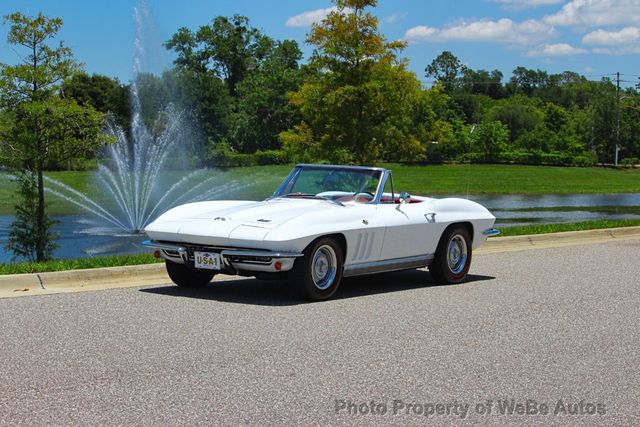
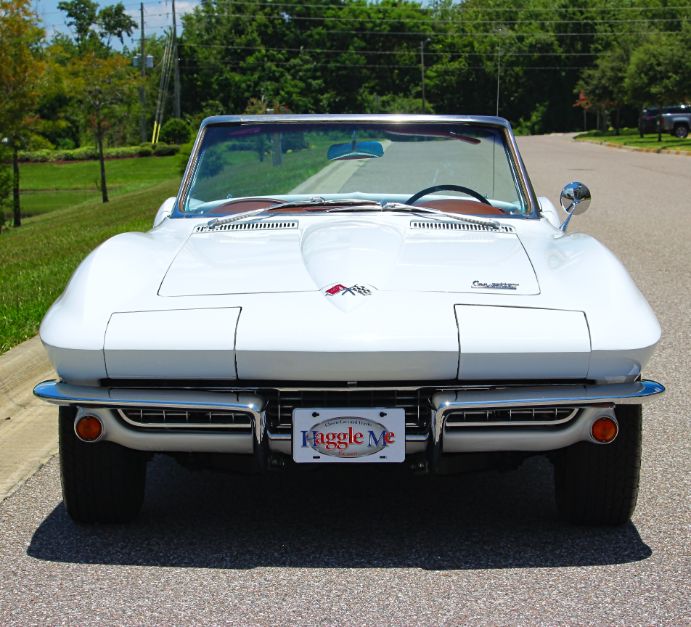
For 1963, Chevrolet introduced an entirely new Corvette, and many enthusiasts consider it the high point of the entire classic era. The C2 Sting Ray came from the design studio of Bill Mitchell, who had succeeded Harley Earl, and it looked like nothing else on American roads. The coupe carried a dramatic split rear window, a styling element that lasted only for the 1963 model year before being replaced by a single piece of glass for better visibility. That one-year split-window coupe is now among the most sought-after of all Corvettes. The complete account lives in our C2 Sting Ray story.
Under the skin, the Sting Ray finally gave the Corvette an independent rear suspension, a major engineering step that improved both ride and handling over the old solid axle. Hidden headlights gave the front end a clean, purposeful look. In 1965 the car gained two more significant upgrades, four-wheel disc brakes and the first big-block engine, the 396 cubic inch L78. The following year brought the 427, and the Corvette's reputation for raw straight-line speed was set.
The split rear window lasted exactly one model year before Zora Arkus-Duntov intervened. His objection was straightforward and practical: the vertical spine obstructed the driver's rearward sightline, which he considered a safety and competition liability. For 1964 the spine was deleted and a single curved piece of glass replaced it. Bill Mitchell reportedly disagreed with the change, regarding the spine as integral to the design. The outcome is one of the more commercially ironic decisions in Corvette history. The 1963 split-window coupe, deleted for visibility, is now far more sought-after among collectors than the cleaner-glassed 1964 car that replaced it.
The peak of the C2 arrived in 1967. The L71 version of the 427 used three two-barrel carburetors to make 435 horsepower. Above even that sat the L88 option, a race-oriented package built around an aluminum-head 427 that was officially rated at 430 horsepower but produced something closer to 550 in reality. The conservative factory rating was deliberate, intended to discourage casual buyers and to keep the car focused on competition. The L88 also deleted the heater and radio as standard equipment, and its 12.5:1 compression ratio required racing fuel. These were not subtle deterrents. Collectors treat the 1967 model year as the C2's high point because it concentrated every performance lesson of the previous four years into a single package: the mature independent rear suspension, the four-wheel disc brakes introduced in 1965, the full big-block lineup, and two of the most potent factory options ever offered on an American road car. Those years also cemented the model's place on the track, a subject covered fully in our look at the Corvette racing career.
The C3 and the long haul, fifteen years of the Shark
The third-generation Corvette arrived for 1968 wearing a body inspired by the Mako Shark II concept, with a long hood, a tapered tail, and dramatic fender bulges. It would remain in production through 1982, making it the longest-running Corvette generation at fifteen model years. Across that span the car changed enormously, reflecting the shifting fortunes of the American performance era. The full arc of those years is laid out in our coverage of the C3 Corvette era.
The early C3 years carried the big-block momentum forward. Before emissions standards and fuel-economy pressure arrived in force, the C3 offered some of the most potent small-blocks and big-blocks in Corvette history. The LT-1 small-block, available from 1970 through 1972, was a high-revving 350 cubic inch engine tuned for those buyers who preferred precise throttle response over raw displacement. Rated at 370 horsepower in 1970, it was a genuine driver's engine and a deliberate counter-program to the torque-heavy big-blocks. Alongside it sat the LS-6 454, the high-compression big-block that represented the C3's brute-force peak. The 1971 LS-6 was rated at 425 horsepower on the old gross scale, and it was the last of the line in any meaningful sense. Compression ratios came down for 1972 to accommodate regular-grade unleaded fuel, and from that point the published numbers tracked steadily downward.
The 1972 model year marked the industry-wide adoption of SAE net horsepower ratings, which measured output with all accessories fitted and the exhaust system in place, as a customer would actually drive the car. The same engine that had been published at 350 gross horsepower might appear at 255 net, not because it had changed, but because the measurement was finally honest. That context matters when reading C3 spec sheets. The 1971 LS-6 454 represented the last gasp of the high-horsepower muscle period on paper, but the real fall in output came from lower compression and leaner carburetion through the middle years of the decade, not simply from the accounting change.
The C3 adapted rather than disappeared. Through the middle and late 1970s, when horsepower numbers were at their lowest and the broader American performance-car market had largely collapsed, Chevrolet leaned on the Corvette's accumulated identity rather than its engine specifications. The styling remained distinctive and recognizable in a showroom full of increasingly anonymous sedans. The name carried weight that no single model year's output figure could undermine. Buyers who wanted a statement car with American credentials and a genuine sports-car heritage had nowhere else to go in the domestic market. That captive position bought the model time, and Chevrolet used it to keep the car present and visible while waiting for conditions to improve.
The convertible body style ended after 1975 and would not return until 1986, leaving the coupe to carry the model through the late seventies. For 1978 the car received a large fastback rear window that updated its profile, and that year Chevrolet marked the model's 25th anniversary with both a Silver Anniversary paint scheme and an Indianapolis 500 Pace Car edition. The generation closed in 1982 with the Cross-Fire fuel injection system and a Collector Edition finished in silver-beige with a gray interior. Several of these limited runs are documented in our guide to Corvette special editions.
"People dismiss the late C3 cars because the horsepower numbers look sad on paper. But you have to read those figures in context. The 1972 switch to net ratings makes a straight comparison meaningless, and the cars themselves were better built than the spec sheets suggest."
— Tom Ramirez
What makes a Corvette a Corvette
Three threads run through every classic Corvette, from the hand-built 1953 roadster to the last Collector Edition C3. The first is the fiberglass body. What began as a cost-saving measure became a defining trait, giving the car a light, rust-resistant shell and a distinctive feel that steel-bodied rivals never matched. No other major American production car committed to the material so completely or for so long.
The second thread is performance, hard-won and sometimes nearly lost. The Corvette spent its first two years underpowered and very nearly cancelled, then found its identity through the small-block V8, fuel injection, big-block torque, and a willingness to build genuine race-bred variants like the L88. Even through the lean years of the middle 1970s, the car kept its focus on driving rather than retreating into pure luxury.
The third thread is survival. The Corvette is the rare American car that has been built continuously since its introduction, outlasting countless rivals and several near-death experiences inside its own company. That continuity is a large part of why the classic cars remain so collectible. The earliest, rarest, and most documented examples now command serious money, and the spread between an ordinary driver and a fully documented car is wide. Collectors chasing the very best examples will recognize many of the cars in our feature on the rarest and most collectible Corvettes. Whatever generation draws you in, the classic Corvette remains the clearest expression of what an American sports car was meant to be.
Sources and notes
- National Corvette Museum — generation history, early production figures, and engine milestones.
- Hemmings Motor News — model-year detail, options, and collector market context.
- Motor Trend — period road tests and the 1972 shift to SAE net horsepower ratings.
- Road & Track — C2 and C3 engineering coverage, including independent rear suspension and big-block options.