Born from a Shark: The Design That Defined a Generation
In 1965, General Motors design chief Bill Mitchell unveiled the Mako Shark II — a rolling piece of sculpture so extreme that it made the original Mako Shark look conservative. Officially designated the XP-830, it wore a paint scheme that graduated from near-black on the hood to brilliant white on the lower body, mimicking the coloration of the actual mako shark Mitchell kept mounted on his office wall. It was outrageous, aggressive, and unmistakably American. It also gave the world its first preview of what the third-generation Corvette would become.
The production C3 that arrived for 1968 could not replicate every curve of the show car — manufacturing reality demanded compromises — but it retained the essence: the long, sculpted hood, the dramatically pinched waist, the fender flares that swelled over the wheels like tensed muscles, and the fastback roofline that swept down to a Kamm-tail truncation. Where the C2 Sting Ray had been elegant and European in proportion, the C3 was emphatically American — wide, low, and built to provoke a reaction.
The C3 shared no body panels with its predecessor, yet it rode a modified version of the same ladder-type frame that had underpinned the C2. The wheelbase held at 98 inches. The suspension geometry — independent at all four corners, with the distinctive rear transverse leaf spring — carried over in refined form. Beneath the skin, continuity; in the skin itself, revolution. That tension between mechanical conservatism and visual drama would define the C3 for all fifteen years of its life.
For a deeper look at where the Corvette came from before the C3, the C2 Corvette Sting Ray history traces the mid-decade years that set the stage — including the split-window fastback, the fuel-injected small-blocks, and the arrival of big-block power that the C3 would inherit and amplify.
A Rocky Arrival: The 1968 Launch Year
The 1968 Corvette arrived amid enormous anticipation and left early reviewers in a complicated position. The car looked sensational. The driving experience, when the mechanical pieces cooperated, delivered on the visual promise. But Chevrolet's manufacturing execution in that first year was, by the standards expected of a flagship sports car, genuinely poor.
Panel gaps were inconsistent. Interior fits were loose. Rattles appeared in new cars. The windshield wiper system — a vacuum-operated hidden design intended to keep the clean hood line uninterrupted — failed to meet newly enacted federal safety standards and had to be recalled and revised. Car and Driver and Road & Track, two publications that had championed the Corvette through the C2 years, published notably critical assessments of the new car's assembly quality.
The powertrain situation was less complicated. The base engine was a 327 cubic-inch small-block making 300 horsepower. Buyers who wanted more could specify a 327 rated at 350 hp, or step up to the 427 cubic-inch big-block in 390, 400, or 435 horsepower states of tune. The L88 — a racing-oriented 427 nominally rated at 430 hp but producing considerably more — was theoretically available but so tightly allocated as to be practically unobtainable for ordinary customers.
The full story of the 1968 C3 launch and its quality-control struggles reveals how close the car came to damaging the Corvette's hard-won reputation — and how quickly Chevrolet course-corrected for the following model year.
"The 1968 Corvette was the most beautiful production sports car America had ever built. It was also one of the sloppiest. Chevrolet had designed something extraordinary and then rushed it out the door before the factory was ready. It took a year to sort out, but when they did, the result was magnificent."
— Tom Ramirez
The Performance Peak: 1969–1972
Chevrolet addressed the 1968 launch problems methodically, and by 1969 the C3 had found its stride. The Stingray name — spelled as one word now, without the space that had separated it on the C2 — returned to the front fenders. The interior was revised for improved ergonomics. Build quality tightened measurably. The car that had looked so promising began to deliver on that promise.
The 1969 model year also introduced the T-top removable roof panel option that would become one of the C3's signature features. With no true convertible tradition yet threatened, the T-tops offered open-air motoring without the structural compromises of a full ragtop — at least in theory. In practice, early T-tops were prone to leaks and wind noise, problems that Chevrolet would spend years refining.
Engine options expanded and intensified through this period. The small-block grew from 327 to 350 cubic inches for 1969, providing a broader torque curve and better real-world flexibility. But the headline story was the high-output machinery available at the top of the order sheet. The LT-1 small-block, introduced for 1970, produced 370 horsepower from its 350 cubic inches through solid lifters, an aggressive camshaft, and high-compression heads — making it the most potent small-block Corvette engine ever offered to that point.
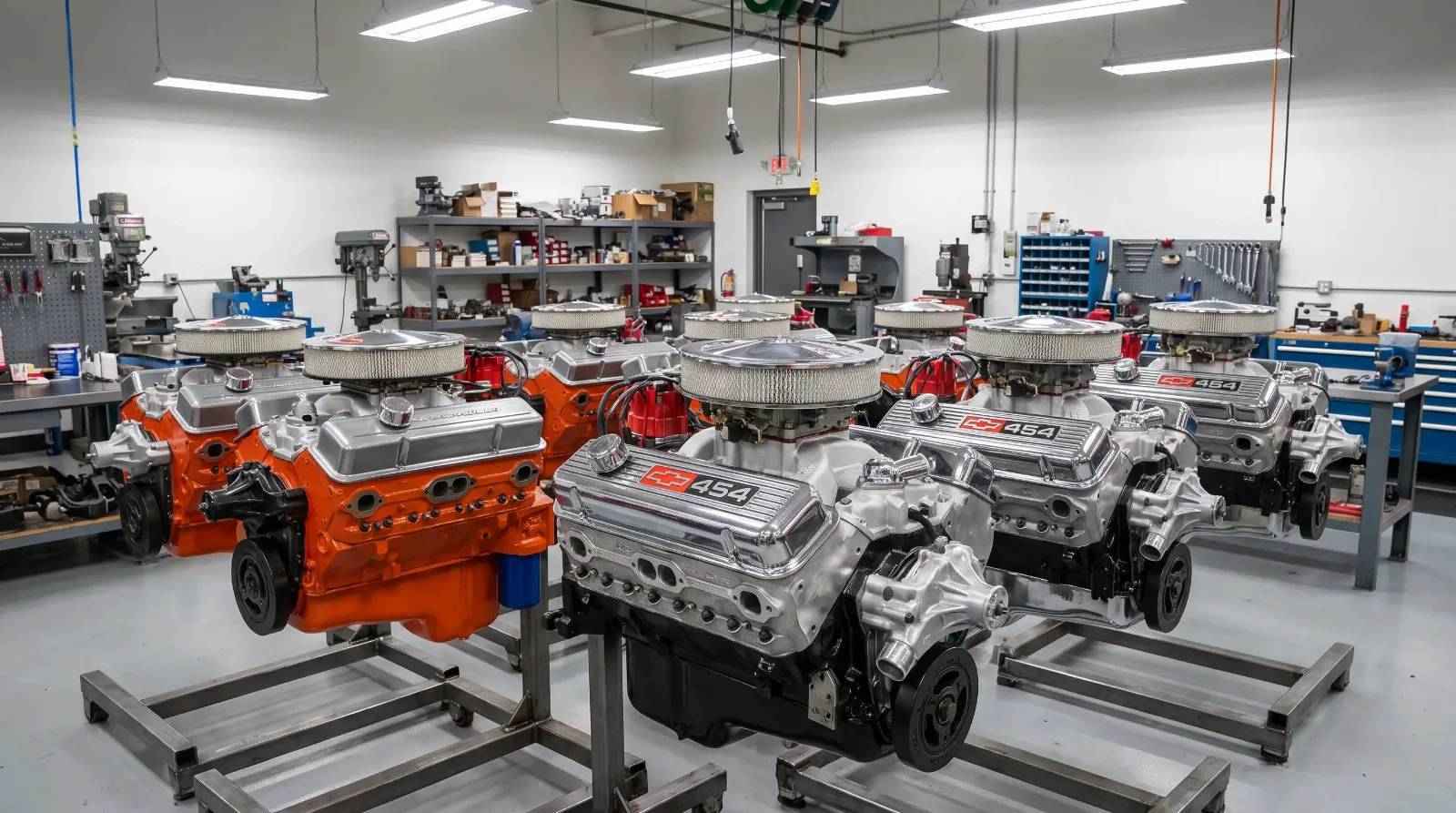
The big-blocks told an even more dramatic story. The LS5 454 arrived for 1970 rated at 390 horsepower, providing mountain-moving torque for buyers who wanted straight-line authority above all else. Then, for 1971, came the LS6 454 — 425 gross horsepower, 11.25:1 compression, and a set of cylinder heads that engineers privately admitted were among the best Chevrolet had ever cast. The LS6 remains, by the traditional gross-horsepower measure, the most powerful engine ever offered in a production Corvette of the classic era.
| Period | Years | Key Engines | Notable Feature | Annual Production Range |
|---|---|---|---|---|
| Launch Year | 1968 | 327 (300/350 hp), 427 (390/400/435 hp) | All-new Mako Shark body; hidden wipers recall | ~28,566 |
| Performance Peak | 1969–1972 | LT-1 350 (370 hp), LS5 454 (390 hp), LS6 454 (425 hp) | Stingray name returns; T-top option; 1971 LS6 peak power | ~21,800–38,762 |
| Malaise Era | 1973–1977 | 350 (165–270 hp), 454 (275 hp through 1974) | Urethane front bumper (1973); rear bumper (1974); convertible dropped (1975); catalytic converter (1975) | ~26,000–49,213 |
| Silver Anniversary | 1978–1979 | 350 (185–220 hp), L82 350 (220 hp) | Fastback rear window restyle; Silver Anniversary edition; pace car replica; production peak 53,807 | ~46,776–53,807 |
| Final Years | 1980–1982 | 350 (190 hp), Cross-Fire Injection 350 (200 hp in 1982) | Weight reduction; first fuel injection since 1965; 1982 Collector Edition; no 1983 model | ~40,614–45,631 |
The 1970–1972 period stands as the C3's performance high-water mark. These were cars that could run 0–60 in the mid-four-second range with the right engine, quarter-miles in the low thirteens, and top speeds comfortably above 150 mph. They did it without traction control, without sophisticated aerodynamics, and without the benefit of modern tire compounds. Raw, physical, and demanding of their drivers, the early high-performance C3s represent some of the most visceral sports cars ever to carry an American badge.
The full accounting of C3 power across the generations places the LT-1 and LS6 in context against what came before and what followed — a story of peaks and valleys that tracks American automotive ambition through one of its most turbulent decades.
The Malaise Years: 1973–1977
The forces that remade American performance cars in the early 1970s were external to GM, external to Chevrolet, and largely beyond any automaker's control. Federal emissions regulations tightened beginning with the 1971 model year, requiring a reduction in compression ratios across the industry. Chevrolet recommended regular-grade fuel for the 1971 Corvette — a sentence that would have been unthinkable applied to the LS6 under any previous understanding of high performance. The change was necessary, and it cost horsepower.
Then came the shift from gross to net horsepower ratings for 1972, which produced numbers that looked catastrophic even when the actual power loss was more moderate. A 350 that had been advertised at 330 gross horsepower suddenly appeared in the brochure at 255 net. The cars had not changed as dramatically as the numbers suggested, but the optics were damaging and the direction was clear.
The 1973 model year brought a visible change: a new front bumper made of body-colored urethane, designed to absorb 5-mph impacts and spring back without damage — a requirement of new federal standards. The chromed front bumpers that had bracketed the C3's nose since 1968 were gone. The 1974 model matched the treatment at the rear, replacing the chrome bumperettes with a full-width urethane cap. The result was a cleaner, if less characterful, nose-to-tail silhouette.
The story of the 1973 bumper transition is, in microcosm, the story of the entire malaise period: federal mandates forcing design decisions that were, in some respects, genuinely thoughtful engineering solutions to real problems, even as enthusiasts mourned the chrome they replaced.
The 1975 model year marked two significant milestones: the arrival of the catalytic converter, which required unleaded fuel and further constrained engine tuning, and the end of the open-top Corvette. The convertible had been a Corvette staple since 1953; it would not return until 1986. In its place, buyers had only the T-top coupe — a compromise that satisfied most buyers but left a generation of enthusiasts without the wind-in-hair experience the car's styling seemed to promise.
By 1975, the base 350 produced 165 horsepower. The optional L82 350 made 205. These are numbers that seem almost comically modest against the 425-hp LS6 of just four years earlier, and yet the malaise-era C3s continued to sell in increasing numbers. The market had adapted. So had the car. It was still the Corvette, still the benchmark of American sports car aspiration, even if the benchmark itself had migrated to a more comfortable altitude.
The 1978 Restyle and the Silver Anniversary
The 1978 model year brought the C3's most significant visual update since the original 1968 launch. The fastback roofline — which had defined the car's silhouette for a decade — gave way to a large, sloping rear window that created a proper hatchback opening and dramatically increased cargo access. The change was functionally useful and visually striking, opening up the rear of the car and giving it a cleaner, more contemporary profile that would carry it through to the end of production.
The timing was deliberate. 1978 marked the Corvette's twenty-fifth anniversary, and Chevrolet intended to celebrate. The Silver Anniversary edition arrived as a two-tone paint option — silver over gray — with special badging and a commemorative interior. More dramatically, Chevrolet produced an Indianapolis 500 pace car replica: a black-over-silver two-tone with red striping, a special interior package, and pace car decals that dealers could optionally apply. The pace car replica was nominally limited but produced in numbers — approximately 6,500 — that diluted its exclusivity. Nevertheless, it became one of the most recognizable special editions in Corvette history and demonstrated that the C3, approaching its second decade, could still generate genuine enthusiasm.
The 1979 model year delivered the C3's greatest commercial success. Production reached 53,807 units — the highest single-year output in Corvette history at that point, a record that reflected both the model's mature appeal and the broader American market's appetite for the car even in its power-reduced form. The L82 engine option continued to provide a meaningful performance step above the base engine, and the Corvette's chassis and handling remained genuinely capable by contemporary standards.
The Final Years: Cross-Fire Injection and the 1982 Farewell
The C3's closing chapter, from 1980 through 1982, was defined by a combination of rationalization and swan song. Chevrolet engineers worked to reduce weight — aluminum intake manifolds replaced iron units, some accessories were deleted, and the base curb weight fell meaningfully — to compensate for the power losses that emissions compliance had imposed. The result was a car that, while still not the fire-breather of 1971, offered reasonable real-world performance in a more refined package.
California buyers received a fuel-injected 350 for 1980, presaging what was coming for the whole line. The 1982 model year brought Cross-Fire Injection to all markets: a throttle-body fuel injection system that replaced the carburetor with twin injectors mounted in a cross-ram intake manifold. The system was sophisticated by the standards of its era and significant in Corvette history — it was the first fuel-injected Corvette since the mechanical Ramjet fuel injection had been discontinued after 1965. The Cross-Fire Injection unit produced 200 horsepower, modest by historical standards but a marked improvement in driveability, particularly in cold-weather starting and emissions behavior.
The 1982 Collector Edition gave the C3 a fitting farewell. Finished in a distinctive silver-beige gradient finish with bronze-tinted glass, distinctive aluminum wheels, and a cloisonné emblem, it was the first Corvette offered with a glass lift-up hatch in the rear. Priced above $22,000 — a substantial sum in 1982 — it sold out its allocation and reminded buyers that the Corvette, even at the end of a fifteen-year run, retained the power to inspire desire.
There was no 1983 Corvette. The C4 that succeeded the C3 was developed with enough problems during the transition that Chevrolet chose to skip the model year entirely rather than release a compromised product, moving directly from the 1982 C3 to the 1984 C4. The Mako Shark II's influence on the C3 design — and the long arc of the design language it established — is explored in detail in the companion piece on the show car that started it all.
Legacy: The Longest Generation and the Cars That Survived
The C3 Corvette ran for fifteen model years — 1968 through 1982 — making it the longest-running Corvette generation in the nameplate's history. It outlasted the muscle car era that birthed it, survived an oil embargo, navigated emissions regulations that hobbled the entire industry, and endured the most prolonged period of performance stagnation in American automotive history. No other American sports car of its era came close to matching that durability.
The reasons were partly commercial — the Corvette's buyer base proved loyal to a degree that justified continued production even through the difficult years — and partly institutional. Chevrolet understood that abandoning or fundamentally reinventing the Corvette risked something valuable: the emotional equity built through two decades of racing victories, magazine covers, and the dreams of buyers who had grown up wanting one. Better to keep the flame burning at lower intensity than to let it go out.
The collector market has rendered its verdict on the C3 era with considerable nuance. The 1969–1972 high-performance cars — particularly the LT-1-equipped coupes and the rare LS6 cars — command significant premiums and occupy a secure position in the hierarchy of desirable American performance cars. Documented matching-numbers examples of these early cars have appreciated steadily, and the supply of unrestored originals continues to contract.
The malaise-era C3s — 1973 through 1977 — have spent decades as the forgotten middle child of the generation, undervalued relative to both the early performance cars above them and the Silver Anniversary models that followed. That calculus is changing. Collectors who missed the early cars at accessible prices have begun to recognize the 1973–1977 cars as the last C3s that could still be found in original, honest condition at prices that make restoration economically sensible. Appreciation has accelerated. The window for affordable entry is narrowing.
The 1978–1982 cars occupy a different niche: attractive to buyers who want the updated styling and the Collector Edition badge, but generally less sought-after by serious collectors than the bookends of the generation. The exception is the documented pace car replica and Collector Edition, both of which have established their own collector constituencies.
What the C3 ultimately represents is something more than the sum of its horsepower ratings or its production numbers. It is the Corvette that survived the most hostile environment in American performance car history without losing its identity. The full Corvette lineage across all generations shows how rare that kind of institutional continuity is — and how much the C3's persistence cost, and preserved. The complete story of the Corvette as America's sports car places the C3's fifteen-year odyssey in the full sweep of that history, from the first 1953 roadster to the present day.
The Mako Shark silhouette is now more than fifty years old. It still turns heads. That may be the most honest summary of the C3's achievement available.
Sources and notes
- National Corvette Museum — Corvette History and Archives
- MotorTrend — Classic Corvette Road Tests and Era Coverage
- Hemmings Motor News — C3 Corvette Technical and Historical Reference
- Supercars.net — 1971 LS6 454 Corvette Specifications and Documentation
- Road & Track — Corvette Historical Coverage and Original Road Tests
- Automobile Magazine — C3 Corvette Generational Overview and Buyer Analysis