The Shark That Never Stopped Swimming
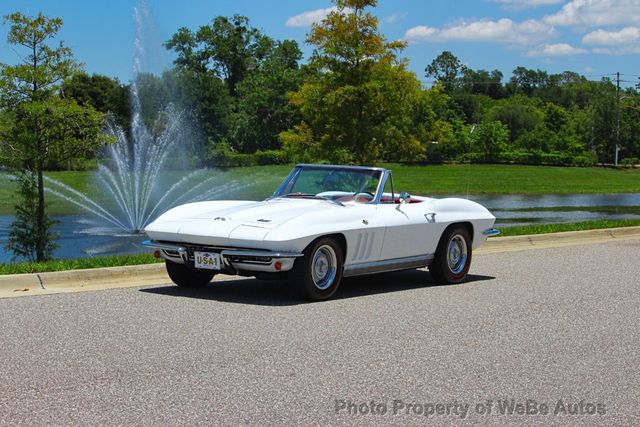
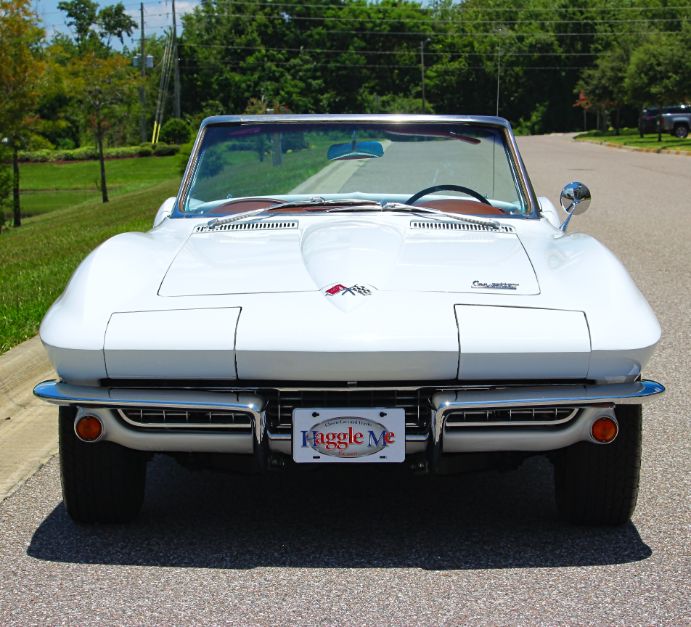
In the spring of 1961, Bill Mitchell returned from a deep-sea fishing expedition off the coast of Baja California with a mako shark strapped to the back of his boat — and an idea that would shape the most recognizable American sports car of the next decade. The shark was real, its skin a gradient of dark blue-gray fading to white along the belly. Mitchell had it mounted and hung in his garage, then told his designers to build a car that looked exactly like it. The result was the Mako Shark I, formally designated XP-755, a sinuous concept that drew so heavily from the lines of the C2 Corvette — then still in development — that the two cars seemed to evolve together, feeding each other's visual logic.
But Mitchell was not finished with sharks. He had established a predator grammar, a design language built around the idea that a car could carry the biological authority of an apex hunter. By 1965, he was ready to push that language to its absolute extreme. The car he unveiled that year, the Mako Shark II, would become one of the most consequential concept cars in American automotive history — not because it was radical, but because it was right.
XP-830: A Concept Built to Become a Car
Most GM show cars of the 1960s were fantasies — wedges of fiberglass and chrome sent on tour to draw crowds and float design ideas that would never see a production line. The Mako Shark II was different. Mitchell and chief designer Larry Shinoda conceived it from the beginning as a preview of where the Chevrolet Corvette was going. The XP-755 had fed the C2; the XP-830 would feed the C3. This was not an accident. It was a strategy.
The car debuted at the 1965 New York Auto Show and immediately dominated the conversation. At roughly the same moment, Zora Arkus-Duntov's engineering team was beginning serious work on what would become the 1968 Corvette. The timing was deliberate. Mitchell wanted the show car to set public expectations before the production team finalized its sheetmetal.
What the audience saw in 1965 was a car that appeared to have been carved from a single piece of tension. The nose came to a sharp point, far more aggressive than anything then in production. The hood swept down and then up in a pronounced clamshell shape that mirrored the top half of a shark's body as it cuts through water. The flanks were deeply sculpted with a crease that ran the full length of the car, starting high at the front fender and sweeping down toward the rocker panel before rising again at the rear haunch. That crease, which Shinoda called the "gill line," was a direct translation of the lateral stripe that runs along a mako shark from pectoral fin to tail.
The fastback roofline dropped steeply from the B-pillar to a Kamm-style tail, giving the car a silhouette that read as motion even at rest. The greenhouse was minimal — slender pillars, a low roofline, a windshield that raked aggressively forward. Every surface was either convex or concave; nothing was flat. The car looked like it had been inflated from within and then pinched at strategic intervals to create drama.
"I want a car that looks like it's going a hundred miles an hour standing still. I want it to look alive."
— Bill Mitchell, GM Vice President of Design, on the philosophy behind the Mako Shark series
Among the show car's most celebrated details were its retractable headlights and wipers, both concealed beneath flush body panels. The wiper system in particular was a signature — hiding the blades behind a clamshell flap that opened only when they were in use, keeping the hood's surface perfectly clean otherwise. This was not merely decorative. It was a philosophical commitment to uninterrupted surface, the idea that nothing on the body should exist unless it contributed to the form.
From Concept to C3: What Survived the Translation
When the 1968 Corvette arrived, automotive journalists and enthusiasts recognized immediately what they were looking at. The C3's launch was not without controversy — there were legitimate complaints about build quality and interior ergonomics, and Duntov himself reportedly had reservations about some of the production compromises — but no one questioned where the design had come from. The Mako Shark II's DNA was unmistakable.
The gill line crease survived intact, running the same trajectory from front fender to rear quarter. The fastback roofline remained, though the production car's version was slightly less steep and incorporated a more practical greenhouse. The pointed nose carried over in spirit, though production tolerances and the requirement to house a conventional bumper system forced it to be somewhat blunter in execution. The hidden wiper system made it to production — one of the relatively few direct functional transfers from the show car — and remained a Corvette feature through several model years.
The wheel arch treatment, with its pronounced flare, translated almost directly. The overall proportion — long hood, short deck, cab-rearward stance — was preserved. Even the color gradient that Mitchell had borrowed from his mounted shark found its way into the show car's paint scheme, a custom two-tone that the production team could not quite replicate but that influenced the Corvette's palette choices for years.
| Design Element | Mako Shark II (XP-830) | 1968 Corvette C3 |
|---|---|---|
| Nose profile | Extremely pointed, near-conical | Pointed but production-softened |
| Fastback roofline | Very steep, dramatic drop | Retained, slightly more upright |
| Gill line crease | Deep, full-length sculpture | Present, slightly shallower |
| Hidden wiper system | Clamshell concealment | Carried to production |
| Wheel arch flares | Pronounced, sculptural | Retained in production form |
| Surface complexity | Extreme, all compound curves | Simplified for tooling |
| Body color gradient | Custom two-tone fade | Single solid colors only |
What did not survive was the extremity of proportion. The show car's hood was dramatically longer relative to the passenger cell than the production car's. The greenhouse was smaller, the tail more dramatically undercut. The surface tension of the concept — the way every panel seemed to be pulled tight over an invisible armature — was necessarily relaxed when the design had to accommodate real-world requirements: crash structures, interior headroom, manufacturing stampings that could not achieve the compound radii of a hand-formed fiberglass body. What reached the showrooms in 1968 was a toned-down version, but it was toned down from something so extreme that the remainder was still the most dramatic production car body in America at the time.
The Lineage: Mako Shark I to Mako Shark II
To understand what the XP-830 meant, it helps to trace how Mitchell had arrived there. The Mako Shark I had been a translation of the biological shark form into the C2 Corvette idiom — the split window, the peaked fenders, the tapered tail. That car established the predator vocabulary but did so in a way that remained tethered to the existing Corvette architecture. The Stingray was already on the road when the XP-755 appeared on the show circuit in 1961, and the relationship between them was one of mutual reinforcement: the concept explained the production car's intent more than it predicted the next generation.
The Mako Shark II represented a different ambition. Here Mitchell was not explaining what existed but projecting what would. He was, in effect, filing a design patent on the next Corvette before the engineering team had finished its work. The XP-830 was a commitment, a public declaration of where the car was going that made it very difficult for the production team to go somewhere else.
The biological logic that connected both cars was not merely aesthetic. Mitchell was making an argument about what a sports car was supposed to be. A shark is not decorative. It is a machine evolved over hundreds of millions of years for a single purpose — to move through its medium with maximum efficiency and minimum friction. Its form is its function. Mitchell believed that the same principle should govern automotive design: that a car's shape should express its purpose, not decorate it. The shark was the perfect template because its beauty was entirely instrumental.
This was, in retrospect, a significant philosophical position at a moment when American car design was awash in chrome appliqué, tailfins borrowed from aerospace iconography, and ornamentation that had no relationship to the mechanics underneath. Mitchell's shark cars proposed something different — that nature, not science fiction, was the right source for automotive form. That a predator from the ocean floor was more honest than a rocket ship from a movie serial.
The Final Expression of a Design Language
The Corvette's story through the 1960s is, in large part, the story of two men in productive tension: Duntov, who cared above all about what the car could do, and Mitchell, who cared above all about what the car looked like. The Mako Shark II was Mitchell's clearest statement of priority. It was a car designed without mechanical constraints — fiberglass over a tube frame, no drivetrain to package, no crash standards to meet — and the result was what happened when a supremely talented designer was freed from every practical limitation.
What is remarkable is how much of it survived. The engineers had to work around it, package a real V8 and a real transmission and real suspension geometry beneath those sculpted flanks, and they managed to preserve the essential character of what Mitchell had drawn. The 1968 Corvette is, in this sense, an engineering achievement as much as a design achievement — the triumph of fitting reality inside an ideal.
The Mako Shark II toured GM's Motorama circuit for several years, continuing to draw crowds even after the production C3 it had inspired was already on the road. In 1969 GM renamed it the Manta Ray and updated some details, partly to distinguish it visually from the car it had so obviously inspired. By then the shark design language had done its work. It had migrated from the concept stage into production reality, from Mitchell's garage wall into every Corvette showroom in America. The third-generation Corvette would remain in production until 1982, fourteen years of essentially the same visual idea — a shark swimming through traffic, a predator form translated into fiberglass and chrome, the most dramatic sustained argument in American automotive design that nature knew something the engineers did not.
Mitchell retired from GM in 1977. He never quite found another metaphor as potent as the one he had pulled from the waters off Baja California in 1961. He did not need to. The shark was enough.