
The Corvette Before the Big-Block: A Small-Block at Its Limit
By 1964, the Chevrolet Corvette had earned a genuine reputation as America's sports car — nimble, handsome, and capable of embarrassing far more expensive European machinery on a winding road. The 327 cubic inch small-block V8, in its highest 375-hp fuel-injected form, was a sophisticated and willing engine. But it was running out of room to grow.
The 327's architecture — a bore of 4.00 inches and a stroke of 3.25 inches — was approaching the practical limits of what Chevrolet's engineers could wring from it without fundamental redesign. Fuel injection kept the power curve high and sharp, but peak output was plateauing. Meanwhile, the American muscle car landscape was shifting beneath Chevrolet's feet.
Ford had dropped its 427 FE big-block into the Galaxie for NASCAR homologation purposes and was bringing serious cubic inches to the street. Pontiac's GTO, launched in 1964, was stuffing a 389-cubic-inch V8 into a mid-size body and selling the result as a performance bargain. Chrysler's 426 Hemi had just dominated Daytona. The message from the market was direct: displacement sells, and American buyers were responding to raw horsepower numbers above almost everything else.
The Corvette, as the flagship of Chevrolet's performance image, could not be seen falling behind. If buyers wanted big-block power, Chevrolet would give them big-block power — and the architecture to do it right already existed.
The Mark IV 396: Engineering a New Kind of Corvette Power
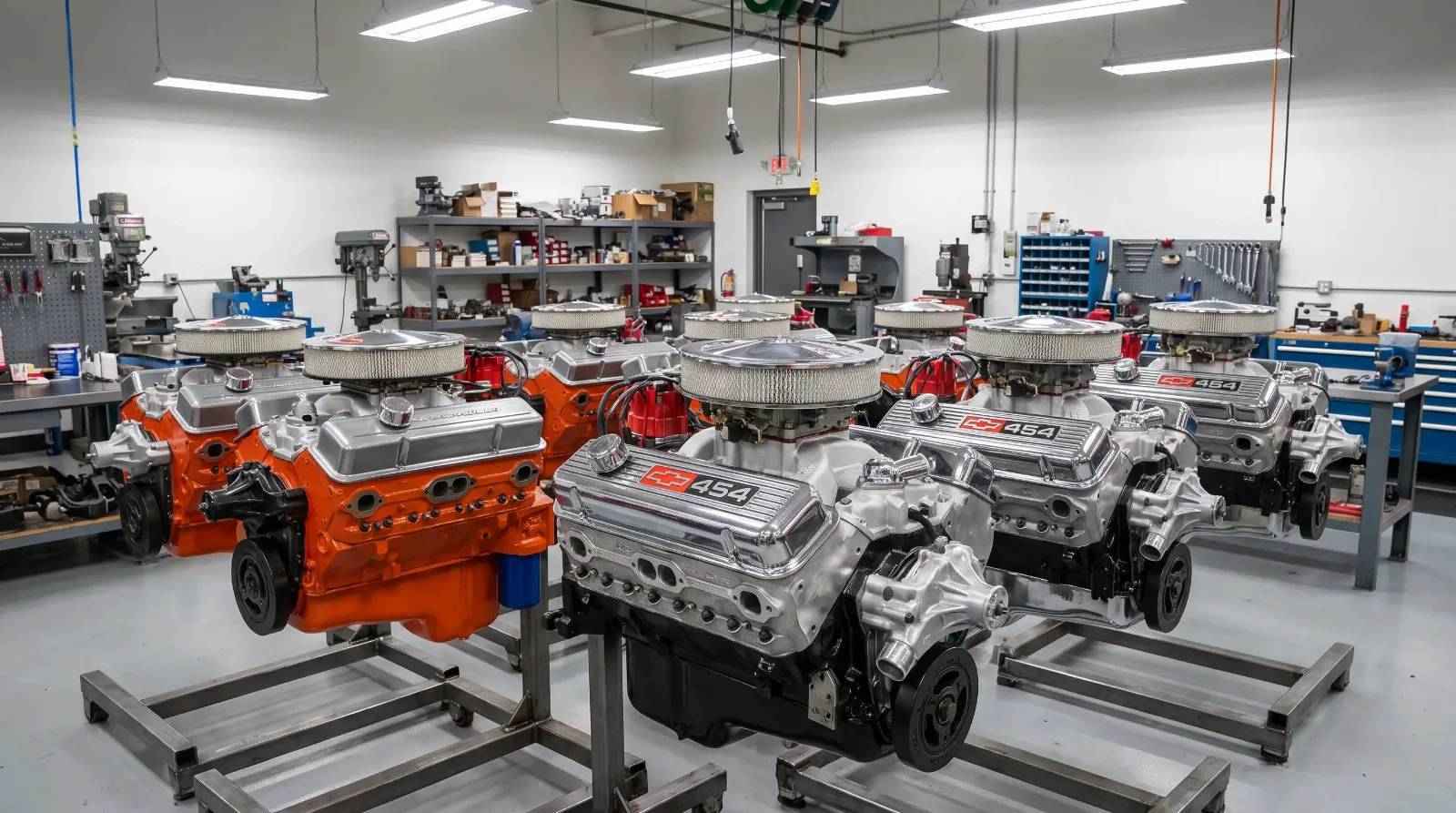
The engine Chevrolet chose for the 1965 Corvette was not a bored-out version of anything that came before. The C2 Sting Ray received the Mark IV — an entirely new big-block architecture that Chevrolet had developed simultaneously for passenger cars, trucks, and racing applications. In the Corvette, it displaced 396 cubic inches, achieved through a 4.094-inch bore and a 3.760-inch stroke.
Those numbers tell a story in themselves. Compared to the 327 small-block's 4.00-inch bore and 3.25-inch stroke, the 396 was wider in the cylinder and significantly longer in the piston's travel. More bore means larger valves can be fitted; more stroke means more swept volume per rotation. The combination produced torque in quantities the 327 could not approach — 425 lb-ft versus the 375-hp 327's 350 lb-ft.
The Mark IV's most distinctive engineering feature was its cylinder head design, which automotive press of the era quickly nicknamed the "porcupine head." The intake and exhaust valves were not arranged in a conventional parallel layout. Instead, they were canted at compound angles — tilted both toward the cylinder bore axis and angled laterally — so that the valve stems projected outward from the head in different directions, giving the assembled head the appearance of a porcupine with quills pointing every which way.
This unconventional geometry was not aesthetic whimsy. The canted valve arrangement allowed Chevrolet's engineers to use larger valves than a conventional head of the same combustion chamber volume could accommodate, while simultaneously optimizing the port shape for high-velocity flow. The intake charge entered the chamber at an angle that promoted the tumbling, swirling motion that improves mixture quality and combustion efficiency. The result was an engine that breathed exceptionally well for its displacement — and that rewarded increases in camshaft duration and lift more readily than conventional head designs of the period.
For the Corvette application, the 396 was rated at 425 horsepower at 6,400 rpm. This was an aggressive state of tune: solid-lifter camshaft, 11.0:1 compression ratio, a single Holley four-barrel carburetor on an aluminum intake manifold, and headers feeding into a dual exhaust system. Chevrolet did not offer a detuned big-block option for 1965 — if you ordered the 396, you got all 425 horsepower.
"The Mark IV was not an enlarged small-block — it was a different philosophy entirely. Where the small-block rewarded revs and precise throttle work, the big-block simply overwhelmed resistance. You didn't have to manage it. You just held on."
— Jim Vasquez
Production Realities: Hood Bulges, Weight Penalties, and Coupe-Only Availability
Installing a 396-cubic-inch engine in a body designed around a small-block was not without compromise. The Mark IV was a physically larger engine in every dimension — taller, wider, and longer than the 327 it supplemented in the option sheet. It did not fit beneath the standard Corvette hood.
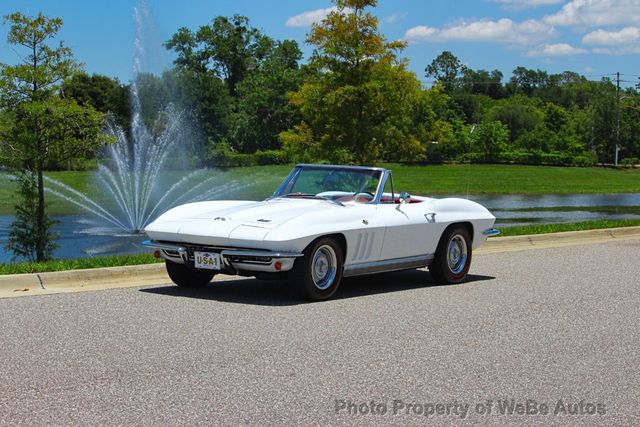
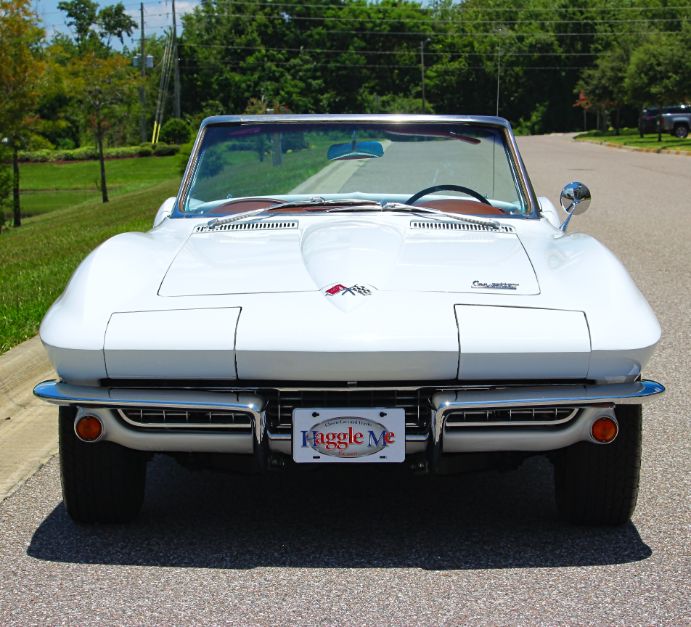
Chevrolet's solution was practical and visually distinctive: a power bulge pressed into the center of the hood, rising just enough to clear the taller intake manifold and carburetor. The bulge was functional — not the cosmetic hood pins and fake scoops that would proliferate later in the muscle car era — and it became an immediate visual identifier of a big-block car. Corvette enthusiasts learn to read hood lines the way others read badges, and the 396 hood announced its occupant clearly.
The weight gain was significant and honestly acknowledged. A 1965 Corvette with the base 250-hp 327 tipped the scales at approximately 3,100 pounds. The 396 coupe added roughly 150 to 170 pounds over that figure, most of it in the nose, which shifted the car's weight distribution in a direction that did not favor the delicate balance that made the C2's independent rear suspension so effective on a winding road.
There was also a restriction that limited 396 production: for 1965, the big-block was available only in the coupe body. The convertible — which accounted for a significant share of Corvette sales — was not offered with the 396 that year. The reasoning involved structural rigidity; the open body required additional bracing to manage the torque loads the big-block imposed through the driveline, and Chevrolet needed another model year to address the engineering. Convertible buyers who wanted maximum power were limited to the 375-hp fuelie 327.
Total 396 production for 1965 came to 2,157 units — a modest number relative to overall Corvette output for the year, but enough to establish the template. The demand signal was clear, and Chevrolet read it correctly.
Performance on the Road and Strip: What the Numbers Said
Period road tests were enthusiastic and, in some cases, struggled to find the right vocabulary for what the 396 Corvette represented. Car and Driver's 1965 test recorded a 0-to-60 mph time of 4.8 seconds and a quarter-mile of 12.8 seconds at 112 mph — figures that placed it among the fastest production cars available from any manufacturer at any price. Road & Track, whose test protocols tended toward slightly more conservative results, recorded 0-to-60 in 5.7 seconds with a quarter-mile in the low 13s.
The variation between outlets reflected the variables inherent in drag-strip testing of street cars: launch technique, track surface, ambient temperature, and the tester's willingness to abuse the driveline. What the tests agreed on was the character of the performance: massive, instant torque that overwhelmed traction at low speeds, a powerband that stayed flat across a wide rpm range, and a sound quality — deep, basso, authoritative — that nothing with a small-block could replicate.
The comparison with the 375-hp 327 fuelie is instructive. That engine was quicker to rev, smoother at part throttle, and arguably more satisfying on a road course where rpm management mattered. In a straight line, the 396 won decisively. The fuelie's advantage was finesse; the big-block's was force.
| Specification | 1965 Corvette 327 (L84 Fuelie, 375 hp) | 1965 Corvette 396 (L78, 425 hp) |
|---|---|---|
| Displacement | 327 cu in (5.4L) | 396 cu in (6.5L) |
| Bore × Stroke | 4.00 in × 3.25 in | 4.094 in × 3.760 in |
| Horsepower | 375 hp @ 6,200 rpm | 425 hp @ 6,400 rpm |
| Torque | 350 lb-ft @ 4,400 rpm | 425 lb-ft @ 4,000 rpm |
| Compression Ratio | 11.0:1 | 11.0:1 |
| Induction | Rochester fuel injection | Holley 4-barrel carburetor |
| Curb Weight (approx.) | ~3,100 lbs | ~3,260 lbs |
| 0–60 mph (period test) | ~5.6 seconds | ~4.8 seconds |
| Quarter Mile (period test) | ~13.4 sec @ 107 mph | ~12.8 sec @ 112 mph |
| Body Style Available | Coupe and Convertible | Coupe only (1965) |
The 396 as Prologue: Setting Up the 427 Era
The 396's single season in the Corvette was always going to be a transitional year. NASCAR's rules package for 1965 had specific displacement limits that influenced what Chevrolet could homologate through its passenger car line, and the 396 was sized partly in response to those constraints. When the sanctioning bodies revised their rules for 1966, Chevrolet was ready with what it had actually wanted to put in the Corvette all along: a 427 cubic inch version of the same Mark IV architecture.
The 427 achieved its additional displacement through a longer stroke — 3.76 inches becoming 4.00 inches — while retaining the 396's bore dimensions. This produced even more torque, available in tune levels ranging from a relatively tractable 390-hp version to the brutal 435-hp L72 with solid lifters, an aggressive cam, and an appetite for 103-octane fuel. The Corvette's story as America's performance flagship would be written in large part through the 427 era that followed.
But the 396 made all of that possible. It proved that the Mark IV could be packaged in the Corvette's engine bay, that the car's structure and driveline could handle the torque loads, and that buyers would pay the premium for big-block power in a Corvette body. The 2,157 units built demonstrated sufficient demand to justify the hood-bulge tooling, the reinforced transmission mounts, and the heavier-duty rear axle components that the big-block required.
In a longer view, the 396's arrival in 1965 represents the moment the Corvette's identity began to bifurcate. The car had always been capable of being multiple things to multiple buyers — grand tourer, weekend racer, boulevard cruiser. The big-block option formalized a split that would define the car through the rest of the C2 generation and into the C3: a small-block Corvette for the driver who valued balance and precision, and a big-block Corvette for the buyer who wanted the most unambiguous statement of American horsepower available on four wheels.
Both answers were legitimate. Both remain so. But the 1965 396 was the moment Chevrolet committed to offering both — and in doing so, transformed what the Sting Ray could be.