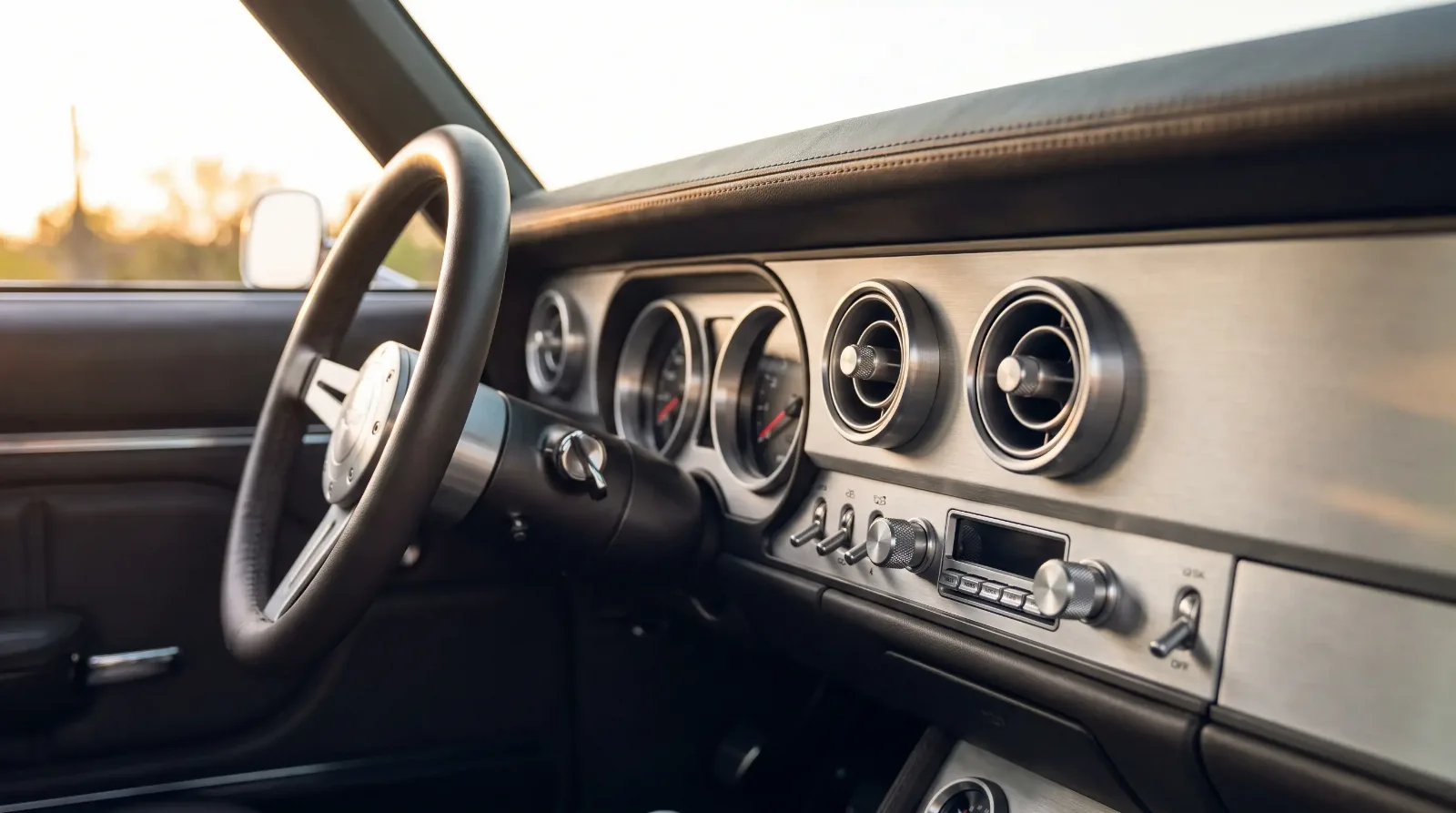
Why comfort upgrades belong in every serious restomod build
There is a class of restomod builder who insists on a gutted interior and no air conditioning because it saves weight. That is a legitimate choice for a track car. For a car you will actually drive on a summer Saturday, however, a 95-degree cabin with no ventilation and heavy manual steering turns the experience sour within 30 minutes. The Vintage Air climate control system and an aftermarket power steering setup together add less than 60 pounds to the car and transform the driving experience from endurance test to genuine pleasure.
These upgrades belong in the same build phase as brake and suspension work. Routing AC lines and power steering lines through a completed interior is miserable. Plan the routing before the dash goes in and you will save hours of rework. See our full overview of pro-touring Camaro builds for the recommended build sequence.
Vintage Air Gen IV SureFit: what is in the kit
The Vintage Air Gen IV SureFit for the 1967-1969 Camaro includes the evaporator case, a centrifugal blower, a condenser, a compressor, all the fittings, and a wiring harness. The evaporator mounts under the dash in the factory heater box location. The condenser mounts in front of the radiator and requires trimming the front valance on some configurations. The compressor mounts to the engine with a bracket kit specific to your engine family.
Pricing for the complete SureFit kit runs in the low thousands of dollars depending on options. Adding the optional heat exchanger for genuine cabin heating brings the total to roughly three thousand dollars. Installation typically runs the better part of a day or two for a competent home builder, or roughly a thousand dollars in shop labor at a shop familiar with the system. The result is a modern R-134A system with genuine heat and defrost capability.
- Vintage Air Gen IV SureFit base kit: in the low thousands of dollars
- With heat exchanger option: roughly three thousand dollars
- Sanden SD-7 compressor (included or optional): best reliability choice
- Parallel flow aluminum condenser: more efficient than tube-and-fin factory style
Power steering conversion options
Factory steering on the first-gen Camaro was either manual recirculating ball or optional power-assisted recirculating ball. Both have the same fundamental problem: slow steering ratio and feedback that disappears under cornering load. For a street restomod, the options are a rebuilt power steering box with a quick-ratio gearset, a rack-and-pinion conversion with hydraulic assist, or a rack-and-pinion conversion with electric power assist (EPS).
The simplest upgrade is a quick-ratio power steering box from Lee Manufacturing or Borgeson. Borgeson sells a direct-replacement 500-series power steering box that reduces turns lock-to-lock from 4.0 to 2.5 and fits the factory mount. Cost is a few hundred to roughly a thousand dollars. It retains the factory pump and hose routing, which keeps the installation simple.
"I ran a rebuilt factory box with a quick-ratio sector gear for two years before switching to a rack. The Borgeson box is genuinely good and costs half what the rack conversion does. If you are not doing autocross, the box is the smarter money."
-- Mike Sullivan
Rack-and-pinion conversion with hydraulic assist
Converting to a rack-and-pinion gives you more direct steering feel, better on-center response, and a simpler hose routing than the old steering box. Flaming River, Unisteer, and Global West all make rack kits for the first-gen Camaro. A hydraulic power rack kit runs one to two thousand dollars and requires a remote power steering pump. Most builders use an electric pump from a newer GM vehicle since it mounts anywhere and eliminates belt-driven parasitic loss.
The steering rack must be mounted at the correct height relative to the lower control arm pivot point to minimize bump steer. Most kit makers include a height adjustment shim kit. After installation, have a shop measure and correct bump steer before driving the car. Aftermarket bump steer kits for the first-gen Camaro run somewhere around a hundred dollars if correction is needed.
Underdash controls and routing
Vintage Air offers two control panel options: the analog rotary control or the digital EVO touch system at an additional couple hundred dollars. The rotary unit fits in a single-DIN opening and is the most period-correct looking choice. The EVO system adds automatic temperature control and a digital display. Both mount in a standard radio opening or a custom center console location.
AC line routing should follow the driver-side firewall and stay away from the exhaust headers. Use P-clamps every 12 inches and protect any line that passes within 3 inches of the exhaust. Vintage Air supplies foam insulation tape for evaporator lines in the engine bay. After installation, have the system evacuated and charged by a shop with R-134A certified equipment. Once these systems are installed, the next project is selecting wheels and tires that make a pro-touring Camaro complete.
| Upgrade | Entry Option | Mid-Level | Premium |
|---|---|---|---|
| Climate control | Universal Vintage Air kit | Gen IV SureFit | SureFit + EVO controls |
| Power steering | Borgeson box reman | Flaming River rack | EPS rack + electric pump |
| AC compressor | Sanden SD-7 | Sanden SD-7 with clutch | Sanden TRS series |
| Cooling fan | Stock belt-driven | SPAL 16-in electric | Dual SPAL pusher/puller |
Sources and notes
Production figures, engine specifications, codes, and dates in this article are cross-referenced from established Camaro references, period documentation, and owner registries. Where sources differ, the most commonly cited value is used. Cost figures are indicative and vary by supplier, region, and condition.