
Classic Cadillac DeVille Buyer's Guide
Definitive buyer's guide for classic Cadillac DeVille 1959-2005. Generation breakdown, body-style variants, V8 inspection, and current market pricing for survivors and concours examples.

The Cadillac DeVille was the foundation of post-war American luxury motoring — Cadillac's high-volume luxury sedan from 1959 through 2005, spanning forty-six years and multiple distinct platform generations. Across this remarkable production run, the DeVille defined what mainstream American luxury looked like: dramatic styling, V8 power, full-size proportions, and the option list that established the Cadillac standard. From the iconic 1959 dual-tail-fin cars (the apex of late-1950s American automotive extravagance), through the Mark VI big-block era (1968-1976 with the legendary 472 and 500 V8s), the downsized 1977-1984 cars, and the front-wheel-drive 1985-2005 modern era, every DeVille generation has its own buyer profile and its own collector trajectory. From a concours judging perspective, documented examples consistently outperform the broader Cadillac market when properly verified.
Overview
The DeVille ran for forty-six years across multiple platform generations. The 1959-1964 fin-era cars represent the apex of late-1950s American luxury styling. The 1965-1970 era refined the formula with cleaner styling. The 1971-1976 era brought the largest DeVilles ever produced (over 18 feet long and 5,000 pounds). The 1977-1984 downsized cars represented the post-CAFE-regulations response. The 1985-2005 front-wheel-drive era closed the DeVille nameplate. Among the marque registries, each era has its own collector trajectory.
Generations Worth Knowing
Fin Era (1959-1964)
The 1959 Cadillac DeVille features the most dramatic tail fins ever produced on any American passenger car. The 1959-1960 dual-fin design defined late-1950s American automotive extravagance. Engine options included the 390 cubic inch V8 paired with the GM Hydra-Matic four-speed automatic. The 1959 Coupe DeVille convertible is the most photographed Cadillac of the fin era — driver-quality cars run $35,000-$70,000, with documented original-paint examples reaching $80,000-$140,000+.
Refined Era (1965-1970)
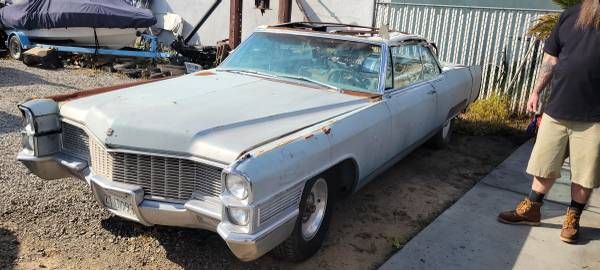
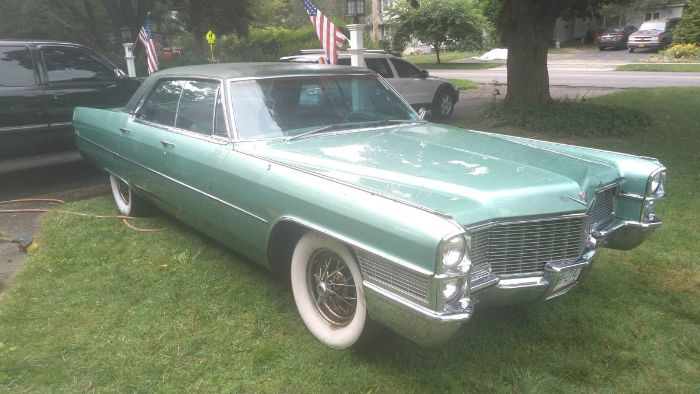
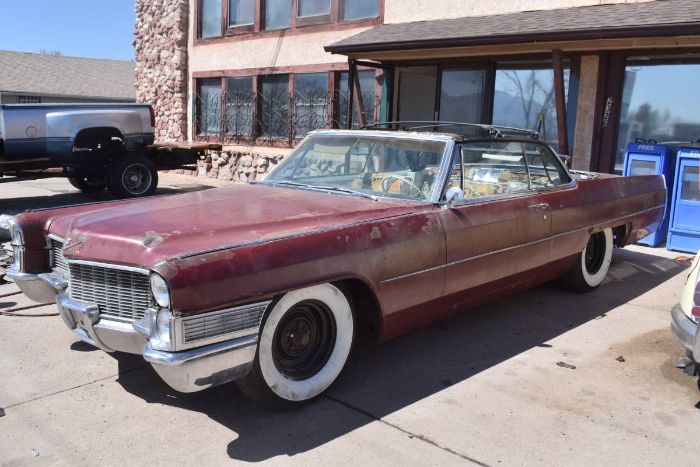
The 1965 redesign brought cleaner styling, refined proportions, and the introduction of the 429 cubic inch V8. The 1968 model year introduced the 472 cubic inch V8 — at the time, the largest production passenger-car V8 in American history. Coupe DeVille and Sedan DeVille variants both saw strong sales through this era. Driver-quality cars run $20,000-$45,000.
Big Body Era (1971-1976)
The 1971 redesign brought the largest DeVilles ever produced — over 18 feet long, 5,000 pounds, and powered by Cadillac's big-block V8 — the 472 cubic inch unit through 1974, then the 500 cubic inch V8 for 1975-1976 (the 500 was Eldorado-exclusive before 1975). These are the apex of post-war American luxury motoring before federal CAFE regulations forced downsizing. The 1976 DeVille convertible (alongside the 1976 Eldorado convertible) was marketed as "the last American convertible." Driver-quality cars run $14,000-$32,000.
Downsized Era (1977-1984)
Federal CAFE regulations forced GM to downsize the entire full-size lineup for 1977. The 1977 DeVille was 800 pounds lighter and dramatically more fuel-efficient than the 1976 cars. The 1977-1979 425 V8 was a robust engine; the 1980-1981 368 V8 less so. The 1981 V8-6-4 cylinder-deactivation system was famously troublesome and is now generally converted to permanent V8 mode. Driver-quality cars run $7,000-$18,000.
Modern Era (1985-2005)
The 1985 redesign moved the DeVille to a front-wheel-drive platform, marking the end of the body-on-frame Cadillac era. The 1985-1993 cars represent the bargain entry into modern Cadillac ownership. The 1994-1999 cars saw refined Northstar V8 engines, and the 2000-2005 final-generation cars closed the DeVille nameplate. Driver-quality modern-era DeVilles run $4,000-$12,000.
What to Look For (in person)
Body Style Verification
Verify the body style code on the firewall dataplate. Coupe DeVille (two-door hardtop) and Sedan DeVille (four-door) have different collector trajectories. Convertible DeVilles (1959-1970, 1984-1993) command significant premium over equivalent hardtop and sedan variants.
Frame and Body Inspection
Body-on-frame chassis on 1959-1984 cars; unibody construction on 1985-2005 cars. For body-on-frame cars, probe the perimeter frame at the body mount points and the front kick-up. Body mount bushings collapse over time. For unibody cars, inspect the rocker panels, floor pans, and cowl seam.
Engine Verification
Cross-reference the VIN engine code with the actual block casting and stamping. The 472 (1968-1974), 500 (1970-1976), and 425 (1977-1979) big-block V8s are bulletproof when maintained. The 368 (1980-1981) and HT4100 4.1L (1982-1985) had known issues. The 4.5L and 4.9L V8s (1988-1996) are reliable. The Northstar V8 (1994-2005) is robust but expensive to service.
Pricing Tiers
| Tier | Description | Price Range (2024) |
|---|---|---|
| Driver | 1985-2005 modern-era DeVille or 1977-1984 downsized, decent paint, runs and drives | $5,000-$15,000 |
| Survivor | 1965-1976 big-body Coupe or Sedan DeVille with original drivetrain, documented mileage | $22,000-$48,000 |
| Concours | Documented 1959-1960 fin-era convertible, frame-off restoration, Cadillac LaSalle Club Senior award | $70,000-$140,000+ |
Common Pitfalls
The biggest pitfall in DeVille buying is paying premium money for a heavily-optioned car with non-functioning power systems. Failed power windows, climate control, or seat motors on a heavily-optioned DeVille can require $2,000-$5,000 in proper specialist repair. Test every function before purchase.
The second pitfall is HT4100 4.1L V8 head gasket failures on 1982-1985 cars. The HT4100 is famously troublesome — verify recent head gasket service history or budget $3,500-$6,500 for proper rebuild.
"Among the marque registries, the unrestored survivor in original livery commands consistent premium over equivalent restorations. The market premium for a documented 1959 Coupe DeVille convertible with intact original tail fins and Cadillac Heritage verification is real — $25,000 or more on a typical car — and it pays to spend the time on proper authentication rather than chase a deal that turns out to be too good to be true. From a concours judging perspective, originality and proper documentation outweigh cosmetic perfection at every level of competition."
— Sarah Whitfield
Final Verdict
The DeVille market rewards documentation, frame integrity, and patience. 1959-1960 fin-era cars are blue-chip investments for buyers who value styling extravagance. 1968-1976 big-body cars (with 472 and 500 V8s) represent the smart-money entry into mid-era Cadillac ownership. 1985-2005 modern-era cars remain the bargain segment with strong appreciation potential as the era reaches collector-vehicle age.
For new buyers, start with a 1971-1976 Sedan DeVille with the 472 or 500 V8 and the Turbo Hydra-Matic 400. They're the most affordable big-body Cadillac, parts support is excellent through specialist suppliers, and the cars represent the apex of personal-luxury motoring. From there, the upgrade path is clear: 1971-1976 Coupe DeVille, then 1968-1970 Coupe DeVille, then 1965-1967 cars, then 1959-1960 fin-era convertibles. Patience and Cadillac Heritage verification beat impulse buys every time in this market.
Browse Cadillac DeVille listings
 Dealer
 United States
1965 Cadillac DeVille
 Dealer
United States
Dealer
United States
1965 Cadillac DeVille
What to Look For
Cadillac Heritage records are the gold-standard verification for any DeVille priced over $25,000. The Cadillac Heritage Center maintains original production records and can verify chassis number, engine number, original paint code, original interior code, options, and delivery destination. Cross-reference against the Cadillac LaSalle Club registry for additional authentication.Body style verification is essential. Coupe DeVille (two-door hardtop) and Sedan DeVille (four-door sedan) have different collector trajectories and pricing structures. Convertible DeVilles (1959-1970, 1984-1993) command significant premium over equivalent hardtops. Verify the body style code on the firewall dataplate against the actual configuration.
For 1959-1960 dual-fin cars, the original undamaged tail fin proportions are critical to value. Tail fin damage from minor parking-lot incidents is universal — verify the fins are straight, undamaged, and original. Replacement fins are available from specialist suppliers but reduce concours value 5-10% versus original.
Frame inspection is the second non-negotiable for body-on-frame cars (1959-1984). Probe the perimeter frame at the body mount points and the front kick-up. Body mount bushings collapse over 50+ years and water pools above them, rotting the frame from inside the boxed sections. Replacement is $2,500-$5,500 per side if needed.
For 1982-1985 cars with the HT4100 4.1L V8, verify recent head gasket service history. The HT4100 is famously troublesome — failed head gaskets are essentially universal on cars older than 30 years that haven't had recent service. Budget $3,500-$6,500 for proper rebuild if not already addressed.
For convertible DeVilles, inspect the rear corners where the top mechanism mounts to the body. Structural rust here compromises top operation and convertible value. Test the top through full open and close cycle.
Document the car. Photograph every panel, every chassis number stamping, every interior detail, every engine bay component, and every identifying tag. The unrestored survivor in original livery is consistently preferable to the freshly-restored car of unknown provenance from a concours judging perspective.
Pre-Purchase Checklist
-
Verify body style code on firewall dataplate
DeVille was Cadillac's high-volume luxury sedan. Coupe DeVille and Sedan DeVille have different value trajectories. -
Cross-reference VIN engine code with block casting
Cadillac 390 (1959-1962), 429 (1964-1967), 472 (1968-1974), 500 (1970-1976), 425 (1977-1979), 368 (1980-1981), 4.1 V8 (1982-1985), 4.5 V8 (1988-1990) each have specific casting numbers. -
Inspect frame at body mount points
Body-on-frame chassis on most generations. Body mount cushions collapse over time. Frame rust = $2,500-$5,500 minimum repair. -
Check rocker panels and lower rear quarters
Universal rust zones across all generations. Magnet test for filler. -
Examine convertible top mechanism (1959-1970, 1984-1993)
Hydraulic systems on convertible DeVilles commonly fail. $1,500-$3,500 to repair properly. -
Test all power options
Power windows, seats, climate, AM/FM. Heavily-optioned cars require expensive specialist repair when systems fail. -
For 1959-1960 cars, verify dual-fin styling intact
Tail fin damage is universal — original undamaged fins add 10-15% value. -
Check 4.1L V8 (1982-1985) head gasket condition
HT4100 4.1L V8 had known head gasket issues. Verify recent service history. -
Inspect cowl seam at windshield base
Where windshield meets firewall. Cowl rust drains into cabin and damages dashboard wood. -
Compression test all eight cylinders
Should read 145-180 PSI uniformly. 472 and 500 big-blocks run slightly higher.
Common Issues
DeVille rust patterns vary by generation. The 1959-1976 body-on-frame cars rust at the lower rear quarters, the rocker panels, the floor pans, the trunk pan, the lower fenders, and the cowl seam. The 1977-1984 downsized cars share rust patterns with 1971-1976 but in a smaller package. The 1985-2005 front-wheel-drive cars use unibody construction and rust at the rocker panels, floor pans, and rear quarter panels.Mechanically, Cadillac V8 engines vary dramatically by era. The 390 (1959-1962), 429 (1964-1967), 472 (1968-1974), 500 (1970-1976), and 425 (1977-1979) V8s are all bulletproof when maintained. The 368 V8 (1980-1981) was reasonable but coupled with the troublesome V8-6-4 cylinder-deactivation system. The HT4100 4.1L V8 (1982-1985) had known head gasket issues — repair runs $3,500-$6,500 in parts and labor. The 4.5L and 4.9L V8s (1988-1996) returned to reliability. The Northstar V8 (1994-2005) is robust but expensive to service due to interference engine design.
The Turbo Hydra-Matic 400 transmission (1965-1980) is essentially indestructible. The 4L60 and 4L80 transmissions on later cars are reliable. The 1985+ FWD transaxles require specific specialist knowledge for proper service.
Electrical issues are extensive on heavily-optioned DeVilles. Power windows, power seats, climate control, AM/FM stereo, cruise control, and various other features were standard equipment on most years. Failed systems require expensive specialist repair — budget $2,000-$5,000 for proper electrical refresh on any neglected DeVille. The dashboard climate control panel is a particular failure point on 1971-1984 cars.
For convertible DeVilles (1959-1970, 1984-1993), the hydraulic and electric top systems are complex and commonly fail. Test the top operation through full open and close cycle. Failed top systems require $1,500-$3,500 in specialist repair.
More DeVille for sale
 Dealer
United States
Dealer
United States
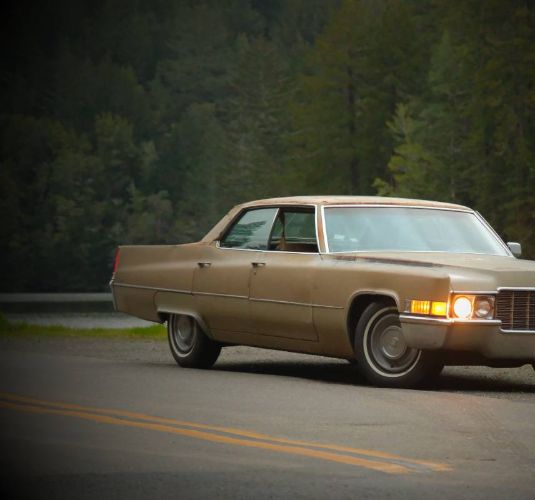
1969 Cadillac DeVille
 Dealer
United States
Dealer
United States
1965 Cadillac DeVille
Pricing Guide
1959-1964 fin-era DeVilles are the most dramatic styling era. Driver-quality 1959-1960 Coupe DeVille convertibles run $35,000-$70,000. Sedan DeVille hardtops: $25,000-$48,000. The 1959 model year is the most desirable. Documented original-paint cars: $55,000-$95,000+.1965-1970 refined-era DeVilles: driver-quality Coupe DeVille convertibles run $22,000-$45,000. Sedan DeVille hardtops: $14,000-$28,000. The 1968-1970 cars (with the 472 V8) are the most desirable. Documented cars: $32,000-$55,000.
1971-1976 big-body DeVilles: driver-quality Coupe DeVille convertibles run $18,000-$38,000. Sedan DeVille hardtops: $14,000-$32,000. The 1976 final-convertible DeVille commands premium — driver-quality 1976 convertibles: $22,000-$42,000, documented original-paint examples: $32,000-$60,000+.
1977-1984 downsized DeVilles: driver-quality cars run $7,000-$18,000. The 1977-1979 cars with the 425 V8 are the most desirable era. Avoid the 1981 V8-6-4 unless documented service history confirms proper conversion to permanent V8 mode.
1985-1993 modern-era DeVilles: driver-quality cars run $5,000-$15,000. The 1984-1993 convertible DeVille (revival of the convertible body style) commands premium — clean convertibles: $9,000-$22,000.
1994-2005 modern-era DeVilles with Northstar V8: driver-quality cars run $4,000-$12,000. The 2000-2005 final-generation cars represent the bargain entry into modern Cadillac ownership.
Project DeVilles start around $3,500-$10,000 across most generations. Stripped roller candidates: $1,500-$5,000. Restoration costs are higher than equivalent Chevrolet restoration due to specialty Cadillac parts and trim.
Fun Facts
The DeVille name was introduced as a sub-model designation for 1949 (Coupe de Ville), and became a stand-alone model line in 1959. The name derives from the French "de la ville" meaning "of the city" — Cadillac's product planners chose the name to evoke European luxury sophistication and distinguish the high-trim Cadillac from base Series 62 cars.The 1968 introduction of the 472 cubic inch V8 in the DeVille made it the largest production passenger-car V8 in American history at the time. Cadillac increased displacement to 500 cubic inches for the 1970 model year — the 500 remained the largest production passenger-car V8 ever produced through the end of its 1976 production run. Both the 472 and 500 are bulletproof engines that commonly exceed 200,000 miles with proper service.
The 1976 Cadillac Coupe DeVille and Sedan DeVille convertibles were marketed alongside the Eldorado as "the last American convertibles" in response to expected federal rollover safety regulations. The regulations never materialized, but the marketing campaign drove dramatic price speculation. Convertible American passenger cars eventually returned for the 1982 Chrysler LeBaron, with the Cadillac DeVille convertible body style returning for 1984-1993 production.
Frequently Asked Questions
Ready to find your DeVille?
Browse 6+ active Cadillac DeVille listings on Classic Cars Arena.
View Listings →