
Ford Galaxie Buyer's Guide
The Galaxie 500 is Ford's full-size muscle car — bigger than a Mustang, heavier than a Fairlane, and powered by some of the most capable FE-series engines Ford ever built. The 427 side-oiler is the headline, but even a 390-powered convertible is a serious collector car. Know what you're looking at before the seller explains it to you.

I've always had a soft spot for the Galaxie 500. It doesn't get the same magazine coverage as a Boss 429 Mustang or a 427 Cobra, but a documented 427 Galaxie is a more significant piece of Ford performance history than most people realize. The NASCAR connection is real — Ford campaigned the Galaxie on superspeedways, and the street 427s that followed were barely detuned race engines. For the buyer who wants full-size American muscle with actual provenance, this is the car. Just understand what you're evaluating before the seller's enthusiasm does your thinking for you.
History & Generations
Ford introduced the Galaxie 500 as a distinct trim level above the base Galaxie for 1962, aligning with the marketing language of the Space Age. The Galaxie 500 occupied the top of Ford's full-size passenger car lineup through 1970, when the LTD effectively replaced it as the prestige model.
1962–1964: The FE Era Begins
The 1962–1964 Galaxies are the most collectible body style of the generation, particularly the formal-roof and — from 1963 — the fastback "Sports Roof" body. Ford introduced the fastback roofline specifically for NASCAR homologation, and the 1963–1964 fastback Galaxie 500 is one of the most visually striking American cars of its era. The 427 side-oiler appeared in 1963 and was offered in 410 and 425 horsepower ratings.
1965–1968: The Sweet Spot
The 1965 Galaxie received a major redesign with a longer wheelbase (119 inches) and cleaner body lines. The FE engine lineup continued: 352, 390, 427, and ultimately the 428 Cobra Jet in 1968. These years offer the best combination of parts availability, body panel sourcing, and engine support. The convertible body style is available throughout this period and carries a consistent premium.
1969–1970: Final Years
The 1969–1970 Galaxie 500 is the largest of the generation — a big, comfortable full-size car that was beginning to be outpaced in the market by the pony car segment. The 429 Thunder Jet and 429 Cobra Jet were available in these final years. Less collectible than the 1963–1964 fastbacks but still strong, particularly in convertible form.
The FE Engine Family
Understanding the FE engine hierarchy is essential to evaluating any Galaxie 500:
- 352 FE (1962–1965): 220 hp, the base V8. Reliable, unexciting. Common in driver-quality cars.
- 390 FE (1962–1970): 265–335 hp depending on year and carburetion. The balanced choice — good power with reasonable parts availability.
- 427 FE side-oiler (1963–1968): 410 or 425 hp. The performance benchmark. Documented, numbers-matching 427 cars command dramatically higher prices.
- 428 Cobra Jet (1968–1969): 335 hp (understated). Strong torque, excellent street manners, more accessible than a 427. Underrated by many buyers — don't overlook it.
- 429 (1969–1970): The new-generation big-block replacing the FE. Thunder Jet and Cobra Jet variants available.
Rust Locations
Trunk floor corners are the primary rust zone on the Galaxie 500 — water pools in the rear trunk corners and works through from the inside. Lift the mat and probe thoroughly. Lower rear quarters are the exterior companion to trunk floor rust — both zones deteriorate together. The frame at the rear kick-up — where the frame rails curve upward over the rear axle — is a structural rust zone that is not visible without getting under the car.
Secondary rust zones include the lower door skin seams, the floor pans under the front seat, and the cowl channel behind the hood. Front lower fenders at the inner fender seam are a water trap on these cars — check that area from underneath.
| Engine | Displacement | Power (hp) | Years Available |
|---|---|---|---|
| FE 352 | 352 ci | 220 hp | 1962–1965 |
| FE 390 | 390 ci | 265–335 hp | 1962–1970 |
| FE 427 side-oiler | 427 ci | 410–425 hp | 1963–1968 |
| FE 428 Cobra Jet | 428 ci | 335 hp (est.) | 1968–1969 |
| 385-series 429 | 429 ci | 320–360 hp | 1969–1970 |
"I've inspected a lot of Galaxies where the seller had '427' memorized and couldn't tell me what 'side-oiler' meant. That's your first tell. A real 427 Galaxie is a significant car — NASCAR-derived, documented, worth protecting. An engine-swapped Galaxie with a 427 block dropped in is a driver car at driver prices. The number on the data plate and the Marti report are what I go by, not the seller's story."
— Mike Sullivan
Pricing & Market
Driver-quality Galaxie 500 sedans with 390 or 352 power trade in the $18,000–$28,000 range. The 1963–1964 fastback body style adds a 20–30% premium at any condition level. Convertibles carry a consistent 20–35% premium. A documented 427 Galaxie in driver condition starts at $50,000 and shows clean above $80,000. Numbers-matching fastback convertibles with 427 and documentation have exceeded $90,000 at major auction. The 428 Cobra Jet cars are meaningfully undervalued relative to 427 examples and represent the best performance value in the segment.
Browse Ford Galaxie listings


What to Look For
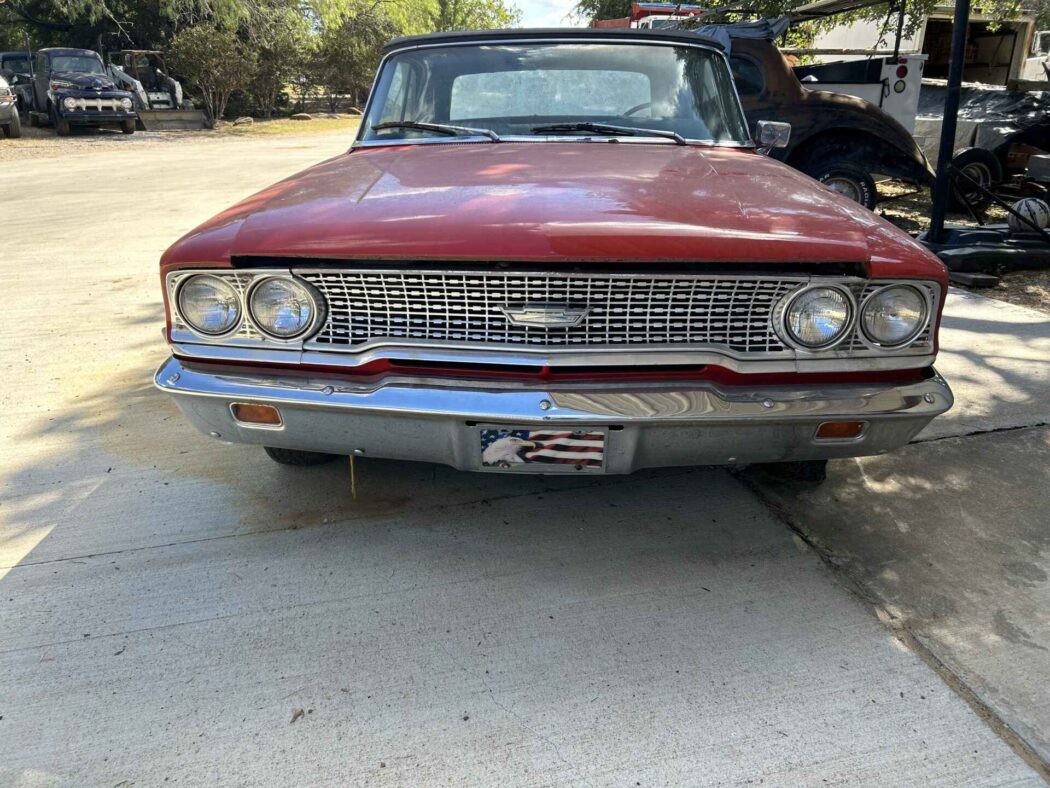
Verify engine identity before evaluating anything else — check block stampings against the VIN decode and Marti report. Trunk floor corners are the primary rust zone; probe thoroughly before accepting any cosmetic presentation. Lower rear quarters at the exterior. Frame rails at the rear kick-up — get under the car and inspect structurally. Lower door skin seams and front lower fenders at the inner fender seam. Verify body style: confirm fastback vs. formal roof in person — the roofline difference is not subtle. On convertibles, check body structure for flex and verify the top mechanism operates correctly. Confirm broadcast sheet, window sticker, or Marti report existence on any 427 car before price discussions begin.Pre-Purchase Checklist
-
Engine number verification
Check block stampings against VIN decode and Marti report before any valuation -
Trunk floor corners
Remove mat and probe all four trunk floor corners for rust-through -
Lower rear quarters
Inspect lower rear fender panels for rust, especially behind wheels -
Frame rear kick-up
Get under car and inspect frame rails at rear axle arch for structural rust -
Body style confirmation
Confirm fastback vs. formal roof roofline in person — don't rely on description -
Floor pans
Check under front seat carpet for rust-through or repairs -
Lower door seams
Inspect bottom edge of door skins for rust at seam -
Convertible top mechanism
Cycle the top — verify hydraulics work, check for cylinder leaks -
FE engine oil leaks
Check rear main, timing cover, and intake manifold gaskets -
Cooling system condition
Verify hoses, thermostat, and coolant condition — FE overheating damages gaskets -
Marti report
Order a Marti report to verify factory powertrain and options independently
Common Issues
Trunk floor rust is the defining structural issue — water pools in rear trunk corners and deteriorates the floor from inside. Lower rear quarters deteriorate with it. Frame rust at the rear kick-up is a structural failure mode that requires a hoist to properly inspect. Door skin seam rust at the lower edges is cosmetic but frequently found. FE engine oil leaks are common — rear main seal, timing cover, and intake manifold gaskets are the usual sources. On 427 cars, engine identity fraud is a known problem — verify numbers before making any valuation decisions. Convertible top mechanism failures are common on unmaintained cars; hydraulic cylinder leaks are the most frequent issue. The FE engine cooling system requires correct hose routing and thermostat spec — overheating accelerates gasket failure on the higher-output engines.More Galaxie for sale
Pricing Guide
Driver-quality 390/352 sedans: $18,000–$28,000. Fastback body adds 20–30% premium. Convertibles add 20–35% premium. Documented 427 Galaxie driver: $50,000–$65,000; show quality: $75,000–$90,000+. Numbers-matching 427 fastback convertible: auction results above $90,000. 428 Cobra Jet cars are undervalued relative to 427 — typically $25,000–$40,000 at driver-to-show quality and represent the best performance value in the lineup. Use Marti Reports (available online) to verify factory powertrain and options before paying any premium.Fun Facts
Ford campaigned the 1963 Galaxie 500 fastback directly on NASCAR superspeedways — the fastback roofline was designed to reduce aerodynamic drag at 160+ mph. Freddie Lorenzen won the 1963 Atlanta 500 in a works Galaxie. The 427 side-oiler was so well-regarded that it appeared in the AC Cobra, the Ford GT40 (early versions), and Ford Thunderbolt drag cars. Ford sold approximately 4,500 street-legal 427 Galaxies in 1963 alone.Frequently Asked Questions
Ready to find your Galaxie?
Browse 6+ active Ford Galaxie listings on Classic Cars Arena.
View Listings →