Who Was Zora Arkus-Duntov?
The man who would become synonymous with the Corvette was born Zachary Arkus in Brussels, Belgium, in 1909. His early years traced a peculiar geography: raised partly in Germany and partly in Leningrad, educated across a fractured Europe, he absorbed engineering not from a single tradition but from several at once. By the time he found his way to automobiles, Zora Arkus-Duntov — he would take his stepfather's name — had already worked as a race driver, an aircraft engine designer in wartime France and England, and as the co-developer of one of the most celebrated engine conversions of the postwar era.
That conversion was the Ardun hemispherical cylinder head, which Duntov and his brother Yura designed and sold starting in 1947 as a bolt-on upgrade for the Ford flathead V8. The Ardun heads transformed a plodding engine into something genuinely competitive, and the performance community noticed. So, quietly, did General Motors. When a Belgian-born engineer with a racing pedigree, a gift for combustion theory, and an instinct for what made cars fast appeared in America, the industry was a small enough world that people paid attention.
What nobody anticipated was the letter.
The Letter That Changed Everything
In 1953, General Motors staged its Motorama at the Waldorf-Astoria in New York, and the centerpiece of the GM dream car display was a low white roadster called the Corvette. The public response was electric — here, finally, was an American answer to the Jaguar XK120, the MG, the Triumph. The styling was Harley Earl at his most confident: swooping, purposeful, unambiguous in its intent.
Duntov attended the show. He admired what he saw. And then he went home and wrote GM a letter explaining everything that was wrong with it.
The Corvette, he argued, was not yet a real sports car. Its engine — the "Blue Flame" inline six borrowed from passenger car duty — was a touring unit, not a performance unit. Its Powerglide two-speed automatic transmission was the wrong equipment entirely. The car had the shape of a sports car without the substance of one, and if General Motors released it as-is, it risked becoming a curiosity rather than a contender. European manufacturers would look at it and not take it seriously. More dangerously, American buyers who actually drove sports cars would feel the same.
The letter was not a job application. It was an engineer's diagnosis, offered by a man who loved cars enough to say what others in the building were too diplomatic to put in writing. GM hired him anyway — or perhaps because of it. He joined the company in 1953 as a staff engineer, and spent the next twenty-two years making the car he'd described in that letter.
"I had no idea they would hire me. I simply told them what I believed was true about their car. I suppose they had not yet said it clearly to themselves."
— Zora Arkus-Duntov, recalling the 1953 letter in a later interview
The full arc of what that letter set in motion took decades to complete. But it began almost immediately, with Duntov doing what engineers do when they inherit a project: finding out exactly what was possible.
Making the Corvette a Sports Car: 1953–1962
The critical intervention came quickly. Ed Cole, GM's chief engineer and one of the great enthusiast engineers in American automotive history, was already working on a small-block V8 that would become one of the defining engines of the postwar era. Duntov aligned himself with that effort and pushed hard for its adoption in the Corvette. The 265-cubic-inch V8 arrived in 1955, and the car was immediately transformed — not yet a fully realized sports car, but no longer a passenger car in a fiberglass costume.
Duntov's own contribution to that transformation came in the form of a camshaft. The solid-lifter grind he developed in 1956 — the camshaft that would permanently carry his name — allowed the small-block to breathe at high rpm in a way that changed what the engine was capable of. The Duntov cam became standard equipment on high-performance Corvette applications and remains one of the most historically significant engine components in American automotive history: a piece of machined steel that redefined what a domestic sports car could do.
In January 1956, Duntov drove a modified Corvette on the Daytona Beach course and recorded 150.583 mph — a speed that made headlines and, more importantly, made the argument he'd been making internally since 1953. The car was fast. The car was real. Now the public and the press knew it too.
The 1957 model year brought fuel injection — Rochester mechanical fuel injection, producing one horsepower per cubic inch from the 283 V8, a benchmark that carried enormous significance in that era. By the time the first generation of the C1 Corvette closed out in 1962, the car that had debuted with a six-cylinder automatic had become a legitimate performance machine. Duntov had done what he'd promised to do.
The Sting Ray and the C2 Era: 1963–1967
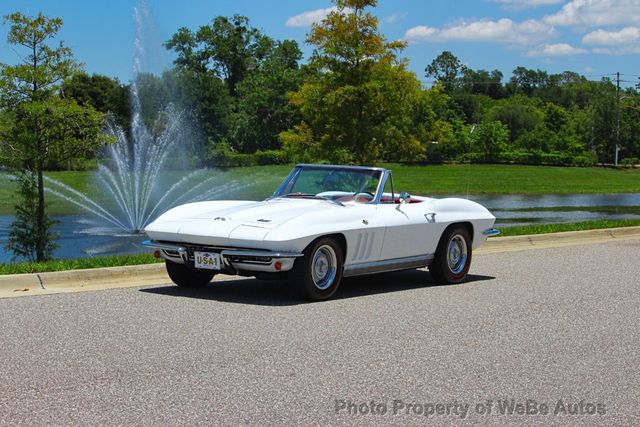
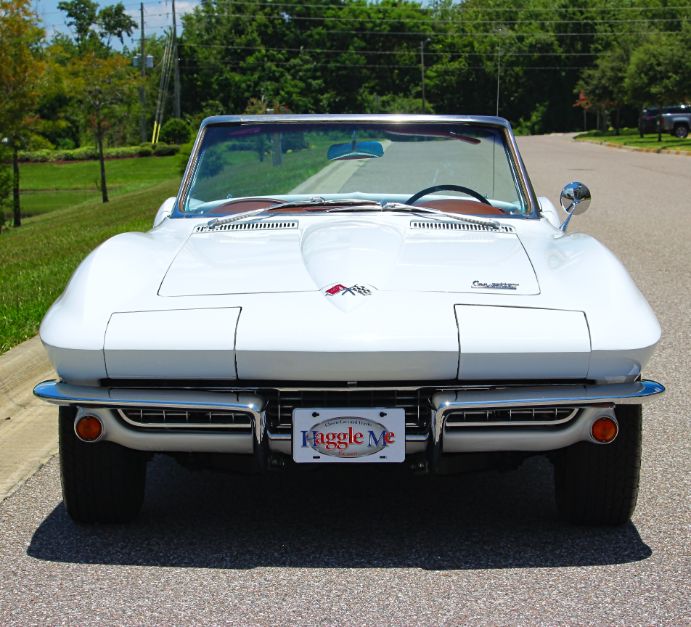
If the first decade was about proving the Corvette could be a sports car, the second decade was about making it a great one. The 1963 Sting Ray represented the fullest expression of Duntov's engineering vision — not because he controlled every aspect of it, but because the feature he had been arguing for since the early 1950s finally arrived: independent rear suspension.
The original live-axle setup was, in Duntov's view, the single greatest limiting factor in the Corvette's handling. A sports car that couldn't put its power down cleanly, that couldn't manage bumps through a corner without unsettling the rear wheels, was compromised at a fundamental level. He had lobbied for independent rear suspension repeatedly during the 1950s and been told, repeatedly, that the cost and complexity weren't justified. The 1963 Sting Ray finally justified them.
The result was a car that could be driven in a way the earlier Corvettes couldn't — with confidence, with nuance, with the sense that the chassis was working with the driver rather than against him. The Z06 competition package, available at launch, made that case emphatically: heavy-duty brakes, suspension, and a 360-horsepower fuel-injected engine in a car that weighed under 3,000 pounds.
Disc brakes arrived in 1965, addressing the remaining safety limitation that had concerned Duntov since the Daytona speed runs. The 427-cubic-inch big-block V8 arrived in 1966, and here Duntov's preferences and the market's appetite diverged. He preferred the small-block: better weight distribution, better handling balance, a car that rewarded skill. The 427 made power the way a sledgehammer makes an argument — massively and somewhat indiscriminately. But the market wanted it, and GM built it, and the big-block Corvette became one of the iconic machines of the muscle car era.
| Year | Event / Contribution | Significance |
|---|---|---|
| 1953 | Writes letter to GM critiquing the Motorama Corvette; hired as staff engineer | Set the philosophical direction for all Corvette development that followed |
| 1955 | Small-block V8 adopted in the Corvette (Cole/Duntov alignment) | Transformed the car from touring roadster to genuine performance machine |
| 1956 | Develops the Duntov cam; sets 150 mph record at Daytona | Proved Corvette's performance credentials publicly and mechanically |
| 1957 | Rochester fuel injection introduced (283 hp / 283 cu in) | First production American car to achieve one horsepower per cubic inch |
| 1963 | C2 Sting Ray debuts with independent rear suspension | Fulfilled Duntov's decade-long campaign for genuine sports car handling |
| 1965 | Four-wheel disc brakes standard on Corvette | Closed the safety gap that had limited the car's racing credibility |
| 1969 | CERV II mid-engine concept demonstrates layout feasibility | Advanced Duntov's long-running argument for mid-engine architecture |
| 1975 | Duntov retires from General Motors | Ended a 22-year tenure that redefined what American performance cars could be |
The Rivalry with Bill Mitchell and the C3
To understand the C3 Corvette — the long-running Shark-era car that spanned 1968 to 1982 — you have to understand the relationship between Zora Arkus-Duntov and GM Design chief Bill Mitchell. They were not enemies. They respected each other in the way that two dominant personalities serving the same car can respect each other while disagreeing about nearly everything that matters.
Mitchell's Corvette was a visual statement. The Mako Shark concept that preceded the C3 was one of the most dramatic show cars GM ever built, and Mitchell pushed the production car toward that drama: lower, wider, more aggressively styled, with a fastback roofline that made the car look genuinely menacing. It was Mitchell's vision of what an American sports car should look like, and by any aesthetic standard, it worked.
Duntov's objections were engineering objections. The C3 was heavier than the C2 it replaced. Its aerodynamics were compromised by styling priorities. The interior was cramped, the visibility was poor, and the car's weight gain worked against the handling balance he'd spent a decade optimizing. He said so, in his particular way — not in board meetings but in memos, in engineering documents, in the careful language of a man who knew his objections were on the record.
The deeper conflict was about architecture. Duntov had been developing mid-engine concepts since the late 1950s, and his experimental vehicles made the case with increasing clarity. The CERV I (Chevrolet Engineering Research Vehicle, 1959) was a single-seat open-wheel racer that Duntov used to explore chassis dynamics and engine placement. CERV II followed in 1964. The XP-819 of 1964 was a rear-engine concept. The Aerovette, shown in 1977, was a fully realized mid-engine Corvette design.
Mitchell was not opposed to the mid-engine layout on pure aesthetic grounds — he had designed stunning mid-engine concepts himself. His resistance was more practical: a mid-engine Corvette would have required abandoning the Shark body, the styling idiom he had built his reputation on. It would have been a different car, not just mechanically but visually and culturally. The tension between these two men shaped the Corvette more than either individual did alone — each pushing against the other, each preventing the car from becoming purely one thing or the other.
Retirement and the Legacy He Left Behind
Duntov retired from General Motors in 1975, replaced as Corvette chief engineer by David McLellan. He was 65 years old. The car he left behind was the C3 — a car he had both shaped and criticized, a car whose longevity testified to Mitchell's aesthetic instincts even as its engineering represented compromises Duntov had never fully accepted.
He lived to see the C4, the C5, and the beginning of discussions about what would eventually become the C8. He died on April 21, 1996, in Grosse Pointe, Michigan. In accordance with a request that speaks to how completely he had merged his identity with the machine, he is buried at the National Corvette Museum in Bowling Green, Kentucky.
The C8 mid-engine Corvette, introduced for the 2020 model year, is routinely described as fulfilling Duntov's vision — a description that is accurate as far as it goes. He had argued for a mid-engine Corvette for the better part of four decades. The C8 proves that the architecture works, that it doesn't compromise the car's identity, that an American sports car can carry its engine behind the driver and still be recognizably a Corvette. Duntov was right about this, and it took GM until 2020 to say so with a production car.
The question of whether he deserves the title "Father of the Corvette" is genuinely complicated. Harley Earl conceived the car. Ed Cole gave it the engine that made it viable. Duntov gave it something harder to define and more lasting: a philosophy. He gave the Corvette the idea that it should be a driver's car first — not a styling exercise, not a boulevard cruiser, not a muscle car in a roadster's clothing, but a machine designed around the experience of driving it well.
That philosophy survived him. It survived the C3's compromises and the emissions-strangled C3 late-period cars and the transition through three chief engineers after him. It's present in every chapter of the Corvette's story, in the way the car has always taken its performance seriously even when the surrounding culture didn't. You can argue about who fathered the Corvette. You can't argue about who gave it its soul.
The Duntov Name Today
There is a particular kind of automotive immortality that comes not from having your name on a badge but from having it become part of the working vocabulary of the people who love the car you helped create. Enzo Ferrari has a badge. Zora Arkus-Duntov has a camshaft.
The Duntov cam — the solid-lifter grind he developed in 1956 — has been reproduced, recreated, and installed in Corvettes for seven decades. It is a piece of hardware that carries a name because the community decided the name mattered, not because a marketing department assigned it. That is a different kind of honor.
Chevrolet formalized the connection with the C8 generation's Zora package: a track-focused, high-downforce configuration that sits above the Z06 in the performance hierarchy. Naming a performance package after Duntov rather than after a letter or a number is an acknowledgment that his contribution was conceptual as much as mechanical. He didn't just make the car faster; he made the case that fast was what it should be.
The C8's mid-engine layout, the Zora package, the reproduction Duntov cams in restored C1s and C2s in garages across the country — these are all evidence of the same phenomenon. A man spent twenty-two years arguing that a car should be a certain thing, and the car became that thing, and now his name is shorthand for that ambition. That is not a common outcome. Most engineers retire and are forgotten by the cars they built. Duntov is different, and the Corvette is different because he was different, and those two facts remain inseparable.
The full biography of Zora Arkus-Duntov spans continents and decades and wars and engineering problems that have no clean solutions. But the core of it fits in that 1953 letter: a man who saw exactly what a car needed to be, said so clearly, and then spent the rest of his working life making it happen.
Sources and notes
- National Corvette Museum — Collections and History
- Hemmings Motor News — Zora Arkus-Duntov: The Man Behind the Corvette
- MotorTrend — The Complete History of the Chevrolet Corvette
- Car and Driver — Zora Arkus-Duntov: The Father of the Corvette
- Jerry Burton, Zora Arkus-Duntov: The Legend Behind Corvette (Bentley Publishers, 2002)
- Super Chevy — The History of the Duntov Camshaft