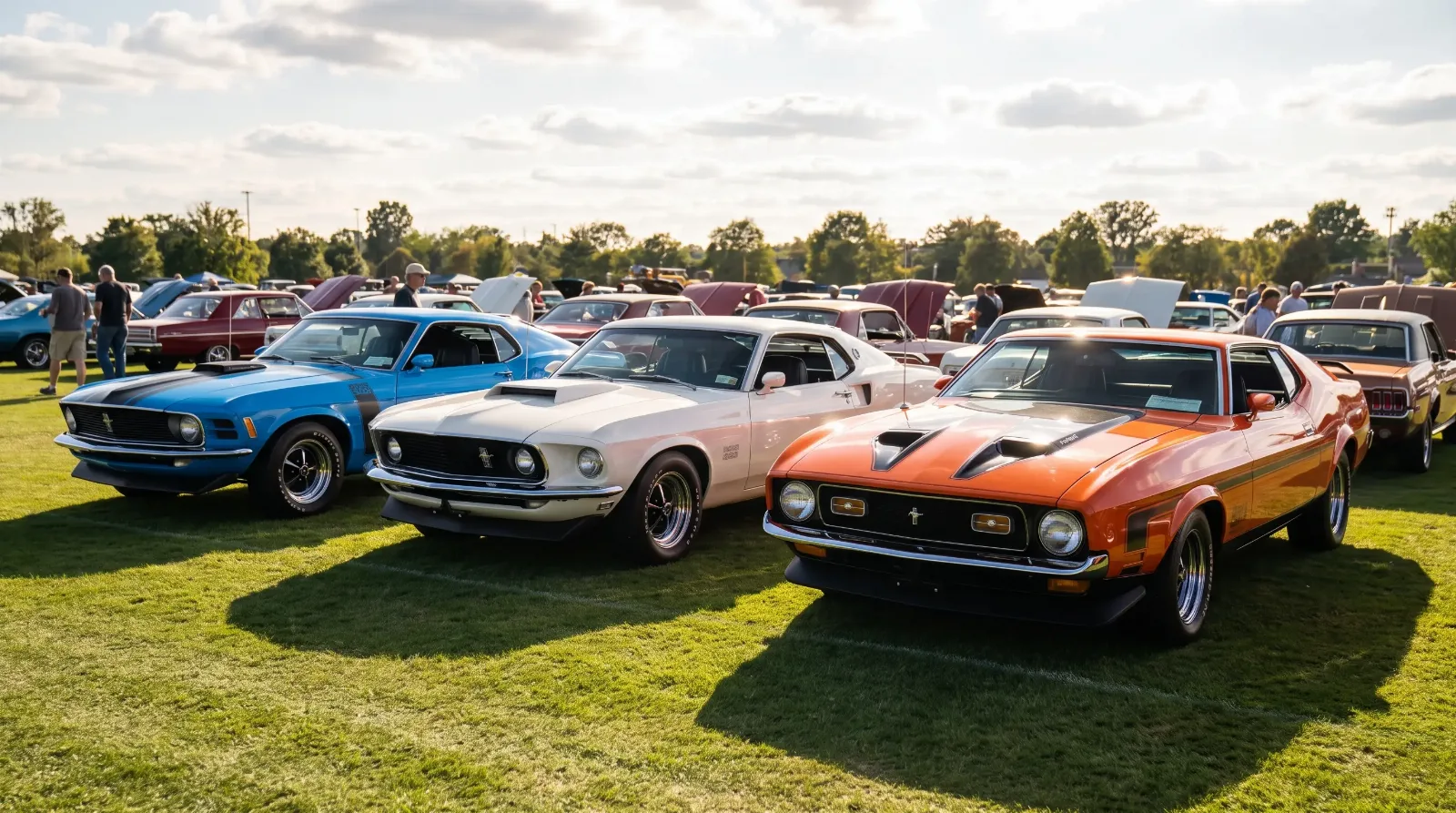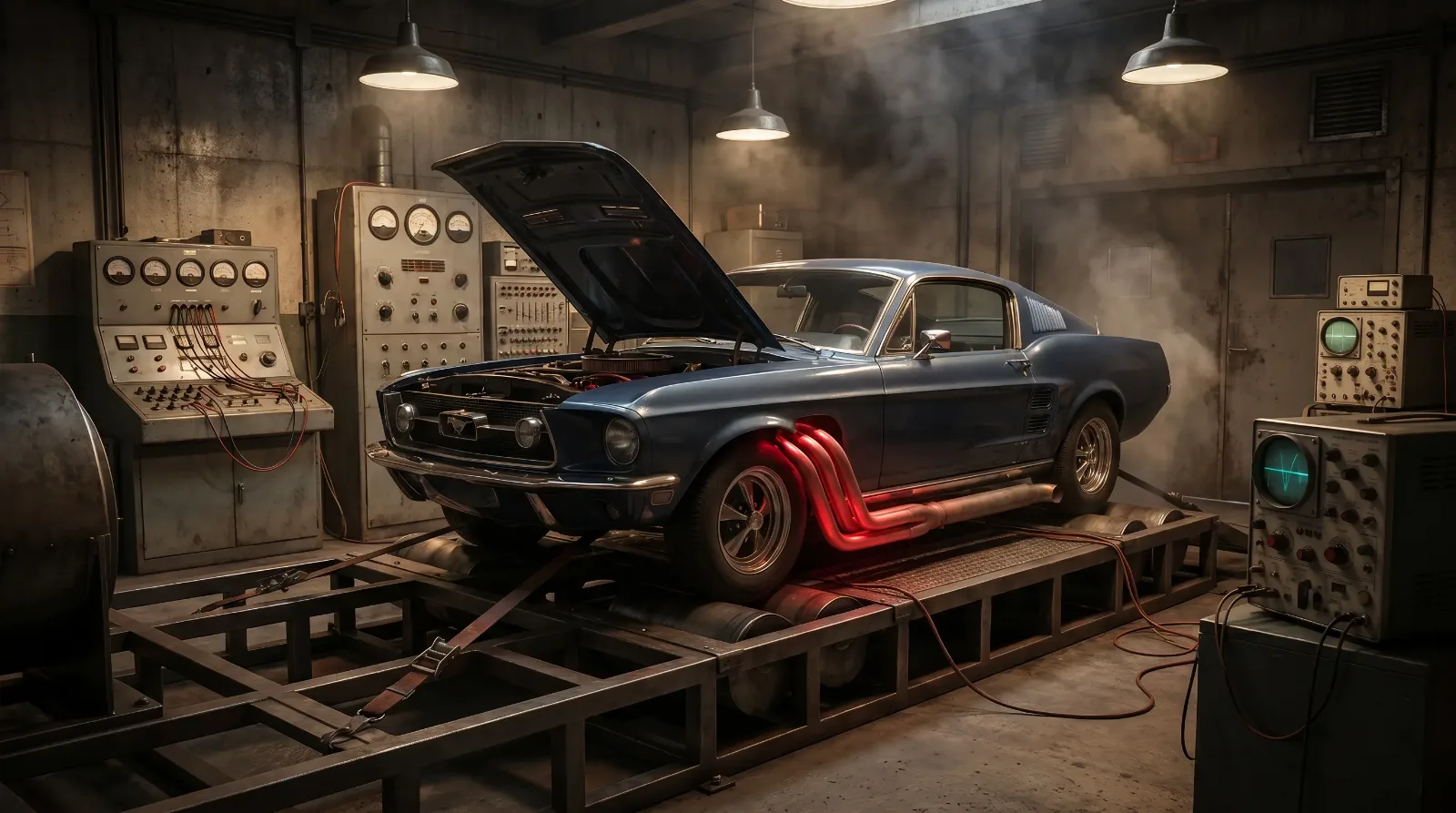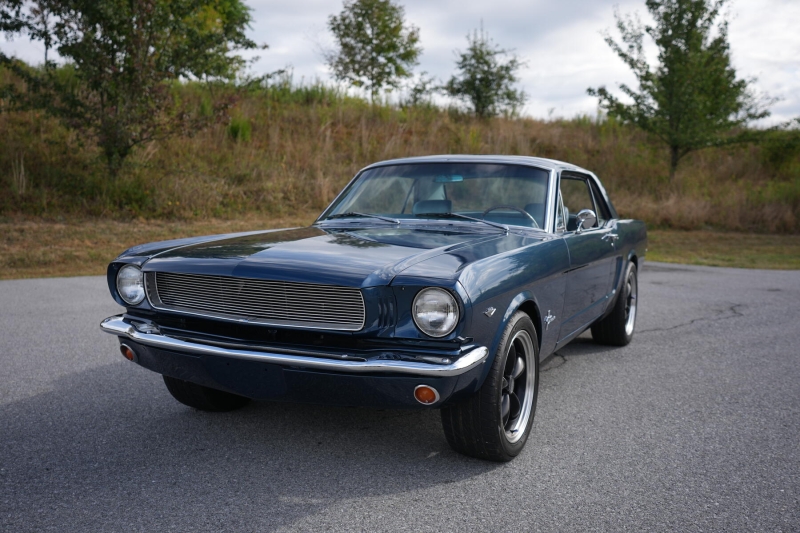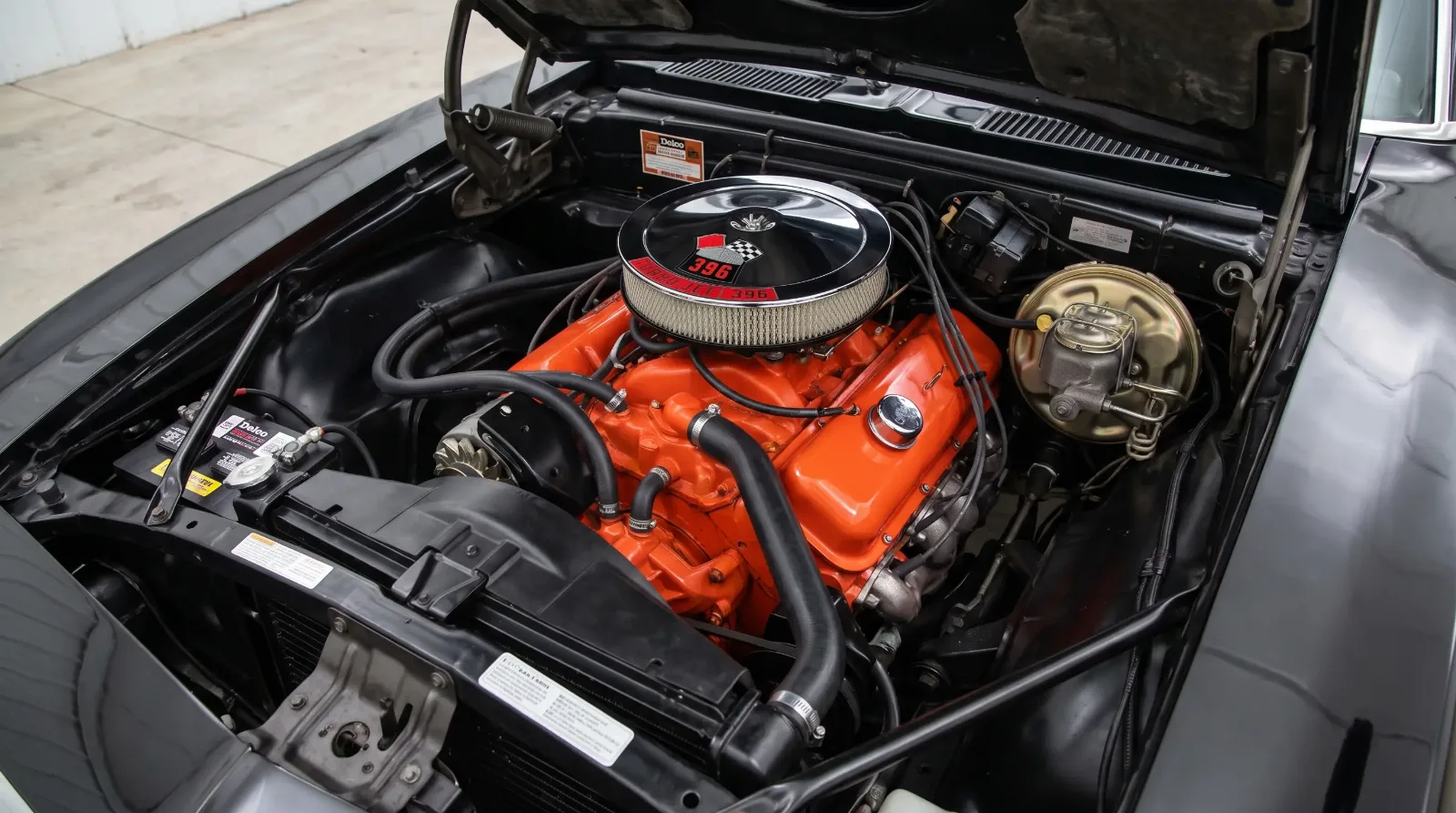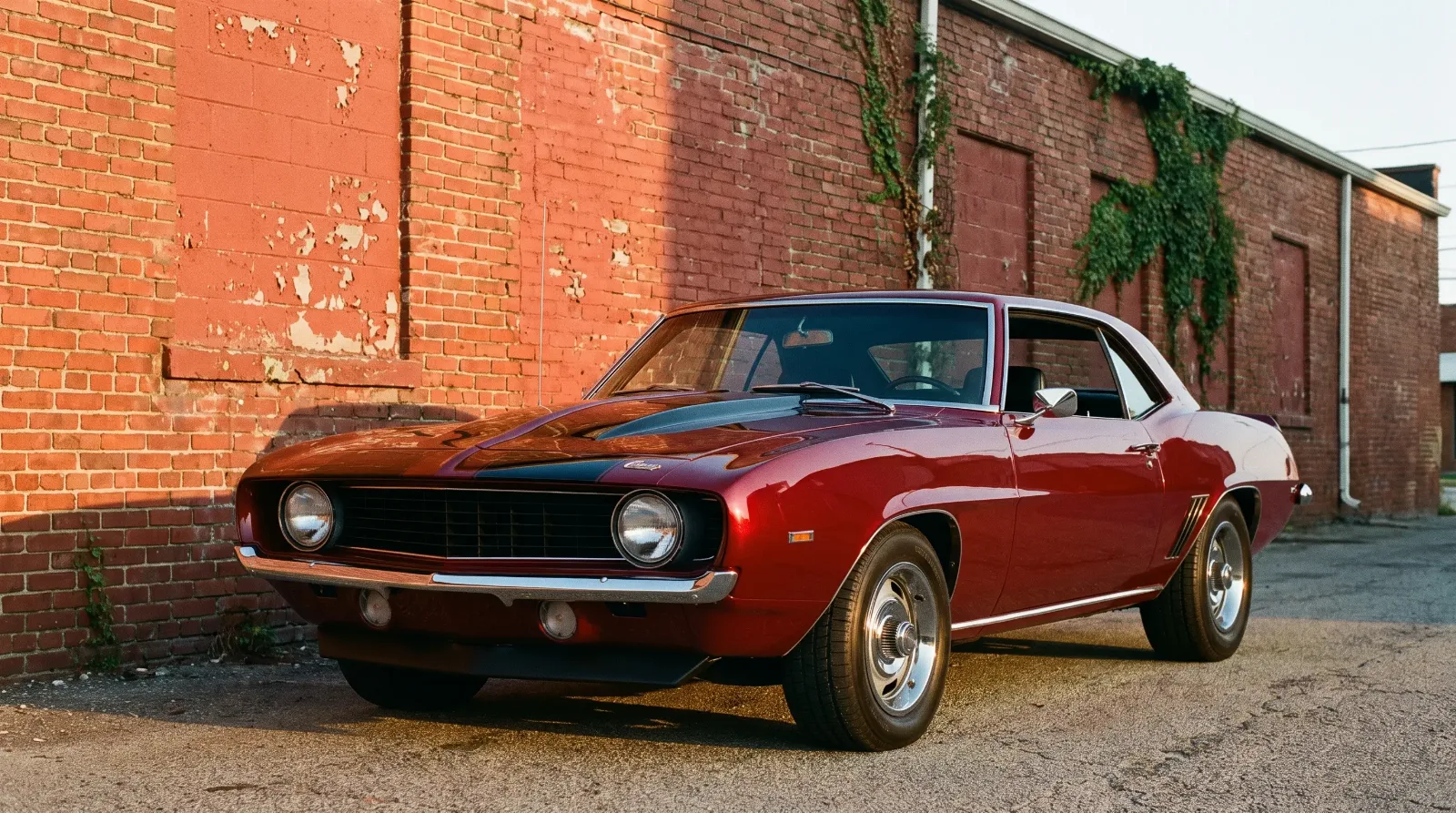

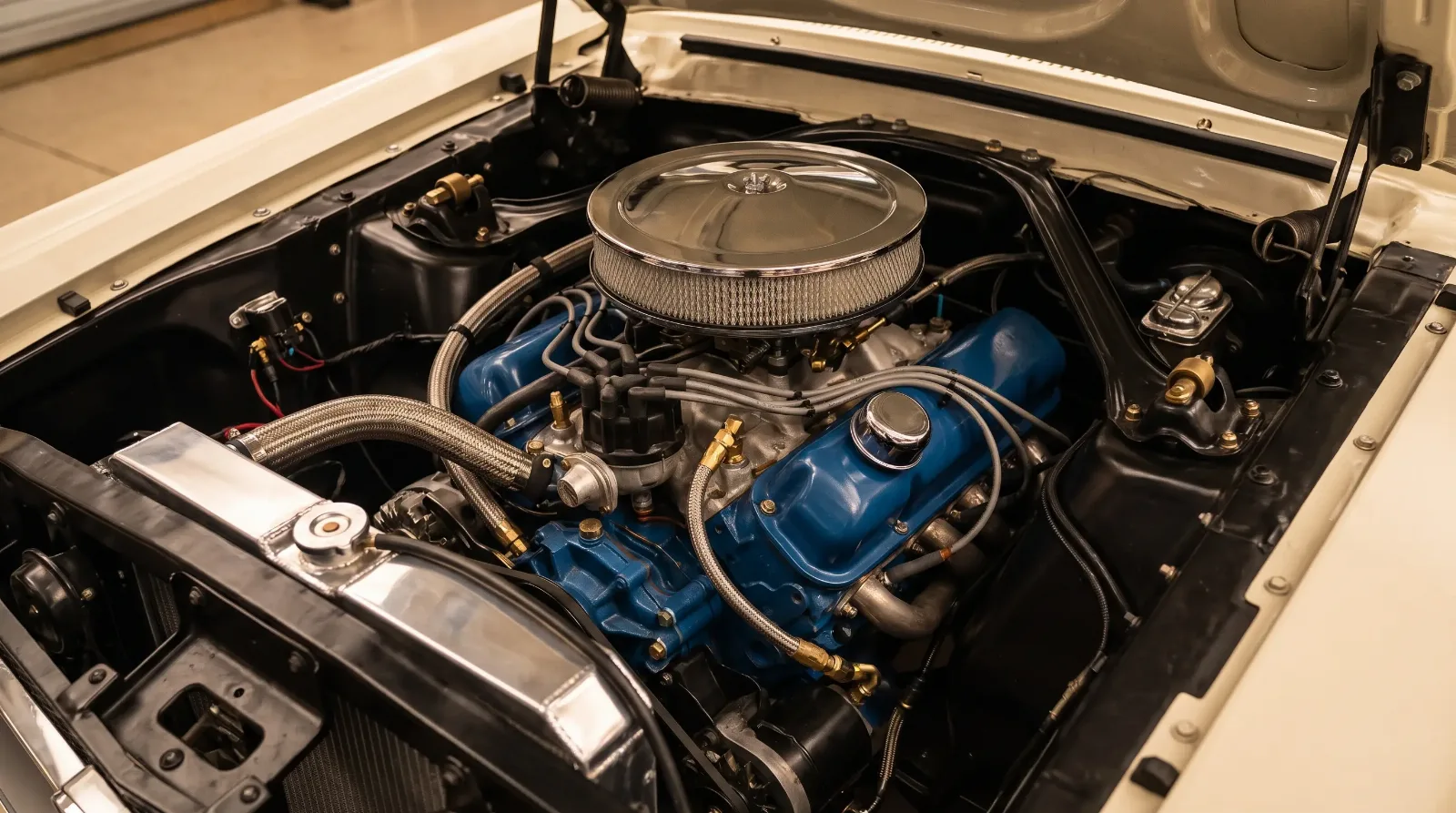
When Ford unveiled the Mustang in April 1964, the engine roster was deliberately layered. Product planners wanted a car that could be a thrifty commuter on Monday and a drag-strip threat on Saturday. To deliver that range, Ford drew on three distinct engine families across the first generation: inline-six economy blocks, small-block Windsor V8s, and eventually the bruising FE and 385-series big-blocks. Understanding which engine went into which car, and when, is the foundation of any serious numbers-matching restoration or purchase decision. If you want to understand where these engines fit within the broader story, start with the performance Mustang lineup before diving into the displacement details below.
The inline-six engines: 170 and 200 cubic inches
The base Mustang launched with Ford's 170 cubic-inch inline-six, a lightweight cast-iron unit carried over from the Falcon. Rated at 101 hp gross and paired with a three-speed manual, it gave the car an attractive window sticker price but little else to brag about. Ford replaced it partway through the 1964 1/2 model year, stepping up to the 200 cubic-inch inline-six that made roughly 120 hp gross. The 200 remained the base engine through 1970, long enough that a substantial portion of early Mustangs left the factory with it. Period road tests described it as adequate for urban driving, though every contemporary reviewer recommended spending the few extra dollars to step up to a V8.
The six-cylinder Mustang has traditionally been undervalued, which makes it increasingly interesting to collectors who want an honest, affordable entry point into the marque. The engine code for the 200 six is "T" on the VIN door tag, a detail that matters when confirming what a car left the factory with.
The small-block Windsor V8s: 260, 289, and 302
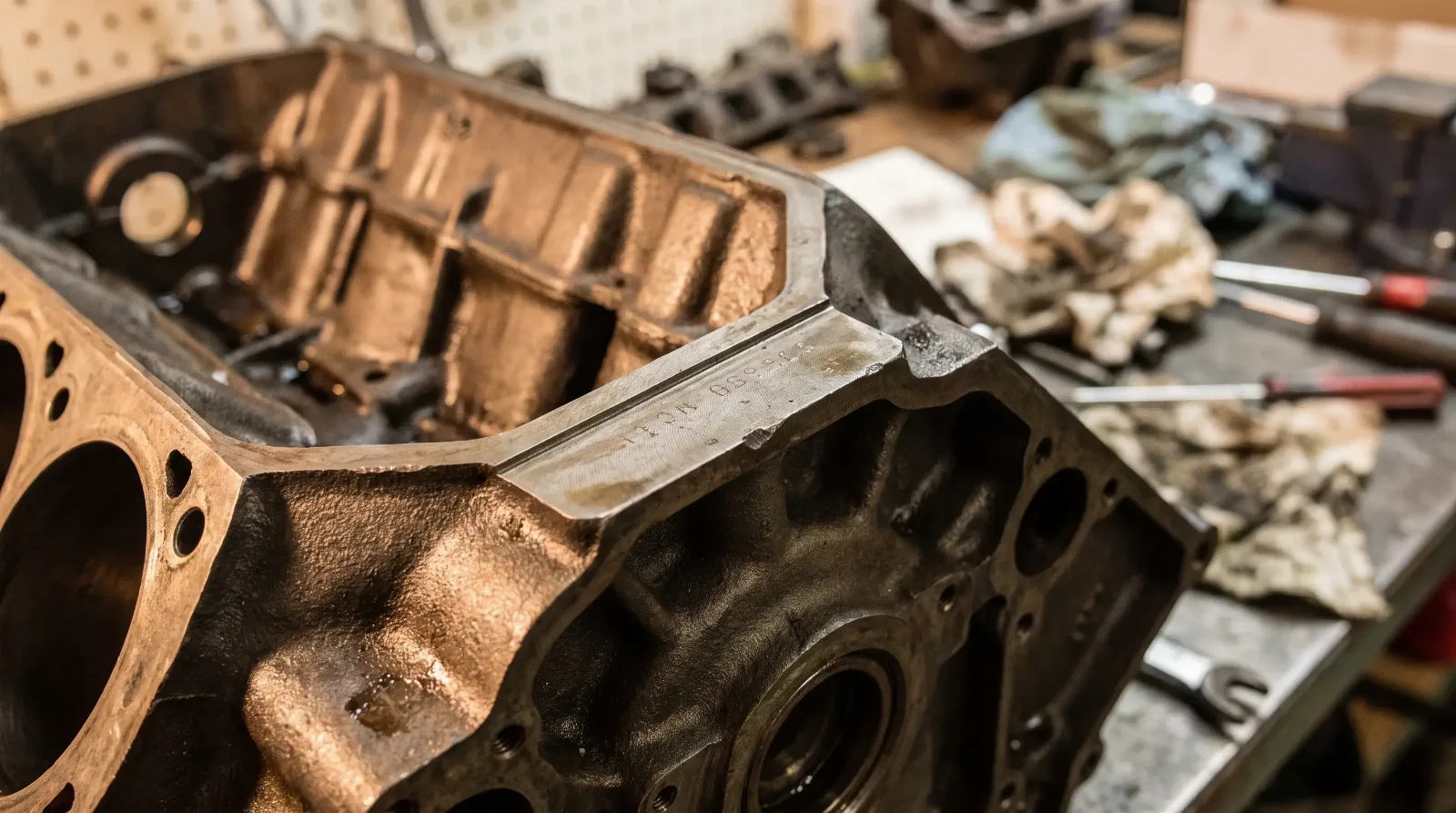
Ford's thin-wall Windsor V8 family defined the first-generation Mustang more than any other engine group. The 260 cubic-inch version (engine code "F") appeared in early 1964 1/2 cars and was quickly superseded, but it earns its place in the record as the first V8 offered in the nameplate. Ford moved fast: by mid-1964 the 289 had taken over in three states of tune.
The standard two-barrel 289 (engine code "C") made a conservative 200 hp gross and suited buyers who wanted V8 torque without premium-fuel obligations. A four-barrel version (engine code "A") pushed output to 225 hp gross; the early-1965 four-barrel "D" code that preceded it was rated at 210 hp gross before the A-code's higher-compression revision. Above the carbureted four-barrels sat the K-code. Ford's 289 High Performance, designated by VIN code "K," was a distinct engine rather than simply a carbureted upgrade. It featured solid lifters, a high-revving cam, a higher compression ratio, and a specially prepared bottom end. Rated at 271 hp gross from the factory, the K-code was capable of considerably more with minimal preparation, and period drag racers treated it accordingly. For a deeper comparison of how the 289 evolved into the next decade's workhorse, see the small-block story.
The 302 Windsor (engine code "F" in 1968 and later) arrived for 1968 as a displacement bump designed partly to stay beneath the insurance-rate threshold that punished larger-displacement engines. Sharing the same bore spacing and external dimensions as the 289, it was a natural swap candidate and the platform on which Ford later built the Boss 302.
The 351 Windsor and 351 Cleveland: the mid-range V8s
For 1969 Ford introduced the 351 cubic-inch small-block in Windsor form (engine code "H"), giving the Mustang a torquier alternative to the 302 without crossing into big-block territory. The 351W used the same block architecture as the 289 and 302 family, which made it attractive for engine-bay packaging and interchangeability. Output in base two-barrel trim ran approximately 250 hp gross.
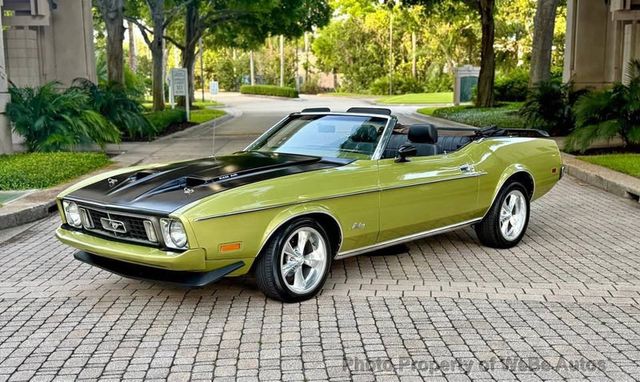
The 351 Cleveland was a different engine entirely, despite sharing displacement. It first appeared in the Mustang for the 1970 model year, where the four-barrel M-code version made 300 hp gross alongside a 250 hp two-barrel H-code. Ford's Cleveland facility produced a block with canted-valve heads that flowed considerably better than the Windsor design, and in four-barrel form the Cleveland made strong top-end power. By 1971, after the industry-wide compression reduction, the two-barrel Cleveland was rated at 240 hp gross and the four-barrel (engine code "M") at 285 hp gross. The Cleveland is often cited as having the best cylinder-head design Ford offered in the Mustang during this era, though its later years placed it squarely in the compression-reduction window, which limited what factory specs could officially reflect.
"When people talk about a first-gen Mustang's character, they're almost always describing the engine. The car the factory put around it is secondary, and that's not an accident."
— Mike Sullivan
The big-blocks: FE-series and 385-series engines
Ford's FE engine family, a long-running V8 line developed in the 1950s, made its Mustang appearance in 1967 when the body was widened enough to accommodate the larger block. The 390 cubic-inch FE (engine code "S") was the entry point. In four-barrel GT form it was rated at 335 hp gross at its 1967 debut, easing to 325 hp for 1968 and 320 hp by 1969, and it gave the Mustang genuine muscle-car credibility against the Chevelle SS 396 and Pontiac GTO of the same period. The 390 was a torque engine more than a high-rpm performer, and buyers who expected it to behave like a race motor were sometimes surprised by its early-throttle character.
Above the 390 sat the 428, and above that the legendary 428 Cobra Jet. Ford introduced the 428 CJ (engine code "R") in April 1968, and it is widely regarded as the most significant performance Mustang engine of the decade. Factory rated at 335 hp gross, an obvious understatement that Ford used to manage insurance premiums, the 428 CJ was capable of considerably more. The Super Cobra Jet variant (engine code "S" with a drag-pack option) added an oil cooler, a cross-bolted main bearing cap arrangement, and Le Mans rods, making it viable for sustained high-rpm use. Serious enthusiasts shopping classic Mustangs with FE big-blocks should confirm engine stampings carefully, as 390 and 428 engines have been swapped frequently over the decades. You can find original examples among the listings of classic Mustangs currently available.
For 1971, Ford introduced the 385-series 429 cubic-inch V8 (engine code "C" or "J" depending on tune) in the Mustang. In Cobra Jet form it produced 370 hp gross; the Super Cobra Jet version was rated at 375 hp gross. The 429 Cobra Jet represented the final expression of Ford's big-block Mustang ambition before tightening emissions regulations and fuel economy pressures changed the market fundamentally after 1971.
Engine reference: first-generation Mustang powerplants at a glance
| Engine | Years offered | Type | VIN code | Notable |
|---|---|---|---|---|
| 170 inline-six | 1964 1/2 | OHV I-6 | U | Launch base engine; replaced quickly |
| 200 inline-six | 1965-1970 | OHV I-6 | T | Long-running economy option |
| 260 V8 | 1964 1/2 | OHV V8, Windsor | F | First V8 in a Mustang; short production run |
| 289 2V V8 | 1965-1967 | OHV V8, Windsor | C | Base V8; regular fuel |
| 289 4V V8 | 1965-1967 | OHV V8, Windsor | A | Mid-level four-barrel |
| 289 Hi-Po (K-code) | 1965-1967 | OHV V8, Windsor | K | Solid lifters; most desirable pre-1968 small-block |
| 302 V8 | 1968-1970 | OHV V8, Windsor | F | Replaced 289; basis for Boss 302 |
| 351 Windsor | 1969-1970 | OHV V8, Windsor | H | Torquier small-block alternative |
| 351 Cleveland | 1970-1973 | OHV V8, Cleveland | M | Canted-valve heads; strong top-end flow |
| 390 FE V8 | 1967-1969 | OHV V8, FE-series | S | First big-block Mustang; torque character |
| 428 Cobra Jet | 1968-1970 | OHV V8, FE-series | R | Underrated at factory; most iconic FE |
| 428 Super Cobra Jet | 1968-1970 | OHV V8, FE-series | S (drag pack) | Le Mans rods; oil cooler; track-focused |
| 429 Cobra Jet | 1971 | OHV V8, 385-series | C | Final big-block era; emissions pressure looming |
| 429 Super Cobra Jet | 1971 | OHV V8, 385-series | J | Top factory rating of the generation |
Sources and notes
All horsepower figures in this guide are factory SAE gross ratings, measured without accessories such as the air cleaner, alternator, fan, and full exhaust. Ford switched to the lower SAE net standard for 1972, so 1971-and-earlier numbers are not directly comparable to later model years. Several performance engines, notably the 428 Cobra Jet and the K-code 289, were widely regarded as conservatively rated for insurance purposes, and independent testing of the era frequently recorded higher output than the published figures. Engine availability and ratings varied within a model year (early vs. late 1964 1/2, mid-year introductions, and running production changes), so individual cars should always be confirmed by their door-tag and block stampings rather than by year alone.
The references below were used to verify displacement figures, availability years, VIN/engine codes, and gross horsepower ratings.
- Ford Mustang (first generation) — Wikipedia
- Ford 335 engine (351 Cleveland) — Wikipedia
- Sorting out the Mustang's 351 Cleveland engines — Hagerty Media
- First-Generation Mustang Engine Codes — CJ Pony Parts
- Engine Specifications — The Mustang 428 Cobra Jet Registry
- Mustang Engines by Model Year — MustangSpecs