A car on the edge of extinction
By the close of 1954, Chevrolet's Corvette was in serious trouble. The two-seat sports car had arrived for 1953 wrapped in genuine excitement, but the reality of owning one quickly dampened enthusiasm. Its Blue Flame Six engine, carried over from passenger-car duty, produced 150 hp through a triple-carburetor arrangement that felt more optimistic than outright fast. The Powerglide automatic was the only transmission available, an odd choice for a sports car. And the build quality from the Flint, Michigan assembly line left plenty of room for improvement. By the end of the 1954 model year, Chevrolet had accumulated roughly 1,100 unsold Corvettes sitting in storage, an embarrassment that reached directly to the desks of General Motors executives. You can read more about those founding struggles in the full C1 Corvette history.
General Motors was, by multiple credible accounts, genuinely weighing whether to cancel the Corvette entirely. The numbers were damning. The car cost more to build than it sold for in meaningful volume, it had not captured the sports-car audience it was supposed to attract, and the division had no clear path toward making it competitive. Into this atmosphere of institutional doubt arrived two developments that would change everything: a new engine, and a very inconvenient competitor from Ford.
Ford's Thunderbird and the competitive crisis of 1955
Ford announced the Thunderbird for 1955, and its sales figures landed like a verdict. The Thunderbird moved approximately 16,155 units in its first model year against the Corvette's roughly 700. That ratio, more than twenty-to-one, was not just a commercial loss. It was a public humiliation. The Thunderbird offered a V8 from the outset, optional porthole hardtop, roll-up windows, and a driving experience that felt substantially more refined than anything Chevrolet had managed in two Corvette model years. If GM's sports car could not compete with Ford's personal luxury entry, the argument for keeping it alive became very difficult to make.
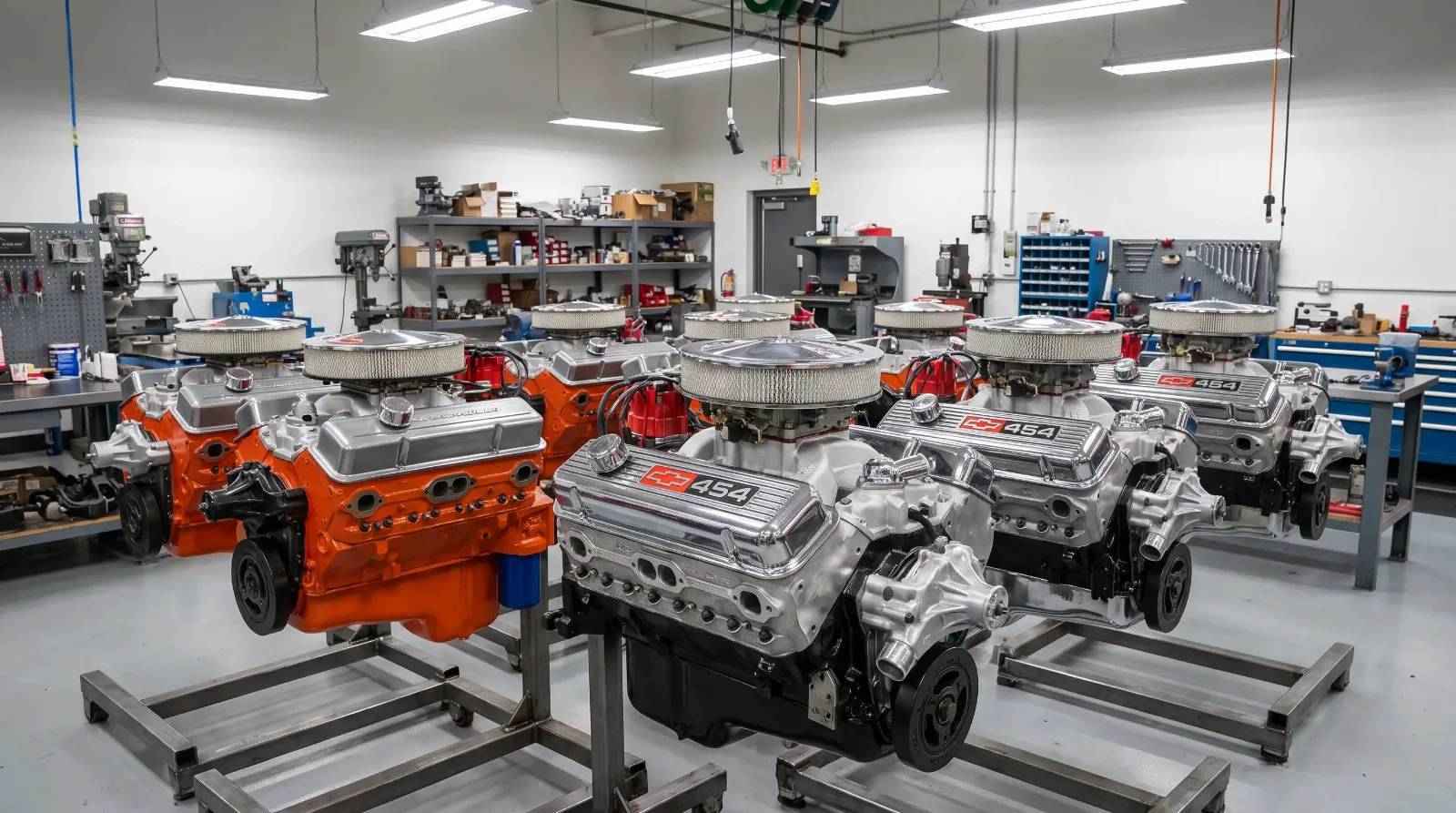
What saved the conversation, at least inside GM, was that a solution was already in development. Ed Cole, then Chevrolet's chief engineer, had been building something important. Cole and his engineering team had designed a new small-displacement V8 from the ground up, one that prioritized lightweight construction, high-revving potential, and a compact package that could fit across the Chevrolet lineup. The 265 cubic inch V8 that emerged from Cole's team would prove to be one of the most consequential engine designs in American automotive history, spawning a family that grew well beyond 400 cubic inches before it was done.
The 265 ci small-block arrives
Cole's 265 ci V8 was offered in the 1955 Corvette with a single four-barrel carburetor producing 195 hp, a substantial improvement over the Blue Flame Six it replaced, which managed 150 hp in its triple-carburetor Corvette tune. The weight difference mattered too. The new V8 was engineered for efficiency in more than one sense: it was lighter than comparable engines of its era, which helped the Corvette's power-to-weight equation without requiring major chassis revisions.
Alongside the V8 came something the Corvette had never offered before: a three-speed manual transmission. This was not a minor detail. Sports car buyers, particularly those who had been frustrated by the Powerglide automatic since 1953, had been asking for a manual gearbox since the beginning. The combination of the 265 ci V8 and a proper manual transmission finally gave the Corvette the mechanical foundation that matched its visual ambitions.
The production numbers for 1955 reflect just how close to the edge the Corvette had come. Approximately 700 units were built, the lowest figure for any Corvette model year. The vast majority carried the new V8; only a handful of early 1955 units were completed with the Blue Flame Six still in place, a remnant of the production transition rather than a deliberate sales choice. What is not in dispute is that the V8 was the configuration that mattered commercially and reputationally, and it was the one that drove whatever enthusiasm existed for the model year.
Zora Arkus-Duntov and the performance argument
Zora Arkus-Duntov had joined Chevrolet in 1953, drawn in part by the Corvette's potential. An engineer with genuine racing experience and an understanding of what made European sports cars work, Duntov had watched the first two Corvette model years with a mixture of admiration for the concept and frustration at its execution. He had written internal memos pushing for more power, better handling, and a manual transmission. The arrival of Cole's 265 ci V8 validated that argument.
Duntov did not design the 265, but he understood immediately what it meant for the Corvette's future. A car with 195 hp, a manual gearbox, and a chassis that could be progressively improved was a car that could be developed into a serious performance machine. The 1955 model year was not that machine yet, not in its final form, but it established the mechanical lineage that would make the 1956 follow-up genuinely competitive. Duntov's influence over the Corvette's development arc, which would eventually include a major role in its racing program, begins to make real sense when you understand that 1955 gave him an engine he could actually work with.
| Specification | 1954 Corvette (Blue Flame Six) | 1955 Corvette (265 ci V8) |
|---|---|---|
| Engine | 235 ci inline-six | 265 ci V8 |
| Horsepower | 150 hp | 195 hp |
| Transmission | Powerglide automatic only | Powerglide auto or 3-speed manual |
| Model year production | ~3,640 units | ~700 units |
| Ford Thunderbird (same year) | N/A | ~16,155 units |
Why 1955 guaranteed the Corvette's future
The argument that the 265 ci V8 saved the Corvette is not sentimental. It is mechanical and commercial. Without a V8, Chevrolet had no credible answer to the Thunderbird's powertrain, no way to satisfy the buyers who wanted a proper sports car rather than a novelty, and no engineering foundation for the performance improvements that would follow. The manual transmission was equally important as a signal: GM was finally treating the Corvette as a driver's car, not a show piece.
"When I look at the 1955 Corvette, I see a car that survived almost by accident. The production numbers were catastrophic, the Thunderbird was outselling it by a ratio that would make any product manager reach for the cancellation paperwork. What changed the calculation was not marketing or styling but a single engineering decision: put Cole's V8 in the car and give buyers a manual gearbox. That combination bought the Corvette enough credibility to survive into the years when it became genuinely great."
— Tom Ramirez
The 700 units built for 1955 represent the Corvette's near-death experience. But each one that left the factory with the 265 ci V8 under its fiberglass hood was proof that the car could be something more than its first two years had suggested. By the time the 1956 model arrived with a restyled body and further performance improvements, the decision had already been made: the Corvette would continue. That decision traced directly back to Ed Cole's small-block and the model year that almost did not happen at all. If you want to see where the classic 1950s Corvette lineage leads, the 1955 model year is where the story's outcome was settled.
Sources and notes
- Hemmings Motor News — 1955 Chevrolet Corvette — Production figures, V8 introduction details, and model year context from Hemmings' Corvette coverage.
- Motor Trend — Corvette 50-year history retrospective — Comprehensive archive piece covering the 1953–1955 period and Ed Cole's engineering contributions.
- Corvette Action Center — 1955 C1 specifications — Factory specifications and production breakdown for the 1955 model year.
- National Corvette Museum — Corvette history — Institutional history covering the early model years, including the 1955 production crisis and the small-block V8 introduction.