Why the numbers matter before you write a check
I've spent a lot of time working from original factory records, and the same truth comes up every time: a Camaro's documentation tells a more complete story than any cosmetic restoration ever can. Numbers matching is not about snobbery. It's about provenance. A car that left Norwood or Van Nuys with a specific drivetrain, in a specific color, built to a specific order has a paper trail that either survives or it doesn't. When it does, the value difference compared to a well-assembled clone can run $20,000 to $50,000 on desirable 1969 configurations. When it doesn't, the car is worth what it looks like, not what it claims to be.
If you're working through the classic Camaro restoration guide, the documentation audit below belongs at the very beginning of the process, before a dollar goes toward paint or interior. Find the inconsistencies now, while you can still renegotiate or walk away.
The cowl tag: what it records and how to read it
The cowl tag, a small aluminum plate riveted to the firewall on the driver side, is the factory's summary of what this specific car was ordered to be. On first-generation Camaros (1967 to 1969), it lists the body style code, exterior paint code, interior trim code, build date, and the manufacturing plant. The tag is stamped, not printed, so alterations are detectable with close inspection under light.
The paint code is the first cross-reference point. A 1969 Camaro with a trim tag showing paint code 72 should be Fathom Green. If the car is wearing a repaint in Hugger Orange with no explanation of the color change documented in the car's history, that's a question to answer, not a reason to panic, but a question. Original-paint cars carry a premium, and sellers who know this sometimes omit the repaint disclosure. Check the jambs, the door hinges, and inside the trunk lid hinge pockets for original color traces.
The build date on the cowl tag gives you a second data point. The engine's pad stamp should reflect a date equal to or slightly earlier than the body build date. An engine dated significantly after the body build date (more than a few weeks) was not the engine the car left the factory with. This is the most common inconsistency I find on cars presented as numbers matching.
The VIN derivative stamp on the engine pad
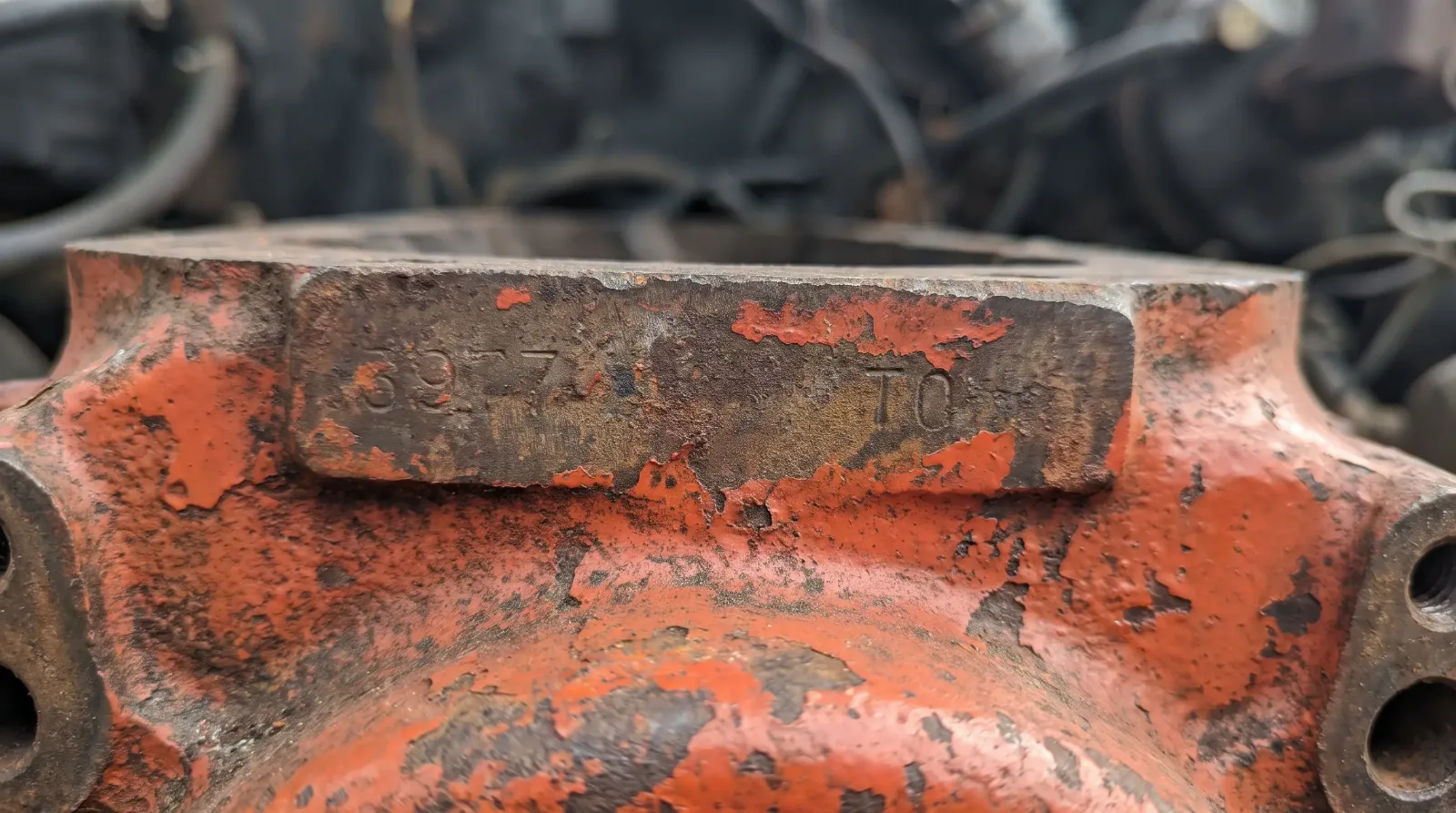
This is the number that separates a matching-numbers car from one wearing the right engine family but not the right engine. On Camaro V8s, the engine ID code is stamped on a machined pad just forward of the cylinder head on the passenger side of the block. That code contains the assembly plant, the production date, and a suffix code that identifies the engine's intended application. The partial VIN, a shorter derivative of the full vehicle identification number, appears alongside it on cars built for specific applications.
The suffix code is where authentication lives. A 1969 L78 396 (375 hp) carrying the suffix "JH" was destined for a Camaro with a manual transmission, while the same engine behind a Turbo-Hydramatic automatic carried the suffix "JL." A car with the wrong suffix, even if the displacement and cylinder count are correct, is not a numbers-matching car. It received a correct-family engine that did not originally belong to this vehicle. Suffix code charts for Camaro applications are well documented in factory and registry literature, and anyone buying a high-value example should have that chart in hand before the inspection.
Next in the series, see rust repair.
Restamped pads are the other issue. If the original engine was pulled and sold (a common fate for high-performance blocks during the 1970s), some sellers had the replacement engine's pad restamped to show the original numbers. The telltale signs are stamping inconsistencies: uneven character depth, a pad surface that's been ground smooth before restamping, or character fonts that differ from factory tooling. A magnet won't catch this. You need light at a low angle across the pad surface, and ideally a reference photograph from an authenticated example.
| Location | What it records | What to cross-check |
|---|---|---|
| Cowl tag (firewall, driver side) | Paint code, trim code, build date, plant | VIN plant character (position 11), paint traces in jambs |
| Engine pad (passenger side, forward of head) | Assembly plant, engine date, suffix code, partial VIN | Engine date must precede or match body build date; suffix must match transmission and application |
| Transmission (tail housing or main case) | Partial VIN derivative (last 8 digits) | Must match the car's full VIN suffix; casting date must precede body build date |
| Rear axle (carrier or housing) | Partial VIN derivative, axle ratio code | Axle ratio should match what was ordered; RPO codes on broadcast sheet confirm |
| Broadcast sheet (under carpet, behind seat panels, under insulation) | Full option content as built, RPO codes | All option codes should reconcile with cowl tag, SPID label, and Protect-O-Plate if present |
Transmission and rear partial VINs
The Muncie four-speed and Turbo-Hydramatic transmissions used in first-generation Camaros carry a partial VIN stamped into the case. On Muncie units, this stamp appears on the main case or the side cover. On TH350 and TH400 automatics, it appears on the main case pad. The partial VIN typically represents the last eight digits of the full vehicle VIN. A transmission that matches this derivative is, by definition, the transmission that left the factory in this car.
Finding transmissions with matching partial VINs is harder than finding matching engines, partly because transmissions move between cars even during the factory warranty period and partly because the registry focus for Camaro has historically centered on the engine. But for Z/28 cars, where the close-ratio Muncie M22 (the "Rock Crusher") was standard, matching transmission documentation adds meaningful value and credibility.
The rear axle is often overlooked. The 12-bolt Positraction rear, standard on SS models and available on Z/28s, carries a partial VIN on the carrier or the housing. The axle ratio should reconcile with what the broadcast sheet records. A 3.73 rear on a car documented with a 4.10 axle in the factory order is an inconsistency worth explaining.
"The broadcast sheet is the closest thing you'll find to the factory's internal build ticket. When it survives, it tells you what every other stamp and tag should say. When it doesn't, you're cross-referencing the secondary sources against each other and hoping they align. I've seen cars where four out of five data points are consistent and the fifth is wrong in a way that changes everything about what the car is."
— Tom Ramirez
Broadcast sheets and verifying an SS or Z/28
The broadcast sheet, also called the build sheet, is the factory production document that traveled with the car down the assembly line. It lists every RPO (Regular Production Option) code ordered for this specific VIN. Chevrolet workers used it to pull parts and verify assembly. At the end of the line, the sheets were discarded, but many survived because workers tucked them under seat cushions, behind door panels, under insulation pads, or beneath trunk carpets. Finding one intact with a car is a genuine documentation event.
For SS verification, the broadcast sheet should show RPO Z27 (the SS package itself) along with the engine RPO that defines the SS variant. The L35 (325 hp 396) and L78 (375 hp 396) are the standard reference points for 1969 SS cars. The Z27 package also included specific suspension, trim, and badging components that should be present and consistent with the car you're looking at.
The Z/28 is a different conversation entirely. The 1969 Z/28 was RPO Z28, not a separate model designation, and it was a low-volume performance package built around the 302 cubic inch small block. That engine, rated at 290 hp but widely understood to have made considerably more in stock form, carries the suffix code "DZ" and was offered only with a manual transmission (there was no factory automatic application for the 1969 Z/28). The Z/28's DZ 302 block has its own casting numbers: 3956618 for 1969. If those casting numbers are not present, the engine is not correct regardless of what the cowl tag says. For an in-depth look at the SS and Z/28 cars, the factory documentation audit described here is the starting point for every serious evaluation.
Beyond the broadcast sheet, Chevrolet issued a Protect-O-Plate card as part of the warranty documentation. This wallet-size card encoded the car's option content in a format service departments could read. Surviving Protect-O-Plates with matching VINs are uncommon, but they provide an independent cross-reference against the broadcast sheet. NCRS-style registries have documented the encoding format in detail.
Sources and notes
Production figures, engine specifications, codes, and dates in this article are cross-referenced from established Camaro references, period documentation, and owner registries. Where sources differ, the most commonly cited value is used. Cost figures are indicative and vary by supplier, region, and condition.
- 1967-69 Camaro Drivetrain Decoding (engine suffix codes) - Camaro Research Group
- Camaro VIN, Cowl Tag, and other Numbers Decoding - Camaro Research Group
- 1967-1969 Chevy Camaro (First Gen) VIN Decoder - JEGS
- How to identify a 1969 Z28 DZ302 engine - Team Camaro Tech
- 1969 Camaro Statistics, decoding & reference - NastyZ28