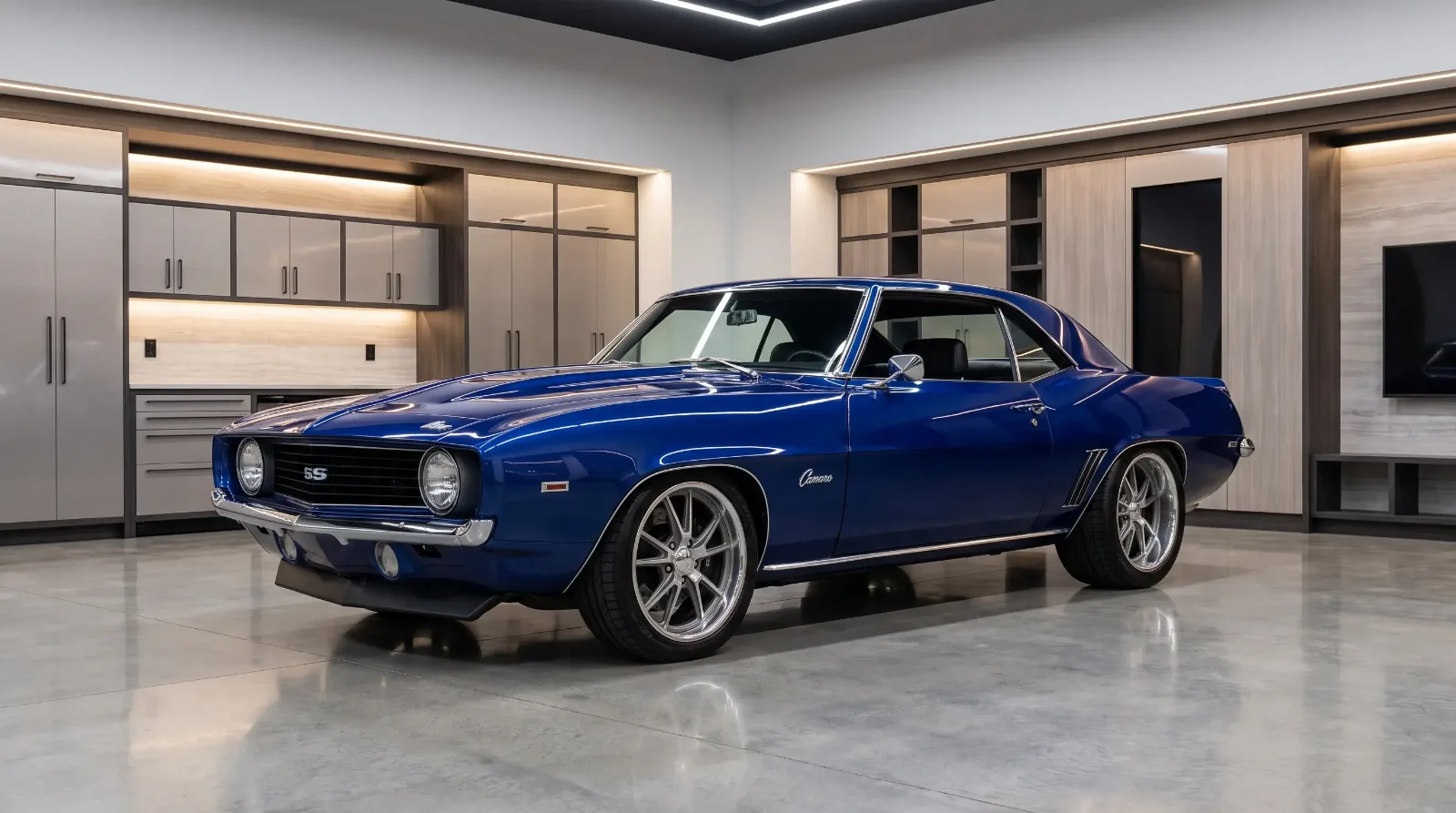
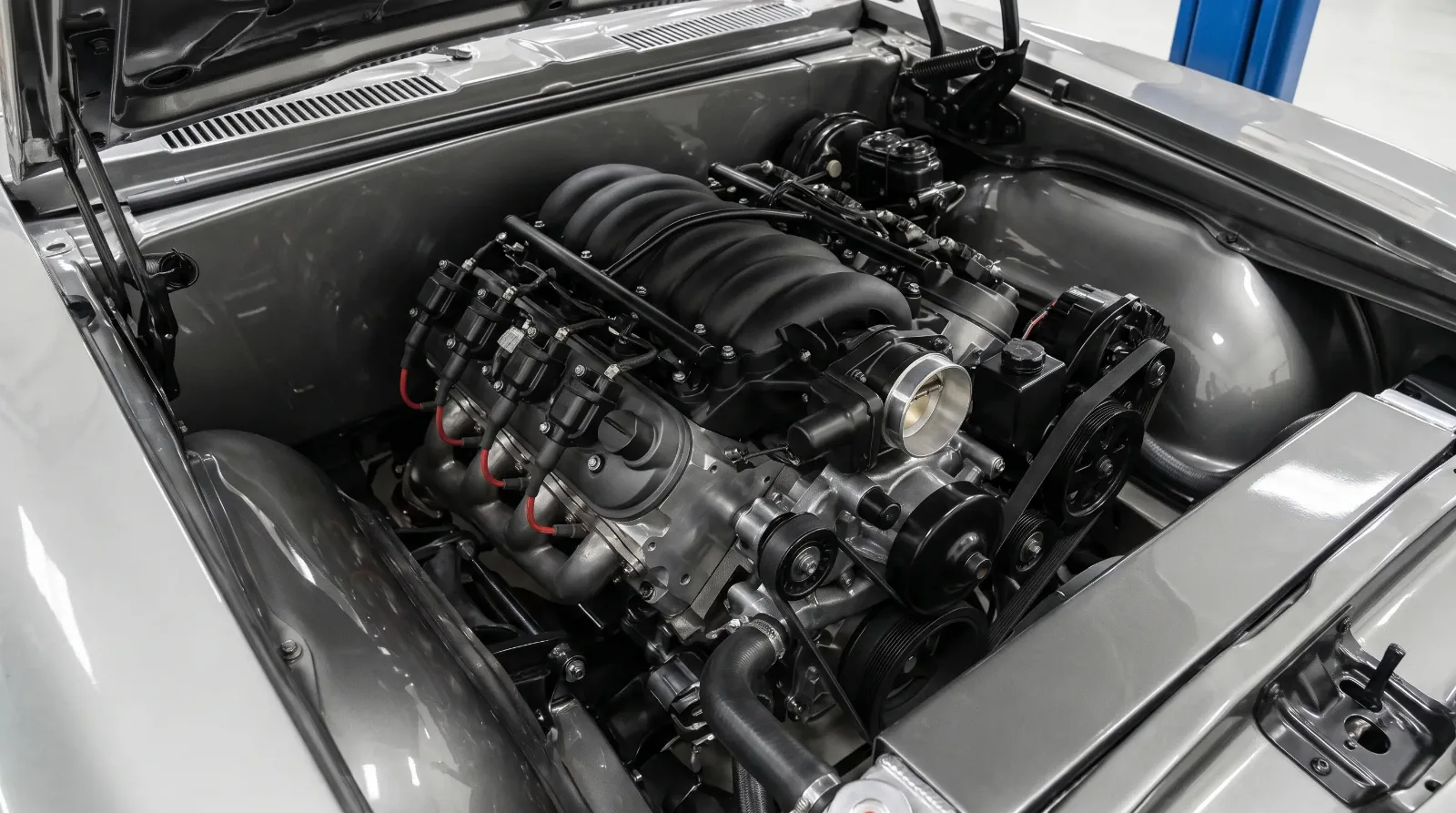
The engine defines the rest of the build
Every major decision in a Camaro restomod traces back to the engine. Brake size follows horsepower. Transmission choice follows torque output. Fuel system complexity follows injector configuration. Cooling system capacity follows heat rejection. Choosing the engine first and building outward is the only logical sequence, yet many builders pick wheels and headers before they know what engine is going in. The result is a box of parts that does not fit together cleanly.
The three realistic categories for a serious first-gen Camaro restomod are the GM LS family, the GM LT family (LT1, LT4, LT5), and the traditional big-block (454, 496, or 502 crate). Each has genuine advantages and genuine compromises. The right choice depends on your power target, your budget, and whether the car will be inspected in a state with strict emissions rules.
This guide covers the engine decision. For context on the full build, see our Camaro restomod overview, and the complete Chevrolet Camaro story for where these engines fit in the model's history.
GM LS crate engines: the default choice for good reason
The LS engine family is the dominant choice for first-gen Camaro builds and for good reason. The block is small, light (approximately 450 lbs dressed), and fits in the original engine bay with minimal modification. Power output ranges from 350 horsepower in a mild LS1 rebuild to 650-plus in a supercharged LSA or LSX crate unit. GM Performance sells crate LS engines directly, and Chevrolet Performance's catalog includes the LS3 at 430 horsepower for around eight thousand dollars and the LSA supercharged unit at 556 horsepower for well into five figures.
Third-party LS crate builders including BluePrint Engines, Pace Performance, and Texas Speed offer assembled crate LS engines at various price points. A 427 LS3 crate from BluePrint Engines runs around seven thousand dollars fully assembled with timing cover and oil pan. These engines use new or remanufactured blocks and are available with a warranty that the OEM-surplus LS engines pulled from wrecked cars are not.
- LS1 (350 hp reman): roughly four thousand dollars
- LS3 430 hp crate (Chevrolet Performance): around eight thousand dollars
- BluePrint 427 LS3: around seven thousand dollars
- LSA supercharged 556 hp: well into five figures
GM LT crate engines: more power, more complexity
The LT1, LT4, and LT5 engines from the C7 and C8 Corvette are the next generation GM small-block. The LT family uses direct injection and displacement on demand, which complicates the fuel system significantly. You need a high-pressure direct injection fuel pump, a separate port injection or returnless returneed fuel system, and a standalone ECM that manages both. The stock LT1 makes 455 horsepower in Corvette trim. The LT4 supercharged unit makes 650 horsepower and the LT5 makes 755 horsepower.
Chevrolet Performance sells LT1 and LT4 crate engine packages. The LT1 Connect and Cruise package, which includes the engine, 8-speed automatic, ECM, and wiring harness, runs around twenty thousand dollars. The LT4 package is in the mid-twenty-thousands. These numbers are significantly higher than the LS equivalent, and the installation complexity is also higher. For a builder who wants maximum power from a modern engine family, the LT is compelling. For a builder who wants simplicity with strong performance, the LS makes more sense.
"I have built both. The LT4 is an incredible engine and the power delivery is smooth in a way the big-block never is. But the fuel system wiring alone added two weeks to the build. If you have not done a standalone ECM tune before, budget for professional calibration."
-- Mike Sullivan
Traditional big-block: the original formula
A numbers-matching first-gen Camaro with a big-block is a different conversation than a restomod build. But for builders who want the traditional look and sound of a 396, 454, or stroked 496, the big-block crate engine remains a strong option. Chevrolet Performance's ZZ454 crate engine produces 450 horsepower and 500 lb-ft of torque for around eight thousand dollars. Brodix, Dart, and World Products all sell big-block short blocks that a builder can assemble to a target power level.
The tradeoffs with a big-block restomod are well known. The engine is heavier by roughly 100-150 lbs versus an LS of similar output, which biases weight forward and requires stiffer front springs. Carbureted big-blocks run a carburetor and mechanical fuel pump rather than the more complex injection systems, which some builders prefer for simplicity. For a car that will stay carbureted and run a period-correct look with modern chassis underneath, the big-block is entirely legitimate.
Supporting systems: cooling, exhaust, and ECM
Every engine choice requires matching support systems. An LS or LT engine needs a standalone ECM (Holley HP or Terminator X, roughly one to two thousand dollars) unless you use the full Connect and Cruise kit. Both engine families need a custom oil pan for first-gen Camaro clearance, with sump location at the front. Canton, Milodon, and Holley all make first-gen LS oil pans at a few hundred dollars.
Cooling system requirements increase with power output. A 450-horsepower engine needs a 3-row or 4-row aluminum radiator at minimum, or a quality two-row all-aluminum unit from Griffin or Fluidyne at several hundred dollars. Electric fan setup from SPAL or Flex-a-lite pulls another few hundred dollars. Budget for all supporting systems before committing to the engine, and then move on to our guide on restomod interiors to complete the build.
| Engine | Output | Approx. Cost | Complexity | Best For |
|---|---|---|---|---|
| LS3 430 hp | 430 hp / 425 lb-ft | ~$8,000 | Moderate | Street touring |
| LSA 556 hp | 556 hp / 551 lb-ft | low five figures | Moderate-High | Street/track |
| LT4 650 hp | 650 hp / 650 lb-ft | mid-$20,000s | High | Max performance |
| ZZ454 BB | 450 hp / 500 lb-ft | ~$8,000 | Low-Moderate | Traditional build |
Sources and notes
Production figures, engine specifications, codes, and dates in this article are cross-referenced from established Camaro references, period documentation, and owner registries. Where sources differ, the most commonly cited value is used. Cost figures are indicative and vary by supplier, region, and condition.