The Engineer Who Refused to Accept Compromise
In the early 1950s, Chevrolet was not a glamorous division. It built practical cars for practical people — reliable, affordable, and almost deliberately unheroic. That changed when Edward Nicholas Cole arrived as chief engineer in 1952. Cole was thirty-nine years old, relentlessly ambitious, and possessed of a rare combination: genuine engineering talent paired with the political instincts to turn ideas into production reality. His arrival at Chevrolet would eventually reshape American automotive history, and the instrument of that reshaping was a small-block V8 engine that barely existed when he first walked through the door.
The Corvette, introduced in 1953, was already struggling. The car looked dramatic — a fiberglass-bodied two-seater with genuine sports car proportions — but underneath sat a six-cylinder engine borrowed from Chevrolet's passenger car line. The "Blue Flame Six," as it was optimistically called, produced 150 horsepower when coupled to a two-speed Powerglide automatic transmission. For a car that was supposed to represent American performance on the world stage, this was an embarrassment. Cole understood the problem immediately.
Drawing the Small-Block from Scratch
What made Cole's approach to the new V8 unusual was his refusal to begin with what already existed. Chevrolet's truck division operated a stout, long-stroke six-cylinder engine. The natural path of least resistance would have been to evolve a V8 variant from that architecture. Cole rejected the idea. He wanted an engine designed from first principles — one that would be light enough, compact enough, and free-revving enough to serve in both passenger cars and performance applications.
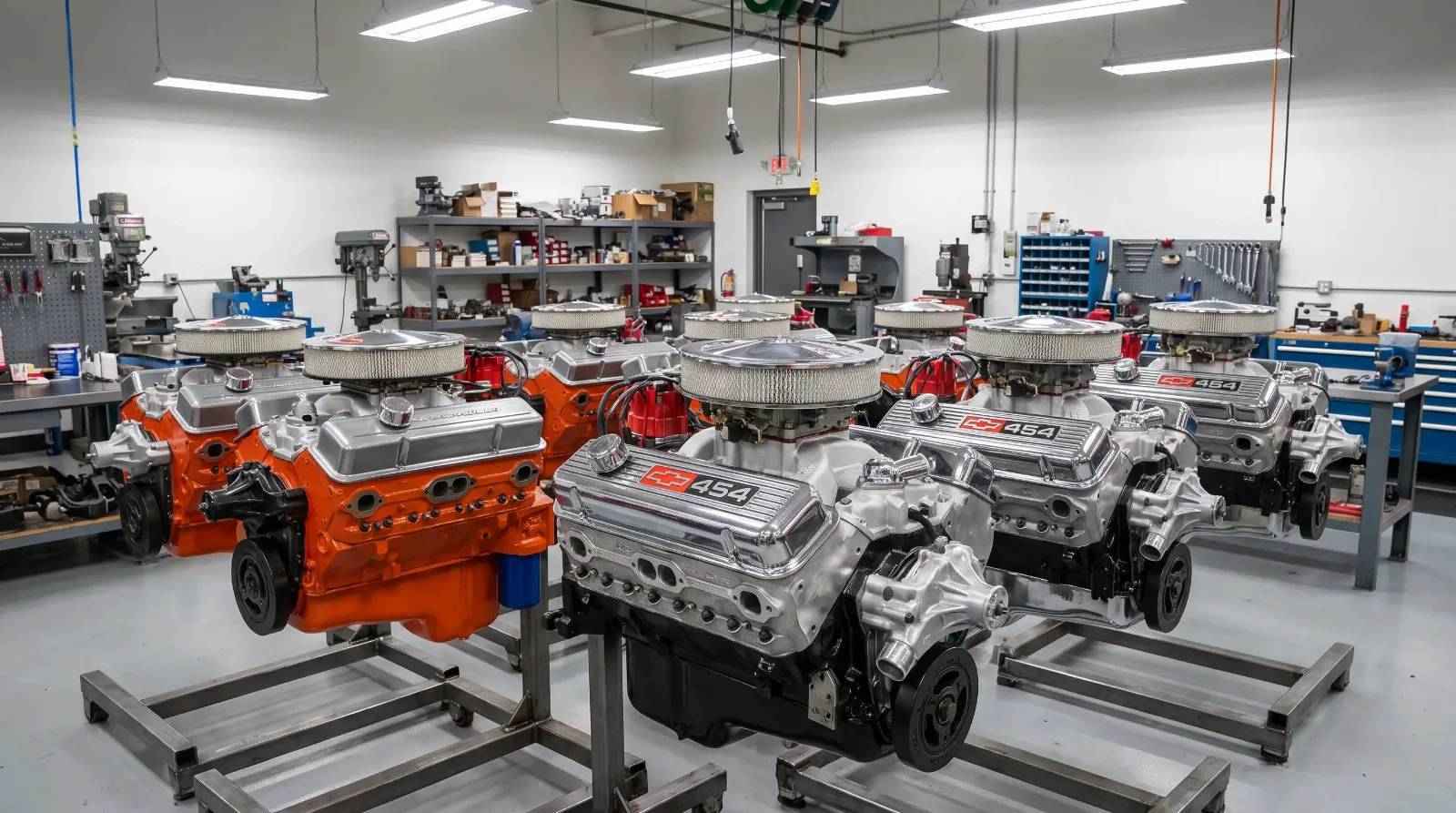
The result was the 265 cubic inch V8, which entered production for 1955. Its displacement figure has become so familiar over the decades that it's easy to forget how deliberately unconventional some of its design choices were at the time. The engine used thin-wall casting for the block, which reduced weight significantly compared to the heavier-walled designs of competitors. Where most V8s of the era used rocker arms mounted on a shared rocker shaft — a design that added weight and complexity — Cole's team specified individual rocker arms, each pivoting on its own ball stud. The manufacturing tolerance this required was tighter, but the result was an engine that breathed more freely at high rpm and was easier to service.
The 265 also featured a short stroke relative to its bore diameter, a configuration that allowed higher engine speeds without the piston velocity penalties that plagued long-stroke designs. Cole was building, in essence, a high-revving sports car engine that could also idle smoothly enough for a grandmother's Bel Air. The engineering brief was that contradictory, and the 265 met it.
"We didn't want to build a truck engine that happened to be a V8. We wanted an engine that could grow with the car, something that had headroom built into the design from the first day."
— Ed Cole, as quoted in period automotive press accounts
The Corvette's Crisis and Cole's Solution
By 1954, the Corvette's future was genuinely uncertain. Sales had been projected at 10,000 units for 1954; actual production came in at around 3,640, and many of those sat unsold on dealer lots. The car's six-cylinder powertrain was the central problem. Enthusiasts who might have bought a Corvette were instead looking at European sports cars — Jaguars, Triumphs, MGAs — that offered genuine driver involvement. The Corvette offered a sports car body on a boulevard powertrain. The combination satisfied almost nobody.
Cole was simultaneously completing the 265 small-block for the broader Chevrolet passenger car line and watching the Corvette crisis unfold. He championed the idea of putting the new V8 into the Corvette for 1955 with characteristic directness. The arguments for it were engineering arguments: the engine fit the available space, the chassis could handle the additional power, and the weight distribution was acceptable. But the argument Cole made most forcefully was a competitive one. Without a compelling powertrain, the Corvette would die. The story of how close GM came to cancelling the Corvette in 1954 makes clear how real that threat was.
For 1955, the 265 went into the Corvette producing 195 horsepower — a number that seems modest by later standards but represented a transformation of the car's character. For the first time, a Corvette could be driven quickly without a kind of grim embarrassment about its powertrain. The engine also came paired, eventually, with a three-speed manual gearbox option, addressing the second great complaint about the original car. Cole had not just saved the Corvette's performance credentials; he had established the template for what the car would become. If you want to understand why the 1955 Corvette V8 was a turning point, the engineering context Cole built makes the story complete.
The Small-Block's Architecture and Its Legacy
Understanding why the small-block V8 mattered requires understanding what it was designed to become, not just what it was in 1955. Cole and his team had not simply built a new engine — they had built a platform. The thin-wall block could accept larger bores. The short-stroke design could accommodate longer strokes for more displacement. The rocker arm geometry could be adapted for more aggressive camshaft profiles. Every element of the original 265 was designed with future growth in mind.
That growth arrived rapidly. By 1957, the small-block had grown to 283 cubic inches, and with Rochester mechanical fuel injection — another technology Cole championed — it produced one horsepower per cubic inch, a figure that had been a benchmark of exotic European engine design and had never been achieved by an American production engine. The story of the 1957 Corvette fuel injection system is really the story of Cole's engine platform reaching its first generation of maturity.
The architecture Cole established in 1955 persisted, in continuously evolved form, for decades. The small-block Chevrolet V8 became the most produced American V8 engine in history. It powered everything from Corvettes to pickup trucks to NASCAR race cars to boats. The design principles that Cole had insisted upon — light weight, clean architecture, built-in growth potential — proved their value across sixty years of production. The engine was not simply a product; it was a philosophy given mechanical form.
Cole's Broader Legacy at General Motors
Ed Cole did not stop at the small-block V8. He went on to develop the Chevrolet Corvair's air-cooled rear engine in the late 1950s — a technically sophisticated design that generated controversy but demonstrated his willingness to pursue unconventional solutions when conventional ones seemed insufficient. He rose through GM's executive ranks with the same momentum he had shown as a working engineer, eventually becoming president of General Motors in 1967, one of the few men to have held both deep technical responsibility and the company's highest executive office.
At GM's presidency, Cole championed the catalytic converter at a time when many in the industry resisted emissions technology, reportedly believing that engineering solutions to environmental problems were both possible and commercially necessary. The pattern was consistent: Cole identified problems that others preferred to defer, and he built engineering answers to them.
For the Corvette specifically, Cole's legacy is foundational. The car that exists today — regardless of how many generations of engineering have intervened — traces a direct line back to the decision to give the 1955 Corvette a proper V8 engine. Without that decision, there might have been no 1956, no 1957, no fuel injection, no big-block era, no mid-engine revolution. The complete story of the C1 Corvette generation is, in significant part, the story of what Cole made possible when he refused to accept that the car was terminally compromised.
The Corvette survived its early crisis because one engineer believed that the right powertrain could transform a struggling experiment into an enduring institution. He was correct. Browse Chevrolet Corvette listings on Classic Cars Arena and you are, in a direct sense, browsing the legacy of Ed Cole's conviction that American sports cars deserved American V8 engines — properly designed ones, built to last and built to grow.
Sources and notes
- Car and Driver — The Greatest American Engine: Small-Block Chevy V8 — historical overview of the 265's design and development
- MotorTrend — History of the Chevrolet Small-Block V8 — technical history from 265 through subsequent generations
- National Corvette Museum — Corvette History — primary institutional source for Corvette development timeline and powertrain decisions
- Hemmings Motor News — Ed Cole: The Man Who Saved the Corvette — biographical profile covering Cole's tenure at Chevrolet and his role in the V8 program
- Society of Automotive Engineers — 1955 Chevrolet V8 Technical Paper — original engineering documentation for the 265 small-block design