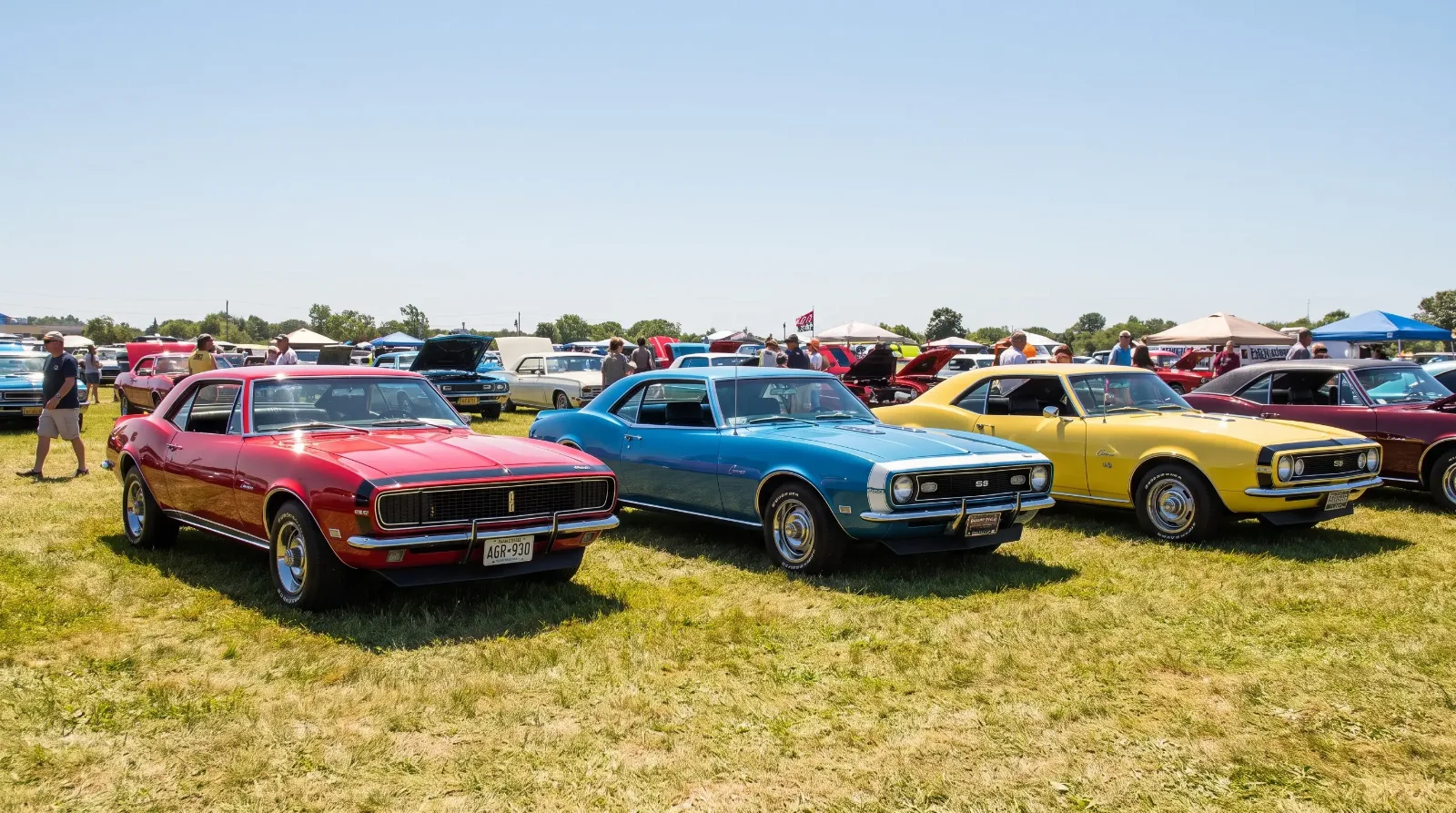


The Falcon inheritance: where it all started
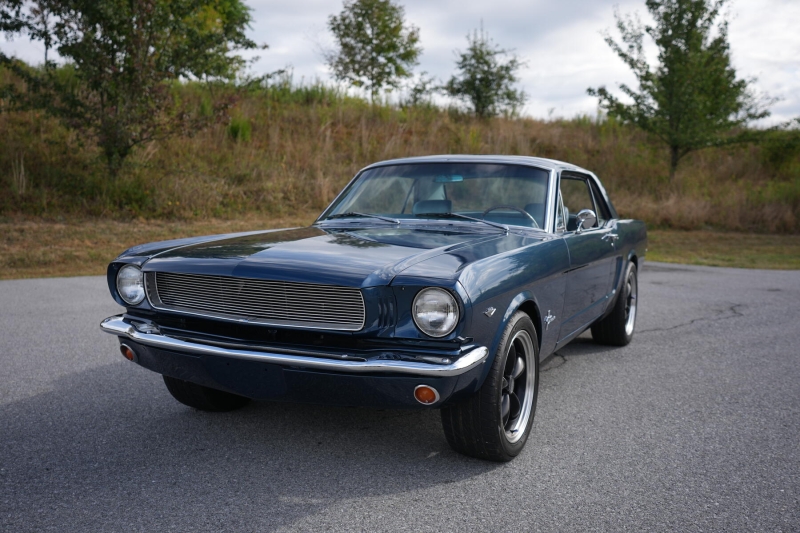
The first-generation Ford Mustang, introduced in April 1964, was not engineered from a blank sheet. Lee Iacocca's team built the car on a shortened version of the Falcon platform, a compact economy car that had been designed around cost, simplicity, and weight, not cornering. That decision gave Ford the tooling, the production infrastructure, and the timeline to hit Iacocca's April target, but it also locked the Mustang into a chassis architecture that road testers would spend the next decade arguing about. Understanding what those engineers inherited is the only way to understand what they achieved, and what they could not quite overcome.
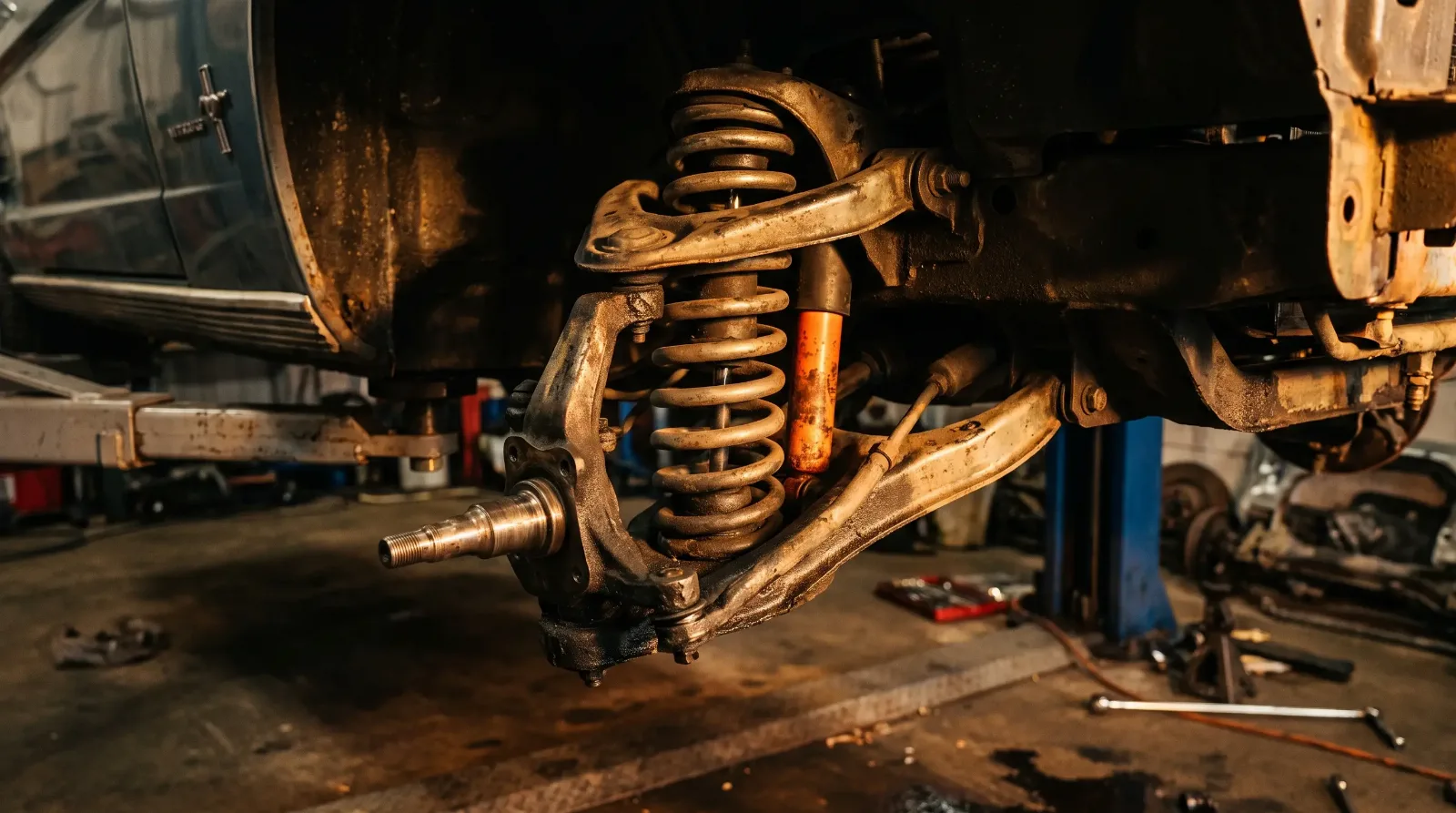
The Falcon unit-body shell brought a front suspension that used an upper A-arm and a lower control arm with a coil spring perched on top. It was conventional enough for 1960, but the geometry had been set for a car carrying a 144-cubic-inch inline-six. When the Mustang's option sheet eventually reached the 428-cubic-inch FE-series big-block, the nose weight climbed dramatically, loading the front suspension far beyond anything the Falcon engineers had considered. For the complete story of what the factory said and did not say about these cars, see our piece on Mustang myths debunked.
Live rear axle and leaf springs: the handling compromise that defined the era
At the rear, the Mustang used a live axle located by two longitudinal leaf springs. This arrangement was entirely standard practice for American production cars in 1964, and it had genuine advantages: low cost, high load capacity, and simple serviceability. In straight-line acceleration, a well-tuned leaf-spring live axle is perfectly adequate. In corners, it is a different matter.
The fundamental problem with a live axle is that the two rear wheels are mechanically connected. When one wheel hits a bump in a corner, the reaction is transmitted directly to the other side, upsetting the car's attitude. The unsprung weight of the axle assembly is also higher than an independent setup, which means the tire has more mass to control when it loses contact with the road surface. Under hard acceleration out of a corner, engine torque twists the leaf springs into an S-shape, and when that wind-up releases it can set the axle bouncing violently on the springs, a phenomenon known as axle tramp or wheel hop, which breaks rear traction unpredictably.
Ford's engineers knew this. Their solution was spring rates and shock absorber valving calibrated for ride comfort first, which left the rear end with a tendency to hop and wander when pushed hard. The standard Mustang springs were also relatively soft to absorb road imperfections for the touring buyer, which compounded the roll problem. This was not incompetence. It was a series of deliberate market decisions that prioritized a large audience of comfortable commuters over a small audience of weekend canyon runners.
Steering, brakes, tires, and the full picture of 1960s technology
The Mustang's standard steering box used a recirculating-ball mechanism, the dominant American design of the period. Compared to the rack-and-pinion setups on contemporary European sports cars, recirculating-ball steering has more inherent lash, a slower ratio, and less feedback through the wheel. The driver feels less of what the front tires are doing, which makes limit driving harder to manage because the warning signs of impending understeer arrive later and with less clarity. The ratio of the standard manual box was about 19.9:1, requiring considerably more wheel rotation to achieve the same lock angle as a tighter European rack.
When buyers ordered the 390 FE or the later 428 Cobra Jet, the problem compounded. Those engines added between 150 and 200 pounds over the front axle compared to the base 289. The steering effort climbed, the front tires approached their lateral load limits sooner, and the car developed the strong understeer that became the center of the handling debate. A base 289 Mustang with the handling package was a considerably different machine than a 428 fastback on stock suspension, but the latter was what the automotive press most often photographed sideways on test tracks, and the image stuck.
Tires and brakes completed the picture. The standard tire on a 1965 V8 Mustang was a 6.95-14 bias-ply, which by contemporary standards offers modest lateral grip and communicates grip loss less progressively than radials. Standard Mustangs through most of the first generation also used four-wheel drum brakes, which fade under repeated hard use. Front disc brakes were available as an option from 1965 and made a real difference, but they were not standard. These were not Mustang-specific failures: bias-ply tires and drums were the norm across the American industry. Judging a 1965 Mustang against a modern sports sedan is an anachronism; judging it against what was available for similar money in 1965 produces a more defensible verdict.
What Shelby, the GT package, and the Boss models actually changed
The handling reputation of the classic Mustang needs to be split into at least two distinct categories: the base touring car and the factory performance variants, because Ford and Carroll Shelby addressed the platform's weaknesses directly and with some success.
Shelby's most influential modification to the GT350 was what became known as the Shelby drop. By relocating the front upper control arm mounting points approximately one inch lower in the shock tower, Shelby's team changed the front suspension geometry to reduce positive camber gain in corners. The result was that the front tires maintained a more favorable contact patch angle as the suspension compressed through a turn, which improved front grip and reduced the car's tendency to push. This was not a dramatic change on paper. On a test track it was immediately noticeable, and it became one of the most widely copied suspension modifications in Mustang history.
The GT handling package available on standard Mustangs from 1965 added stiffer springs, a larger-diameter front anti-roll bar, a quicker 16:1 steering box, and heavier-duty shock absorbers (Carroll Shelby went further still, fitting adjustable Konis as standard on the GT350). The result was a car that road testers consistently praised for its competence. Car and Driver's 1965 tests noted that the GT-equipped Mustang handled well for an American production car, a qualified but genuine compliment from a publication that regularly tested European machinery.
The Boss 302, built for Trans-Am competition eligibility and sold from 1969 to 1970, took the process further. It used stiffer springs front and rear, heavy-duty shocks, a larger front anti-roll bar, a quicker steering ratio, and staggered rear shocks to control axle wind-up under acceleration. The Boss 302 was a legitimate sports car by any reasonable standard, and contemporary road tests treated it as such. The same chassis that drew skepticism in 1965 had been tuned into a competitive racing platform by 1969 without fundamental structural change.
If you are considering one of these machines for your garage, the full range of classic Mustangs illustrates how different the variants can be in character and in capability.
"The first-generation Mustang's handling problems are real, but they are also mostly documented from base cars with big-block engines, not from GT350s or Boss 302s — those are different machines that happened to wear the same badge."
— Tom Ramirez
The truth behind the reputation
The classic Mustang's handling reputation is neither fabricated nor fully accurate. The base car on its standard suspension, fitted with a large-displacement engine and bias-ply tires, did understeer meaningfully, did exhibit rear axle instability under hard cornering, and did have steering that filtered out much of what the front tires were doing. These are engineering facts, not myths invented by European-car partisans.
What the reputation gets wrong is the scope of the claim. The 289 High Performance Mustang with the handling package, the Shelby GT350, the 1969 Mach 1 with the competition suspension, and the Boss 302 are all first-generation Mustangs that handled well enough to embarrass far more expensive machinery when driven by competent drivers. The platform had real limitations, but the engineers, and Shelby's team in Venice, California, found ways to work around most of them within the constraints of production economics and period technology.
The more accurate statement is that Ford designed the standard Mustang for a mass market that wanted a sporty-looking personal car, not a sports car, and that the suspension reflected those priorities. When Ford and Shelby actually tried to make a sports car out of the platform, they largely succeeded. The car the mythology describes is real. So is the car the mythology ignores.
Sources and notes
This article is intended as general historical and educational background for classic-car enthusiasts. Engineering figures for cars of this era vary between sources depending on measurement method, options fitted, and model year; treat the specifications here as representative period values rather than absolute factory data. Always confirm details against original factory literature or a marque registry before relying on them for restoration or purchase decisions.
- Boss 302 Mustang — Wikipedia (staggered rear shocks and axle wind-up control; 1969–1970 production and Trans-Am homologation)
- Curbside Classic — Vintage Car and Driver review, 1969 Mustang Mach 1 428 Cobra Jet (59.3% front weight bias)
- Speedway Motors — Understanding the Shelby/Arning Drop (relocating the upper control arm mounts ~1 inch and the resulting geometry changes)
- Ford Falcon (North America) — Wikipedia (1960 Falcon launched with the 144-cubic-inch six; 170 added in 1961)
- CJ Pony Parts — First-Generation Mustang Tire and Wheel Sizes (6.95-14 bias-ply standard on 1965 V8 cars)
- Ford FE engine — Wikipedia (FE big-block displacement and weight context versus the 289 small-block)