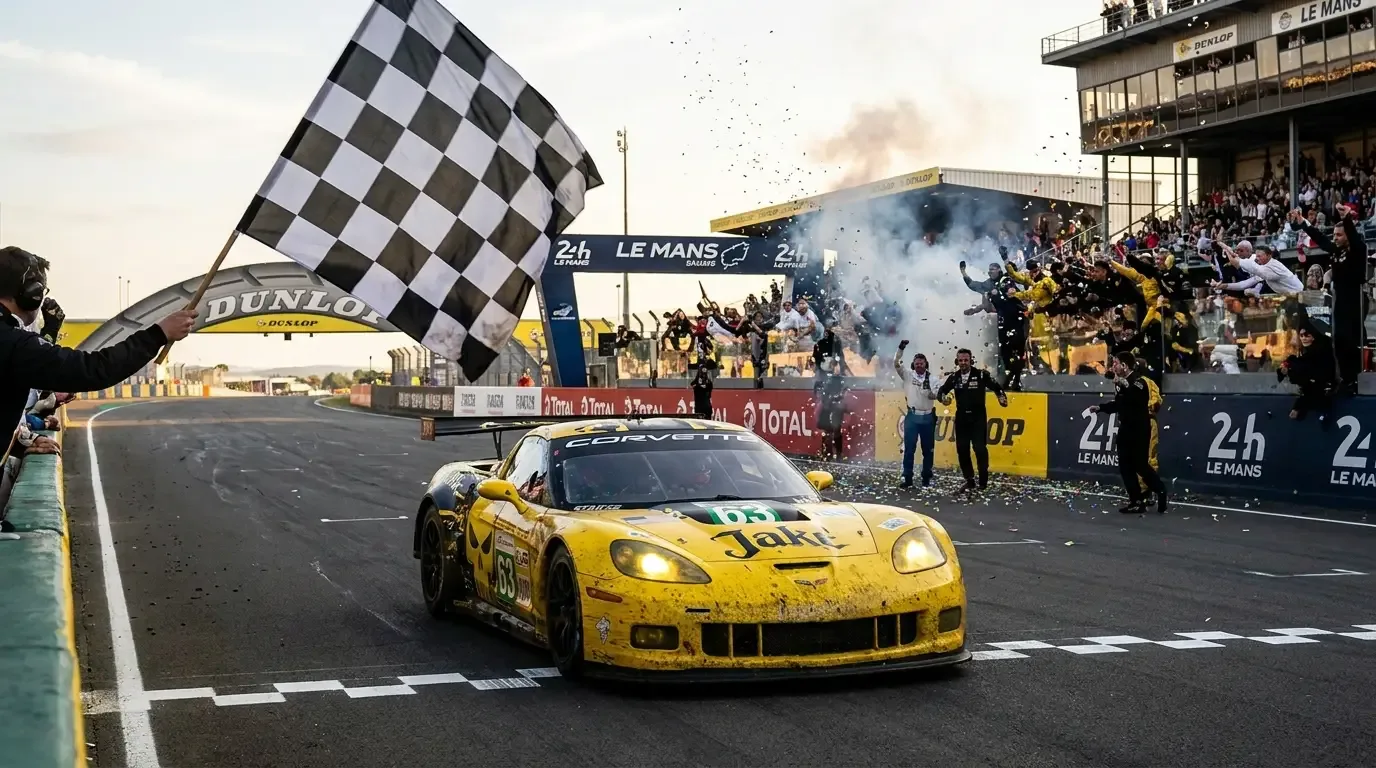
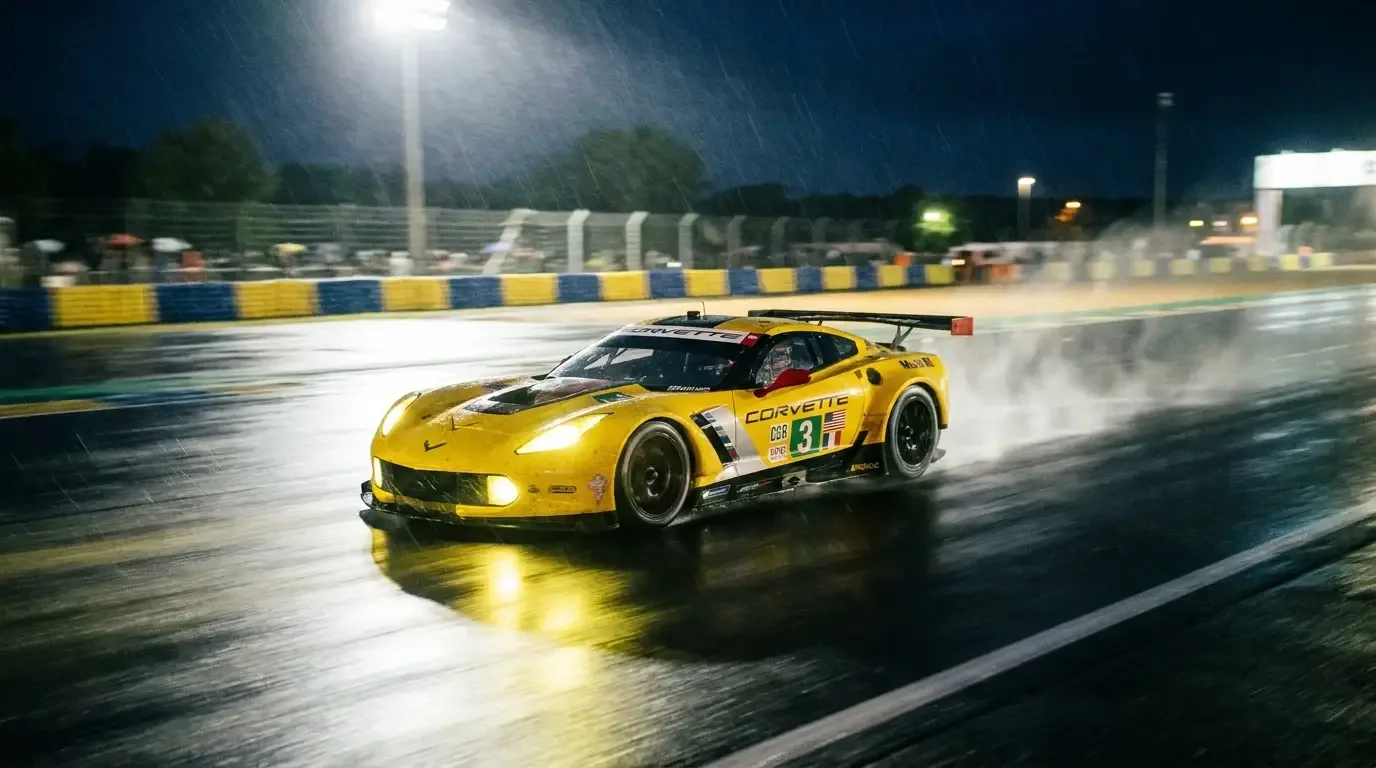
There is a corner of Le Mans called the Ford Chicanes, just before the Porsche Curves, where the decision to commit happens fast or it doesn't happen at all. In 2000, a Corvette Racing C5-R hit that section during its debut race and the crew chief back in the pitlane held his breath. The car came through clean. It was the start of something that most people in the paddock didn't expect to last more than one season.
It lasted a decade. For the full picture of how Corvette got to that moment, Corvette Racing History covers the program from its origins to its return to top-level competition. What this article is about is the car that carried the racing program through its most productive era at Le Mans, and what made it work.
Origins of the C5-R
Corvette Racing was reconstituted as a factory effort in 1999 after a long absence from serious endurance competition. The C5-R was developed from the production C5 Corvette, which gave it a structural head start. The production car's all-aluminum LS1 V8 and hydroformed frame rails provided a foundation that could be adapted for racing without the weight penalty of building a bespoke chassis from scratch.
Pratt and Miller Engineering, the program's constructor, took the production body structure and worked outward from there. The racing version ran a purpose-built aluminum V8 displacing around 7.0 liters, derived from the production small-block architecture but built to racing tolerances. The engine started at 6.0 liters in 1999 before being enlarged during that first season. Power output climbed across the car's racing life as the engine was refined, reaching figures in the range of 590 to 610 horsepower in its later GTS-class configuration, subject to FIA air restrictor regulations.
The GTS class structure at Le Mans meant the C5-R was competing against Ferrari 550 Maranellos, Dodge Vipers, Saleen S7s, and various Porsche entries depending on the year. The LMGTS category during this era was genuinely competitive. Corvette Racing won on merit, not by default.
The Le Mans record, year by year
The program's first Le Mans came in 2000, when Corvette Racing entered the 24 Hours for the first time with the C5-R. The cars did not win, but they finished, taking 3rd and 4th in the GTS class, which mattered for a new program still developing its endurance strategy. The real breakthrough came in 2001, when the Corvette Racing team took its first class victory at Le Mans. From there the results built steadily.
Between 2001 and 2004, Corvette Racing accumulated a string of GTS class wins at Le Mans that established the program's credibility. The 2003 race was the exception: Ferrari's Prodrive-run 550 GTS Maranello broke the streak, relegating the two Corvettes to second and third in class. The team came back in 2004 to reclaim the top step. The consistency across the era was as notable as the victories themselves. Finishing Le Mans requires managing tire wear, fuel strategy, driver changeovers, and the inevitable mechanical attrition of 24 hours at speed. Corvette Racing built systems for all of it, and the results reflected that discipline.
The C5-R ran in LMGTS class configuration, competing against cars with significantly larger budgets and longer racing histories. Ferrari had been running at Le Mans for decades by the time Corvette showed up. The fact that the Corvette program won repeatedly in this company said something about both the car and the people running it. For a deeper look at the specific win tally and what it means statistically, the related article lays out the numbers.
| Year | Class | GTS Class Result | Notable competitor |
|---|---|---|---|
| 2000 | LMGTS | 3rd in class | Ferrari 550 Maranello |
| 2001 | LMGTS | Class win (1-2 finish) | Ferrari 550 Maranello |
| 2002 | LMGTS | Class win (1-2 finish) | Ferrari 550 Maranello (Prodrive) |
| 2003 | LMGTS | 2nd and 3rd in class | Ferrari 550 GTS Maranello (Prodrive, class winner) |
| 2004 | LMGTS | Class win (1-2 finish) | Ferrari 575 GTC / Ferrari 550 GTS Maranello |
What made the C5-R competitive
A lot of racing programs buy the right car and still lose because the organization around it doesn't function. Corvette Racing got both things right at the same time. Pratt and Miller built a reliable car. The team ran clean strategy. The driver lineup, which at various points included Oliver Gavin, Ron Fellows, Johnny O'Connell, and others, was composed of people who knew Le Mans and could pace a 24-hour race without burning the car up in the first six hours.
The C5-R's aerodynamics were developed with Le Mans specifically in mind. The long Mulsanne straight (and later the chicanes added to it) penalized drag. The car's body kit was tuned for low drag with enough downforce to stay planted through the Porsche Curves. This wasn't a car designed for sprint races. It was engineered for endurance, and it showed in the data every time the team analyzed post-race wear.
"The C5-R didn't win Le Mans with flash. It won with the kind of preparation that only shows up after midnight, when the other teams are dealing with surprises they didn't plan for."
— Patrick Walsh
The production C5's structure also meant that Chevrolet could market the racing connection directly to buyers. The "Win on Sunday, sell on Monday" logic never fully left Corvette's DNA. When the C5-R was winning GTS classes, the production C5 Z06 was positioned as the street version of that same spirit, and Chevrolet's marketing leaned into it. If you're interested in how the racing history connects to what you can buy today, there are classic Corvette for sale that carry the lineage of this era.
The C5-R's place in Corvette Racing's story
The C5-R ran at Le Mans from 2000 through 2004 before the program transitioned to the C6-R. By the time it retired from top-level competition, it had accumulated three GTS class victories at Le Mans -- in 2001, 2002, and 2004 -- and podium finishes in the years between. The number of consecutive class wins at the outset was enough to prompt serious conversations in the press about whether the car had become dominant in a way that diminished the competition.
That conversation missed the point. The C5-R was competitive because the team running it was competent, not because the class was weak. Ferrari, Dodge, and Saleen all had real hardware in those years. Corvette Racing beat them repeatedly because it managed the race better, kept the car reliable, and made fewer errors in the night hours when Le Mans tends to sort out who actually prepared.
The C5-R also established the infrastructure that made the C6-R and later C7.R programs possible. The engineering database, the Pratt and Miller relationship, the driver development pipeline, and the Le Mans-specific strategy knowledge all transferred. The C5-R's Le Mans run wasn't a standalone achievement. It was the foundation of two more decades of Corvette Racing success, which is explored further in the wider context of what the Corvette has meant to American automotive culture.
Sources and notes
- Wikipedia: Chevrolet Corvette C5-R -- engine displacement (6.0L then 7.0L), 610 hp peak output, Le Mans record 2000-2004
- CorvSport: C5-R Le Mans victories -- year-by-year results, car numbers, driver rosters for LMGTS class wins
- Wikipedia: 2003 24 Hours of Le Mans -- confirmed LMGTS class winner Ferrari 550-GTS Maranello (#88, Enge/Kox/Davies); Corvette #50 second, #53 third
- Daily Sports Car: Corvette C5-R by the Numbers -- chassis history, Le Mans entries, driver pairings
- 24h-lemans.com: Ferrari GTs -- confirms 575 GTC entered 2004 Le Mans but both factory entries retired; 550 Maranello was the class threat in 2002-2003
- Corvette Blogger: Corvette Racing at Le Mans retrospectives -- confirmed 1-2 GTS finishes in 2001, 2002, 2004