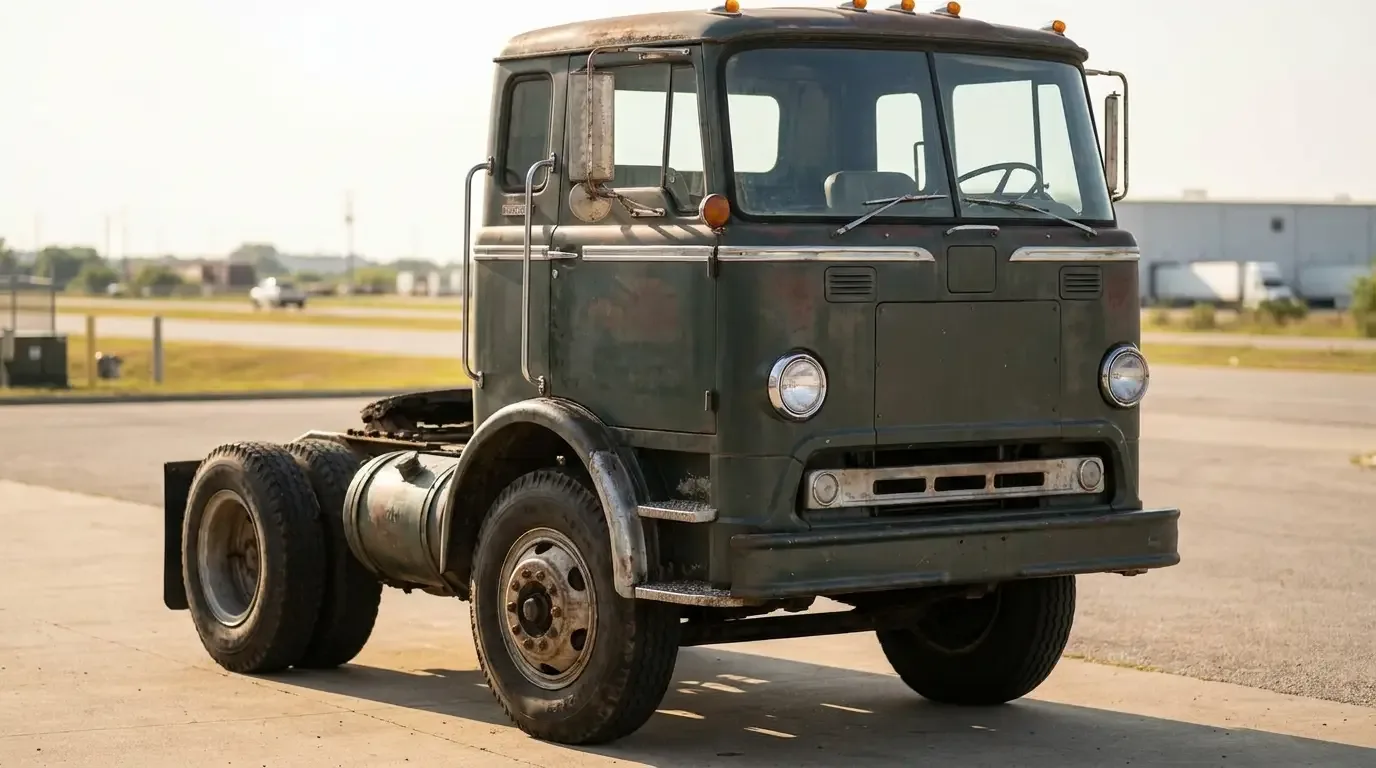
Stand next to an old cab-over and the first thing you notice is that there is no hood. The windshield sits almost over the front axle, the grille is a flat panel between the headlights, and the driver perches up high like he is riding the engine rather than sitting behind it. That is the whole idea. A cab-over truck, short for cab-over-engine and usually written COE, puts the cab directly on top of the motor instead of behind it. It is one of the oldest layout decisions in truck building, and it explains a lot about why old trucks look the way they do. If you want the wider picture of how these shapes fit together, start with our classic truck body styles explained guide and come back here for the flat-face specifics.
What actually makes a truck a cab-over
The defining feature is simple. The driver sits at or ahead of the front axle, and the engine lives underneath or just behind the seats rather than out front under a long hood. Because there is no engine bay sticking out, the front of the truck is nearly vertical. People call it a flat-face, a snub-nose, or a bulldog nose depending on the era and who is talking.
Conventional trucks, the ones with a hood, are the opposite. Engine first, then the cab. A conventional and a cab-over can carry identical drivetrains and identical payloads. The difference is purely where the cab sits relative to the engine. That one choice changes almost everything about how the truck drives, how you service it, and how you climb into it.
- Vertical front. Little or no hood ahead of the windshield.
- High seating. The driver sits above the drivetrain, often needing steps and a grab handle to board.
- Tilt cab (on later models). Many COEs tilt the entire cab forward on a pivot to expose the engine.
- Short overall length. The truck is stubby for its wheelbase because nothing lives ahead of the axle.
Not every flat-fronted truck tilts. Early cab-overs from the 1930s and 1940s often had a fixed cab, and you serviced the engine through a doghouse cover inside the cab or through side panels. The tilt cab came later and made the layout far more practical to live with.
Why the layout existed in the first place
Cab-overs were not built to look tough. They were built to beat a ruler. For decades, various state and federal rules in the United States capped the overall length of a truck-and-trailer combination. If your rig could only be a certain number of feet long, every foot spent on a hood was a foot you could not spend on cargo. A cab-over deletes the hood, so more of the legal length goes to the trailer. That is the entire economic argument, and it was a powerful one.
Overall-length limits around 65 feet were common in many states through the mid-twentieth century, and shorter tractors let fleets pull longer trailers or run a shorter, more maneuverable combination in tight cities. When federal rules changed in the early 1980s to regulate trailer length rather than the whole combination, the length penalty on a long hood largely disappeared, and the main reason to buy a cab-over went with it.
The packaging trade-offs, good and bad
Every advantage of a cab-over comes with a bill attached. The layout buys you length and visibility, and it charges you in ride comfort, noise, and service access. Here is the honest ledger.
| Trait | Cab-over (COE) | Conventional |
|---|---|---|
| Overall length for same load | Shorter | Longer |
| Forward visibility | Excellent, you see the curb | Blocked by the hood |
| Turning in tight spots | Better | Worse |
| Ride quality over the front axle | Rough, you sit over the wheels | Smoother |
| Engine and heat noise in cab | Higher | Lower |
| Routine engine access | Tilt cab or doghouse cover | Open the hood |
| Crash structure ahead of driver | Very little | Engine and frame |
The visibility is genuinely superb. You sit high and forward, and you can see the front bumper and the near-side curb, which is why delivery drivers and city fleets loved them. The turning is tight. The length saving is real. But you also sit right on top of the front axle, so every bump comes up through the seat, and the engine is close enough that heat and noise are part of the job. In an accident, there is very little truck between the driver and whatever is ahead, which is one reason the design fell out of favor for long highway hauls even before the rules changed.
"People romanticize the flat nose, and I get it, they look great. But drive one loaded for eight hours and your kidneys will file a complaint. You sit over the axle, not behind it. That truck was built to save feet, not to save your back."
— Robert Halloran
Where cab-overs actually earned their keep
The layout showed up wherever length or maneuvering mattered more than a plush ride. On American highways, big sleeper and day-cab COEs pulled long trailers through the 1960s and 1970s, and a whole generation grew up seeing that flat-faced silhouette on the interstate. In the city, smaller cab-overs became the default shape for delivery, moving, and vocational work, and that job never went away. The modern medium-duty box truck, the beverage truck, the tow rig, and the compact dump are all still cab-overs because a short, tight-turning truck makes sense on a loading dock and in an alley.
- Long-haul tractors. The classic sleeper COE of the 1960s and 1970s, now the most collectible slice of the segment.
- Local delivery and moving trucks. Short wheelbase, big box, easy to spot the curb.
- Vocational and municipal. Dumps, sweepers, and utility bodies that work in tight space.
- Cabover pickups and vans. The forward-control light trucks and vans of the 1950s and 1960s, where the driver sat over or ahead of the front wheels.
Outside the United States the story never really paused. In Europe and Japan, where roads are narrow and length rules developed differently, the cab-over stayed the mainstream heavy-truck shape and still is. So the layout did not fail. It simply retreated from the one place, the American open highway, where the ride penalty finally outweighed the length savings.
The collector and custom cult following today
Here is the part that surprises people. The cab-over went from unwanted to hunted. For years these trucks were worth scrap money because nobody wanted a rough-riding, hard-to-service tractor. Then the exact things that killed them on the highway, the flat face, the odd proportions, the sheer visual punch, made them irresistible to hot rodders and collectors.
Two crowds drive the interest. Restorers chase clean examples of the classic long-haul COEs and the 1950s forward-control haulers, prizing original cabs and correct trim because good sheet metal is getting scarce. Customizers go the other way and build wild cab-over car haulers and ramp trucks, dropping modern running gear under a vintage flat-face cab. A period-correct COE on a shortened frame, sitting low with a matching trailer, is a show-stopper at any truck meet, and clean project trucks that once sold for a few hundred dollars now change hands for real money.
The appeal, in the end, is honesty. A cab-over does not pretend to be anything. It is a working shape that solved a real problem, and it wears that history on its flat face. That is exactly why the people who love these trucks love them, and why a design the industry mostly abandoned refuses to disappear.
Sources and notes
- Period commercial-vehicle road tests and manufacturer sales literature (cab-over vs conventional comparisons).
- Factory service manuals and body-builder guides for tilt-cab mechanisms and forward-control layouts.
- Historical summaries of US truck length and size regulation, including the early-1980s federal changes to trailer-length rules.
- Marque and model histories covering American, European, and Japanese cab-over production.
- Collector-truck auction results and club valuation guides for COE tractors and forward-control haulers.