Here is the thing most guys forget about an old truck: it stops worse than it goes. You can drop a fresh crate motor between the rails and never touch the brakes, and plenty of owners do exactly that. Then they get one panic stop on a downhill grade with a load in the bed, and they learn what four-wheel drums feel like when the shoes get hot. Not good. So before you fall in love with the paint, understand what is behind those wheels, because drum vs disc brakes is the single biggest safety gap between a truck you drive and a truck you park.
This is a general look at how the two systems work, when the factories made the switch, and the front disc conversion that a lot of owners bolt on. It pairs with our rundown on classic truck engines, because power and stopping power are two halves of the same decision.
How a drum brake actually works
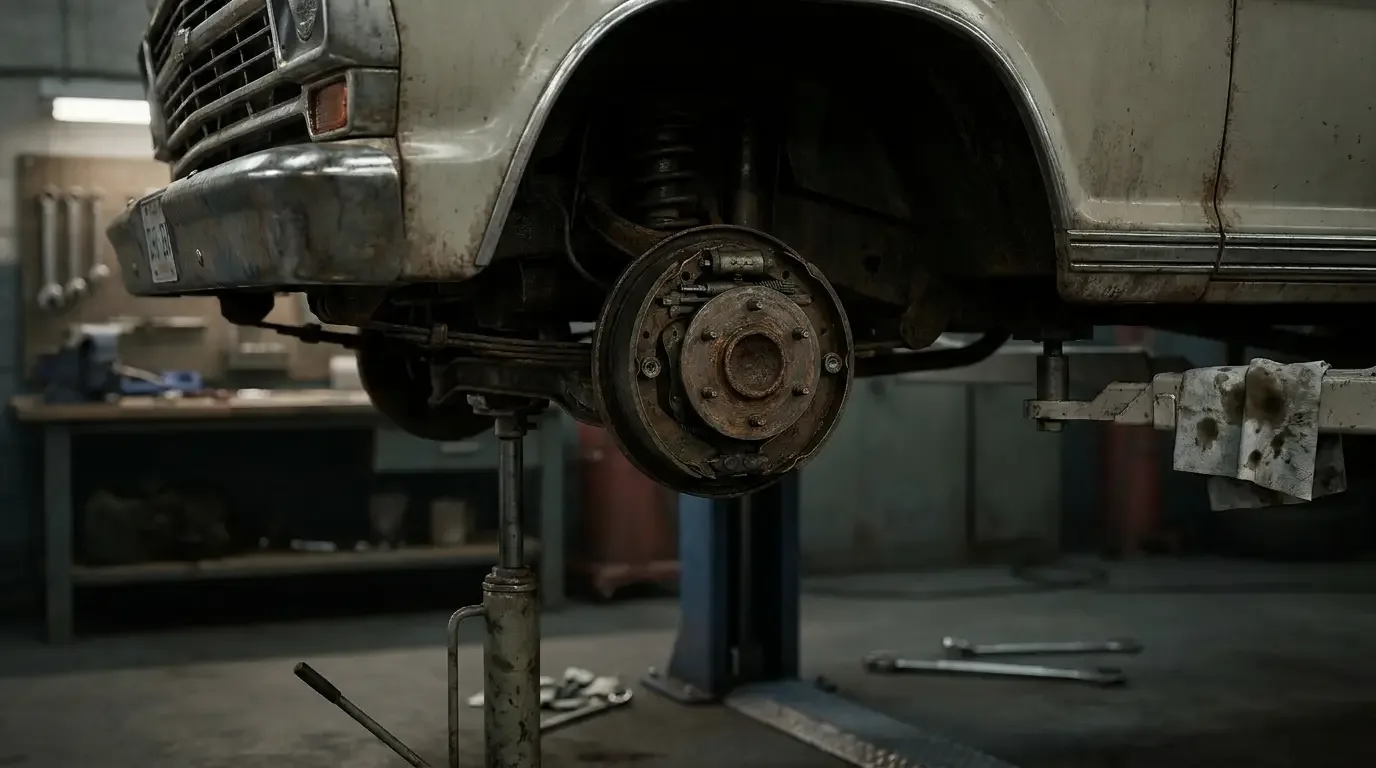
A drum brake is a sealed cast-iron cylinder that spins with the wheel. Inside sit two curved shoes lined with friction material. Step on the pedal, hydraulic pressure pushes a wheel cylinder, and the shoes spread outward against the inside of the drum. Friction slows the wheel. Let off, and return springs pull the shoes back in.
The clever part is what old-timers call self-energizing action. The rotation of the drum tries to drag the leading shoe along with it, which wedges it harder into the drum. That mechanical assist means drums can generate a lot of clamping force without much pedal effort. It is why a truck with no power booster and four-wheel drums can still feel reasonable in the driveway. It is also why the same truck can feel terrifying on the tenth stop in a row.
The weakness is heat. That cast-iron drum is a closed box. The friction dumps heat into it, and the box has nowhere to send it fast. Do a couple of hard stops and the drum expands, the shoes have farther to travel, and the pedal sinks. Get water inside from a puddle and the shoes lose grip until they dry out. Every drum brake ever built has these two problems. Good ones just delay them.
How a disc brake changes the math
A disc brake throws the closed box away. Instead of a drum, you get a flat rotor spinning in open air, and a caliper that straddles it holding two pads. Hit the pedal and the caliper piston squeezes the pads against both faces of the rotor. That is it. No self-energizing wedge, no return springs fighting you, no sealed box trapping heat.
Because the rotor lives in open air, it sheds heat. That is the whole ballgame. A disc that just did three hard stops is hotter, sure, but it is throwing that heat into the wind instead of hoarding it. Fade resistance goes way up. Discs also self-clean. The pads wipe the rotor face on every rotation, so a puddle barely registers. And discs self-adjust as the pads wear, where a drum needs its shoes manually adjusted or a star-wheel mechanism that seizes if you ignore it.
The trade is that discs need more clamping force to do the same work, since you lose the drum's mechanical assist. That is why nearly every disc setup runs a power booster. On a classic truck conversion, the booster and a matched master cylinder are not optional extras. They are the reason the system works at all.
"A drum brake feels great right up until it doesn't. Discs don't have a moment. They just keep working. That difference is worth more than any horsepower you'll add."
— Mike Sullivan
When the trucks made the switch
Cars beat trucks to discs by years, and there was a reason. A truck carries load, and load means the rear axle does a bigger share of the braking than it does on a car. The factories were slow to trust discs on the front of a work truck, and slower still to bother with the rear.
Broad strokes, front disc brakes started showing up as options and then as standard equipment on half-ton American trucks through the first half of the 1970s. By the back half of that decade, front discs were common on new light trucks. The rear stayed drum for a long, long time, and honestly still does on plenty of modern trucks, because drums are cheap, hold up under load, and make an easy parking brake. So the era you are shopping in tells you a lot:
- Pre-1970s trucks: Almost always four-wheel drum from the factory. Expect it, budget for it.
- Mid-1970s and up: Front discs increasingly likely, rear drums nearly guaranteed.
- Anything restored or restomod: Check what is actually bolted on, not what the year should have. Owners swap this stuff constantly.
Do not trust the title year. Trust what your eyes see when you pull the wheel. A 1968 truck with a modern master cylinder and a vacuum booster hanging off the firewall has been converted, and that changes everything about how it drives and what it is worth.
Safety and maintenance, side by side
The two systems ask for different work and forgive different mistakes. Drums have more parts hidden inside that box: shoes, wheel cylinders, springs, adjusters, hold-down clips. It is fussy to service and easy to reassemble wrong. Discs have fewer parts out in the open where you can see them, but the pads wear faster and the rotors can warp if you cook them or torque the wheels unevenly.
| Factor | Drum | Disc |
|---|---|---|
| Heat handling | Poor, fades under repeat stops | Good, sheds heat in open air |
| Wet performance | Weak until it dries out | Self-wiping, barely affected |
| Self-adjusting | No, needs manual or star-wheel adjustment | Yes, adjusts as pads wear |
| Pad/shoe life | Longer wear intervals | Shorter, but easier to inspect |
| Service difficulty | Fiddly, many hidden parts | Simpler, parts exposed |
| Parking brake | Built in, simple | Needs extra mechanism |
On maintenance, a drum system that has sat for decades is almost never safe as found. The wheel cylinders corrode and stick or leak, the rubber flex lines rot from the inside, and the shoes glaze or delaminate. Fluid absorbs water over the years and drops its boiling point, which is exactly what you do not want in a system that already struggles with heat. Whatever you buy, plan on a full hydraulic refresh before you trust it, drum or disc.
🔧 Inspection Priorities
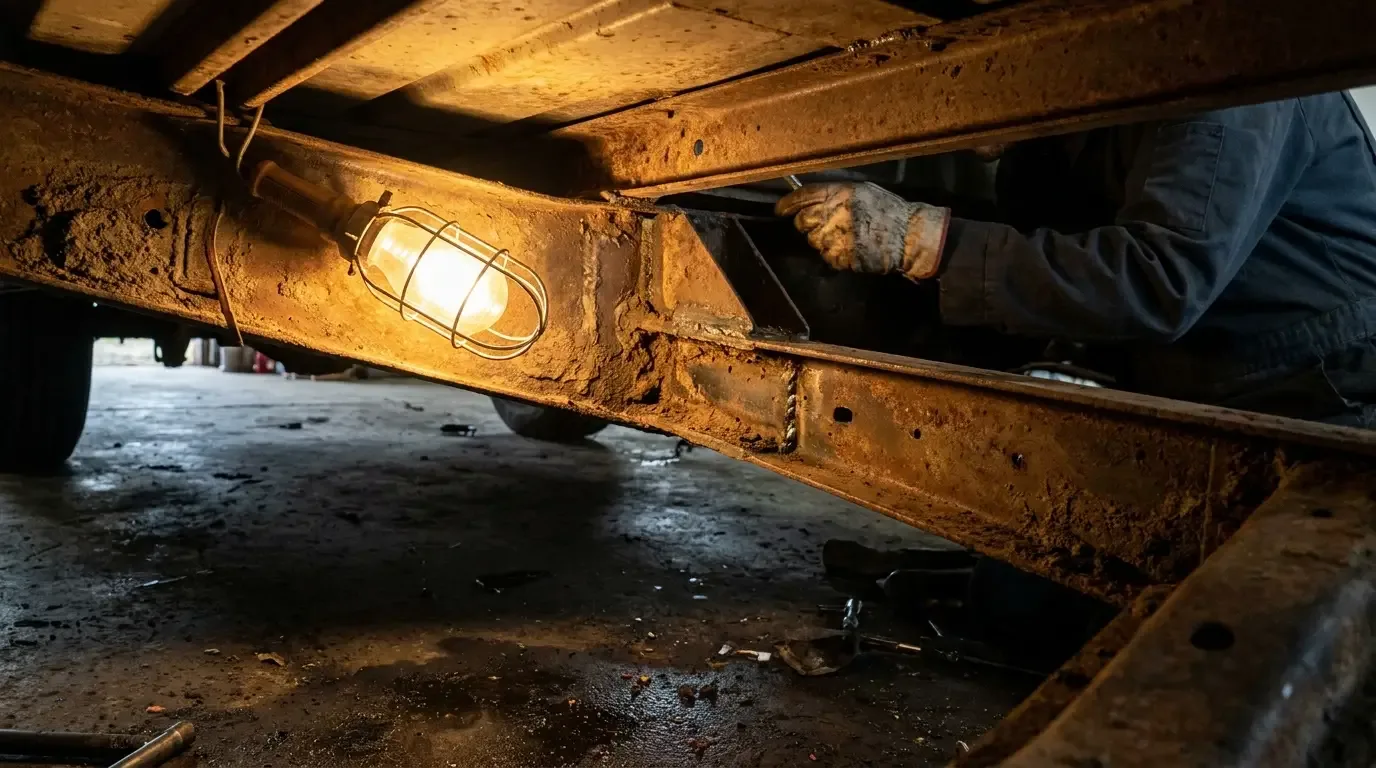
- Pull a front wheel and look. Disc or drum? Rusty scored rotor or a cracked drum tells you what is coming. Get under it with a good light, not a phone at arm's length.
- Check the flex lines. Cracked, swollen, or weeping rubber lines are a hard stop on any deal until replaced. Cheap part, expensive failure.
- Test the pedal. A pedal that sinks slowly to the floor under steady pressure means a leaking master cylinder or wheel cylinder. Budget the rebuild.
- Look for a conversion. Vacuum booster and modern master on an early truck means someone already did the front disc swap. Verify it was done right, matched master, correct proportioning.
- Sample the fluid. Black, murky brake fluid means years of neglect and water contamination. Assume the whole system needs flushing.
The disc-swap upgrade owners actually do
Here is the job that comes up on nearly every old truck build: converting the front drums to discs. It is popular because it fixes the scariest weakness, the front brakes fading on a downhill or in traffic, and because kits exist for most common platforms that bolt to the factory spindles or supply new ones.
A proper front disc conversion is not just the rotors and calipers. It is a system. You need a master cylinder sized for discs, almost always a vacuum booster to supply the clamping force, and a proportioning valve so the front discs and rear drums balance instead of the fronts locking first. Skip any one of those pieces and you get a truck that either has a mile-high pedal or throws its nose down and swaps ends when you brake hard. I have seen both, and neither is fun to fix in a parking lot.
Is the swap worth it? On a truck you actually drive, yes, every time. On a trailer queen that rolls onto a flatbed and back off, the factory drums rebuilt correctly will stop it fine for the mileage it sees. Match the brakes to how the truck lives. A worn drum system is not a dealbreaker on the right truck at the right price. It is just a line item you plan for before you sign, not a surprise you discover on the first steep hill.
Sources and notes
- Factory service manuals for period light trucks (brake system specifications, adjustment and bleeding procedures).
- Period road tests and buyer guides covering the transition from drum to front-disc brakes on American trucks.
- Aftermarket disc-conversion kit installation guides and general shop manuals.
- General brake-engineering references on self-energizing drum action and disc heat dissipation.