
Callaway Cars built a lot of things over the years, but nothing made more noise in the late 1980s than the twin-turbo Corvette. Not the engine noise, though there was plenty of that. The noise I mean is the kind that rolls through a showroom floor and lands in the automotive press six weeks later with phrases like "fastest production car in America." Reeves Callaway and Chevrolet had agreed to something unusual: a dealer-installed performance package that carried a factory warranty. That arrangement mattered more than most people understood at the time.
The Callaway Twin Turbo sits at an odd intersection of factory and aftermarket. It is not a Corvette that someone dropped a turbo kit onto in a garage. It came out of Old Lyme, Connecticut, with Chevrolet's blessing, showing up on the window sticker as RPO B2K, and wearing a full factory warranty on the boosted drivetrain. That kind of arrangement was almost unheard of in 1987, and it gave the package a legitimacy that pure aftermarket conversion kits never had. For more on corvette special editions history, see more on corvette special editions.
How the B2K package came to exist
Reeves Callaway approached General Motors with a straightforward proposition: let Callaway build a forced-induction Corvette that dealers could order through the standard RPO system, and back it with the factory warranty. Chevrolet agreed, and the B2K option went on sale for the 1987 model year at a price of $19,995 on top of the base Corvette's cost. The cars left the Bowling Green assembly plant as standard C4 Corvettes, then traveled to Old Lyme, Connecticut, where Callaway performed the conversion.
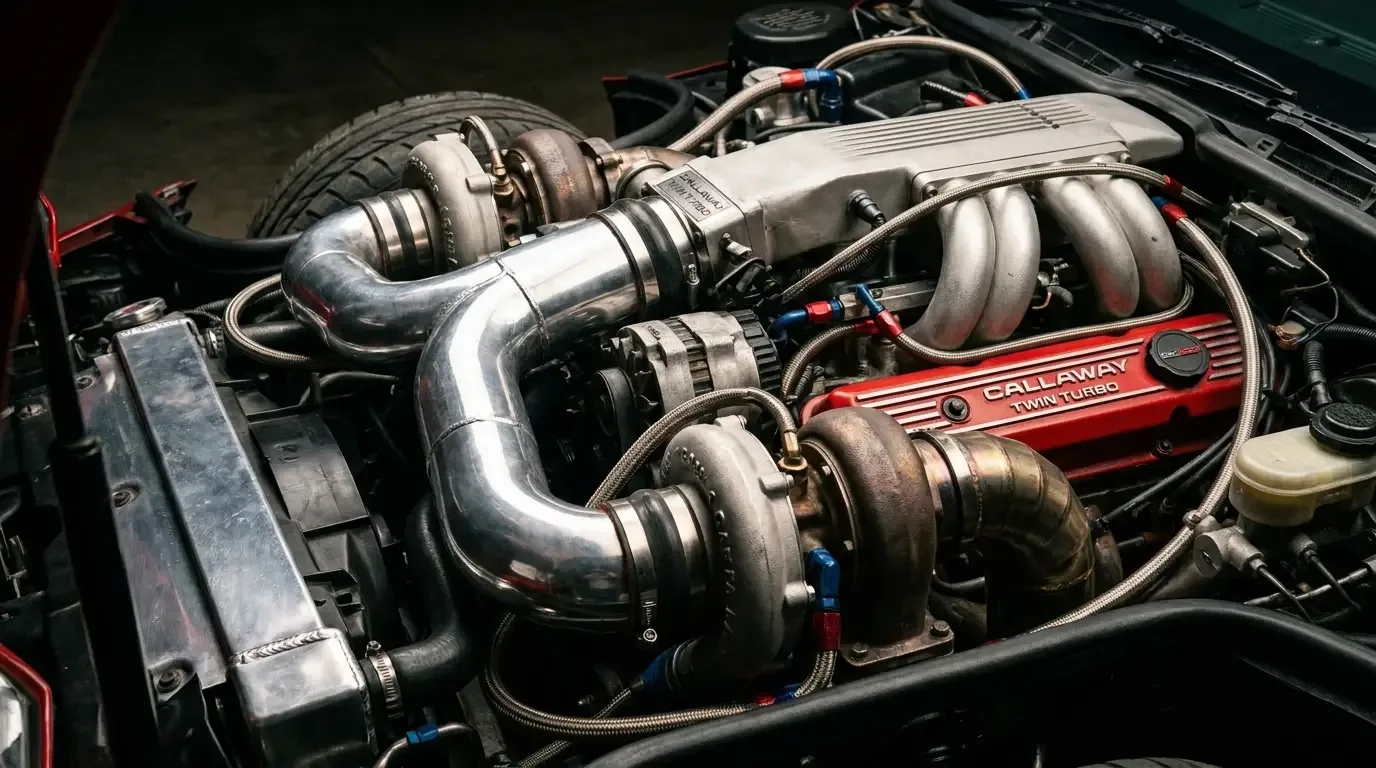
The work involved more than strapping turbos to a stock L98. Callaway retuned the fuel injection system, added custom intercoolers, and reworked the cylinder head porting to handle forced induction reliably. The result was a twin-turbocharged V8 that Callaway rated at 345 hp for 1987, climbing to 382 hp in 1988 and remaining there through 1989, before reaching 390 hp for 1990 and 402 hp in the final 1991 model year. Those numbers put the car squarely in supercar territory for the period, particularly given the Corvette's already low curb weight.
What Callaway actually did to the engine
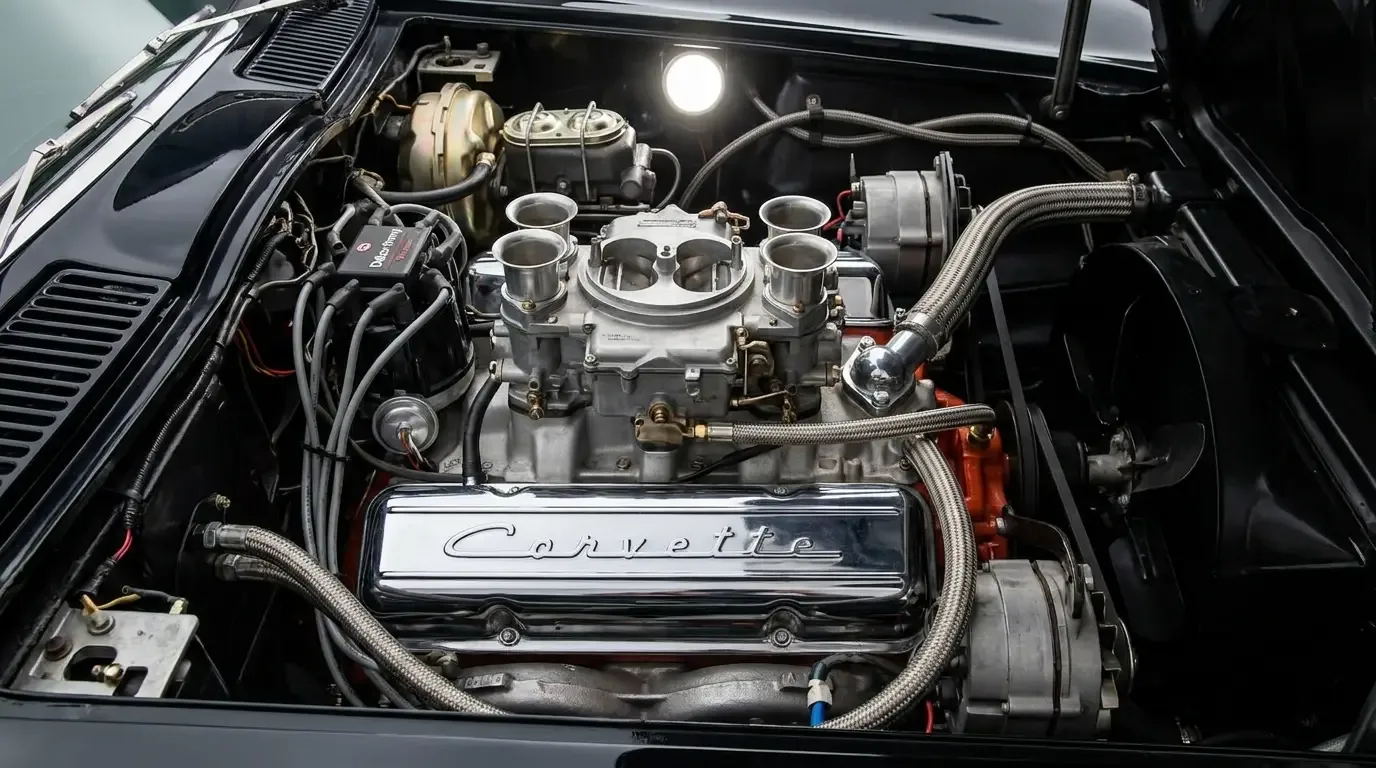
The base engine in a 1987 C4 Corvette was the L98, a 350 cubic inch small-block making around 240 hp in stock form. Callaway's conversion centered on two Warner-Ishi RHB 52W turbochargers mounted low in the engine bay, feeding air through intercoolers before it reached the intake manifold. The boost pressure ran at a conservative level by race standards, which allowed the engine to operate on pump premium fuel and hold together over long service intervals.
The companion story on the companion story covers how the small-block evolved through the C4 generation, which gives useful context here. Callaway was not working with a purpose-built forced-induction platform. They were adapting an engine designed for natural aspiration, which required careful attention to oiling, cooling, and cylinder pressure. The fact that these cars held together in daily use, often racking up significant miles, says something about the engineering. It also says something about how conservatively Callaway set the boost.
| Model year | Base engine | Rated power (approx.) | Top speed (tested) |
|---|---|---|---|
| 1987 | L98 350 V8 | 345 hp | 177.9 mph |
| 1988 | L98 350 V8 | 382 hp | ~180 mph |
| 1989 | L98 350 V8 | 382 hp | ~180 mph |
| 1990 | L98 350 V8 | 390 hp | varies by spec |
| 1991 | L98 350 V8 | 402 hp | varies by spec |
Production numbers and what that means for buyers today
Callaway did not build large numbers of these cars. Total production across the B2K run has been documented at roughly 497 cars ordered through normal dealer channels across the 1987 through 1991 model years, with some sources citing around 510 when including all variants. That low production count was a function of the hand-built nature of the conversion and the premium price. In a market where a base Corvette coupe cost around $27,999 in 1987, adding the $19,995 Callaway package put the total well above $45,000, which was real money at the time.
Low production numbers cut both ways for collectors. The cars are genuinely rare, which supports value at the top of the market. But parts availability reflects that rarity. Callaway-specific components, including the turbocharger units, intercoolers, and the custom intake manifolding, are not items you source from a conventional supplier. If you find a B2K car with a turbo that needs rebuilding, you are dealing with a specialized rebuild shop or, in some cases, a complete assembly purchased from Callaway directly. The company has remained in business and does support older cars, which matters more than it might seem when you are standing in front of a potential purchase.
If you want to start looking at actual examples, C4 Corvettes for sale is the right place to begin filtering by year and checking for B2K documentation in the listings.
"I've looked at a lot of these over the years, and the first thing I want to see is the window sticker or build sheet showing B2K. Without that documentation, you're buying someone's story, not a Callaway. The second thing I want is the Callaway serial number plate. It should be in the engine bay. If it's gone, that's a conversation stopper."
— Mike Sullivan
What to check when buying a Callaway twin turbo
Buying any C4 Corvette requires attention to the usual suspects: the aluminum front frame rails that rot from road salt, the fiberglass body panels that mask rust developing at the mounting points underneath, and the digital instrument clusters that fail with age. A Callaway adds several layers on top of that baseline.
The turbos themselves are the first mechanical concern. These units have been in service for 35 years or more. A turbo that spins correctly will spool smoothly without noise and show no shaft play when you check it cold. Oil leaks at the turbo flanges are common on high-mileage examples. The intercooler boots crack with age, and a cracked boot means boost is leaking somewhere in the intake path, which shows up as a soft top end under hard acceleration.
Where these cars fit in the C4 collector market
A clean, documented B2K Corvette with verifiable Callaway provenance is a different asset from a standard C4, even a performance-optioned one. The rarity, the factory warranty backstory, and the historical press attention combine to put these cars in a separate category. Driver-quality examples with documentation have moved across a wide range at auction in recent years, with condition, mileage, and the completeness of the paper trail driving significant variation. Show-quality, low-mileage examples have exceeded well into five figures at auction.
The market for undocumented examples, or cars that claim Callaway provenance without supporting paperwork, is considerably softer and for good reason. An L98 C4 with someone's twin-turbo kit is not a B2K car, regardless of how it looks under the hood. There were aftermarket turbo kits sold during the C4 era, and some have turned up wearing Callaway badges they did not earn. Verification matters here in a way it does not for most production cars.
The C4 generation overall has been gaining collector attention after years of being the undervalued generation between the iconic C3 and the later C5 and C6. A properly documented Callaway benefits from that rising tide while sitting well above the standard C4 market. It is not a quick flip investment, but for someone who wants to drive one of the genuinely notable American performance cars of the late 1980s and own something rare, the B2K makes a coherent case for itself.
Sources and notes
- Corvette Action Center: 1987 Callaway Twin Turbo specs — confirmed 345 hp, 465 lb-ft torque, Warner-Ishi RHB 52W turbochargers, $19,995 B2K option price, 177.9 mph top speed
- Wikipedia: Callaway Cars — confirmed year-by-year HP figures (345/382/382/390/402 hp), 497 B2K cars ordered through dealer channels, Reeves Callaway founding history
- Callaway Cars official site: About Our Founder — confirmed Reeves Callaway (Ely Reeves Callaway III) founded the company in Old Lyme, CT in 1977; SCCA Formula Vee champion background
- CorvSport: 1987-1991 Callaway B2K Twin Turbo — confirmed production span, pricing history, and performance context across model years
- Vette Vues: History of the Callaway Sledgehammer — confirmed 254.76 mph record set October 26, 1988, at the Transportation Research Center in Ohio
- National Corvette Museum: Callaway Corvettes — confirmed 510 total cars built (all variants), RPO B2K program history, and Callaway's ongoing parts support for vintage cars