
What RPO codes actually are
RPO stands for Regular Production Option. Every piece of equipment Chevrolet installed on a Corvette from the factory carried a three-character code that started with a letter. These codes were recorded at the plant, printed on the window sticker, and, more importantly for authentication purposes, stamped onto the tank sticker attached under the hood. The tank sticker is the factory's own contemporaneous record of what left the line on a specific car. It is not a guarantee of current condition, but it is the baseline document that every serious Corvette authentication conversation starts from.
The system did not originate with the Corvette. Chevrolet used RPO codes across its entire lineup, and many codes carry over from other models. What makes Corvette documentation distinct is the culture around it. The NCRS and Bloomington Gold have spent decades building grading standards that rely on RPO-level accuracy. When judges at a Bloomington event walk up to a car, they are comparing what they see against what the tank sticker says should be there. Missing codes, added codes, and mismatched codes all matter.
If you are researching a specific Corvette before purchase, the tank sticker and its RPO list should be your first stop, not the seller's description. The tank sticker is not foolproof. Restamped numbers exist. But the codes on that sticker represent what Chevrolet says it built, and that is a harder document to argue with than a seller's memory.
Reading the build sheet and tank sticker
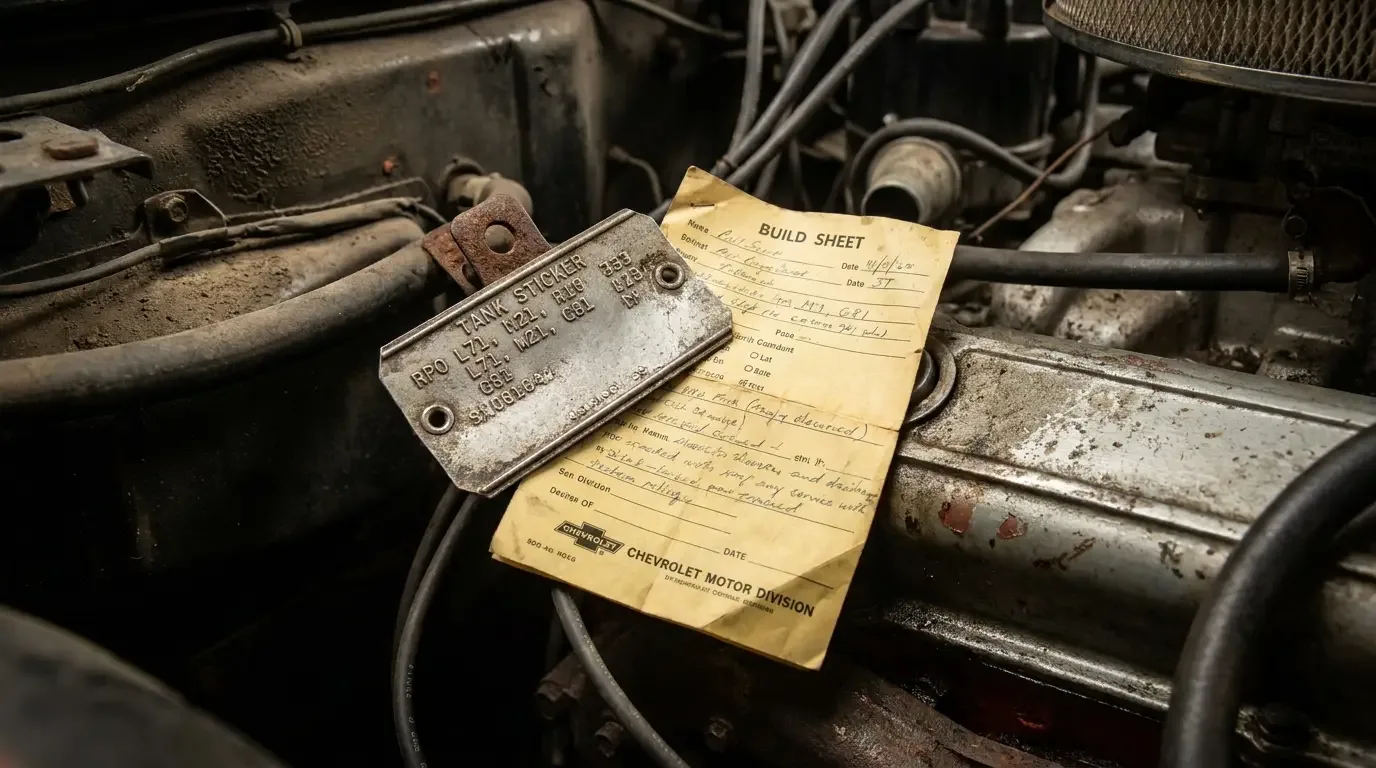
The build sheet, sometimes called the broadcast sheet, is a different document from the tank sticker. The build sheet was a production instruction form that traveled down the assembly line with the car. Many of them were stuffed inside door cavities, under seats, or under carpet during the build process, which is why restorers sometimes find them during disassembly decades later. A surviving build sheet is significant because it is a working production document, not a summary record.
The tank sticker, by contrast, was affixed to the car after build and is what most authentication work centers on. It lists the RPO codes the car was equipped with, along with the model year, body style code, exterior color code, interior trim code, build date, and the St. Louis or Bowling Green plant designation. The format changed over the decades, and a researcher needs to know what a correct tank sticker looks like for the specific model year they are examining. A 1963 sticker does not look like a 1972 sticker. Subtle differences in format, font, and layout have been documented by the registry community and are part of what makes a sticker credible or suspicious.
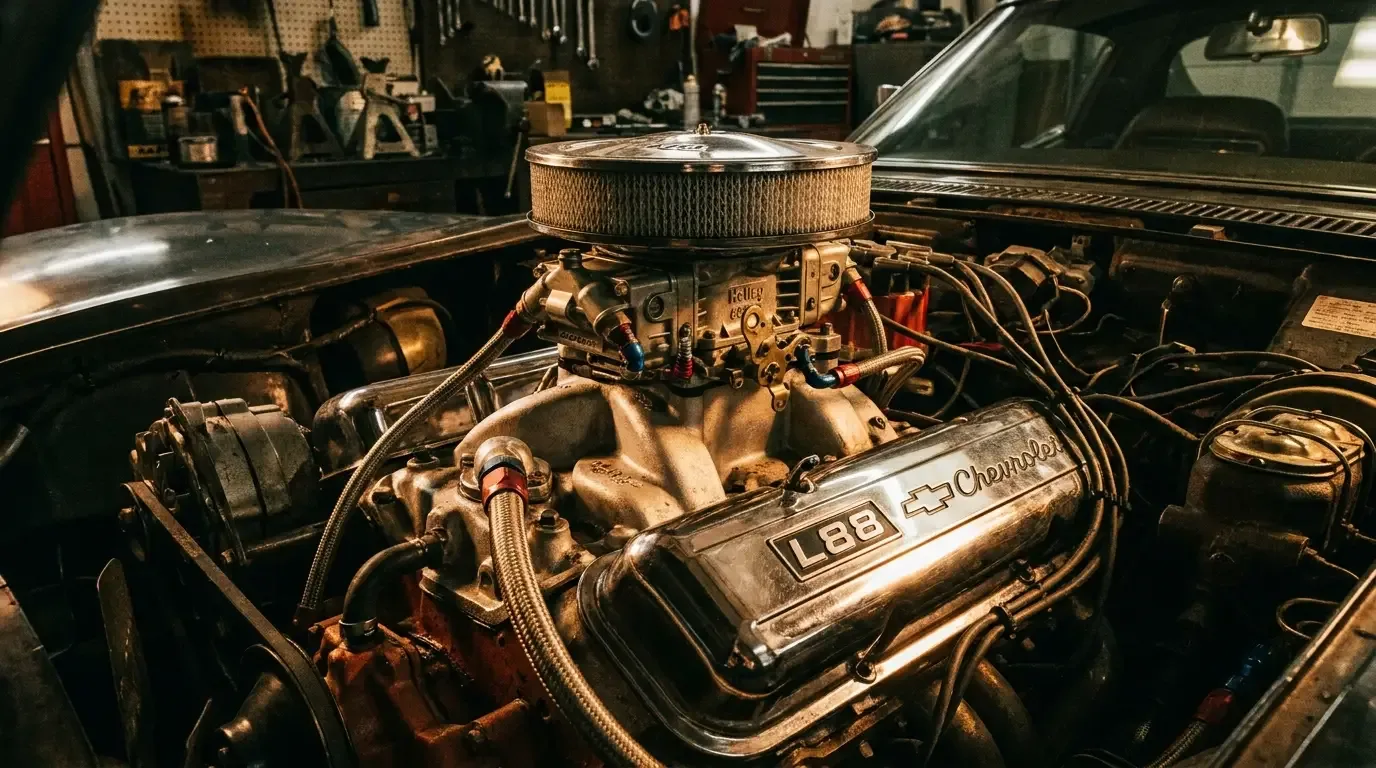
When you find a Corvette with its original tank sticker intact, the first step is transcribing every code before you do anything else. Cross-reference that list against documented production data for the year. Some codes are extremely common. Some are rare enough that their presence on a sticker warrants closer inspection of the car to confirm the equipment is actually there. An L88 code without an L88 engine is a problem. An M22 close-ratio four-speed code without a Muncie in the car is a problem. The codes should match the physical car.
The Corvette Special Editions & RPO Codes documentation goes deeper on how specific option packages were bundled and what codes indicate factory-correct special editions versus dealer-added equipment. That distinction matters more than buyers sometimes realize.
Common RPO codes and what they mean
| RPO Code | Description | Notes |
|---|---|---|
| L46 | 350 cu in V8, 350 hp | 1969 only; replaced the 327 cu in L79 when displacement increased to 350 cu in that year |
| L82 | 350 cu in V8, high-output version | Late C3 performance option, 1973-1980; output varied by year (250 hp in 1973-74, 205 hp in 1975 after catalytic converter introduction) |
| L88 | 427 cu in high-compression racing engine | 1967-1969 only; 20 built in 1967, 80 in 1968, 116 in 1969; requires full documentation |
| ZL1 | 427 cu in all-aluminum racing engine | 1969 only; only 2 sold to the public; rarest and most valuable Corvette RPO |
| M21 | 4-speed close-ratio manual transmission | Muncie; paired with performance engines |
| M22 | 4-speed close-ratio heavy-duty manual | Rock Crusher; stronger helix-angle gear design for high-torque applications; required with L88/ZL1 in most years |
| J56 | Special heavy-duty brakes | Often paired with high-output engines; presence confirms factory brake package |
| N37 | Tilt-telescopic steering column | Common comfort option; useful for trim verification |
| C60 | Air conditioning | Not available with L88 or ZL1 in 1967-1969; Chevrolet excluded comfort options from race-oriented packages |
| ZR1 | Special purpose racing package | 1970-1972; LT1 350 cu in small-block based; only 53 built across all three years; not to be confused with the 1990s ZR-1 model designation |
This list is not exhaustive. The full RPO catalog for any given model year runs to dozens of codes covering everything from paint colors to radio options to off-road exhaust systems. The codes above are the ones that come up most often in authentication conversations because they represent significant equipment choices with real dollar values attached. An L88 car with documentation is worth a fundamentally different amount than an L88 car without it.
"The code on the sticker is only the beginning. What matters is whether the car in front of you actually has what that code says it should. I've seen stickers that looked right, with the right codes in the right format, on cars that hadn't seen a factory engine in thirty years. The sticker is a starting point, not a conclusion."
— Tom Ramirez
Using RPO codes when buying a Corvette
Practical application of RPO research starts before you look at the car. If the seller provides a VIN, you can use it to request documentation from NCRS or to cross-reference with available registry data. Some years and configurations have more thorough registry coverage than others. C2 cars from 1963 to 1967 and C3 cars through the early 1970s have been documented most extensively, because those are the years that attract the most collector interest and the most authentication scrutiny.
When you get to the car, locate the tank sticker first. On most C2 and C3 Corvettes, it is on the firewall under the hood. If it is missing, that is not automatically disqualifying, but it does raise the question of why it is gone. Stickers get damaged. They fall off. They get removed during restoration. Any of those explanations may be true. The absence of a sticker means you are working from secondary documentation, which is harder to verify and, in the collector market, is reflected in the price.
If you are looking at a car with significant RPO codes, bring a reference list for that specific model year. The NCRS publishes judging documentation that includes what codes should look like and what combinations are factory-correct. A car with an L88 code and air conditioning in a year when that combination was not offered is a flag, not a confirmation. Option conflicts are documented and known. The registry community has done the work of establishing what Chevrolet actually built.
If this kind of documentation work interests you, the next in the series covers the factory performance packages in detail, including how the option codes translated into specific engineering decisions at the plant level.
Where to go from here
RPO documentation is one part of a larger authentication process. The tank sticker establishes what the factory intended to build. The VIN decodes the basic configuration. The partial VIN stamps on the engine block and transmission case establish whether the drivetrain is original to the car. The trim tag in the door jamb documents interior and exterior color assignments from the factory. All of these documents need to agree with each other, and with the car itself, for a clean documentation story.
The collector market prices documentation-clean cars differently from everything else, and that gap is largest at the top of the market. Driver-quality Corvettes sell on condition. Show-quality and investment-grade cars sell on documentation. If you are buying a car for serious money, budget time and resources for a proper authentication review before you commit. The cost of getting it wrong is substantially higher than the cost of getting it right.
For buyers who want to find a verified example rather than navigate authentication alone, searching classic Corvette for sale listings gives you a starting point with cars that have been listed with basic documentation details included.
Sources and notes
- Corvette Action Center: L88 production numbers by year (1967: 20, 1968: 80, 1969: 116)
- CorvSport: 1969 ZL1 Corvette — only two sold to the public; 94 ZL1 engines with Corvette prefixes built at Tonawanda
- CorvSport: 1970-1972 ZR1 — LT1 350 cu in engine, 53 total units across three years
- Old Car Memories: L82 horsepower history — 250 hp (1973-74), 205 hp (1975) after emissions regulations
- Wikipedia: Muncie 4-Speed Transmission — M21 vs M22 gear design and helix angle differences
- Corvette Action Center: J56 heavy-duty brake package history and specifications