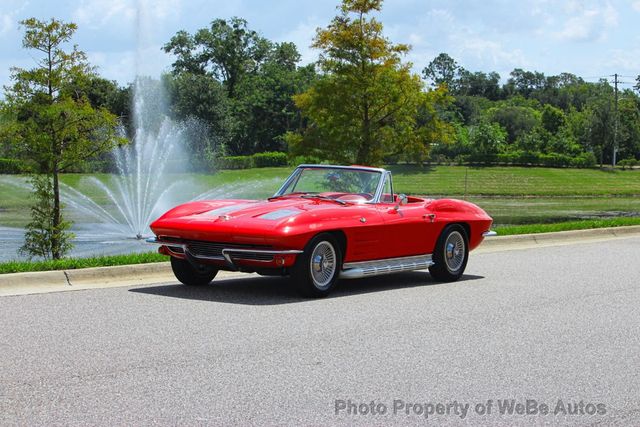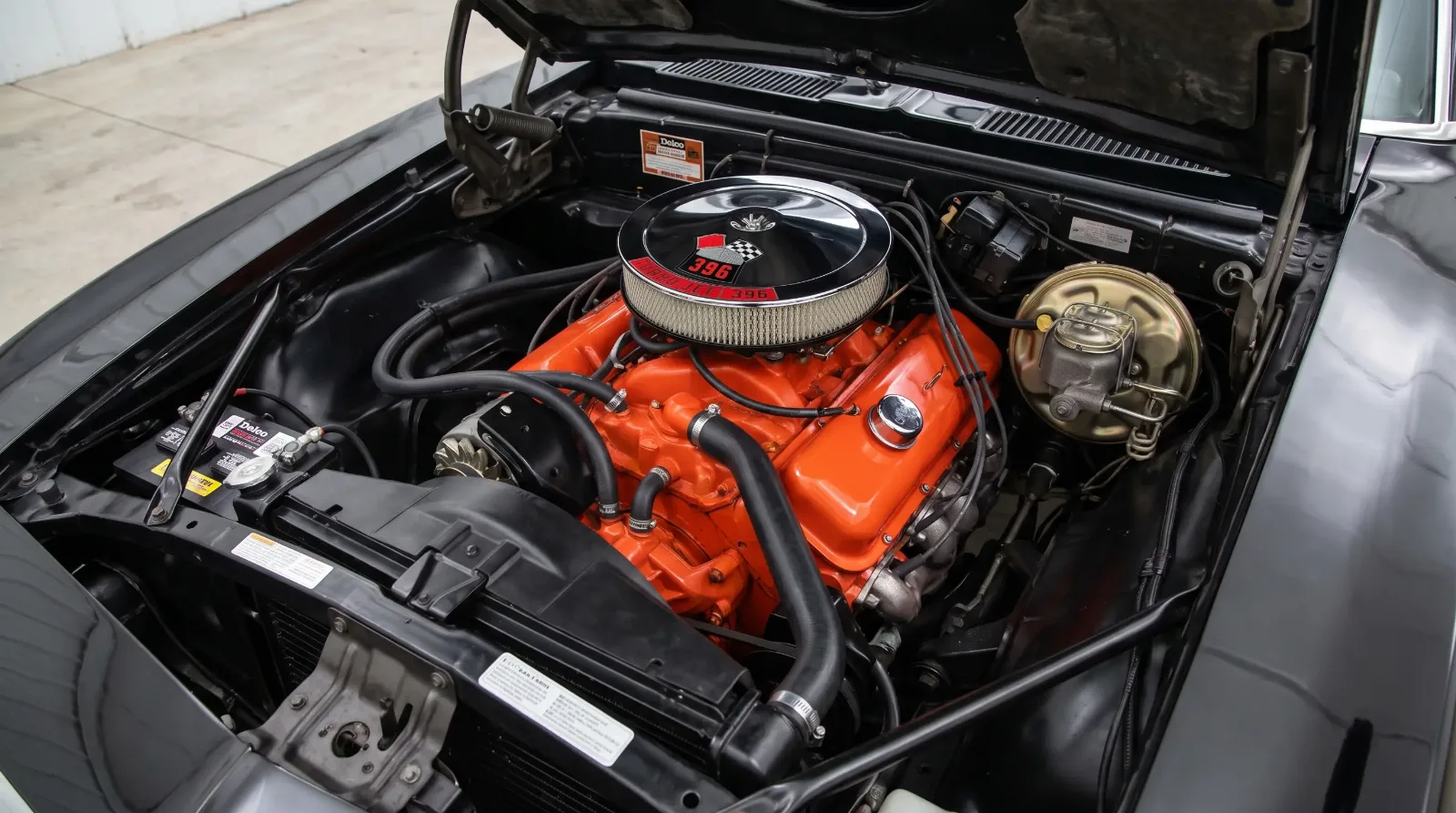

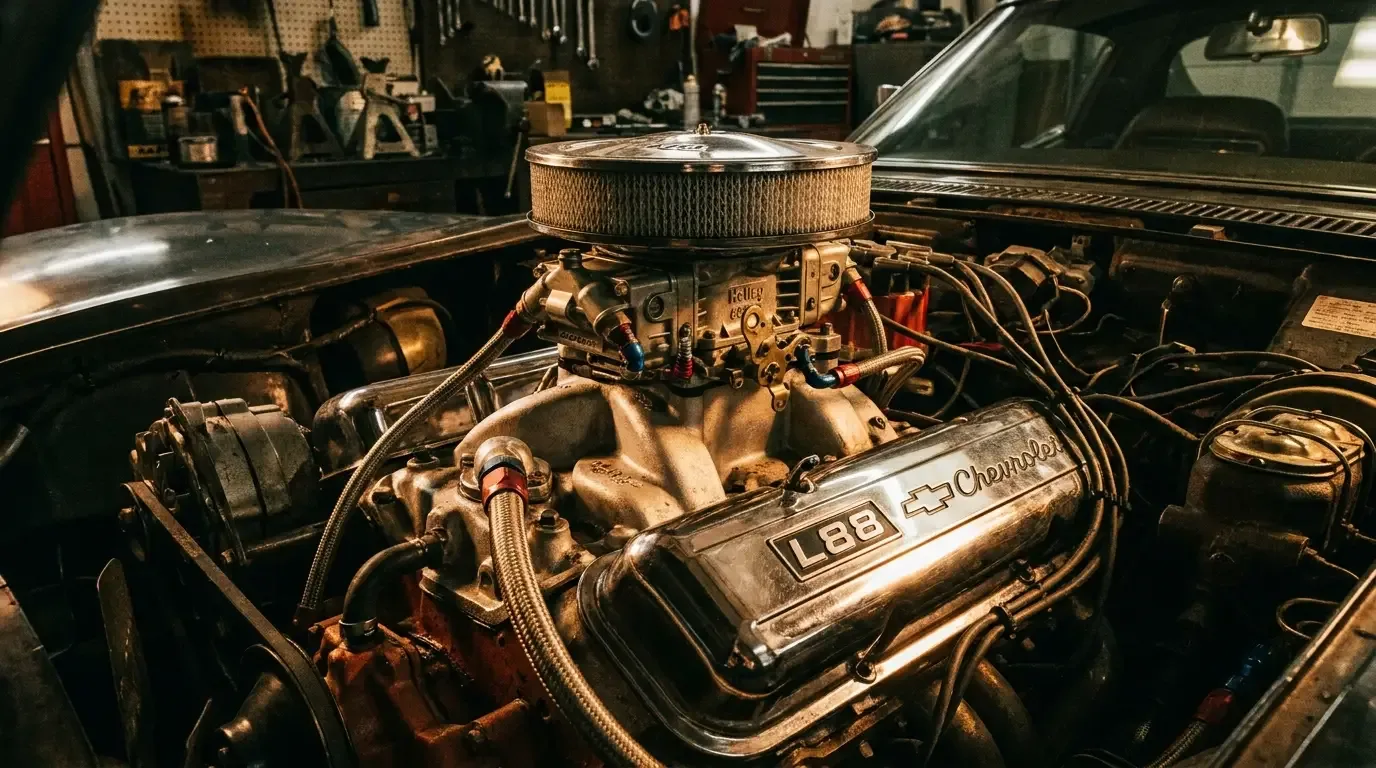
The Corvette's reputation as America's sports car runs straight through its big-block era. From 1965 through 1974, Chevrolet offered displacement options that no European competitor could match on price, and few could match on raw output. The 427 and 454 cubic-inch engines that powered these cars are not myths. They are documented, option-coded, tank-stickered facts. Understanding what they were, how they differed, and what that means for a car you're looking at today starts with the factory record.
If you want the broader story of how the Corvette got here, the Corvette's origins go back to 1953 and take some turns before the big blocks arrive.
The 427: what the factory actually built
Chevrolet introduced the 427 cubic-inch big block in the Corvette for the 1966 model year, replacing the 396 that had debuted a year earlier. The 427 ran in Corvette production through 1969. During those four years, it appeared in multiple states of tune under different RPO codes, and the differences between them are significant.
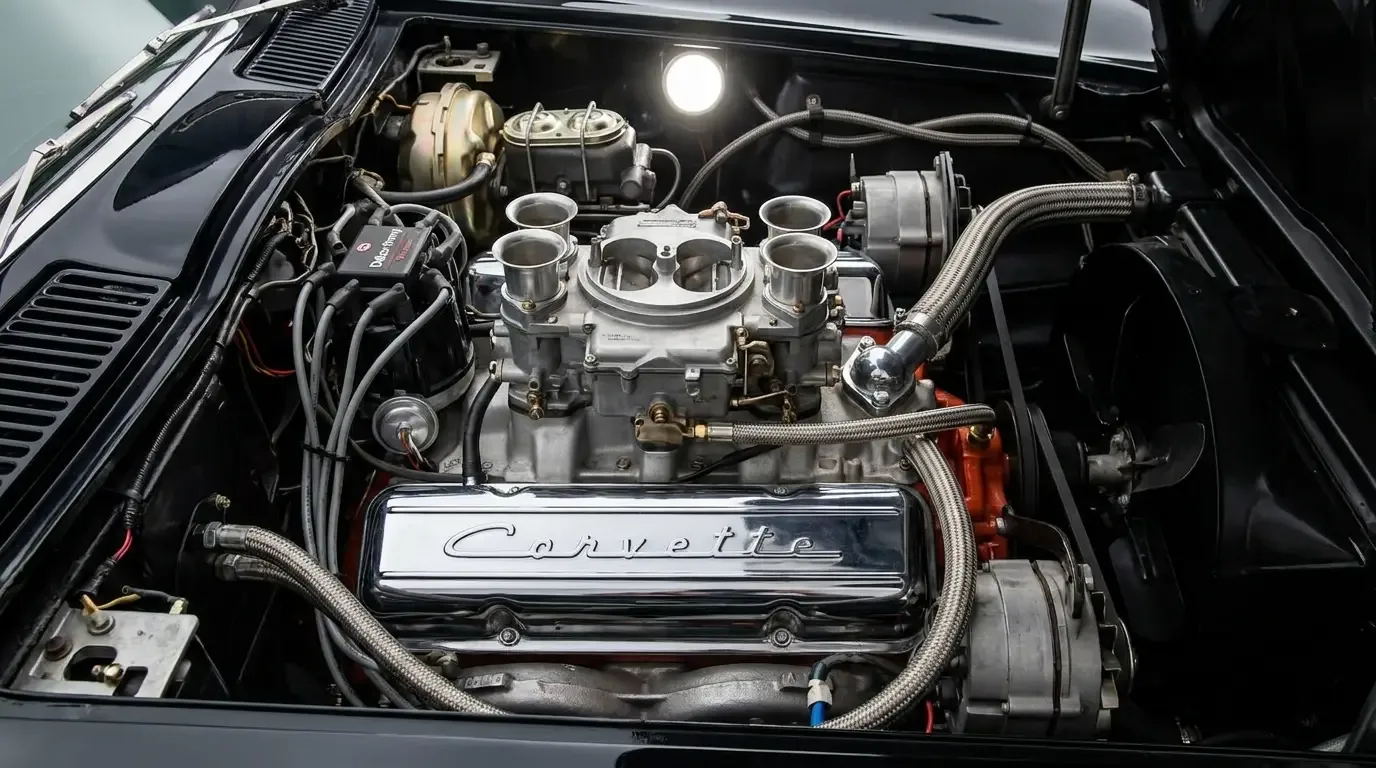
The L36 was the base 427. Rated at 390 horsepower, it was a torque-heavy engine suited to street driving, with hydraulic lifters and a cast-iron intake. The L68 added three two-barrel carburetors on an aluminum intake for a factory rating of 400 horsepower. Both were practical choices for a car you intended to drive year-round.
The L71, also tri-carbureted but with solid lifters and higher compression, was rated at 435 horsepower. The L89 was an L71 with aluminum cylinder heads, which reduced weight and made the engine more responsive, though the factory horsepower rating stayed the same. Production on the L89 was low in all three years it was available, making documented examples genuinely rare.
The L88 is the option that commands the most attention. Rated at 430 horsepower from the factory, which was an obvious understatement intended to discourage street use, the L88 was a racing engine sold through the regular order form. It required a host of companion options, deleted the radio and heater, and produced power that was incompatible with pump gasoline. Production numbers were small: 20 units in 1967, 80 in 1968, and approximately 116 in 1969 (some registry sources cite 118; the exact count depends on how cancelled or incomplete orders are counted). An L88 with documentation is a different category of car from anything else wearing a 427 badge.
If you're reading RPO codes on a build sheet and want to understand what each code actually means for the car in front of you, the related article on RPO codes and build sheets covers the documentation process in detail.
The ZL1: aluminum all the way through
One more 427 deserves its own paragraph. The ZL1, available in 1969 only, replaced the L88's iron block with an aluminum block, bringing total engine weight down by roughly 100 pounds. The factory listed it at the same 430-horsepower figure as the L88, which fooled nobody who knew what they were looking at. Exactly 2 Corvettes received the ZL1 in 1969. The price of the option alone was more than a base Corvette. These are not buyer's market cars; they are museum-level pieces when they surface.
| RPO Code | Engine | Factory Rating | Years Available |
|---|---|---|---|
| L36 | 427 cu in, hydraulic lifters | 390 hp | 1966-1969 |
| L68 | 427 cu in, tri-carb | 400 hp | 1967-1969 |
| L71 | 427 cu in, solid lifters, tri-carb | 435 hp | 1967-1969 |
| L89 | 427 cu in, L71 + aluminum heads | 435 hp | 1967-1969 |
| L88 | 427 cu in, racing spec | 430 hp | 1967-1969 |
| ZL1 | 427 cu in, all-aluminum block | 430 hp | 1969 only |
| LS5 | 454 cu in | 390 hp | 1970-1974 |
| LS6 | 454 cu in, high-performance | 425 hp | 1971 only |
The 454 and the compression squeeze
The 427 was gone after 1969. For 1970, Chevrolet bored the big block out to 454 cubic inches. On paper, the displacement increase suggested more of everything. The reality was more complicated.
The 1970 LS7 option was announced in factory literature but was not actually put into production. The LS5, at 390 horsepower, was the real base 454 for 1970 and went on to serve through 1974 in diminishing states of tune.
The 1971 LS6 is the high-water mark for the 454 in the Corvette. Factory rated at 425 horsepower (gross) with solid lifters and high compression, it represents the last gasp of the high-compression era before emissions regulations and the industry-wide shift to net horsepower ratings changed the numbers. The LS6 was available for one model year in the Corvette, with around 188 units produced. Documented LS6 cars with their original drivetrain carry a premium that reflects scarcity and the engine's reputation.
After 1971, compression ratios dropped, horsepower ratings fell sharply under the new net measurement standard, and the 454 became a progressively milder engine through its last year in 1974. By that final year, the engine that had made 425 horsepower in gross terms three years earlier was producing 270 horsepower net. The displacement was the same. The character was not.
"The factory rating on an L88 or an LS6 tells you almost nothing useful. What matters is the documentation behind the number: the tank sticker, the build sheet, the original block casting date relative to the car's production date. The horsepower figure is just the starting point."
-- Tom Ramirez
What to look for when the engine matters
The big block Corvette market is full of engine swaps, re-stampings, and option code fraud. This is not speculation; it is the history of any market where specific configurations carry large premiums. If the car in front of you is represented as an L88, L89, LS6, or ZL1, the documentation burden is on the seller.
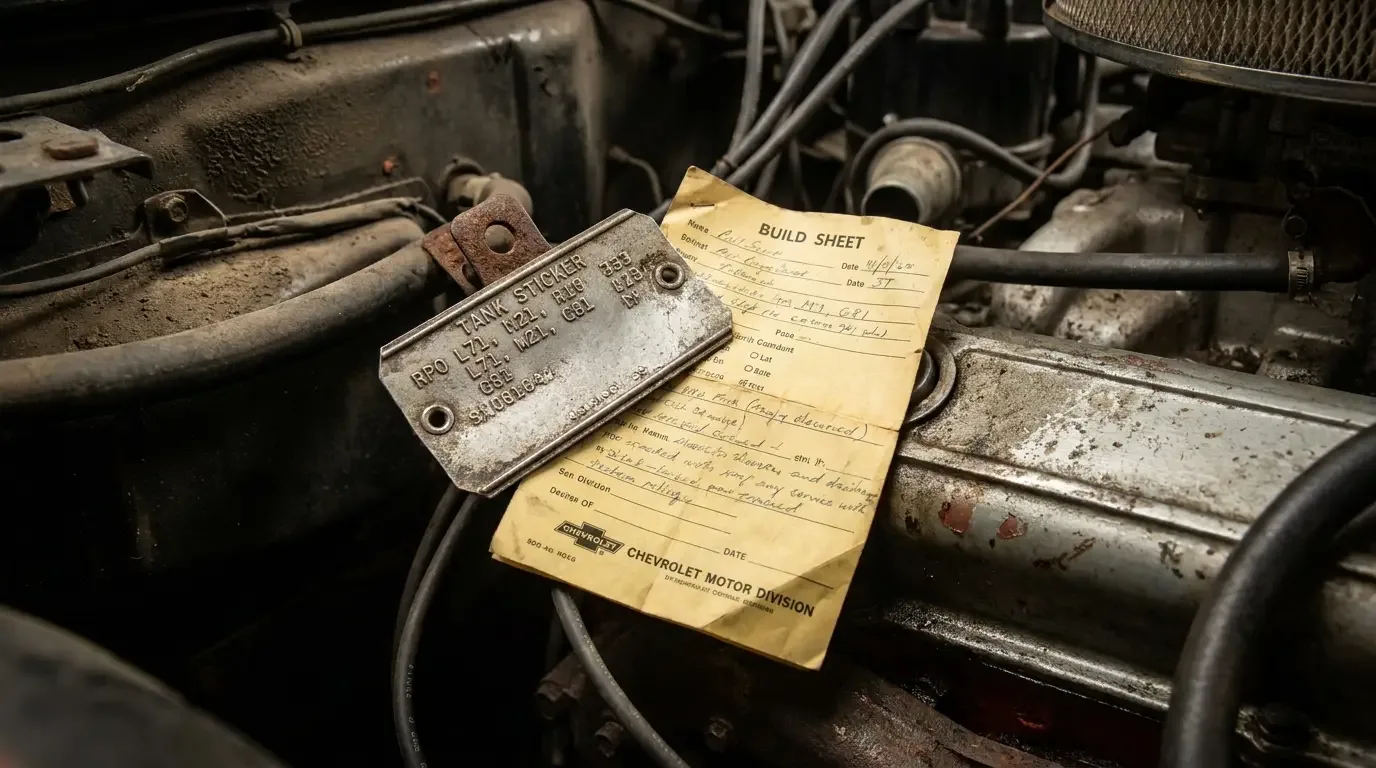
The tank sticker is the primary document. It is a Chevrolet assembly record affixed to the engine compartment and records the major options as built. A car cannot be accurately represented as a specific RPO without it, or without a paper trail that explains its absence convincingly. The NCRS documentation process exists precisely because the stakes are high enough to attract fraud.
Block casting numbers matter. The casting date on the block must precede the vehicle build date. An L88 block cast after the car shipped is an L88 block installed in a car that was not built as one. This is not a technicality; it changes the value significantly.
For the more common L36, L68, and LS5 cars, the engineering concerns are different. These engines were sold in volume, parts availability is reasonable, and the performance expectations are more modest. What you want to verify is that the engine present is numbers-matching, that the heads haven't been swapped for later emissions-spec castings, and that the car's records support what the seller is claiming.
If you want to see what's currently available, big-block Corvettes for sale on ClassicCarsArena range from driver-quality L36 cars to documented examples at the top of the market.
Context within the Corvette lineup
The big-block era overlaps with some of the most collectible Corvette configurations across the model's history. Corvette Special Editions sometimes intersected with big-block availability in ways that compound both value and documentation complexity.
What the 427 and 454 engines represent, in practical terms, is a decade of Chevrolet engineering operating at maximum output before external constraints changed the direction. The L88 and LS6 are genuinely exceptional machines by any standard. The volume engines, the L36 and LS5, are more accessible, more driveable, and honest about what they are.
The difference between the cars is real. The factory records, when they exist and are intact, make that difference legible. When they don't exist, the burden of proof is higher. That's not unique to Corvettes, but it matters more here than in most markets because the premiums are large and the fakes are convincing.
Sources and notes
- Corvette Action Center: L88 production numbers by year (1967-1969)
- Corvette Action Center: 1971 LS6 engine specifications confirming 425 hp gross rating
- Vette Vues: L88 Corvette history, factory rating, and actual output range
- CorVSport: 1969 ZL1 Corvette -- aluminum block, production, and weight savings
- Hagerty Media: Last big-block Corvettes including 1974 LS4 270 hp net rating
- Mac's Motor City Garage: Birth of the Corvette big block -- 396 debuts in 1965