
The engine that changed what a Corvette could be
There is a specific moment in Corvette history where the factory stopped apologizing for the car's performance and started making a statement. For most of the 1980s, the Corvette was fast enough by the standards of what was on the road, but it wasn't extraordinary. The LT5 engine changed that argument completely. When Chevrolet introduced the ZR-1 for the 1990 model year, it did so with a powerplant that had no real precedent inside General Motors and no close rival outside of it. The ZR-1 was the first Corvette that made European supercar builders take the threat seriously.
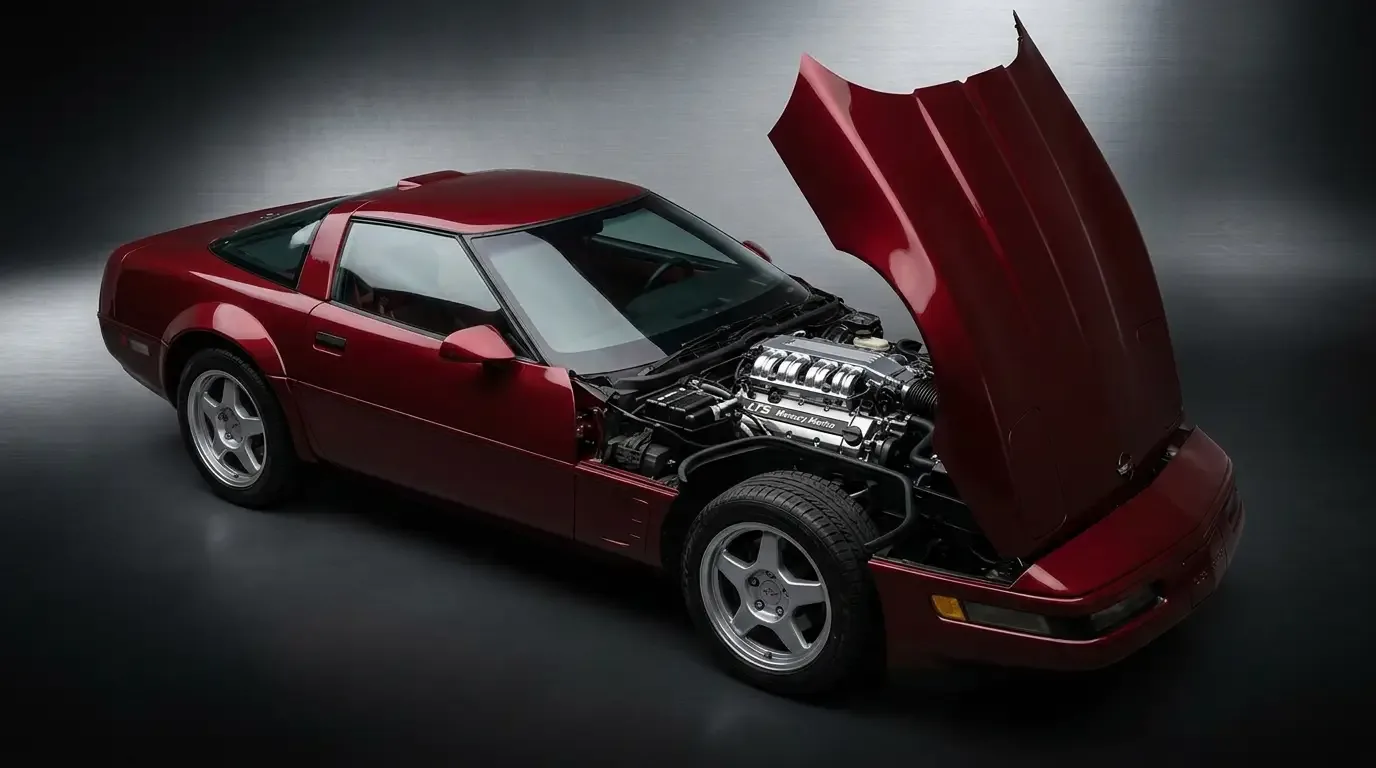
The LT5 didn't come from the Corvette engineering team in the conventional sense. It was a collaborative project between GM and Lotus Engineering, which GM had acquired in 1986. Lotus handled much of the cylinder-head design work; the production engine was assembled by Mercury Marine in Stillwater, Oklahoma. That manufacturing arrangement is one of the more unusual chapters in American performance history, and it produced results that were worth the complexity. If you want to understand how the ZR-1 earned its "King of the Hill" nickname, the LT5 is where you start. For broader context on how special editions like this fit into Corvette history, read the corvette special editions story.
What the LT5 actually was
The LT5 was a 5.7-liter (350 cubic inch) all-aluminum V8 with dual overhead camshafts and four valves per cylinder. That 32-valve configuration was essentially unheard of in American production car engines at the time. The Corvette's standard engine used a pushrod design that dated back decades; the LT5 was a clean-sheet architecture built to different priorities.
Rated output for the 1990 model year was 375 horsepower at 6,000 rpm, with 370 lb-ft of torque at 4,800 rpm. Those numbers look modest by current standards, but in 1990 they represented a significant margin over anything else in the American market. The standard Corvette L98 made 245 horsepower that year. The ZR-1 had a 53 percent power advantage over its platform sibling from the factory.
In 1993, Chevrolet increased LT5 output to 405 horsepower by revising the camshafts, intake porting, and throttle body. That upgraded engine, sometimes designated LT5 Gen II, carried through the end of ZR-1 production in 1995. The horsepower increase is real and documented, but the two generations are not always clearly labeled in sales listings, so confirming the model year matters when you are evaluating a specific car.
| Model year | Engine designation | Horsepower (rated) | Torque (rated) |
|---|---|---|---|
| 1990-1992 | LT5 (Gen I) | 375 hp @ 6,000 rpm | 370 lb-ft @ 4,800 rpm |
| 1993-1995 | LT5 (Gen II) | 405 hp @ 5,800 rpm | 385 lb-ft @ 4,800 rpm |
The valet key and the full-power mode
One of the more interesting engineering decisions around the LT5 was the power management system GM built into it. The ZR-1 shipped with two keys: a standard key that limited the engine to roughly half its rated output, and a second key that unlocked full power. The intent was to give owners a way to hand the car to a valet or mechanic without handing over access to 375 or 405 horsepower. In practice, the system worked as advertised, though how many owners actually used the reduced-power key regularly is an open question.
The mechanism operated through a secondary throttle system. In restricted mode, the secondary intake runners were closed off, effectively cutting the engine's breathing capacity and capping output. In full-power mode, all runners opened at higher throttle positions. It was a real engineering solution, not a software speed limiter. The physical keys for these cars have been lost or misplaced on some examples, which is worth asking about before you buy.
"The ZR-1's valet key isn't a gimmick. It's the factory's acknowledgment that this engine needed to be treated differently than anything else on the lot. When you're talking about provenance on one of these, the presence of both keys tells you something about how the car was owned."
— Tom Ramirez
How the ZR-1 differed from the standard C4
The ZR-1 was built on the same C4 platform as the standard Corvette, but the differences ran deeper than the engine. The rear body was widened by about three inches to accommodate larger rear tires. The rear track was wider, and the bodywork was restyled accordingly: the ZR-1 used a convex rear fascia rather than the standard car's concave design, and the taillights were distinctive enough that the ZR-1 and standard coupe are easily distinguished from behind. The wider rear body gave the ZR-1 a more planted, muscular stance that most observers found successful.
The suspension was tuned differently as well. ZR-1s used the FX3 Selective Ride Control system, a driver-adjustable suspension that allowed three settings: Touring, Sport, and Performance. The system is electronically controlled and has known failure modes on aged examples, which should be on any pre-purchase checklist. Replacement components exist but are not inexpensive.
Transmission options were limited to a six-speed manual throughout the ZR-1's production run. Chevrolet did not offer an automatic in the ZR-1 at any point. The gearbox used was the ZF S6-40, sourced from ZF in Germany. The shifter action on these cars varies considerably with age and condition; a worn example can feel notchy in a way that a well-maintained car doesn't.
Buyers interested in a genuine ZR-1 should search for documented examples. Current listings are worth reviewing: ZR-1 Corvettes for sale give a useful read on current asking prices and how sellers are presenting these cars.
Production numbers and what they mean for buyers
The ZR-1 was never a volume product. Total production across the six model years (1990-1995) was 6,939 units, which is a small number relative to total C4 Corvette production. Individual year production varied, with 1990 being the highest-volume year at 3,049 units and later years declining as the model aged and the price premium became harder to justify. By 1995, the C4 platform was entering its final year, and buyers who wanted to wait for the C5 had reason to hold off.
The relatively modest production run means genuine ZR-1s are not common, but they are not rare enough that fraudulent examples are a widespread concern. The wider rear body is visible and structural; you cannot retrofit it from a standard C4 at reasonable cost. The LT5 engine is distinct from the standard L98 or LT1 visually and mechanically. Authentication is not the same challenge it is with factory race-prepared cars, but it still rewards careful documentation review. The factory records and NCRS resources can help establish whether a given car left the line as a ZR-1.
The Corvette's performance lineage has a few reference points that the ZR-1 connects to directly. The L88 of the late 1960s was another moment when the factory built something that exceeded the public's expectations and then made it available, quietly, to buyers who knew to ask. You can read more here about how that earlier factory performance chapter unfolded and how it compares to what the LT5 represented two decades later.
The ZR-1 sits in an interesting position in the current market. It is old enough to have crossed into genuine collectible territory, but it is a 1990s car, which means maintenance histories are often incomplete and wear items are aged. Buyers who understand what the car is and what it costs to keep right tend to fare better than those who approach it as a simple used car purchase at a premium price.
Sources and notes
- Corvette Action Center: 1990-1995 ZR-1 LT5 Engine Specifications — confirmed Gen I (375 hp @ 6,000 rpm / 370 lb-ft) and Gen II (405 hp @ 5,800 rpm / 385 lb-ft) output figures
- Corvette Action Center: 1990-1995 ZR-1 Production Numbers — confirmed 6,939 total units and year-by-year breakdown (1990: 3,049; 1991: 2,044; 1992: 502; 1993-1995: 448 each)
- Wikipedia: Chevrolet Corvette (C4) — confirmed LT5 horsepower figures, ZF S6-40 manual transmission designation, and wider rear bodywork details
- Corvette Action Center: ZF 6-Speed Transmission Differences — confirmed the ZF S6-40 model designation and two-generation (black-tag/blue-tag) history of the gearbox used in the ZR-1
- GM Authority: Remembering the Lotus-Developed LT5 V8 — confirmed Lotus Engineering's cylinder-head design role and Mercury Marine's assembly work in Stillwater, Oklahoma
- Vette Vues: C4 ZR-1 History — confirmed wider rear bodywork (approximately 3 inches), valet key dual-mode system, and FX3 Selective Ride Control suspension