What the ZR1 actually was in 1970
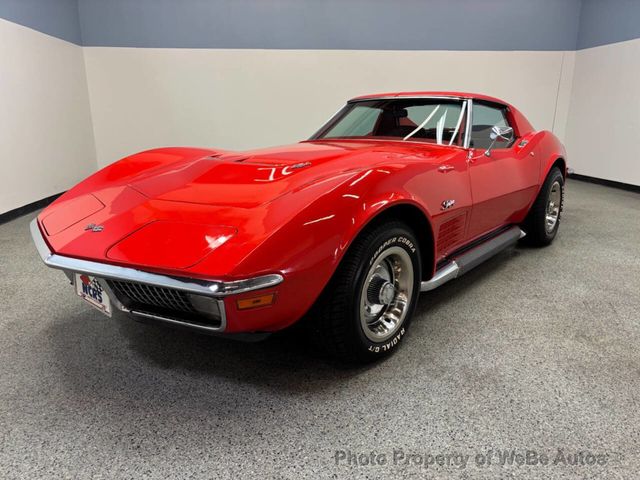
Most people call it the ZR1. The factory called it something closer to a racing parts order. In 1970, RPO ZR1 was not a showroom option you ticked off a sheet, it was a special performance package built around the solid-lifter small-block LT1 engine, available only to buyers who knew what they were ordering and were prepared to deal with the consequences. The package existed to homologate the car for SCCA production racing, and Chevrolet made no particular effort to advertise it. You can find corvette special editions that got far more marketing attention and sold in far larger numbers.
The ZR1 designation for 1970 covered a specific combination documented under RPO ZR1: the LT1 350 cubic inch V8 with solid lifters and a high-compression setup, paired with a mandatory manual transmission, deletion of comfort items that added weight, and heavy-duty cooling and suspension components. This was not a car you ordered if you intended to drive it daily to an office. It was a car you ordered if you had a trailer and a racetrack on your calendar. For the full arc, see Corvette heritage.
The LT1 engine at the center of the package
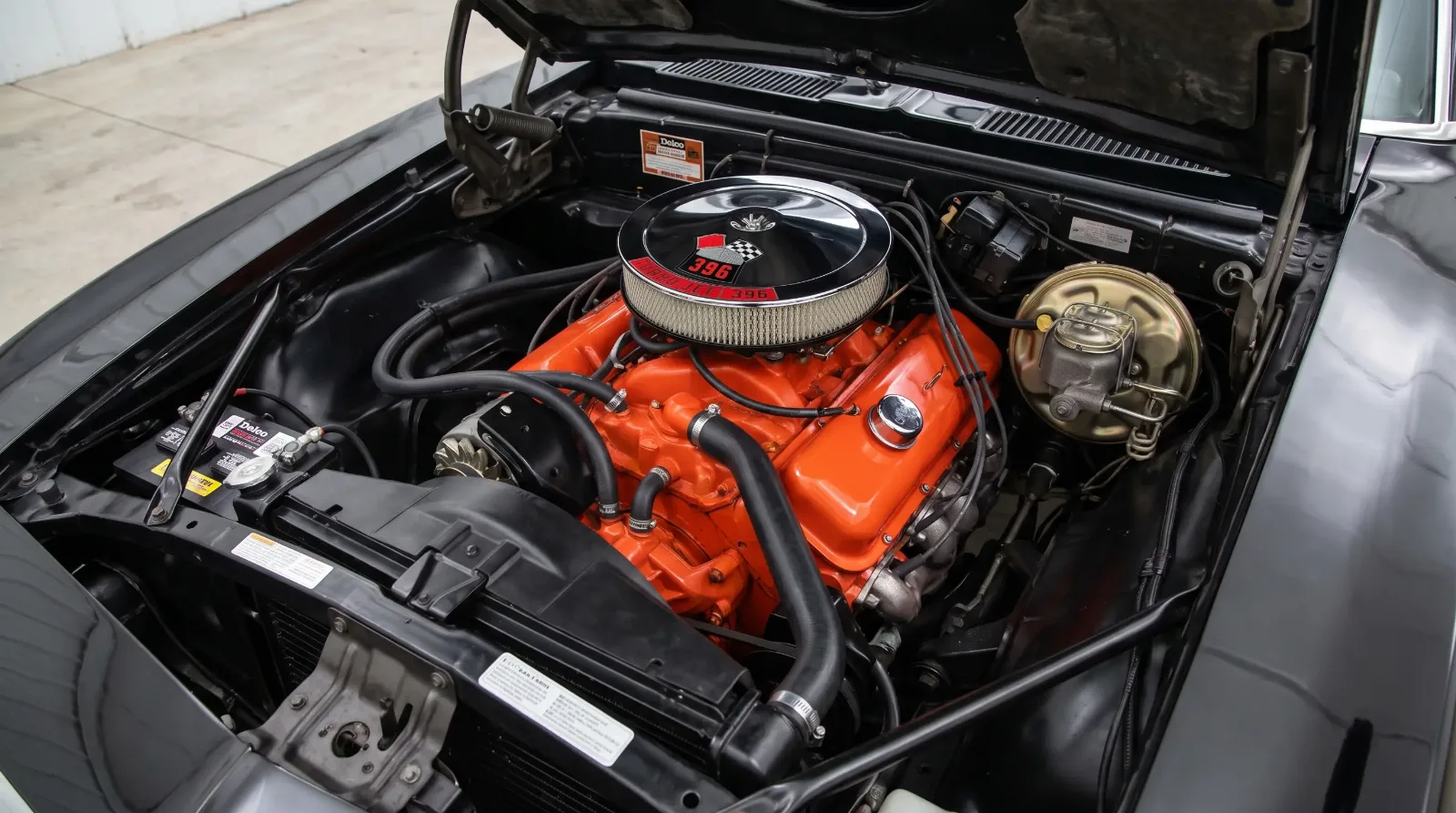
The LT1 350 is what most buyers remember, and it deserves its reputation. Rated at 370 horsepower (factory gross rating for 1970) with solid lifters, an aggressive cam, and high-flow aluminum cylinder heads on an iron block, this engine pulled hard across the rev range in a way the hydraulic-lifter variants simply did not. It was the same basic displacement as the base 350, but the internals were a different conversation.
| Package / Engine | Displacement | Rated power | Lifter type | Trans options |
|---|---|---|---|---|
| ZR1 (RPO ZR1) | 350 cu in (LT1) | 370 hp (gross) | Solid (mechanical) | 4-speed manual only |
| Standard LT1 (without ZR1) | 350 cu in (LT1) | 370 hp (gross) | Solid (mechanical) | Manual or automatic |
| Base 350 | 350 cu in | 300 hp (gross) | Hydraulic | Manual or automatic |
| LS5 454 | 454 cu in | 390 hp (gross) | Hydraulic | Manual or automatic |
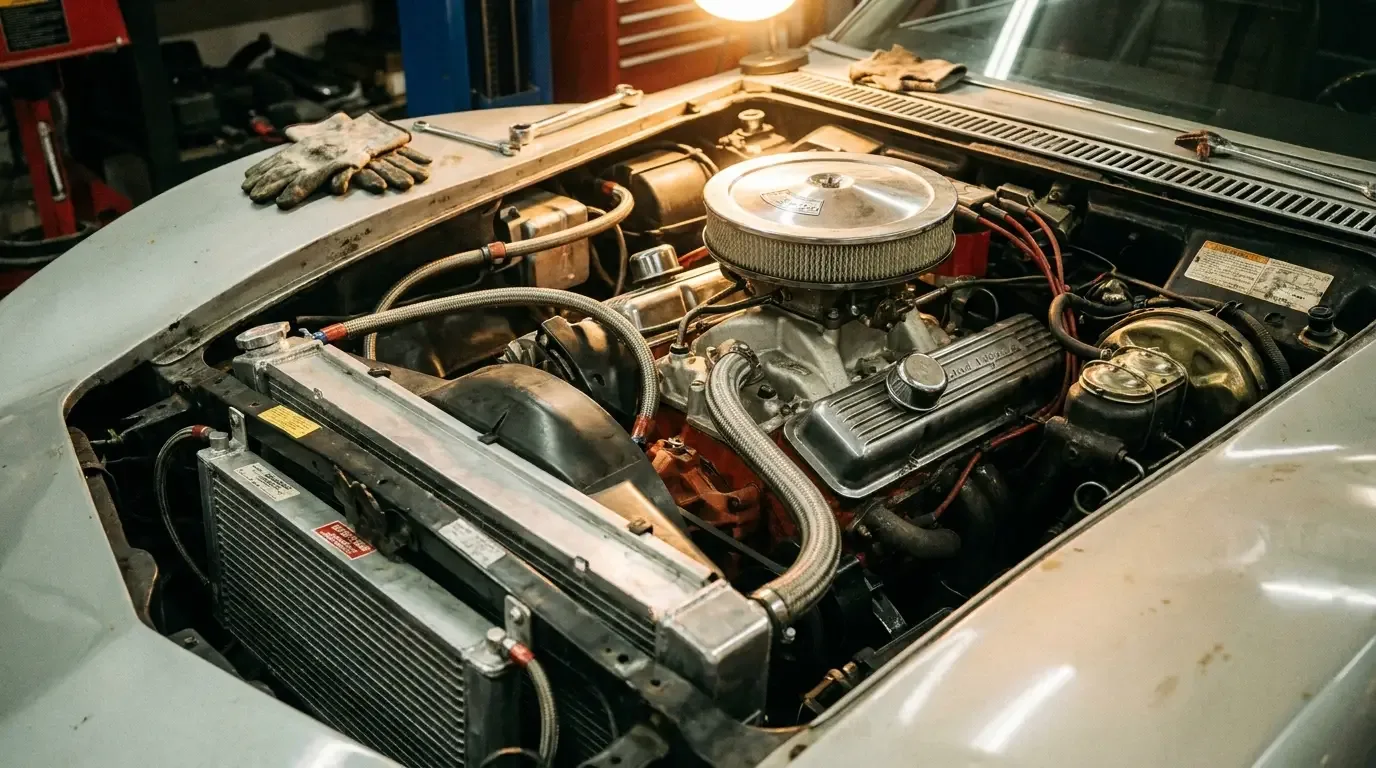
The important distinction between the LT1 as a standalone option and the LT1 as part of the ZR1 package comes down to what else was included. The ZR1 added aluminum cylinder heads (shared with the standalone LT1 but confirmed on the ZR1 build), a transistor ignition, a heavy-duty aluminum crossflow radiator with surge tank, and the deletion of the radio, air conditioning, power steering, power windows, rear window defroster, and alarm system. Those deletions were not oversight, they were intentional weight reduction and simplification for track use. If the original window sticker or tank sticker shows air conditioning, it did not come with ZR1. The two options were mutually exclusive.
How the ZR1 differed from the standard LT1 Corvette
Buyers in 1970 who wanted the LT1 engine without the racing package complications could simply order RPO LT1 and get the solid-lifter 350 in a car that still had its radio, could be ordered with air conditioning, and allowed automatic transmission selection. This is the distinction the market gets confused about regularly. The LT1 engine existed in two contexts: as a standalone option accessible to any buyer who wanted performance, and as the core of the ZR1 package aimed at racers.
The ZR1 package included the M22 "Rock Crusher" heavy-duty four-speed transmission as a mandatory component, along with the F41 heavy-duty suspension, J56 dual-pin heavy-duty power brakes, a larger-capacity aluminum crossflow radiator, and the transistorized ignition system. Each of these additions served the racetrack intent. The M22 was built for sustained high-rpm use; the heavy-duty cooling handled the heat load of extended track sessions; the suspension tuning favored handling response over ride compliance.
For anyone researching Corvette heritage, the 1970 ZR1 represents a meaningful inflection point. It was the year the C3 generation reached its highest-performing factory configuration for road racing homologation, before emissions regulations in subsequent years began pulling the performance catalog in a different direction.
"The tank sticker on a ZR1 tells you more than the engine code alone. Look for the option deletions, no AC, no radio. A ZR1 with those items present on the build sheet is a conversation that needs to happen before any money changes hands."
— Tom Ramirez
Production numbers and documentation challenges
The rarity of the 1970 ZR1 creates a documentation problem that any serious buyer needs to understand before entering the market. With only 25 units built, there are almost certainly more cars being represented as ZR1s than were actually produced. The NCRS has processed authentication requests on C3 performance cars for decades, and the 1970 ZR1 is exactly the kind of car that attracts misrepresentation, sometimes through genuine ownership mistakes and sometimes through deliberate fraud.
Authentication for a 1970 ZR1 rests on several layers. The VIN itself does not distinguish a ZR1 from any other 1970 Corvette coupe, the package does not produce a unique VIN structure. What matters is the partial VIN stamped on the engine block's pad, the tank sticker showing the RPO codes, the build sheet if one survives in the car's structure, and the casting date on the engine relative to the car's build date. The casting date has to be earlier than or very close to the assembly date; an engine dated months after the car was built is not the original unit.
The NCRS documentation process is the recognized standard here. A car with NCRS judging history and a file in the registry carries a different weight than a car with a claimed history and a folder of photocopied documents. This is not a car to buy on seller representation alone. It is worth comparing to a related piece on later ZR1 variants to understand how documentation standards evolved across generations.
What a 1970 ZR1 costs today and where to look
Authenticated 1970 ZR1 Corvettes with documented provenance and NCRS credentials trade at significant premiums over standard LT1 cars. The market for these is thin enough that transaction data is scarce, which means values are set more by negotiation between informed parties than by comparable sales volume. Recent collector car auction results show documented examples trading from around $170,000 to over $450,000 depending on condition, color, options, and the strength of the documentation file. A rare convertible variant sold at auction in early 2025 for $451,000, while coupe examples with clean NCRS histories have changed hands in the $170,000 to $220,000 range. Undocumented cars claiming ZR1 status trade at a steep discount to those figures, for obvious reasons.
The market for 1970 LT1 Corvettes without the ZR1 package is more liquid and more accessible. A solid-driver-quality LT1 coupe from 1970 in a desirable color combination with a documented engine might realistically trade in the $60,000 to $90,000 range in current conditions. Show-quality concours-restoration examples go higher. The LT1 engine without the package is still a legitimate performance specification with a following, and the broader market for 1970 Corvettes provides more comparable sales to work with.
If you are actively looking at the market, browsing current 1970 Corvettes for sale gives you a real-time view of asking prices and helps calibrate what the market is doing right now. Asking prices are not transaction prices, but the spread tells you something about supply.
Keeping a ZR1 LT1 correct
For owners of authenticated cars, originality matters to a degree that goes beyond aesthetics. The solid-lifter LT1 requires more attention than a hydraulic-lifter engine. Valve lash adjustments are not a set-it-and-forget maintenance item; they need periodic checking, and the intervals depend on how the car is driven. An LT1 that runs hard on track will need more frequent attention than one driven carefully on the street. The factory cold valve lash specification for the 1970 LT1 is 0.024 inch intake and 0.030 inch exhaust; these figures come from the factory service manual and GM documentation, and the factory service manual is what you should be working from, not a generic small-block guide.
Replacement parts availability for the LT1 is generally good for the engine internals. The factory-correct option items that define the ZR1 package are a different matter. Correct-date-coded components are what NCRS judging cares about, and sourcing them through reputable Corvette specialists is worth the premium over generic replacements if the car's point score matters to the owner. The Corvette community has enough specialists who understand the 1970 package that parts and knowledge are accessible, but it takes more effort than sourcing parts for a more common configuration.
Sources and notes
- National Corvette Museum: 1970 Corvette Specs — confirmed engine ratings (LT1 370 hp gross, base 350 300 hp gross, LS5 454 390 hp gross)
- Vette Vues: C3 ZR1 Corvette History (1970–1972) — confirmed 25 units built in 1970, M22 mandatory, package composition, production totals across all three years
- Corvette Blogger: Rarest Corvette Small Block — confirmed ZR1 package contents (M22, J56 brakes, transistor ignition, aluminum radiator, comfort deletions)
- CorvetteForum: 1970 LT1 Cold Valve Lash Adjustment Settings — factory specification 0.024 in. intake / 0.030 in. exhaust confirmed from GM documentation
- Corvette Blogger: 1970 ZR1 Convertible auction listing (2025) — recent transaction data including Mecum Indy 2024 ($170,500) and Mecum Kissimmee 2025 ($148,500) results
- CorvSport: 1970–1972 Corvette ZR1 — LT1 aluminum cylinder heads on iron block confirmed, package restrictions including AC/radio/power steering deletions