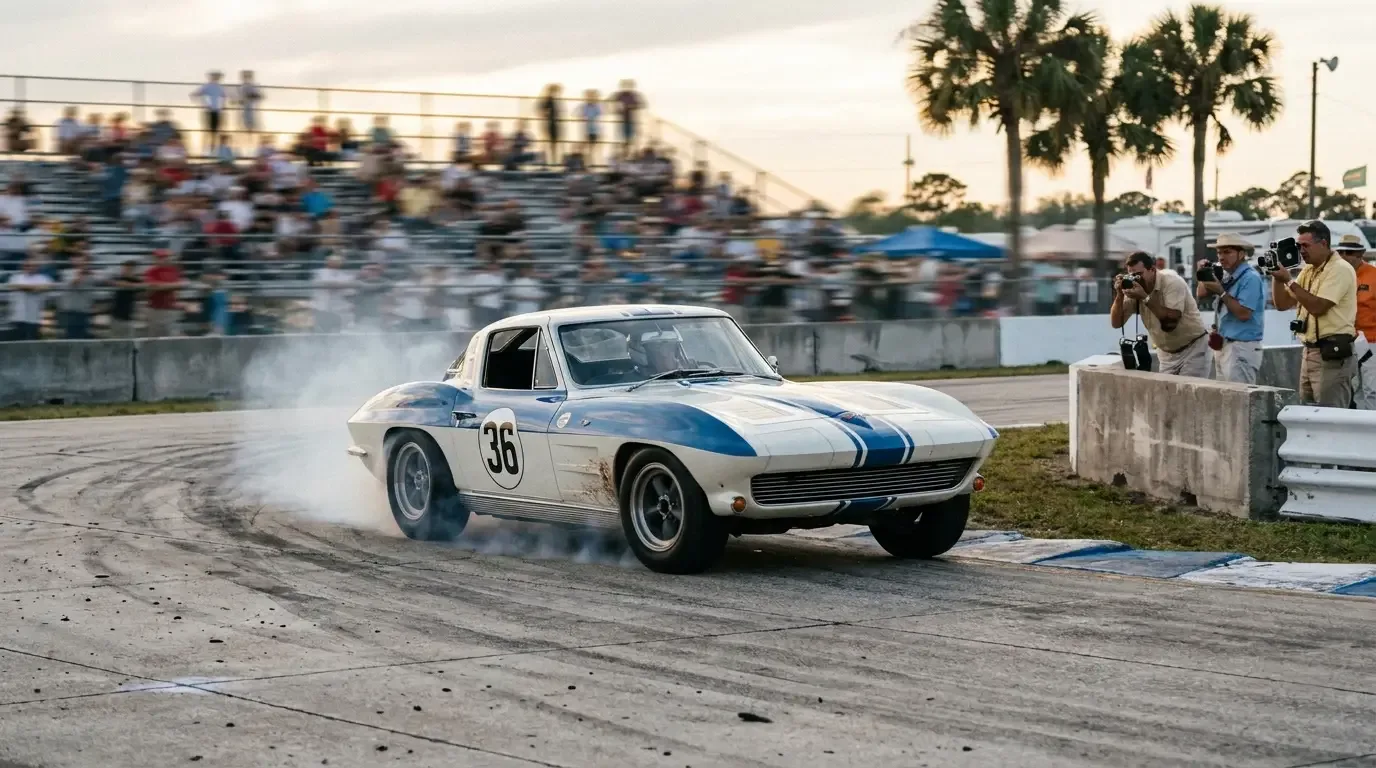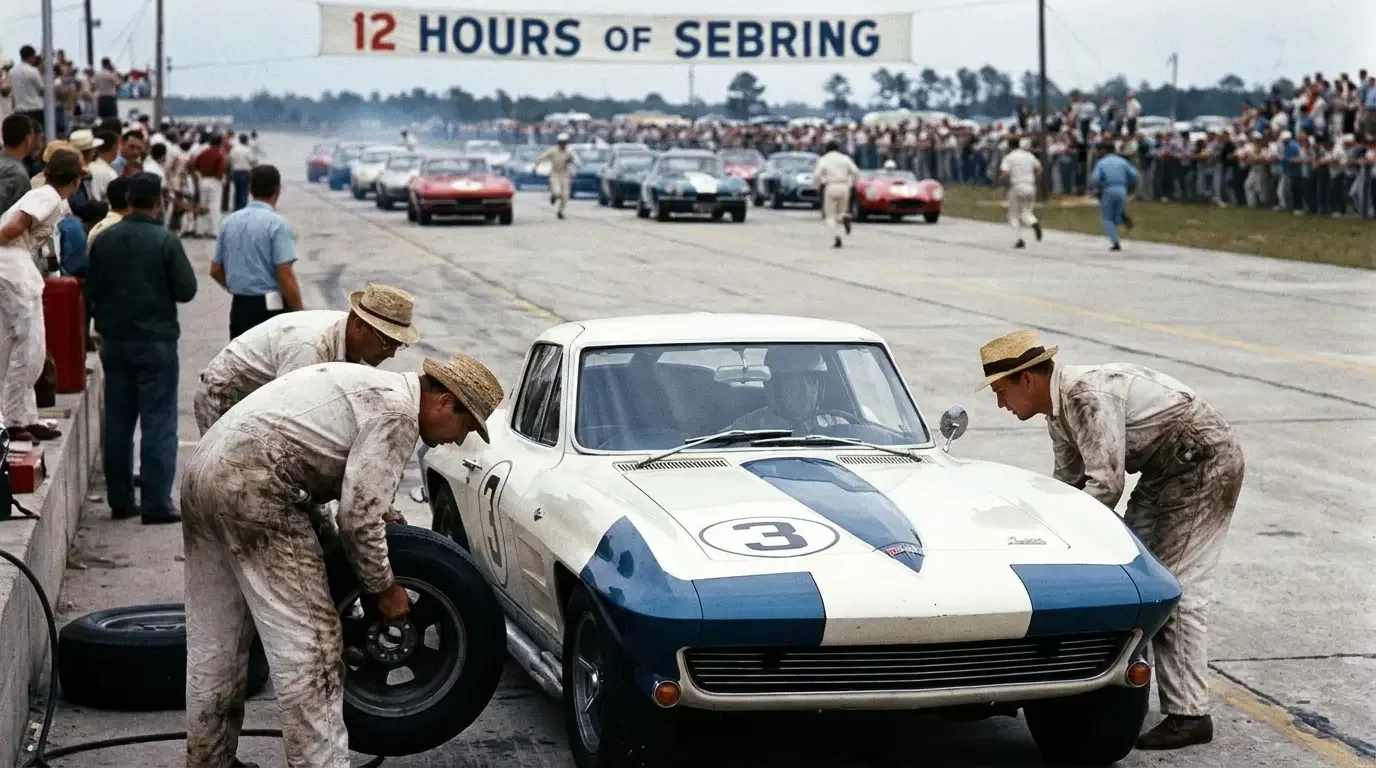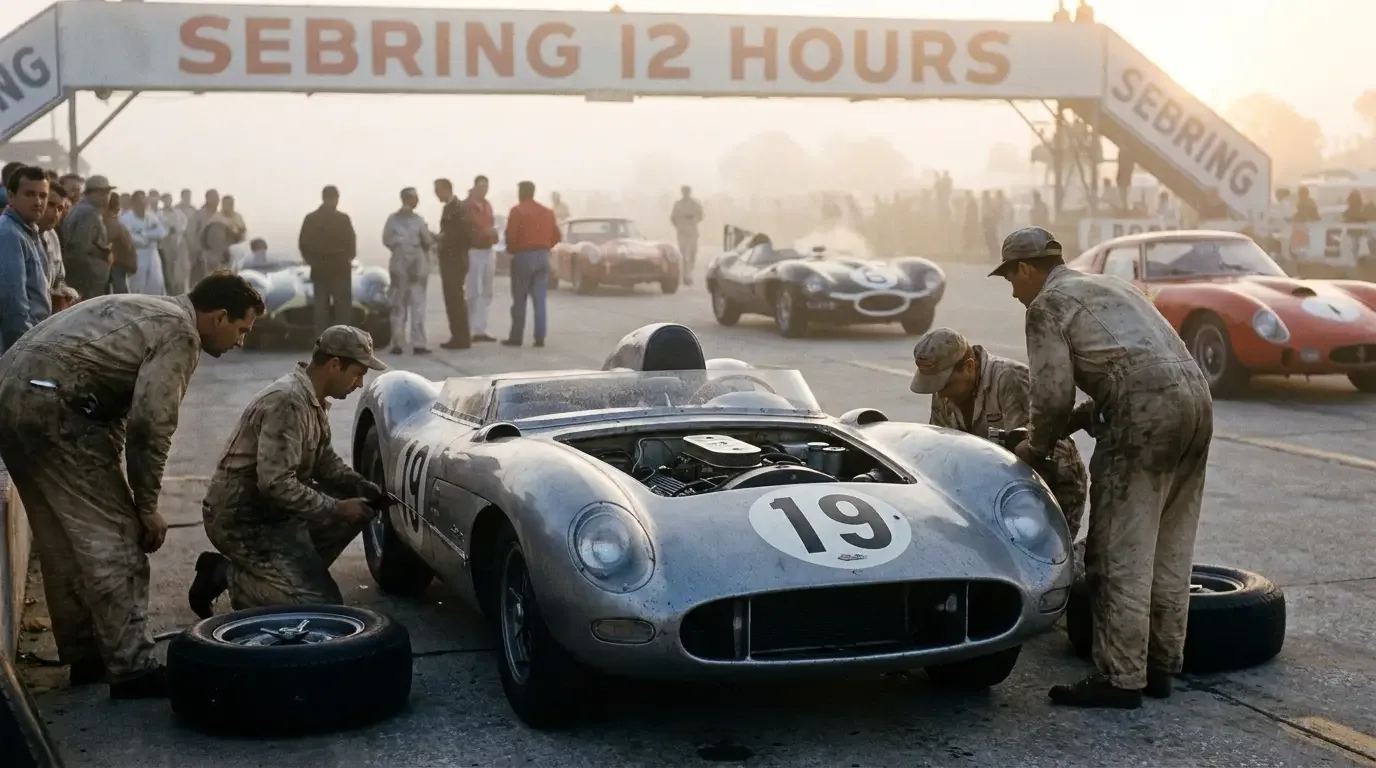
The 1956 Sebring 12 Hours didn't make the Corvette famous overnight. What it did was give the car a story that the factory could actually use, and that the enthusiast press could believe. Before Sebring, the Corvette had two years of sales struggles and a reputation as a boulevard cruiser with a six-cylinder. After Sebring, it had a race result. That matters more than people remember.
Zora Arkus-Duntov understood what the car needed. He'd been pushing Chevrolet toward motorsport since he arrived at the company in 1953, and by 1956 he had the tools to make an argument that worked. The new 265 cubic inch V8, fitted to the Corvette for the first time in 1955 and properly sorted by '56, gave the car something to race on. The question was whether anyone at Sebring would take it seriously. Read the deeper story of how racing shaped everything that came after this moment.
What Sebring looked like in 1956
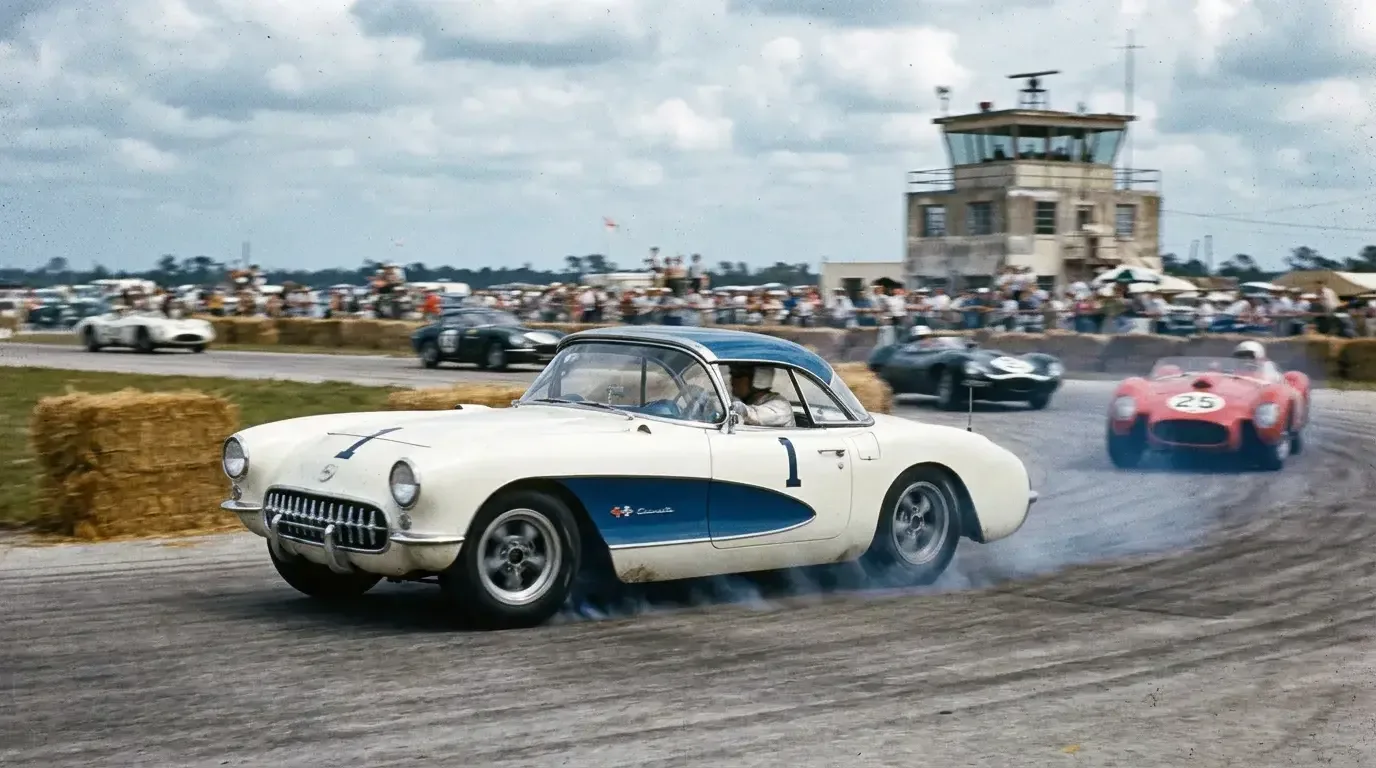
The 12 Hours of Sebring was already establishing itself as the American answer to Le Mans. The 1956 edition drew factory and semi-factory entries from Ferrari, Maserati, and Aston Martin alongside the privateer field. For an American sports car to show anything meaningful in that company was genuinely difficult. The circuit at Sebring, built on a former World War II airfield in central Florida, rewarded mechanical reliability as much as outright speed. Long straights followed by tight, bumpy corners over concrete and tarmac patches. The kind of course that broke things.
Chevrolet did not field an official factory team. The cars that ran were entered by Raceway Enterprises, with development support and parts that had Duntov's fingerprints all over them. The distinction mattered to the corporation at the time and matters less now. The preparation was serious.
The cars and the result
Three Corvettes ran at Sebring in 1956. The lead car, driven by Walt Hansgen and John Fitch, finished ninth overall and first in the Sports 8000 class (designated S8.0 in the FIA classification). That's the number that got remembered. The other entries had mechanical difficulties, which was not unusual at Sebring for anyone. The class win gave the factory something to put in advertisements and gave the press something to write about.
The 1956 Corvette ran a modified version of the 265 V8. Exact output figures for the race-prepared engines varied by configuration, but the street-version dual-quad 265 with RPO 469 was rated at 225 hp, rising to 240 hp when the optional RPO 449 high-lift camshaft (known informally as the Duntov cam) was added. The racing cars ran with mechanical fuel injection development work from Duntov already in progress, though the production Ramjet fuel injection option wouldn't arrive until 1957. What they had at Sebring was a carbureted setup tuned harder than anything in the showroom.
| Specification | 1956 Corvette (street) | Notes |
|---|---|---|
| Engine | 265 cu in V8 | First full year of V8 in Corvette |
| Top street output | 225 hp (RPO 469) / 240 hp (RPO 469+449) | RPO 449 "Duntov cam" added 15 hp over the base dual-quad |
| Transmission | 3-speed manual or Powerglide | 3-speed preferred for racing |
| Sebring finish | 9th overall, 1st in Sports 8000 class (S8.0) | Fitch/Hansgen; class designation per FIA/ACCUS classification |
| Production (1956) | 3,467 units | Up sharply from 1955's low of 700 units built |
Why the result mattered beyond the trophy
Sebring 1956 landed at a moment when the Corvette's future was genuinely uncertain. Only 700 Corvettes were built in 1955, and internal discussions about cancelling the model had taken place. A class win at a prestigious endurance race, against European competition, in front of the American sports car press, gave the car a reason to exist beyond what Ford's Thunderbird was doing to it in the showroom. The T-Bird outsold the Corvette badly in this period. Racing gave Chevrolet something the T-Bird couldn't answer.
Duntov wrote a memo after Sebring outlining what the car needed for the following year at Le Mans. The SS project that came from that memo is the next chapter in the racing story. But the 1956 Sebring result was what justified the investment in that direction. Without the class win, the argument for continued development funding was much harder to make.
"The thing about Sebring 1956 is that it wasn't a dominant performance. It was a credible one. And for a car that needed credibility more than anything else right then, credible was exactly enough."
— Patrick Walsh
What the 1956 Corvette actually was
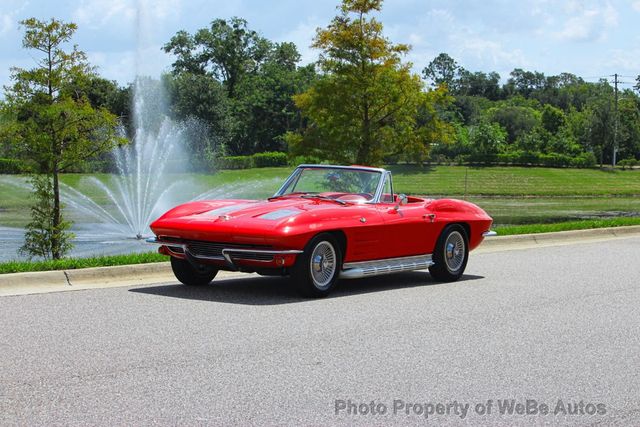
Away from the race, the 1956 street car was a significant step forward from the cars that preceded it. New body styling dropped the original 1953-style sides for a cleaner shape with removable hardtop options and roll-up windows, which the early cars famously lacked. The dual exhaust exited through the rear rather than the bodywork. The interior was revised. These were real improvements that addressed legitimate complaints from buyers.
The V8 made the car what it should have been from the start. The 235 cubic inch Blue Flame six that had powered the 1953 and 1954 cars was adequate for a touring car and inadequate for anything serious. The 265 V8 changed the character entirely. Anyone looking at early Corvettes for sale today will find that 1956 and later C1s command notably stronger prices than the six-cylinder cars, and the reason is mechanical.
Sebring didn't transform the Corvette's sales overnight. The 1956 model year saw production increase substantially from the near-collapse of 1955, but the car still wasn't volume business for Chevrolet. What racing gave it was a direction. The factory knew, after 1956, that there was a performance path worth following. Everything that came after, including the fuel injection cars of 1957, the SS project, and eventually the Sting Ray, traces back to decisions made in the wake of that ninth-place finish in Florida.
Sources and notes
- Wikipedia: 1956 12 Hours of Sebring — confirmed 9th overall finish for Fitch/Hansgen Corvette, S8.0 class designation, full results table
- Racing Sports Cars: Sebring 1956 results — confirmed S8.0 class win and 9th overall position with lap count
- CorvettStory.com: 1956 Corvette specs and options — confirmed RPO 469 (225 hp dual-quad) and RPO 449 (240 hp Duntov cam) output ratings
- CorvSport: 1956 Corvette production numbers — confirmed 3,467 total units built
- CorvetteForum: Six times Corvette nearly got cancelled — confirmed 1955 production crisis (only 700 units built) and internal cancellation discussions
- CorvSport: 1956 Chevrolet Corvette SR — confirmed Raceway Enterprises entry, Fitch and Hansgen as drivers, Class B / Sports 8000 result