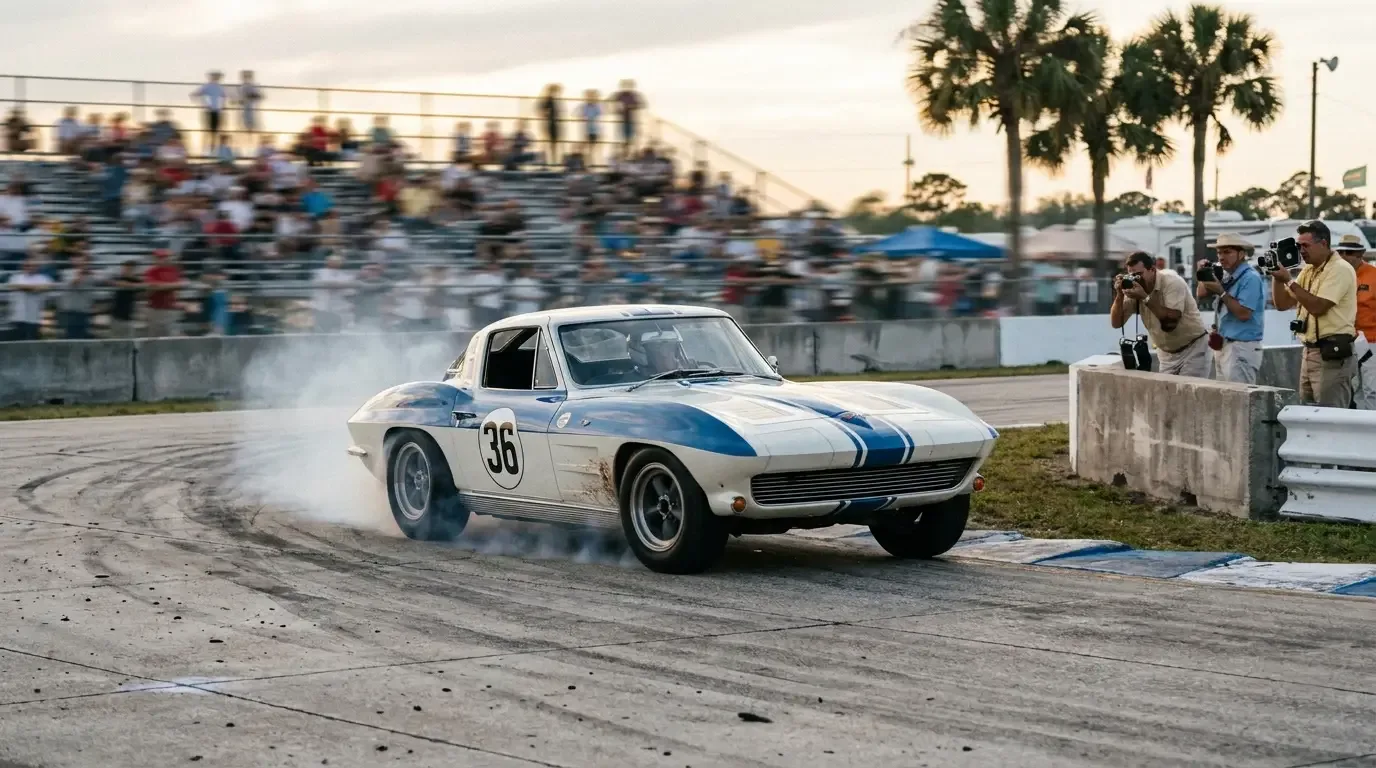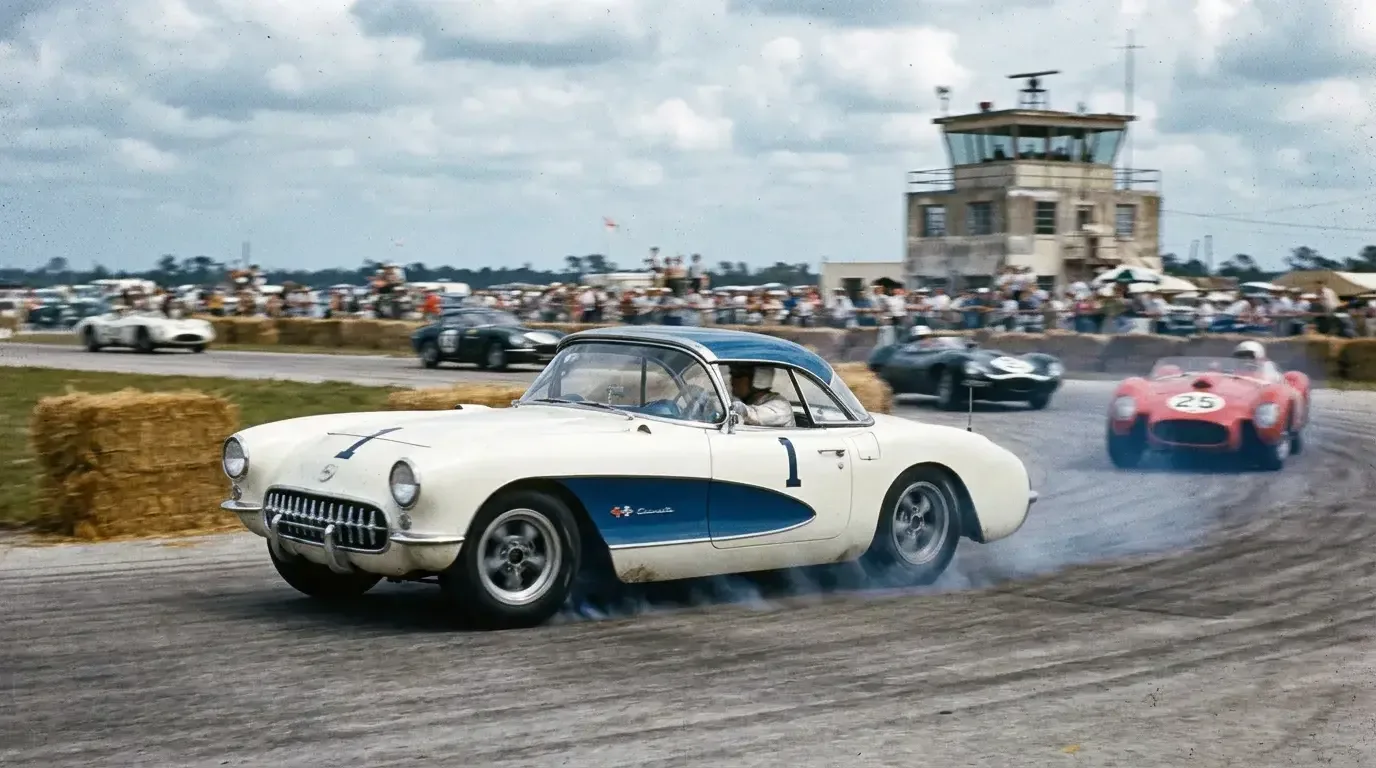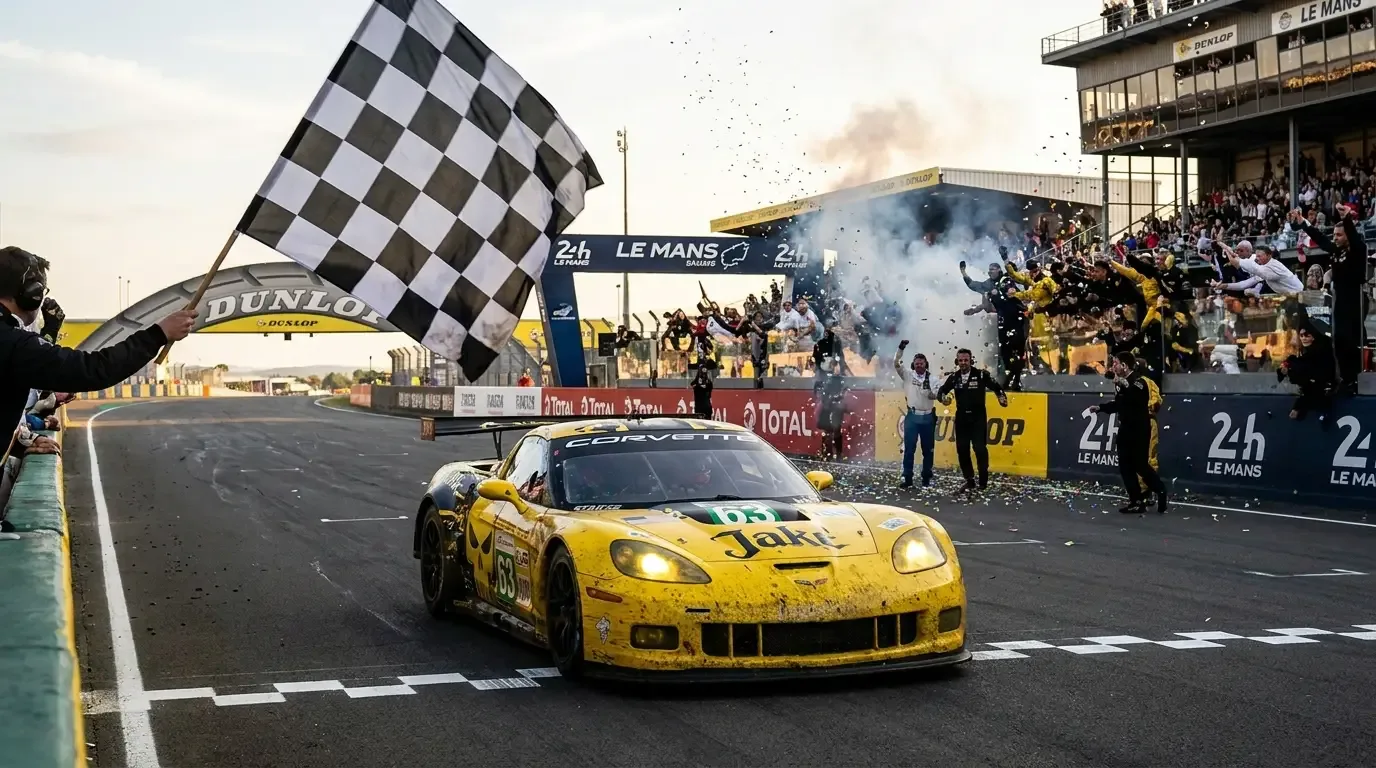
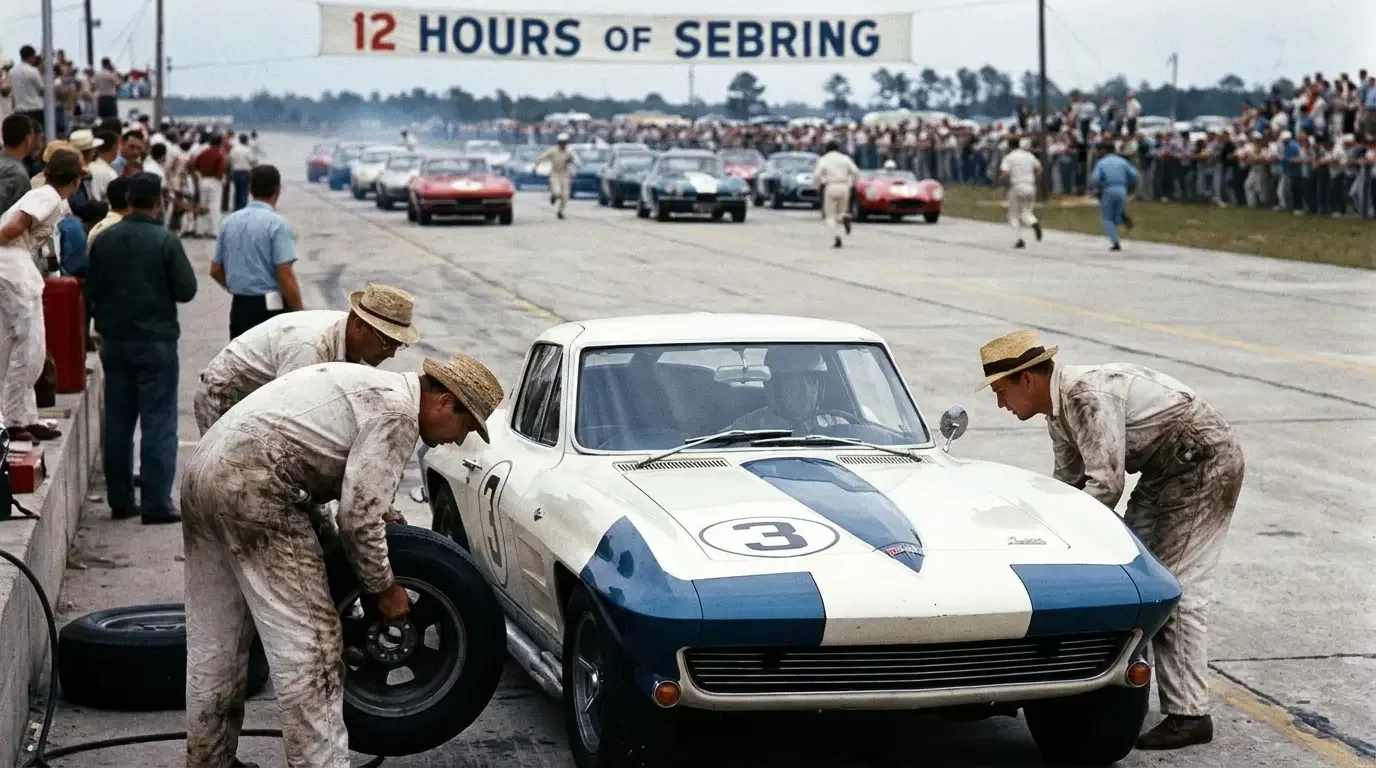
There is a stretch of asphalt at Sebring International Raceway, cracked, patched, brutally bumped, that has swallowed up faster and better-funded machines than the Corvette. But the Corvette kept coming back. From the mid-1950s onward, the car showed up at the 12 Hours of Sebring and at Le Mans carrying the full weight of what Chevrolet needed to prove: that an American sports car could race, really race, against Europe's best.
This is not the full Corvette racing story. For that, the corvette racing history story runs from the earliest C1 efforts through Corvette Racing's GT programs in the modern era. What follows is focused on Sebring and Le Mans specifically, the two circuits where the Corvette's competitive identity was built and tested hardest.
The 1956 Sebring campaign that changed everything
By 1955, the Corvette was still finding itself as a road car. The six-cylinder had been dropped, the V8 had arrived, and the chassis was beginning to feel like something you could actually throw at a corner. Zora Arkus-Duntov understood what a race result could do for the car's reputation, and he pushed hard for factory participation at Sebring.
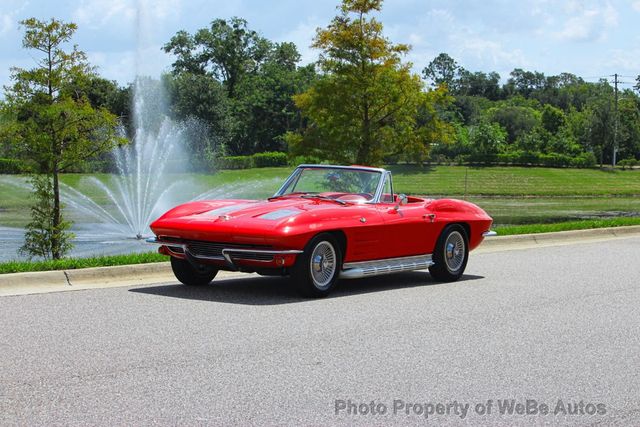
The 1956 race gave the Corvette its first real proof of concept in international competition. A pair of factory-backed Corvettes ran against the European sports cars that dominated the event, and while neither car won outright, the class result and the sheer act of finishing put the Corvette on a different footing. The Walt Hansgen and John Fitch entry took ninth overall and won Class B outright. read the related story for the full account of that campaign, including what Duntov's team had to improvise overnight to keep the cars running.
What 1956 established was a template: Chevrolet would use Sebring as a proving ground, and the lessons learned in Florida in March would flow directly back into production cars. The fuel injection system that appeared on the 1957 Corvette was developed in this competitive environment, with Rochester Ramjet injection first run experimentally at Sebring before reaching consumers as a production option. That is not a coincidence.
Le Mans: the long road to credibility
Le Mans is a different kind of test. Sebring beats a car up mechanically over twelve hours. Le Mans breaks it over twenty-four, at higher average speeds, with a longer straight that punishes any aerodynamic or cooling weakness without mercy.
The Corvette's relationship with Le Mans took longer to develop than Sebring. The French circuit requires reliability at a level that American racing culture of the late 1950s was still learning to prioritize. The early Corvette efforts at Le Mans were largely private entries or semi-official campaigns, and the results were mixed. Class finishes accumulated. Outright victories against the prototype machinery from Ferrari, Jaguar, and later Porsche were another matter entirely.
What changed the equation was Corvette Racing's formation as an official GM-backed program in 1999, built around the C5-R and later the C6.R. Those cars brought engineering resources and a long-term commitment that the earlier efforts simply did not have. The GT class victories at Le Mans that followed were earned against factory Ferraris and factory Porsches, which is a different conversation from finishing a sports car race in class.
| Era | Platform | Key result | Circuit |
|---|---|---|---|
| 1956 | C1 (factory) | Class B win (9th overall), proved reliability | Sebring 12H |
| 1960 | C1 | GT class win (8th overall, Fitch/Grossman) | Le Mans 24H |
| Late 1960s | C3 variants | Continued class competition | Sebring, Le Mans |
| 2000-2013 | C5-R / C6.R | Multiple GT class wins at Le Mans (2001, 2002, 2004, 2005, 2006, 2009, 2011) | Le Mans 24H |
| 2014-2019 | C7.R | GTLM championships, Sebring wins, Le Mans GTE Pro win (2015) | Sebring, Le Mans |
Sebring's particular cruelty
Drivers who have done both will tell you Sebring is harder on a car than Le Mans. The old airport surface, with its expansion joints and surface irregularities, transmits punishment through the entire drivetrain in a way that smooth modern circuits do not. Brakes fade faster than the data suggests they should. The heat in Florida in March sits inside a closed cockpit at temperatures that make concentration genuinely difficult by hour eight.
For the Corvette, Sebring became the race where character got tested. The C5-R era produced some of the most competitive Sebring results in the car's history, with class victories in the IMSA-era GT class that required the team to manage tire wear, fuel windows, and traffic from faster prototype cars simultaneously. It is not glamorous racing. It is grinding, strategic, and usually decided by which team makes fewer mistakes over twelve hours rather than which car is fastest in qualifying.
Corvette Racing's Sebring record across the C5-R, C6.R, and C7.R generations includes at least 11 class victories and established the program as a consistent front-runner in GT class racing rather than an occasional visitor hoping for a good result.
"What Sebring reveals about a car, and about a team, is not what happens when everything goes right. It's what happens at hour nine when the brakes are gone and the car is three seconds off its best lap time and you still have to make decisions. The Corvette Racing teams that won there earned it in a way that a single fast lap never captures."
— Patrick Walsh
What these races meant for the road car
The connection between Corvette racing at Sebring and Le Mans and the production Corvette is not just marketing copy. The fuel injection tuning from 1956-57, the suspension geometry work that carried through the C2 development, the brake cooling improvements that made it into later production cars, the aerodynamic knowledge accumulated through the C5-R and C6.R programs that influenced the C6 Z06 and Z07 packages, all of it traces back to racing that happened at these two circuits.
If you want to understand why the Corvette evolved from a soft cruiser into a genuine sports car between 1955 and 1963, the racing record at Sebring is part of the answer. Duntov was explicit about it: competition results drove engineering priorities back at the factory. A class win at Sebring in 1960 meant something in the engineering department. A finish at Le Mans meant something in the boardroom.
For the complete context of how the Corvette became what it is today, the complete Corvette history covers the full arc from Motorama concept to modern supercar, with the racing history woven throughout. The Sebring and Le Mans chapters are essential to that arc, but they read differently once you understand the production decisions they were influencing in parallel.
Finding a piece of that history
The Corvettes that raced at Sebring and Le Mans in the early years were production-based cars, which means that some of what was learned on the circuit eventually made its way into the cars you can buy today. The fuel-injected 1957 Corvette carries that history in its option code. The C2 Sting Ray carries it in its suspension tuning. Later C5 and C6 Z06 variants carry it in their brake specifications and their aero packages.
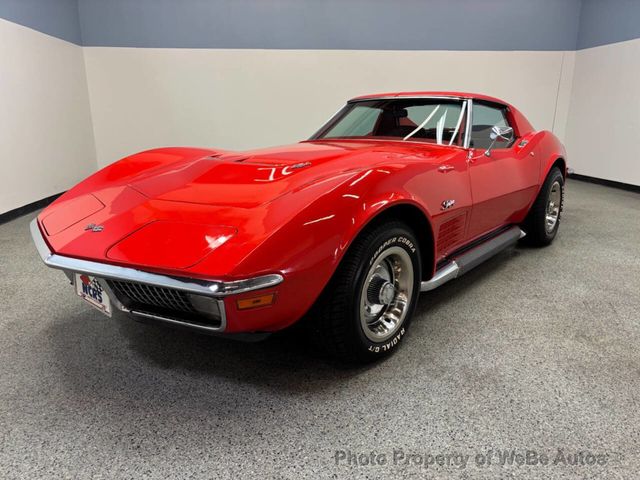
If you are looking to own part of that lineage, classic Corvette for sale listings run the full range from early C1 examples that predate the Sebring program to later performance variants whose engineering owes a direct debt to the racing knowledge accumulated at these circuits. The price ranges vary considerably by generation, condition, and documentation, but the connection to competition history is built into every one of them.
The Corvette's racing record at Sebring and Le Mans is not the longest in international sports car racing, and the car was not always the fastest thing on the circuit. What it is, consistently, is a record of a production sports car that showed up at the hardest races in the world and found out what it was made of. For a car that started life as a styling exercise on a 1953 show stand, that record means something.
Sources and notes
- Wikipedia: 1960 24 Hours of Le Mans — confirmed Fitch/Grossman (#3) finished 8th overall and won the GT5.0 class outright
- Wikipedia: Corvette Racing — confirmed program established 1999 by GM and Pratt Miller; 11 Sebring class victories; full Le Mans win tally by generation
- Wikipedia: 1956 12 Hours of Sebring — confirmed Hansgen/Fitch finished 9th overall, first in Class B; multiple Corvette entries including factory and private cars
- 24 Heures du Mans official site: Corvette's first class win at Le Mans in 1960 — primary source confirming the 1960 GT class result
- National Corvette Museum: Fuel Injection history — Rochester Ramjet FI development context and its racing origins
- Wikipedia: Chevrolet Corvette C5-R — confirmed Le Mans debut in 2000, first class win 2001; C5-R program 1999-2004 with 3 Le Mans class wins