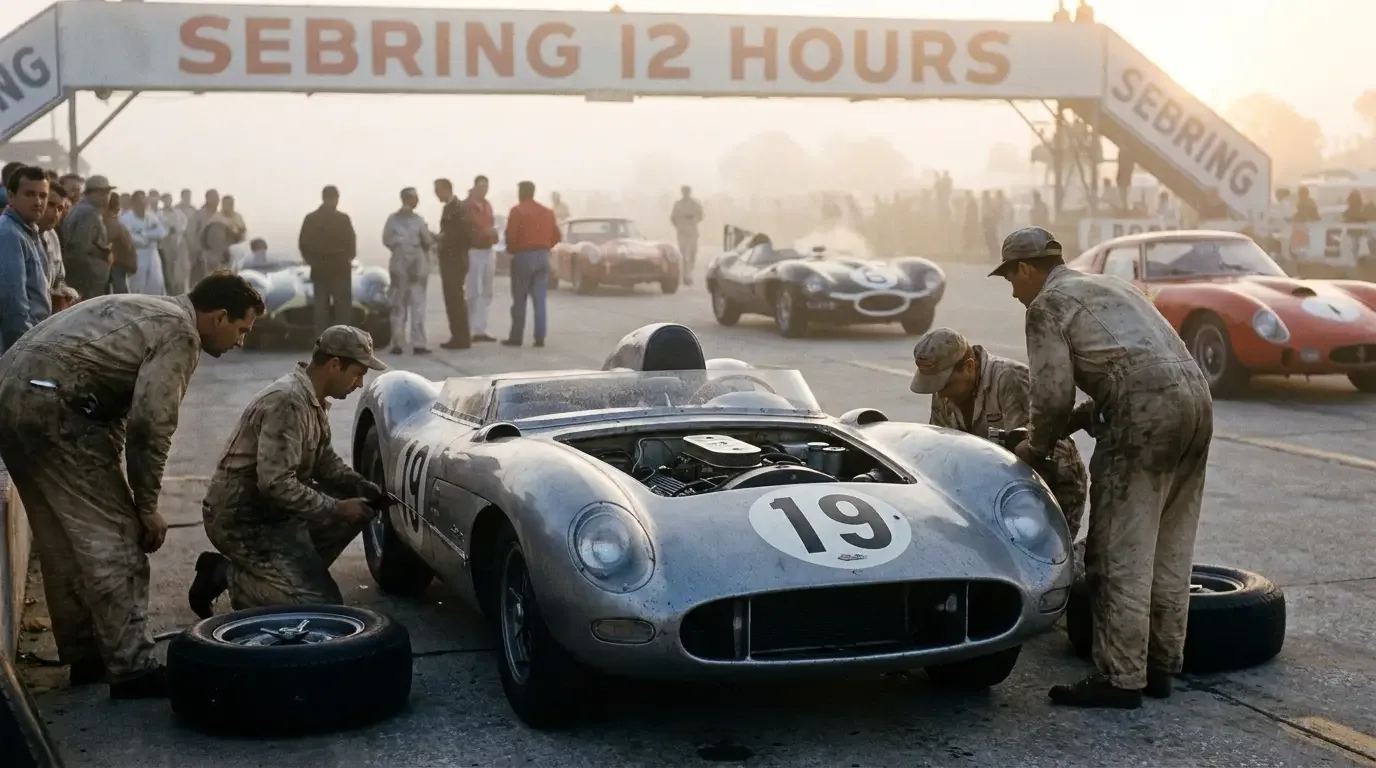
The Corvette SS arrived at Sebring in March 1957 as one of the most ambitious things General Motors had attempted on a race circuit. It was not a modified production car with a roll cage welded in. It was a purpose-built racing machine, designed from a clean sheet, built in secret over roughly six months by a small team at the GM Styling Section and in Chevrolet's Engineering. For anyone tracing corvette racing history, the SS is the starting point for understanding what GM believed the Corvette could become.
What happened at Sebring that year is a short story with a complicated legacy. The car ran for only twenty-three laps before a suspension bushing failed. It never finished. And yet the Corvette SS shaped the next two decades of Corvette engineering in ways that a race win might not have.
What the Corvette SS actually was
The SS used a spaceframe chassis constructed from small-diameter chrome-moly steel tubing, a significant departure from the production Corvette's ladder frame. The design drew inspiration from the Mercedes-Benz 300SL chassis and weighed approximately 180 pounds on its own. The body was magnesium, not fiberglass, chosen for weight reduction, and the complete car came in at a dry weight of around 1,850 pounds. The wheelbase was shorter than the production car at 92 inches, and the suspension used de Dion geometry at the rear, which was not a common arrangement in American racing at the time.
Power came from a fuel-injected 283 cubic inch small-block V8, the same basic architecture being developed for the production Corvette. Output figures cited in period sources range from around 307 to 310 hp, though GM was not always precise in its claims during this era. The car used a four-speed manual gearbox. Brakes were finned aluminum drums, not discs, which would prove to be one of the car's weaknesses under race conditions.
The body design came from Bill Mitchell's styling team. The shape was low, aggressive, and aerodynamically considered in ways that the production Corvette of 1957 was not. A mule car, sometimes called the development mule or test car, was built ahead of the actual racer using a fiberglass body and standard drivetrain. The mule was used exclusively for practice and testing; it was not entered in the race itself.
Sebring 1957: twenty-three laps and a suspension bushing
The 12 Hours of Sebring on March 23, 1957, was the competitive debut for the SS. John Fitch and Piero Taruffi were the drivers entered for the race. Fangio and Carroll Shelby had originally been signed to drive the car but both asked to be released from their contracts when the SS was not completed in time for adequate pre-race testing. Fangio instead competed for the Maserati factory team, ultimately winning the race overall alongside Jean Behra.
During practice, Zora Arkus-Duntov allowed Fangio and Stirling Moss to take the development mule for demonstration laps. Within two laps, Fangio had broken the course lap record in the practice car -- a remarkable result that underscored what the platform might have been capable of with more development time.
The statement lasted about twenty-three laps. The bushings tying the rear lower trailing arms to the chassis split -- they had been installed improperly -- causing the rear wheel to contact the bodywork. The car was also suffering from excessive heat in the cockpit and brake fade. Taruffi started the race and Fitch took over briefly, but the team withdrew before the suspension failure became terminal. The retirement was logged at approximately the one-hour mark.
The development mule did not race at Sebring; it served only as a practice vehicle and was later purchased by Bill Mitchell.
To understand the context, read more on the history of what Chevrolet was trying to accomplish with the Corvette program in this period. The SS was not an isolated experiment. It was part of a larger effort to establish the Corvette as a credible international sports car, not just a styling exercise.
| Detail | Corvette SS (1957) |
|---|---|
| Chassis | Tubular chrome-moly spaceframe (~180 lb) |
| Body material | Magnesium |
| Engine | 283 cu in fuel-injected V8 |
| Horsepower (approx.) | ~307-310 hp |
| Wheelbase | 92 inches |
| Rear suspension | De Dion |
| Transmission | 4-speed manual |
| Race entry | 12 Hours of Sebring, March 23, 1957 |
| Race result | Retired, ~23 laps, suspension bushing failure |
| Race drivers | John Fitch, Piero Taruffi |
The AMA ban and what it cut short
About two and a half months after Sebring, on June 6, 1957, the Automobile Manufacturers Association adopted its resolution against factory involvement in racing. GM, Ford, and Chrysler all signed on. That decision ended the Corvette SS program before it could be developed further. A related piece covers what the AMA ban meant specifically for the 1957 Corvette program, including the engineering work that was shelved.
The timing matters because the SS had real problems that a development program might have solved. The braking was inadequate for endurance racing at the pace the car was capable of sustaining. The de Dion rear suspension was sophisticated but had not been fully sorted. A second Sebring or a Le Mans entry might have produced a competitive result, or it might have exposed deeper limitations. There was no opportunity to find out.
What the AMA ban did not stop was the transfer of knowledge. The engineers who worked on the SS went back to their regular assignments, and the thinking they had done about spaceframe construction, weight reduction, and independent rear suspension fed into the C2 Corvette program. The Sting Ray's independent rear suspension, introduced for 1963, had roots in the work that started with the SS and continued through Zora Arkus-Duntov's ongoing development efforts even during the period of official non-involvement.
"The SS ran twenty-three laps and then sat in storage, but the engineering work didn't stop. The people who built that car kept working on the same problems. You can trace a direct line from the de Dion experiments on the SS to the IRS that went into the 1963 Corvette. A failed race entry isn't the same as a failed program."
-- Tom Ramirez
Where the car is now and what it represents
For decades the Corvette SS was preserved at the Indianapolis Motor Speedway Museum. In February 2025 it sold at RM Sotheby's Miami auction for $7.705 million -- a record for any Corvette sold at auction. It represents one of the most historically significant Corvettes ever built, not because of what it accomplished on track but because of what it attempted and what followed from the attempt.
The car's significance in Corvette history is sometimes understated because it did not win. Racing history tends to organize itself around results. The SS has no result to organize around. What it has is a specific technical ambition at a specific moment in time, and the documentation to prove what that ambition looked like in metal and magnesium.
For collectors and historians, the SS represents the road not taken. GM's official withdrawal from racing after the AMA ban meant that the Corvette's racing success in the late 1950s and 1960s was achieved through independent efforts, through dealers and private teams and drivers who operated outside the factory's official support. The SS was the last time, for many years, that GM put a fully factory-developed racing Corvette on a starting grid.
If you want to find an example of the production Corvettes that were racing contemporaries of the SS, 1957 Corvettes for sale still come to market with some regularity, particularly the fuel-injected examples that shared their basic engine architecture with the race car.
Sources and notes
- Wikipedia -- Chevrolet Corvette SS: race drivers (Fitch/Taruffi), wheelbase (92 in), horsepower (310 hp), bushing failure cause, Fangio's practice-only role
- Wikipedia -- 1957 12 Hours of Sebring: confirmed mule was not a race entry; Fangio won overall for Maserati with Jean Behra
- Hagerty Media -- Sebring 1957: Fangio and Moss drove the practice mule only; Fitch and Taruffi raced the SS
- RM Sotheby's Miami 2025: Corvette SS XP-64 sold February 27, 2025 for $7.705 million -- record for any Corvette at auction
- Corvette Action Center -- 1957 Corvette SS specs: 307 hp at 6,400 rpm, tubular spaceframe, de Dion rear suspension detail
- This Day in Automotive History -- March 23, 1957: Corvette SS race debut, AMA ban context, program cancellation