Why four headlights changed the 1958 Corvette
The 1958 model year brought the most dramatic exterior change in Corvette history up to that point. Where the 1957 car carried a single headlight on each side, the 1958 switched to paired units, two per side, stacked horizontally in chrome bezels that became an instant identifier. That change was not a Corvette decision in isolation. It was part of a broader GM styling shift that touched nearly every division that year, and it landed on the Corvette at a moment when the car was already being repositioned as something heavier and showier than its original 1953 brief. To understand the full picture of the C1's styling evolution, the full picture puts the 1958 changes in proper sequence.
What makes the 1958 quad-headlight treatment worth examining closely is not just that it happened, but how it was executed and what it signaled about where the Corvette was headed stylistically through the end of the C1 run.
The styling context: GM's chrome era hits Corvette
By the mid-1950s, the dual-headlight trend was building industry-wide, driven in part by federal regulations that eventually mandated minimum light output at specific heights. GM's styling staff under Harley Earl, who remained head of design through most of 1958 before retiring that December, had been working toward a busier, more chrome-laden look across all divisions, and 1958 was the peak of that direction. The Impala got it. The Bonneville got it. The Corvette got it.
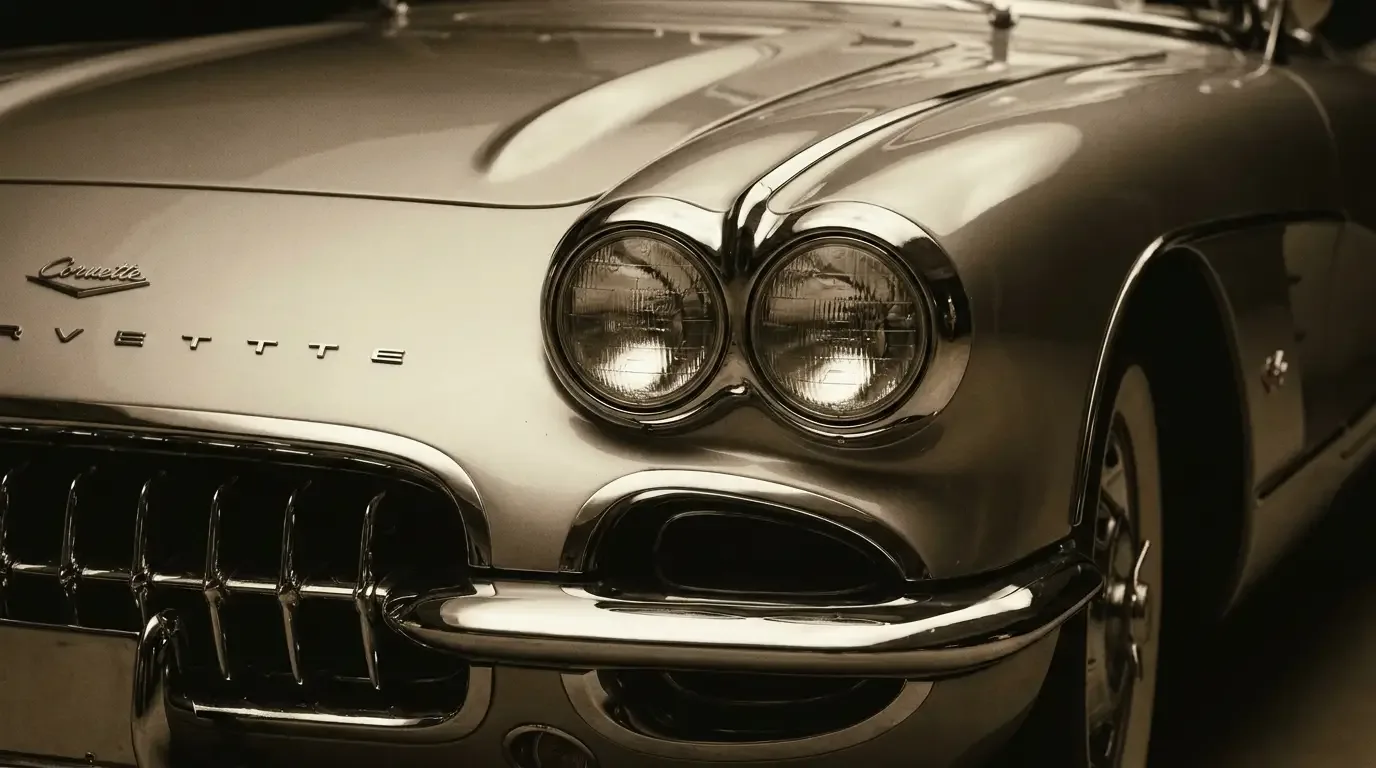
On the 1958 Corvette, the quad headlights sat inside separate chrome-ringed bezels mounted in a restyled front end that was wider and more blunt than the 1956-1957 nose. The grille treatment changed alongside the headlights, with a new arrangement of vertical teeth that replaced the earlier horizontal bar design. Chrome strips ran along the hood. Dummy louvers appeared on the trunk lid. The car got heavier visually in nearly every dimension compared to what came before it.
Whether this was an improvement is a matter of taste that the Corvette community has debated for decades. Production figures show the 1958 sold well relative to prior years, with 9,168 units built compared to 6,339 in 1957. Buyers were clearly not put off by the new look.
How the quad-headlight setup actually worked
Each of the four sealed-beam units served a specific purpose. The inboard lamps handled the low-beam function; the outboard units came on with the high beams, adding range and spread. This was the standard dual-headlamp configuration used across GM and most of the domestic industry at the time. The Corvette's implementation was not technically unusual. What set it apart was the chrome surround treatment and the way the bezels integrated into the body panel.
| Year | Headlight configuration | Front end style | Notes |
|---|---|---|---|
| 1953-1955 | Single (2 total) | Rounded, integrated into body | Original C1 nose design |
| 1956-1957 | Single (2 total) | Revised with exposed headlights | Cleaner, more European look |
| 1958 | Quad (4 total, 2 per side) | Wider, chrome-bezeled pairs | Shared GM styling direction |
| 1959-1960 | Quad (4 total, 2 per side) | Simplified, removed trunk louvers | Detail cleanup of 1958 design |
| 1961 | Quad (4 total, 2 per side) | Ducktail rear, carried forward front | Transitional toward C2 |
The chrome bezels on 1958 cars were specific to that model year. In 1959, the design was revised slightly with a cleaner presentation and the chrome surround was refined. If you are looking at a claimed 1958 and the headlight bezels do not match the correct style for that year, it is worth checking whether trim from a 1959 or 1960 has been substituted.
What survived into 1959 and beyond
GM's stylists were not completely satisfied with the 1958 result. The trunk louvers disappeared for 1959 along with several other chrome details. The quad-headlight arrangement itself stayed, and it carried forward through 1962, but the surrounding treatment was progressively simplified. Each year from 1959 onward removed something from the 1958 car's busier elements while keeping the four-light format that had become the Corvette's face. For a detailed look at where the C1 design went from there, see more here.
The 1958 car is now understood as the starting point of a styling evolution rather than a finished statement. In that sense, the quad headlights were permanent but the rest of the trim package around them was clearly in flux.
"The 1958 front end is the one people argue about, but it's worth remembering that GM kept the four-light setup through the end of C1 production. What they trimmed away were the decorative additions. The core headlight arrangement was considered right from the start."
— Tom Ramirez
Identifying a correct 1958 front end today
Corvette restoration work in the C1 era frequently involved swapping body panels and trim between model years, because the cars shared enough dimensional similarity to make cross-year parts tempting when correct pieces were hard to find or expensive. The 1958 front clip has specific characteristics that distinguish it from 1959-1962 pieces, and NCRS judging standards for 1958 cars reflect this.
The correct 1958 headlight bezels are a heavier chrome pressing than what appeared in 1959 and later years. The inboard and outboard bezels are separate pieces joined at a shared mounting point in the fender opening. Period parts documentation lists these as distinct part numbers from the 1959 revision. If a car is presented as a 1958 with what appear to be later bezels, it is worth asking what else may have been sourced from a different year.
If you are in the market for a C1, looking at documented 1958 examples with correct front-end trim alongside other available years is the right approach. Searching current listings is a good starting point: 1958 Corvettes for sale gives a current view of what is available and asking prices.
The 1958 in the broader C1 story
The quad headlight change matters because it came at a transition point. The 1953-1957 Corvette had been a progressively improving sports car that was finding its performance identity. The 1958 brought the styling language of GM's consumer car divisions onto the Corvette in a more direct way than any prior year. The car gained weight, gained chrome, and gained features. It also gained buyers, which was not nothing in 1958 when the car's survival had not been entirely certain just a few years earlier.
What the four-headlight front end did, permanently, was give the C1 a distinctive face that read as American rather than European. The Italian sports cars of the period used single headlights, mostly recessed or faired in. The 1958 Corvette's four chrome-circled units announced clearly that this car was from Detroit even if it wore a fiberglass body and had ambitions beyond the boulevard.
That identity stuck. By the time the C2 arrived for 1963, the quad-headlight format was retired in favor of the hidden headlamp design, but the C1 finished its run with the four-light face it had acquired in 1958. For anyone working through the history of the first-generation car, the 1958 styling change is the single most visually significant event in the model's twelve-year production run.
Sources and notes
- CorvSport: 1958 Corvette Production Numbers, confirming 9,168 units built in 1958 versus 6,339 in 1957
- CorvSport: 1958 C1 Corvette Guide, confirming the redesigned centered instrument cluster and tachometer placement introduced for 1958
- Corvette Report: Harley Earl retired as GM design chief in December 1958, with Bill Mitchell succeeding him at the end of that model year
- CarBuzz: History of the US sealed-beam headlight law, confirming quad headlights became legal nationwide only by the 1958 model year
- Corvette Story: 1959 style update confirming removal of the 1958 trunk lid spears and simplified hood louvers
- Wikipedia: Chevrolet Corvette (C1), general cross-reference for model-year styling changes 1953-1962