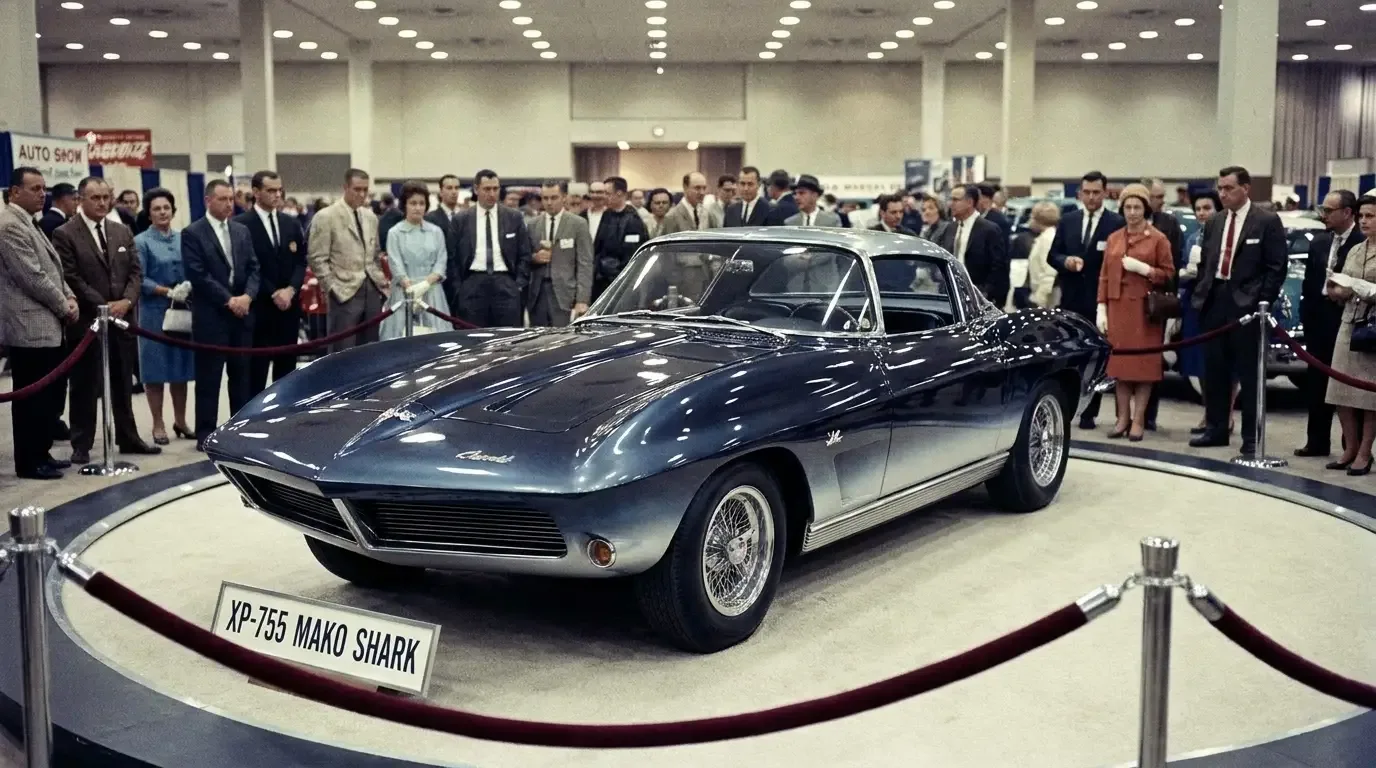
There are show cars, and then there are show cars that change everything. Bill Mitchell's Mako Shark I sits firmly in the second category. Built in 1961 on a modified 1961 Corvette chassis and known internally as the XP-755, this concept car did not just turn heads at auto shows. It pointed directly at the shape of things to come, and what came was the C2 Corvette Sting Ray. If you want to understand where one of the greatest American sports cars got its lines, the Mako Shark I is where the story starts.
Mitchell had taken over as head of styling at General Motors after Harley Earl retired in 1958, and he brought an obsession with ocean predators to the design studio. The mako shark he reportedly caught on a deep-sea fishing trip is the story behind the car's name and color treatment, and it has been told enough times that it has taken on a life of its own, but the car itself stands as proof that the inspiration ran deep. The graduated blue-to-white-to-silver paint scheme that ran from nose to tail was not a styling exercise. It was a direct translation of that shark's coloration onto steel and fiberglass. Mitchell directed the project as GM's design chief, while stylist Larry Shinoda, one of his key studio designers, did the hands-on work of translating that vision into the car's actual lines.
To understand the Mako Shark I fully, you have to read the c2 corvette sting ray story alongside it. The two cars existed simultaneously during their development, feeding ideas back and forth in ways that make clean attribution difficult. Mitchell's team was working on the production Sting Ray even as they refined the show car, and the lines crossed in both directions.
From concept to show circuit
The car that became the Mako Shark I began as the XP-755 in GM's Advanced Design studio. Mitchell pushed his team to explore a more aggressive, lower-slung profile than anything the Corvette had worn through the C1 years. The existing 1961 Corvette donor chassis gave the stylists a starting point, but the body that went over it bore little resemblance to the production car underneath.
The car had an unofficial preview on June 18, 1961, when Mitchell had it run a single lap at Road America in Elkhart Lake, Wisconsin, before quietly withdrawing it. Its real public unveiling came in April 1962, on Chevrolet's stand at the New York Auto Show, and it immediately attracted the kind of attention that earns a car a second life on the show circuit. GM sent it on tour across major American auto shows through the early 1960s, and audiences responded to the shape in a way that went beyond the usual concept car enthusiasm. People could see where this was going. The production Sting Ray that arrived for 1963 confirmed their instincts.
The design language that shaped the C2
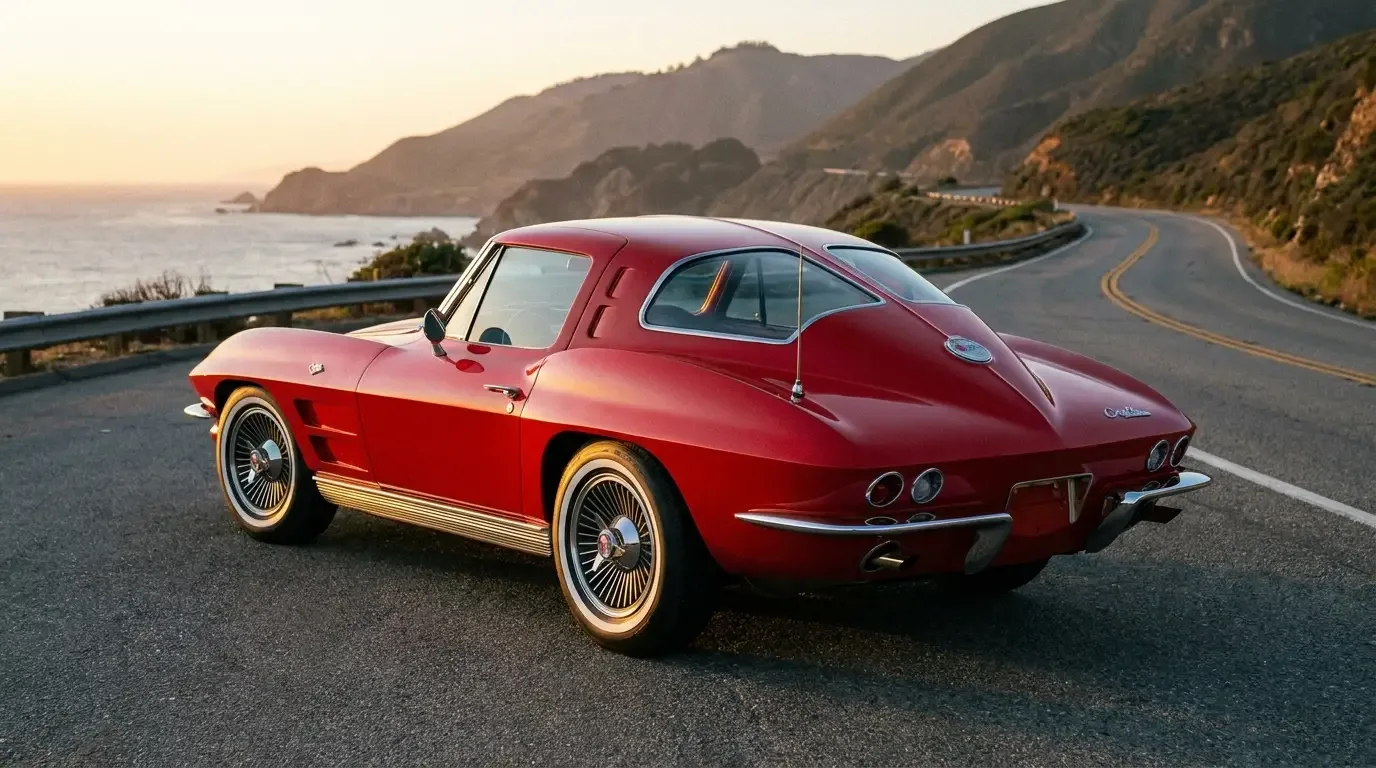
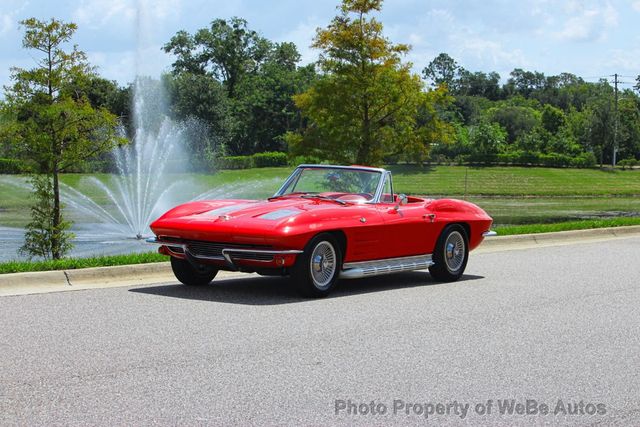
Pull up a photograph of the Mako Shark I next to a 1963 Corvette Sting Ray split-window coupe and the family resemblance is immediate. The tapered nose, the pronounced fender peaks, the way the body curves back from the cockpit toward the tail. Mitchell's team was working in the same vocabulary on both cars, which is exactly how GM's design process operated at the time.
Several elements that defined the C2 can be traced directly to the Mako Shark I's profile. The pinched waist, the aggressive hood line, the general stance that communicated speed while standing still. The production car had to accommodate things a show car never does, mainly an actual human being getting in and out of it comfortably, and those constraints softened some of what Mitchell's team had drawn. But the core proposition survived the translation from concept to production.
The color graduation from deep blue at the nose through lighter shades toward the tail is the Mako Shark I's most distinctive visual move. It required custom mixing and careful masking at each stage, and GM's show car preparation team executed it at a level of craft that made the concept car a reference point for automotive paint work during that period. As the car continued its show career through the 1960s, GM's preparation crews reportedly touched up and refined the paintwork more than once to keep the graduated effect sharp, though records of each individual refresh are not well documented.
The mechanical package underneath
Show cars of this era often carried placeholder powertrains or non-functioning displays where the engine should be. The Mako Shark I was different. Built on a working Corvette chassis, it carried a real V8, and that engine changed more than once over the car's life. It debuted with a supercharged 327-cubic-inch V8 fitted with a custom blower, a two-inch aluminum manifold, and four side-draft carburetors. Over the years that followed, GM experimented with several other setups under that hood, including a fuel-injected version and a configuration running two four-barrel carburetors. The car now on display carries a 427-cubic-inch aluminum-block ZL-1 big block, installed later, producing roughly 425 horsepower. What is clear across every iteration is that the car was functional rather than purely cosmetic, which aligned with Mitchell's philosophy that a sports car concept should operate as one.
| Detail | Specification |
|---|---|
| Base vehicle | 1961 Corvette (modified chassis) |
| Concept designation | XP-755 |
| Debut | New York Auto Show, April 1962 (unofficial preview June 1961) |
| Designer | Larry Shinoda, under Bill Mitchell, GM Styling |
| Body material | Fiberglass (custom) |
| Production | One car (concept/show) |
| Current status | GM Heritage Center, Sterling Heights, MI |
The suspension and running gear drew from the standard Corvette of the period, which meant independent rear suspension was not yet part of the picture. The 1963 production Sting Ray would introduce the independent rear setup that made the C2 a landmark car dynamically. For more detail on the specific production variants that followed, more here on the Z06 that came out of that same design generation.
What the Mako Shark I meant for Corvette history
Mitchell's design work at GM spanned decades and produced cars across multiple brands, but the Corvette was always where his personal investment showed most clearly. He drove Corvettes, he raced Corvettes through the backdoor channels that GM's official non-competition policy allowed, and he pushed the Corvette's design vocabulary further than any corporate executive had reason to expect.
The Mako Shark I represents that investment at a specific moment. The C1 generation had established the Corvette as a genuine sports car despite early criticism about its Blue Flame six-cylinder engine and two-speed Powerglide transmission. By 1961 the car had found its mechanical footing with big-block options and proper manual gearboxes. What it still needed was a visual identity that matched its performance ambitions, and Mitchell delivered that through the concept program.
"The Mako Shark I is not a footnote to C2 history. It's the sentence that the C2 is the answer to. You can't fully read the Sting Ray without it."
— Patrick Walsh
The connection between the show car and the production Sting Ray has sometimes been overstated in both directions. Some accounts treat the Mako Shark I as essentially a pre-production C2, which oversimplifies a development process that ran across multiple studios and design iterations. Others position it as a purely separate exercise that happened to influence what came after. The reality sits between those poles: the car was a genuine design exploration that Mitchell used to test and develop the visual language he was simultaneously applying to the C2 program.
Where the car is today
The Mako Shark I lives on in the GM Heritage Center in Sterling Heights, Michigan, GM's own archive of significant concept and production vehicles, where it is preserved as one of the collection's most historically important pieces. It occasionally travels for display alongside production Corvettes at museum exhibits and Corvette gatherings around the country, including appearances near production Sting Rays that let visitors see the design conversation Mitchell was having with himself in immediate visual focus.
For collectors who want to own a piece of that era rather than admire it through glass, the C2 generation remains attainable at a range of price points. Clean driver-quality 1963-1967 Sting Rays trade in a wide band depending on body style, engine, and documentation, with convertibles generally commanding more than coupes below the top condition tiers. Browse C2 Sting Rays for sale to see what the current market looks like across the generation.
Sources and notes
- Wikipedia, Mako Shark (concept car): confirmed XP-755 designation, Larry Shinoda's role as designer under Bill Mitchell, and the New York Auto Show debut timing
- CorvSport, 1961 XP-755 Mako Shark I Concept: confirmed the June 1961 Road America preview lap, the April 1962 New York Auto Show public debut, the original supercharged 327 V8 specification, and the car's current home at the GM Heritage Center
- Conceptcarz, 1961 Chevrolet Corvette Mako Shark I XP-755: confirmed the later 427 cubic-inch aluminum-block ZL-1 engine and approximate 425 horsepower output now fitted to the car
- Remarkable Corvettes, 1961 Mako Shark I XP-755: cross-checked design and restoration details, including the continuity of the shark paint theme through the Mako Shark II era
- LSX Magazine, Bill Mitchell's Mako Sharks: confirmed the Mako Shark II's 1965 debut and its role previewing the C3 generation, distinguishing it from the original 1961 car