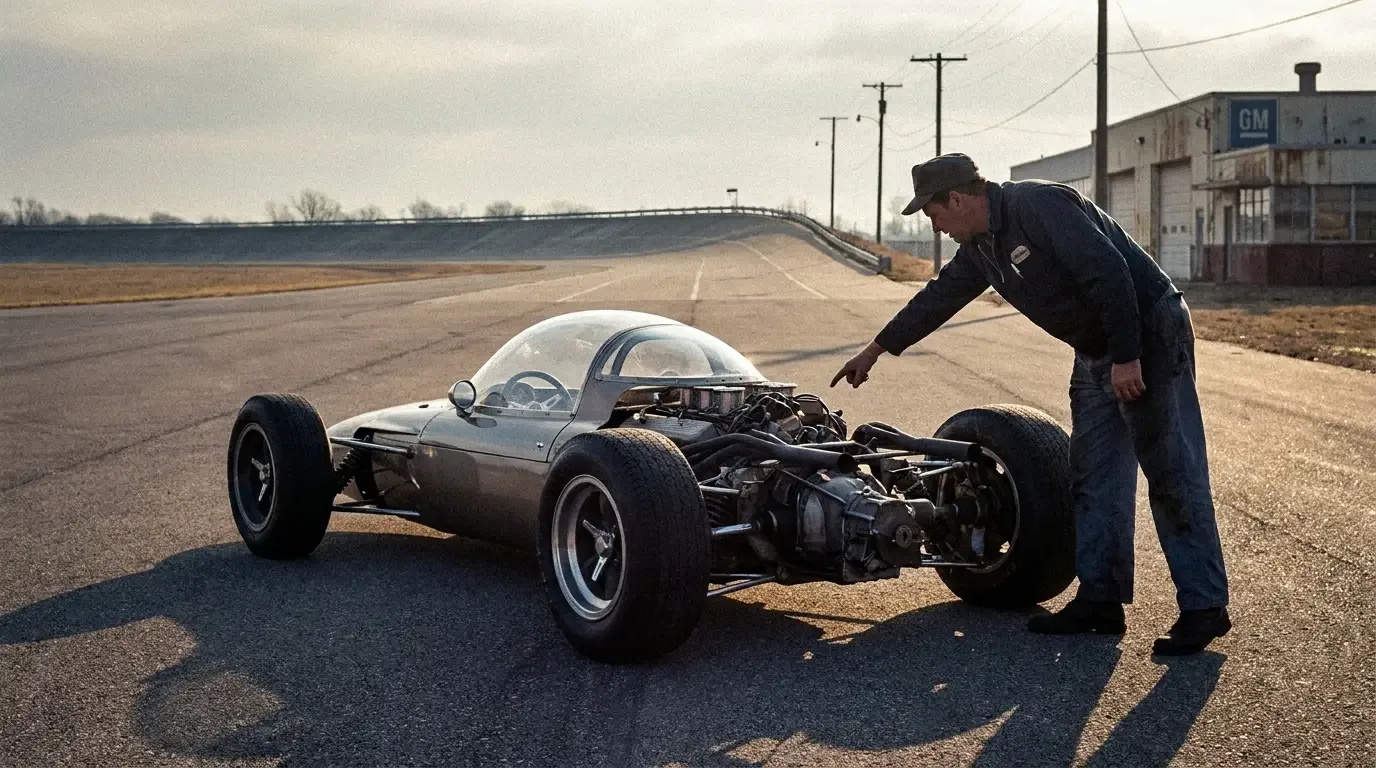
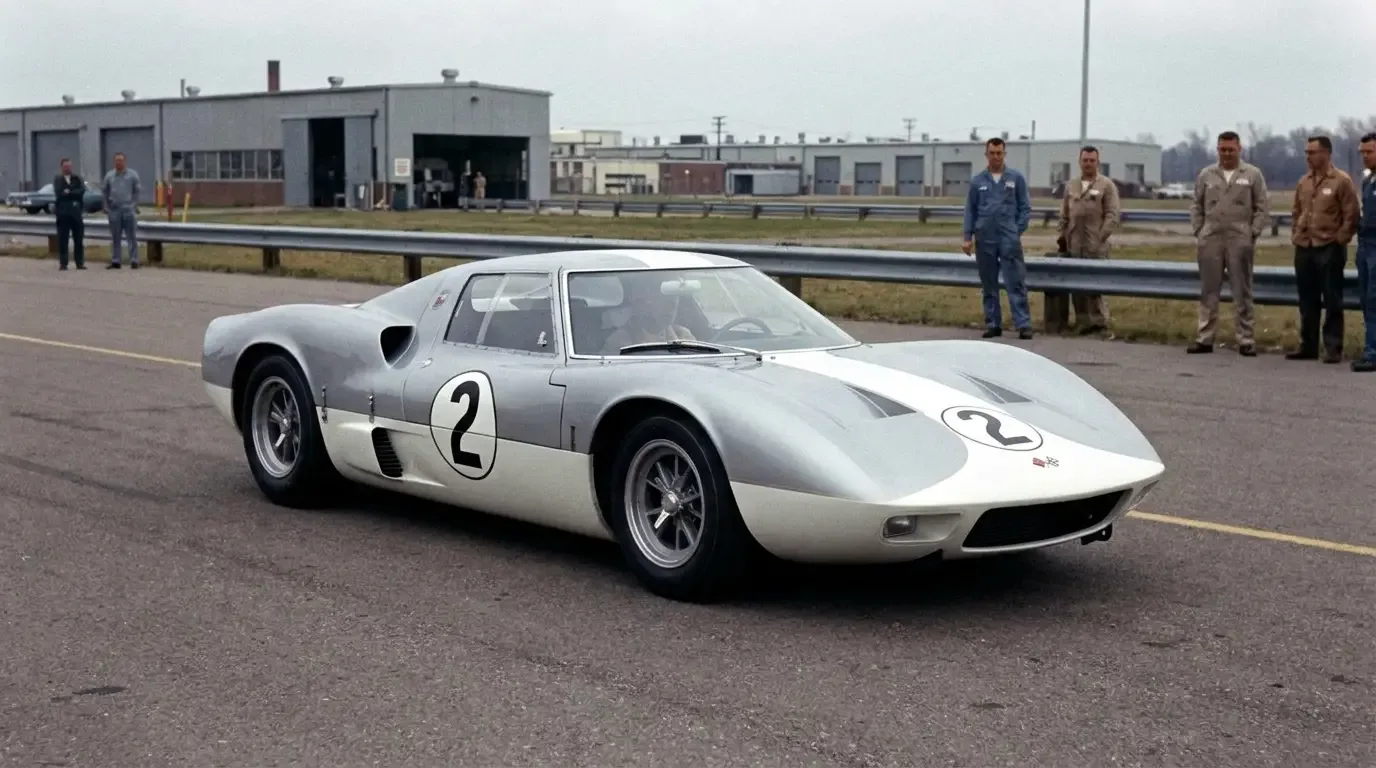
Most people outside the engineering community have never heard of the CERV II. That is not because it was insignificant. It is because it never went into production, and prototype programs that die on the drawing board rarely get the attention they deserve. This one deserves attention. The CERV II was a four-wheel-drive, mid-engine experimental vehicle built by Chevrolet in 1964, and it pointed toward a Corvette that would not arrive for another fifty-five years.
The CERV acronym stands for Chevrolet Engineering Research Vehicle. The first CERV, built in 1959 and 1960, was a single-seat open-wheel racer. The CERV II was a different animal: fully enclosed, aerodynamically developed, and engineered with a drivetrain arrangement that was genuinely advanced for the period. Understanding what it was and why it existed requires some background on the zora arkus duntov era at Chevrolet, because the CERV II was Duntov's project in almost every meaningful sense.
What Duntov was actually trying to solve
By the early 1960s, Zora Arkus-Duntov had a clear picture of what the Corvette needed to be. He wanted mid-engine placement. He wanted all-wheel drive in some form. He wanted a power-to-weight ratio that could stand up to European sports racers. General Motors management wanted something it could sell to the American public at a reasonable price, and those two sets of goals were not always compatible.
The CERV II gave Duntov a legitimate engineering test bed. It was funded as research, which meant it was not subject to the same cost and producibility constraints as a production vehicle. The team could try things that would have been rejected outright in a product meeting. Four-wheel drive was one of them.
The all-wheel drive system on the CERV II used two Powerglide-based torque converters rather than a mechanical clutch to split power between the axles: an 11-inch converter and a two-speed gearbox at the rear, feeding a driveshaft that ran forward to a second, 10-inch converter and gearbox ahead of the engine. Chevrolet engineers experimented with different torque splits, targeting roughly 35 percent of power to the front wheels at low speed and around 40 percent at high speed. This was not the crude part-time four-wheel drive that appeared on trucks of the period. It was a more sophisticated, speed-sensitive approach, intended to improve traction and handling balance rather than just off-road capability, and Duntov filed a U.S. patent on the variable torque-split concept in 1966. The intent was track performance, with Le Mans and Sebring among the events Chevrolet initially had in mind before GM's spring 1964 racing ban ended those plans.
The engine situation
Power came from an all-aluminum, 377 cubic inch small-block V8 fed by a Hilborn fuel injection system, not a supercharger as sometimes claimed. Chevrolet's own figures put initial output at around 500 horsepower, and later accounts of the fully developed engine cite roughly 490 to 550 horsepower depending on tune. The exact figure is difficult to pin down because this was an experimental program and the documentation that survives is not always precise about which configuration was being measured at any given test session. In 1969, the car was fitted with an all-aluminum 427 cubic inch ZL1 V8, conservatively rated at around 550 horsepower, for further testing.
| Item | Specification | Notes |
|---|---|---|
| Built | 1964 | Chevrolet Engineering Research Vehicle program |
| Engine position | Mid-mounted | Behind driver, ahead of rear axle |
| Engine | V8, 377 cu in (6.2 liter) | All-aluminum small-block with Hilborn fuel injection; later fitted with a 427 cu in aluminum ZL1 V8 for 1969 testing |
| Estimated power | Approximately 490-550 hp | Figures vary across period sources and engine configuration |
| Drivetrain | All-wheel drive | Twin Powerglide-based torque converters with variable front/rear torque split, patented by Duntov in 1966 |
| Body | Enclosed coupe | Aerodynamically developed; distinct from CERV I open-wheel layout |
| Current location | Private ownership | One vehicle built; sold at RM Sotheby's New York auction in 2013 for $1,100,000 after decades in the Briggs Cunningham Museum |
The engine was positioned behind the driver and ahead of the rear axle, the configuration Duntov had been arguing for in production Corvettes for years. The CERV II let him demonstrate, on a real vehicle, what that arrangement could do. It also let him gather data on how the all-wheel drive system interacted with weight distribution and aerodynamics. That data would inform Corvette engineering thinking for decades, even when the production cars did not reflect it directly.
Why it never became a production car
The CERV II is the kind of prototype that raises an obvious question: why did none of this reach production? The answer involves corporate politics, cost, and timing. GM management killed a production mid-engine Corvette proposal in the mid-1960s, a decision that Duntov argued against and lost. The reasons were various, and if you want to follow the full thread, read on for the complete picture of how that debate played out over the following decades.
The all-wheel drive component faced its own separate obstacles. Four-wheel drive in a sports car was not something the American market was asking for in 1964, and it added mechanical complexity that increased weight, cost, and the potential for things to go wrong in service. Chevrolet was building Corvettes to be sold, maintained, and occasionally repaired by dealers across the country. A twin-supercharged mid-engine AWD coupe was not that vehicle.
There was also the racing regulation question. The CERV II was built partly with racing applications in mind, but the major sanctioning bodies of the period were moving in directions that would have made the car difficult to campaign competitively in any major class. The development investment could not be recouped through racing results if the car had no class to run in.
"The CERV II tells you exactly what Duntov was thinking. Mid-engine, all-wheel drive, serious aerodynamics. He had the technical case ready in 1964. The production Corvette took until 2020 to catch up on the mid-engine part, and it still does not have the AWD."
— Tom Ramirez
What the CERV II's legacy actually looks like
It would be satisfying to draw a clean line from the CERV II's all-wheel drive system to some later production feature, but the history is not that neat. The technical approaches Duntov's team developed did not translate directly into production hardware. What the CERV II contributed was more in the nature of proof of concept and institutional knowledge.
Engineers who worked on the program understood what mid-engine weight distribution felt like and what AWD traction gains were achievable. That knowledge existed inside GM even during the long period when production Corvettes remained front-engine and rear-drive. It contributed to how engineers thought about the car's limits and possibilities.
The C8 Corvette, which finally arrived in 2020 with a mid-mounted engine, is the delayed production realization of what Duntov was demonstrating in the CERV II. The E-Ray variant, released in 2023 with an electric front motor supplementing the rear-mounted V8, adds all-wheel drive to the mix. Fifty-nine years after the CERV II, the production Corvette has something resembling the same basic drivetrain architecture. The path was not straight and Duntov did not live to see it, but the destination he was pointing toward finally arrived.
Sources and notes
- Wikipedia: Chevrolet Engineering Research Vehicle: confirmed CERV I (1959-1960, 283 cu in) and CERV II (1964, 377 cu in Hilborn fuel-injected V8) build dates, engine displacement, and AWD torque-transfer description
- RM Sotheby's, New York Art of the Automobile 2013, Lot 139: confirmed engine specifications, the 11-inch/10-inch Powerglide torque converter AWD system, front/rear torque split targets, and the $1,100,000 sale price
- CorvSport: confirmed Hilborn fuel injection (not supercharging), horsepower range across configurations, and Milford Proving Ground top speed testing
- Conceptcarz: confirmed development timeline starting late 1961, the 1969 ZL1 427 cu in engine swap, and the abandoned Le Mans/Sebring racing plans
- Revs Institute (Automedia): confirmed the two-torque-converter AWD design and Duntov's 1966 patent on variable front/rear torque split
- Engineering.com: additional confirmation of CERV II engine output figures and the experimental nature of period test documentation