
What the CERV I was and why Zora built it
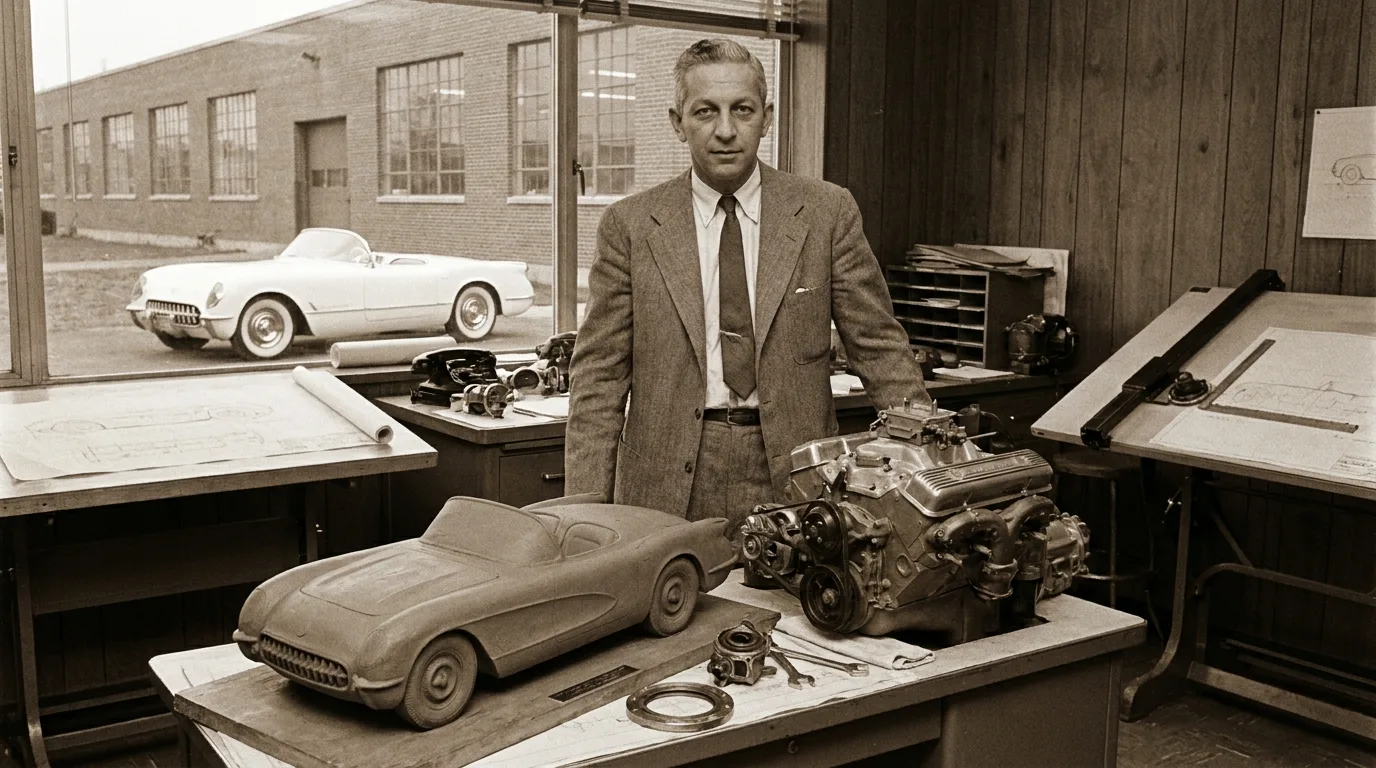
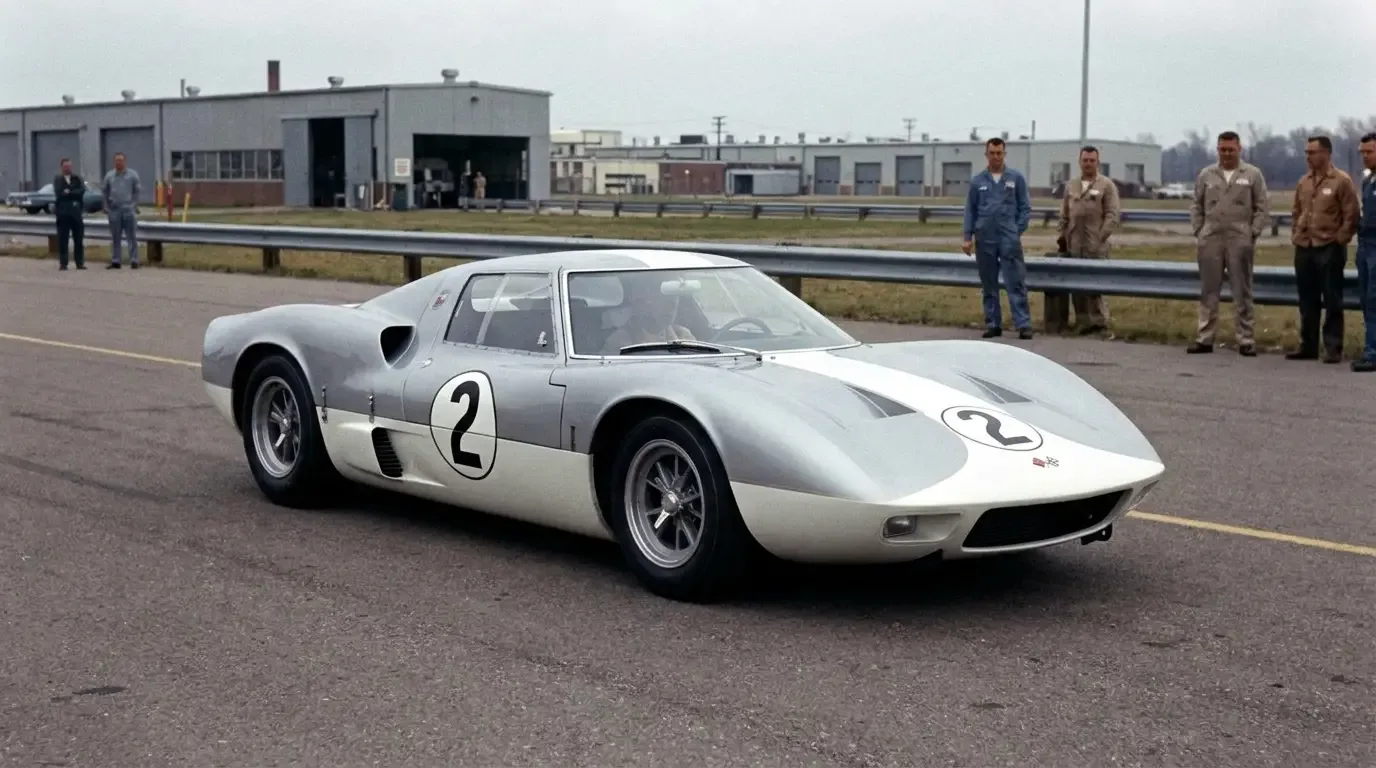
In 1959, Zora Arkus-Duntov had a problem. The Corvette was selling, but it was not proving itself the way he wanted it to, not at the limit, not against European sports-racing machines, not in the kind of sustained high-speed running that separated a real sports car from a boulevard cruiser. What he needed was a vehicle with no production constraints, something that existed purely to answer engineering questions. The result was the CERV I, which stood for Chevrolet Engineering Research Vehicle. It was a single-seat, open-wheel roadster that Duntov built with the intention of learning, and then applying what he learned to the Corvette itself. To read the deeper story of how Duntov shaped the Corvette over three decades is to understand how consistently the CERV program sat at the center of his method.
The car was not intended for production and was not intended for customer eyes. It was a laboratory on wheels, and Duntov treated it as such. He drove it himself, repeatedly, and the data he gathered fed directly into Corvette development decisions through the early 1960s and beyond.
The layout and engineering of the CERV I
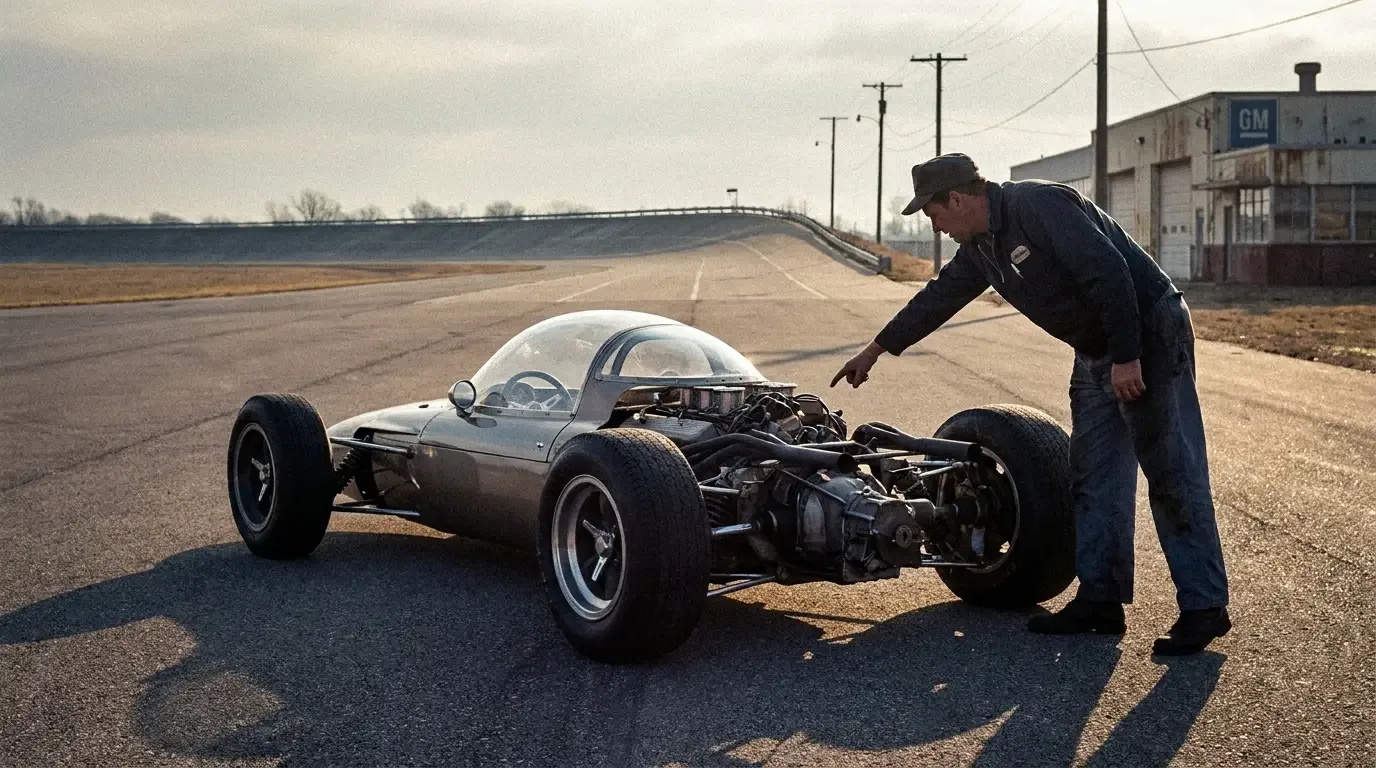
The CERV I was built around a space-frame chassis with an aluminum body, keeping weight low enough that the handling figures it generated would be meaningful rather than obscured by mass. The suspension was independent at all four corners, which was not common in American production cars of the period and which Duntov was actively trying to refine for eventual Corvette use. The rear suspension geometry on the CERV I directly informed what appeared on the 1963 Sting Ray, which was the first production Corvette to feature independent rear suspension.
Power originally came from a specially built, lightweight version of Chevrolet's 283 cubic inch small-block V8, producing roughly 350 hp thanks to extensive use of aluminum and magnesium in the block, heads, water pump, and other components that brought the whole engine down to about 350 pounds. It drove through a fully synchronized 4-speed manual in a mid-engine layout, with the powerplant mounted just ahead of the rear axle line to improve weight balance. That placement was another area of active experimentation. Duntov wanted to understand what a properly balanced mid-engine layout could do for handling, and the CERV I gave him a controlled environment to find out. The overall configuration, at roughly 1,600 pounds ready to run, was closer to a Formula 1 car of the era than anything Chevrolet was building for the street.
How the CERV I connected to Corvette development
The line between the CERV I and the production Corvette was not hypothetical. The 1963 Sting Ray's independent rear suspension was the clearest outcome, but the aerodynamic work mattered as well. Duntov was gathering real-world data on how the body shape affected stability at speed, information that had direct application to the Corvette's evolving form through the C2 generation. The car was also used to study brake behavior under sustained high-speed loading, another area where the production Corvette needed improvement.
For a full account of the Corvette's development arc and where the CERV program fits within it, the Classic Cars Arena Corvette story covers the production history and the engineering milestones that brought the car from 1953 through its later generations.
What made the CERV I valuable as a tool was precisely that it had no production constraints. Duntov could change the suspension geometry, alter the weight distribution, try a different aerodynamic treatment, and run the car at Riverside or on a private test track without any of the compromises that come from designing something a customer has to live with. The production Corvette benefited from every one of those tests, even when a particular configuration was abandoned.
"The CERV I was not a concept car and it was not a show piece. Duntov drove it hard, measured what happened, and used the results. That's how factory development was actually done when the engineers were serious about it."
— Tom Ramirez
The CERV I today and what it represents
The CERV I survived and is preserved, which is not guaranteed for vehicles of its type. Factory experimental cars were often dismantled when their usefulness ended, or converted into something else, or simply lost. The CERV I exists as a physical record of a specific moment in Corvette engineering history, the period when Duntov was actively trying to close the gap between what the Corvette was and what he believed it could be.
The car eventually led to additional CERV concepts. The companion story on the CERV II covers the all-wheel-drive prototype that Duntov developed later in the 1960s, which took the program in a different direction and explored four-wheel torque distribution well before that became a common engineering problem to solve. The two vehicles together represent a coherent research program, not a series of disconnected experiments.
For historians working from factory records, the CERV I is interesting because it left a paper trail. Development notes, test data, photographs from Riverside, internal Chevrolet Engineering reports. The documentation is not complete by any standard, and some of what was done during the car's active testing years was not formally recorded in ways that survived. But enough exists to reconstruct the sequence of experiments and the conclusions Duntov drew from them, and those conclusions show up clearly in the 1963 Sting Ray's specification sheet.
Why the CERV I still matters to Corvette history
The straightforward answer is the independent rear suspension. Without the CERV I test program, it is harder to explain how Chevrolet Engineering arrived at a production-ready IRS solution for the 1963 Sting Ray in the timeframe they did. The development work was not invented fresh at the start of C2 production planning. It was accumulated through years of running the CERV I under controlled conditions, identifying failure modes, and refining the geometry until Duntov was satisfied that a production version could be built reliably enough to go in a car a customer would drive.
The broader point is that the CERV I represents how serious development work was structured at Chevrolet Engineering during the period when the division was actively competing in performance. Duntov was not the only engineer involved, but he was the one who drove the car, who set the test agenda, and who translated what the data showed into production decisions. The CERV I was his instrument for doing that, and the Corvettes that followed it carry the results of what he learned.
Sources and notes
- Wikipedia, Chevrolet Engineering Research Vehicle: confirmed original 283 cubic inch, 350 hp engine, curb weight of 1,600 pounds, independent suspension, and the CERV I's influence on the 1963 Corvette Sting Ray's rear suspension.
- Corvette Action Center, 1960 CERV I specifications: confirmed the fuel-injected 350 hp 283 engine, 1,600 pound total weight, chrome-molybdenum tube frame, four-wheel independent suspension, and the November 1960 Riverside debut with Duntov driving demonstration laps.
- Corvette Report, history of mid-engine Corvettes part 1: confirmed the CERV I's engineering test-bed role and its Riverside public debut timeline.
- RM Sotheby's, 1960 Chevrolet CERV I auction listing: confirmed the 206 mph speed was set at GM's Milford Proving Grounds in 1964 with the later 377 cubic inch engine, not at the 1960 Riverside debut, and the CERV I's role in developing the 1963 Sting Ray's independent rear suspension.
- Corvette Report, mid-engine Corvettes part 3: confirmed the 1964 refit with a 377 cubic inch aluminum small-block and Rochester fuel injection used for the Milford top-speed runs.
- Grokipedia, Chevrolet Engineering Research Vehicle: cross-referenced engine iteration history and the 206 mph Milford Proving Grounds result.