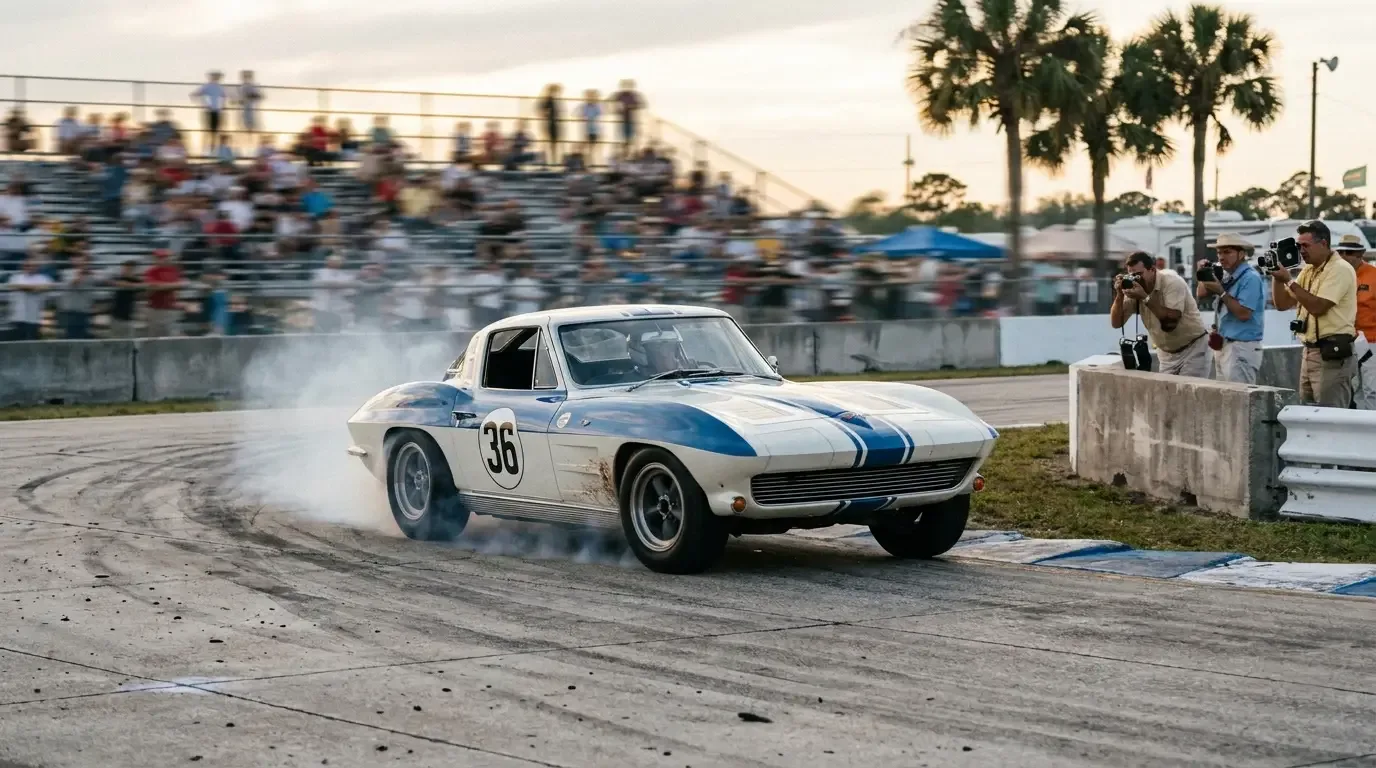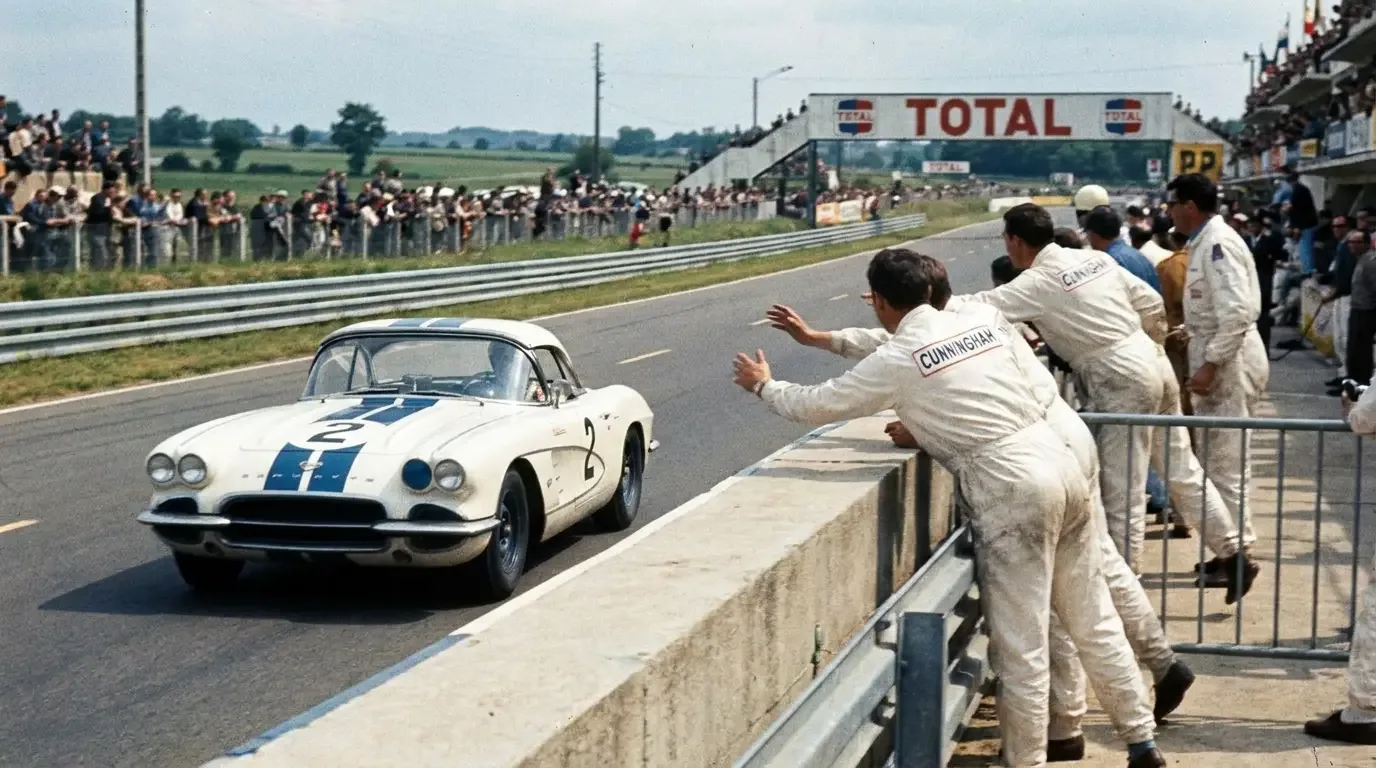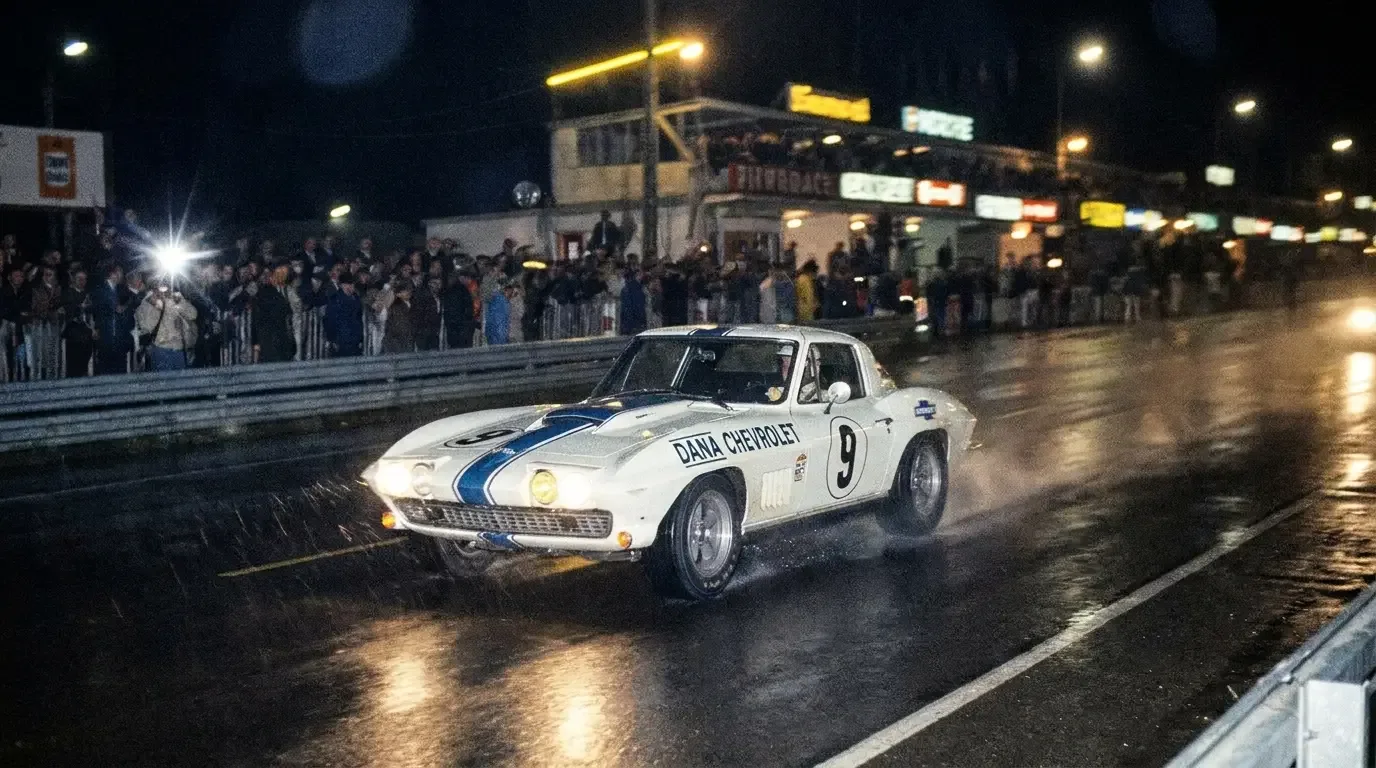

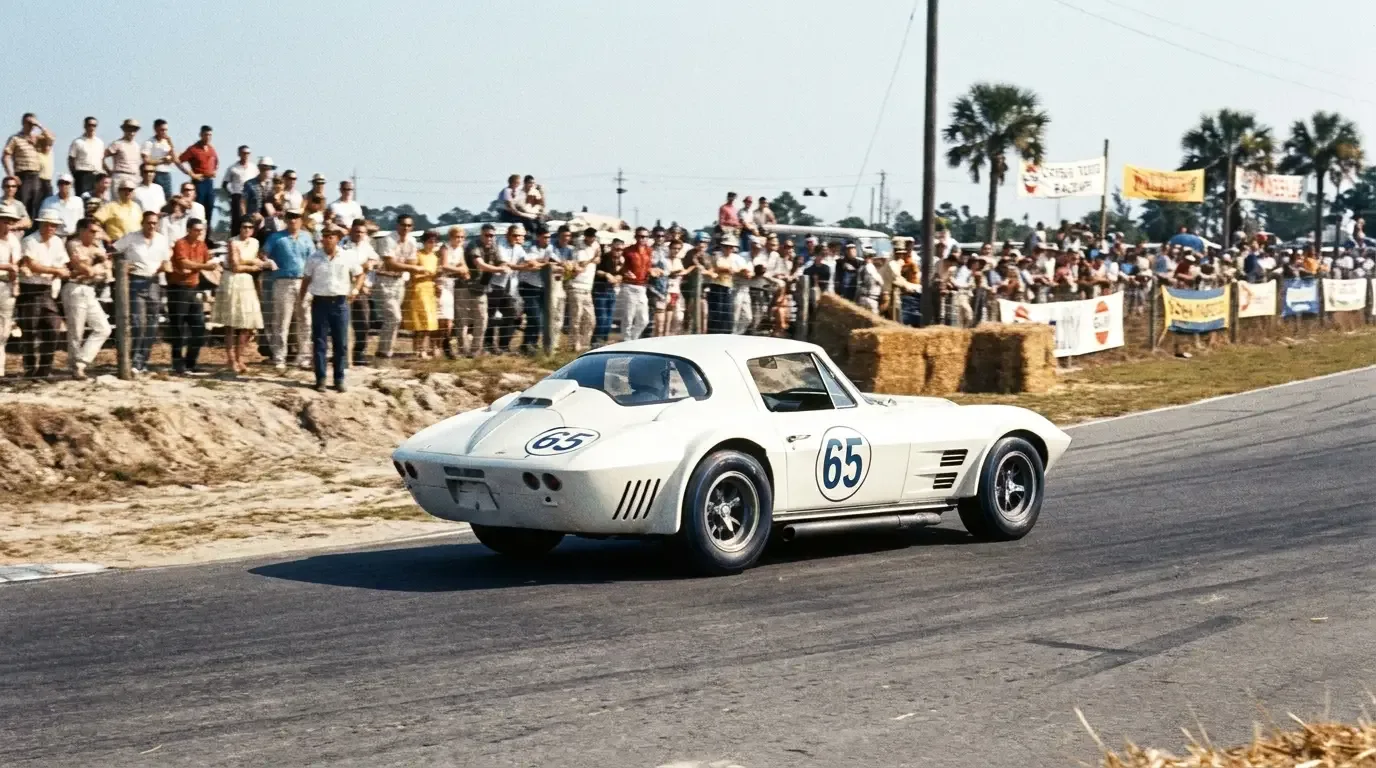
Five cars. That's the whole story, in one number. General Motors ordered the Corvette Grand Sport program shut down in January 1963, and by then only five examples had been assembled at the Corvette engineering shop in St. Louis. Not fifty. Not five hundred. Five. Those cars would go on to define what American racing looked like in the mid-1960s, and the story of how they came to exist, and why the program was killed so abruptly, is worth knowing if you care about the corvette racing history era at all.
Zora Arkus-Duntov wanted to beat Ferrari at Le Mans. That was the stated ambition behind what Chevrolet internally called the XP-87, later designated the Grand Sport. He drew up a lightweight competition Corvette, built around a tubular space frame instead of the standard body-on-frame construction, with a fiberglass body that came in well under the production car's weight. The target was somewhere in the neighborhood of 1,800 to 2,000 pounds, against a standard 1963 Corvette that tipped the scales at roughly 3,000. The car was never meant for showrooms.
What the Grand Sport was built to do
Duntov's team built the Grand Sport as a pure racing machine. The body panels were fiberglass, some reportedly thin enough to flex. The chassis was a multi-tube space frame, not the standard perimeter ladder frame the production car used. The intended engine was a 377 cubic inch all-aluminum small-block V8 with four Weber side-draft carburetors, though in its very first race outings early in 1963 the cars ran the production 327 cubic inch fuel-injected motor before the aluminum engines were ready. Power figures cited in period accounts ranged from around 485 horsepower in baseline trim to upward of 550 horsepower in full race configuration, and it's worth treating any specific horsepower claim with caution given how much these cars were modified by their subsequent owners.
The suspension was fully independent front and rear, which the production Corvette had introduced in 1963 anyway, but the Grand Sport's setup was engineered specifically for the stresses of endurance racing. Disc brakes at all four corners, another area where the car was ahead of where GM's production line stood at the time. The whole machine was conceived to be credible at Daytona, Sebring, and Le Mans against factory-backed European competition.
Why only five were built
GM's corporate management was committed to the AMA (Automobile Manufacturers Association) safety resolution of 1957, which asked member companies to withdraw from factory-sponsored racing. The resolution was observed selectively across the industry, and Chevrolet had been finding ways around it, but the Grand Sport program was a significant enough undertaking that it caught the attention of corporate leadership. In early 1963, the order came down to halt production. The original plan reportedly called for as many as 125 cars to qualify the Grand Sport for GT-class racing under FIA homologation rules, which required a minimum number of road cars to be built. Five fell far short of that number, which meant the car could never compete in its intended class.
The five cars that existed were distributed to private racing teams rather than destroyed. This is the detail that saved them. Duntov sent chassis 003 to Illinois Chevrolet dealer Dick Doane and chassis 004 to Grady Davis of Gulf Oil, while the Mecom Racing Team fronted by Texas oilman John Mecom Jr. received chassis 005. Chassis 001 and 002 were retained by GM and later sold to Roger Penske in 1966 after being updated with the same modifications incorporated into the three cars already racing. GM's official involvement ended on paper; the practical involvement continued through parts supply and technical advice.
If you want to explore what happened after those five cars hit the track, read on about the factory racing hardware that followed through the rest of the decade.
The five cars and their histories
| Chassis | Initial recipient | Body style | Notable events |
|---|---|---|---|
| 001 | Retained by GM (sold to Roger Penske, 1966) | Coupe (converted to roadster for Daytona 1964) | Nassau Speed Week 1963, Daytona 1964 |
| 002 | Retained by GM (sold to Roger Penske, 1966) | Coupe (converted to roadster for Daytona 1964) | Nassau 1963, multiple SCCA events |
| 003 | Dick Doane | Coupe | Sebring 1963, SCCA Watkins Glen 1963 |
| 004 | Grady Davis / Gulf Oil | Coupe | Nassau 1963, multiple SCCA events |
| 005 | John Mecom Jr. / Mecom Racing | Coupe | Nassau 1963, Sebring 1964 |
The chassis numbers and specific histories get complicated because these cars were modified substantially during their racing lives. Chassis 001 and 002 were converted from coupe to roadster configuration in preparation for Daytona 1964, with their roofs removed and low windscreens installed to reduce frontal area. Some received different engines at different points. The ownership chains are documented, but the documentation requires cross-referencing multiple sources, and any claim about a specific car's exact configuration at a specific race should be treated as approximate unless you're working from period photographs or timing sheets.
What they actually accomplished on track
The Grand Sports raced through 1963 and into 1964, with the most visible outings at Sebring and the Nassau Speed Week events. Results were mixed. The cars were fast in straight lines and showed promise, but reliability issues and the limitations of the power units they were running in early competition kept them from the outright victories the program was designed to produce. The Nassau Speed Week in December 1963 is often cited as the high-water mark of their early racing career, where three of the cars were upgraded with the 377 cubic inch aluminum V8s and driven by Roger Penske, Augie Pabst, and Dick Thompson. The Grand Sports finished third, fourth, and sixth in the Governor's Cup feature race, running competitively against international machinery.
By 1966, some of the cars had received big-block engines, which transformed their power delivery considerably. The small-block program Duntov had originally envisioned evolved into something quite different as the teams running these cars adapted to what was available and what worked. The cars you see in period photographs from the mid-1960s are often significantly different from what left the St. Louis shop in 1963.
"Five cars isn't a program, it's a statement. And the statement was: we could have done this. Duntov knew it, the teams that ran them knew it, and the people who've studied these cars for the last sixty years know it. The shutdown is as much a part of the Grand Sport story as anything that happened on track."
— Patrick Walsh
Where they are now and what they're worth
All five Grand Sports survive. That alone is remarkable for a group of racing cars that went through decades of hard use, multiple owners, and significant modification. The cars have been restored and are generally considered among the most significant American racing cars of the 1960s. When they appear at auction, the conversation starts in the millions. Chassis 002 reportedly carried a high bid of $4.9 million at a 2009 RM auction without meeting reserve, and values have almost certainly moved upward since then given where the blue-chip American racing car market has gone.
These are not cars for buyers looking for a driver. They are museum-level artifacts, and the authentication process for any claimed Grand Sport is intensely scrutinized. There are replica Grand Sports in existence, built on production Corvette chassis with Grand Sport-style bodywork. They look right at distance and they're legitimate hot rods in their own right, but they are not the factory cars, and any transaction involving a claimed "original" Grand Sport demands documentation that goes well beyond a bill of sale.
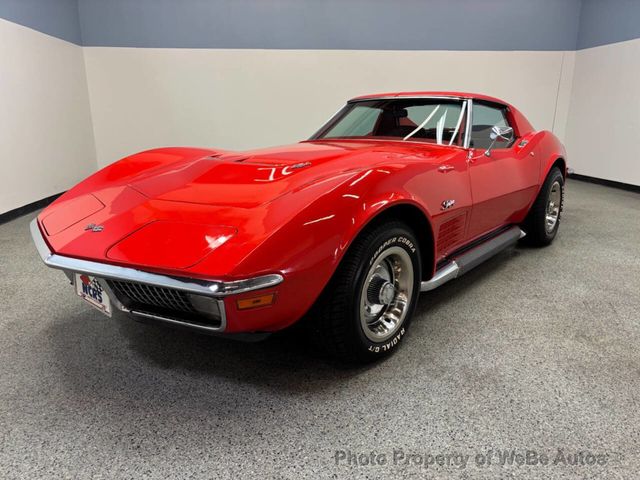
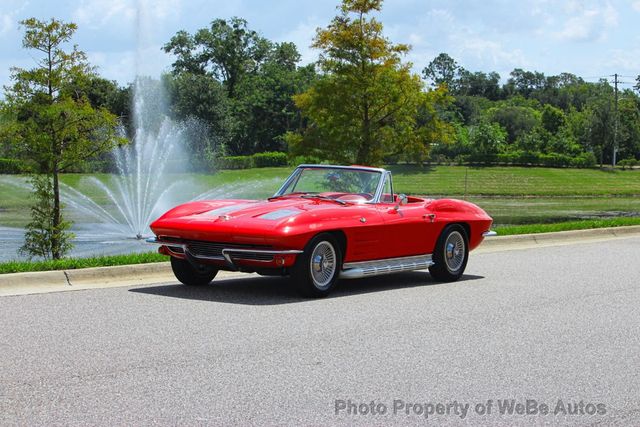
If you're interested in what authentic 1963 Corvette hardware looks like in the collector market today, 1963 Corvettes for sale gives you a sense of where the production cars trade, which provides useful context for how far outside that range the Grand Sports sit.
Sources and notes
- Corvette Action Center: 1963 Grand Sport specifications (weight 1,980 lbs, engine 377 ci / 485 hp, disc brakes, Weber carburetors confirmed)
- Chevy Hardcore: Corvette Chronicles, the 1963 Grand Sport (chassis distribution, Nassau 1963 drivers, program history)
- Classic Car Collector News: Grand Sport history (chassis 001/002 built as coupes, converted to roadsters for Daytona 1964; 003 to Doane, 004 to Davis confirmed)
- Rick Carey's Collector Car Auction Reports: Grand Sport s/n 002 (2009 RM auction, $4.9M high bid, no sale; chassis 001/002 roadster conversion history)
- ConceptCarz: 1963 Corvette Grand Sport Lightweight (Nassau 1963 results: Penske 3rd, Pabst 4th, Thompson 6th in Governor's Cup)
- Wikipedia: Chevrolet Corvette C2 (Grand Sport section, AMA ban context, FIA homologation 125-car requirement)