The 1967 Le Mans entry is the place where the L88 Corvette stopped being a factory option code and became a legend. One car made the trip to France that June. It did not finish. But the record it set on the Mulsanne Straight in qualifying held up against purpose-built European racing machinery longer than anyone expected, and the program changed the conversation about what an American production car could do on a twenty-four-hour circuit. If you want to understand the corvette racing history era, the 1967 Le Mans program is one of its defining chapters.
What the L88 actually was
Chevrolet released RPO L88 for the 1967 model year as a racing engine option. The factory rated it at 430 horsepower, a number chosen deliberately to keep insurance companies from paying too close attention. The actual output was considerably higher, with most period estimates and independent dyno tests suggesting something closer to 560 horsepower, though figures from documented rebuilds have ranged from around 520 to over 570 depending on state of tune. What is not in dispute is the specification: a 427 cubic inch big-block with an aluminum cylinder head, an 850 cfm Holley carburetor, a solid-lifter camshaft with aggressive timing, and a 12.5:1 compression ratio that required racing fuel.
Ordering L88 from the factory was not straightforward. Chevrolet required buyers to delete the heater, the radio, and the standard air cleaner. They also required the M22 close-ratio four-speed transmission and the heavy-duty J56 brakes. The intent was clear: this was a car configured for racing, sold to racers. GM's corporate racing ban was technically still in effect, so the L88 program existed in a gray zone where Chevrolet could say it wasn't officially racing while selling the equipment to people who were.
Total L88 production for 1967 was 20 cars. The option was rare when new and is extraordinarily rare now.
The 1967 Le Mans entry
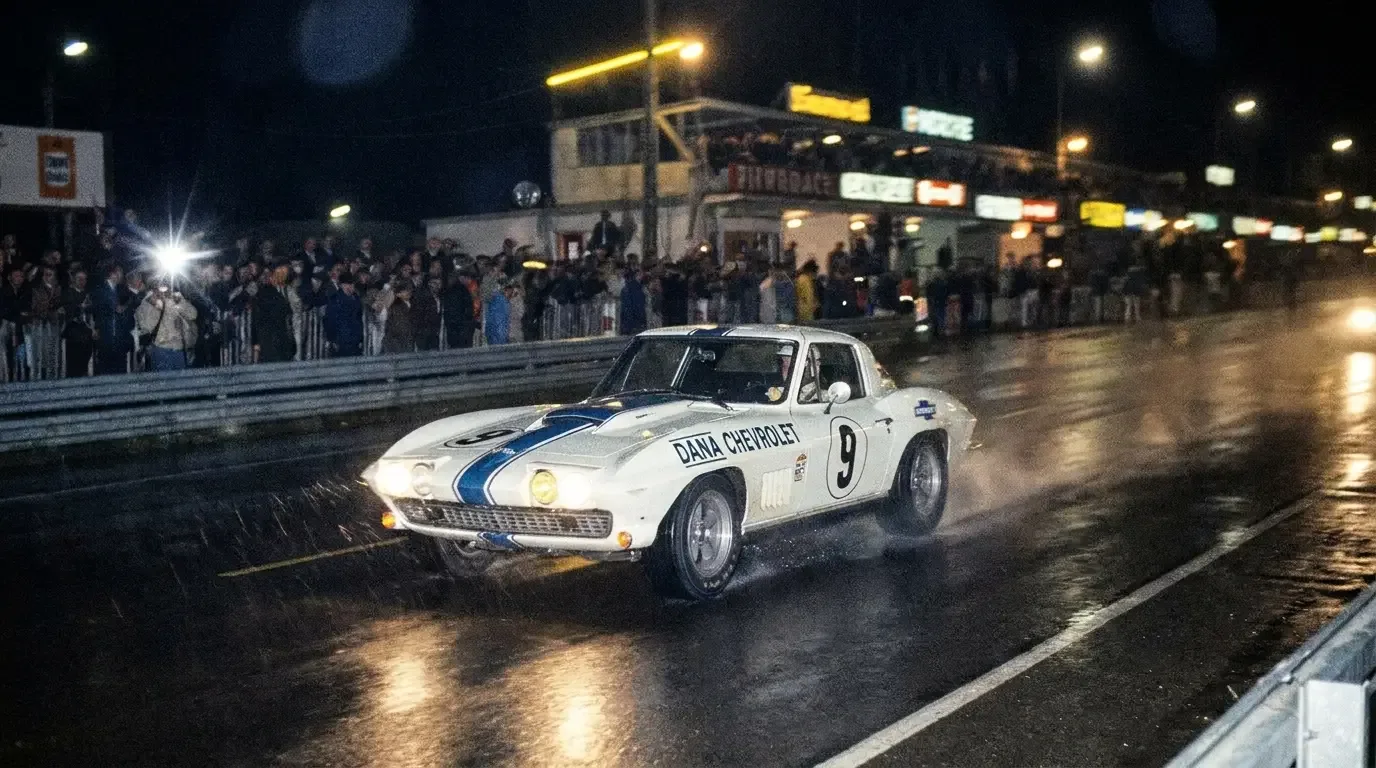
Dick Guldstrand and Bob Bondurant entered the single L88 Corvette at Le Mans in 1967 as car number 9, under the Dana Chevrolet banner, a California dealership whose owner Peyton Cramer made the program possible. Guldstrand prepared the car himself and had deep concerns about one area of the specification going in: the stock wrist pins in the L88 engine. He and Traco Engineering, which blueprinted the powerplant, warned that the factory wrist pins would be vulnerable to the sustained demands of Le Mans. Chevrolet held firm. For marketing purposes, the engine was to remain as it left the factory.
In qualifying, the Guldstrand/Bondurant car put up numbers that drew attention. On the Mulsanne Straight, Guldstrand recorded 171.5 mph, a notable benchmark for a production-based car against a field of purpose-built European machinery. The European press noticed. Chevrolet noticed, even if they could not officially say so.
The race itself did not go according to plan. At approximately the eleven-and-a-half hour mark, while running at the front of the GT class, the L88's engine failed. The cause was exactly what Guldstrand had flagged before the race: a wrist pin. The Corvette retired after 167 laps, the only Corvette entry in the field.
The DNF is the whole story only if you're focused on the results sheet. What the 1967 program proved was that the L88 platform had the pace to compete at the highest level. The follow-up efforts in 1968 and beyond, including the better-documented Owens/Corning Fiberglas Racing Team entries, built directly on what was learned in 1967. To read the complete Corvette history is to see how the Le Mans program fits into a longer arc of factory and privateer ambition.
| Specification | 1967 L88 |
|---|---|
| Engine | 427 cu in (7.0L) V8 (RPO L88) |
| Cylinder heads | Aluminum (factory) |
| Factory rated horsepower | 430 hp (understated; actual output estimated around 560 hp) |
| Compression ratio | 12.5:1 |
| Carburetor | 850 cfm Holley four-barrel |
| Transmission required | M22 close-ratio four-speed |
| Fuel requirement | High-octane racing fuel required |
| 1967 production | 20 units |
| Le Mans 1967 entry | Car #9, Dana Chevrolet, Guldstrand/Bondurant |
| Le Mans 1967 result | DNF, engine failure (wrist pin), approximately 11.5 hours |
What the cars were up against
The 1967 Le Mans field included the Ford GT40 program at full factory strength, Ferrari's factory team, and the Chaparral entries that represented the leading edge of aerodynamic development. The Ford Mk IV won that year, driven by Dan Gurney and A.J. Foyt in the only all-American victory in Le Mans history. For an American privateer running what was essentially a modified production car to record 171.5 mph on the Mulsanne Straight and lead the GT class says something about the engineering that went into the L88 from the factory.
The Corvette's weight was a disadvantage at Le Mans. The C2 body was heavier than the purpose-built GT cars, and the configuration was not optimized for the long Mulsanne Straight. The teams worked around these constraints with gearing choices and setup, but there was a ceiling on what preparation could accomplish against cars designed from scratch for endurance racing.
"The 1967 Le Mans result was a DNF, and the people who stop there miss what the program actually accomplished. Qualifying pace against factory GT40s in a production-based car is not nothing. The factory knew it. The teams knew it. The NCRS documentation on these cars is thin partly because nobody at Chevrolet wanted their fingerprints on a racing program they were officially not running."
— Tom Ramirez
The American privateer effort at Le Mans was not unique to Corvette, but the L88 program was unusual in the factory's level of indirect involvement. This pattern, unofficial support for officially independent efforts, would continue through the C3 era and is part of why understanding the related article on the Greenwood Corvette program adds context to what began in the late 1960s.
Legacy and collector significance
The surviving 1967 L88 Corvettes are among the most documented and scrutinized cars in the NCRS system. Because production was so limited and racing provenance adds value, every car that has come to market with claimed Le Mans or competition history has been put through a documentation process that is not forgiving of gaps or inconsistencies. Tank sticker data, build records, and surviving photographs from the period matter more for these cars than for almost any other Corvette variant.
Prices for authenticated 1967 L88 Corvettes at major auctions have reached well into the seven figures. Multiple examples have sold between $1.65 million and $3.85 million at Mecum and other major auction houses, with the highest confirmed result a $3.85 million sale in 2014. Cars with traceable racing history and supporting documentation carry a premium that reflects both the rarity of the option and the difficulty of establishing clean provenance. A car that cannot produce documentation of its L88 specification from new is a different proposition entirely, regardless of what the engine currently carries.
For collectors approaching this segment, the NCRS and Bloomington Gold documentation programs are the starting point, not the finish line. The L88 community is small enough that experts know the surviving cars and their histories. An undocumented car claiming Le Mans provenance should be treated with appropriate skepticism until the paper trail is established.
The 1967 Le Mans program did not produce a trophy. What it produced was proof that the L88 concept worked at the highest level of endurance competition, a result that shaped the factory's thinking about the C3 Corvette's racing potential and opened the door for the privateer efforts that followed through the 1970s. If you are looking at 1967 L88 Corvettes for sale, the documentation process described here is the right place to start before any conversation about price.
Sources and notes
- Wikipedia: 1967 24 Hours of Le Mans — confirmed single Corvette entry #9, Dana Chevrolet, drivers Bondurant/Guldstrand, DNF at 167 laps
- Racing Sports Cars: 1967 Le Mans results — confirmed car #9 Chevrolet Corvette Sting Ray, Bondurant/Guldstrand, class pole position
- Corvette Action Center: L88 production figures — confirmed 20 units built in 1967 out of 22,940 total production
- CorvSport: 1967 L88 race cars — confirmed Guldstrand Mulsanne speed of 171.5 mph; engine failed at approximately 13th hour
- AutoEvolution: 1967 L88 Corvette auction sales — confirmed seven-figure range, $1.65M to $3.85M at Mecum and other major houses
- Corvette Action Center: L88 engine specifications — confirmed 430 hp factory rating, 427 cu in, 12.5:1 compression, 850 cfm Holley, aluminum heads