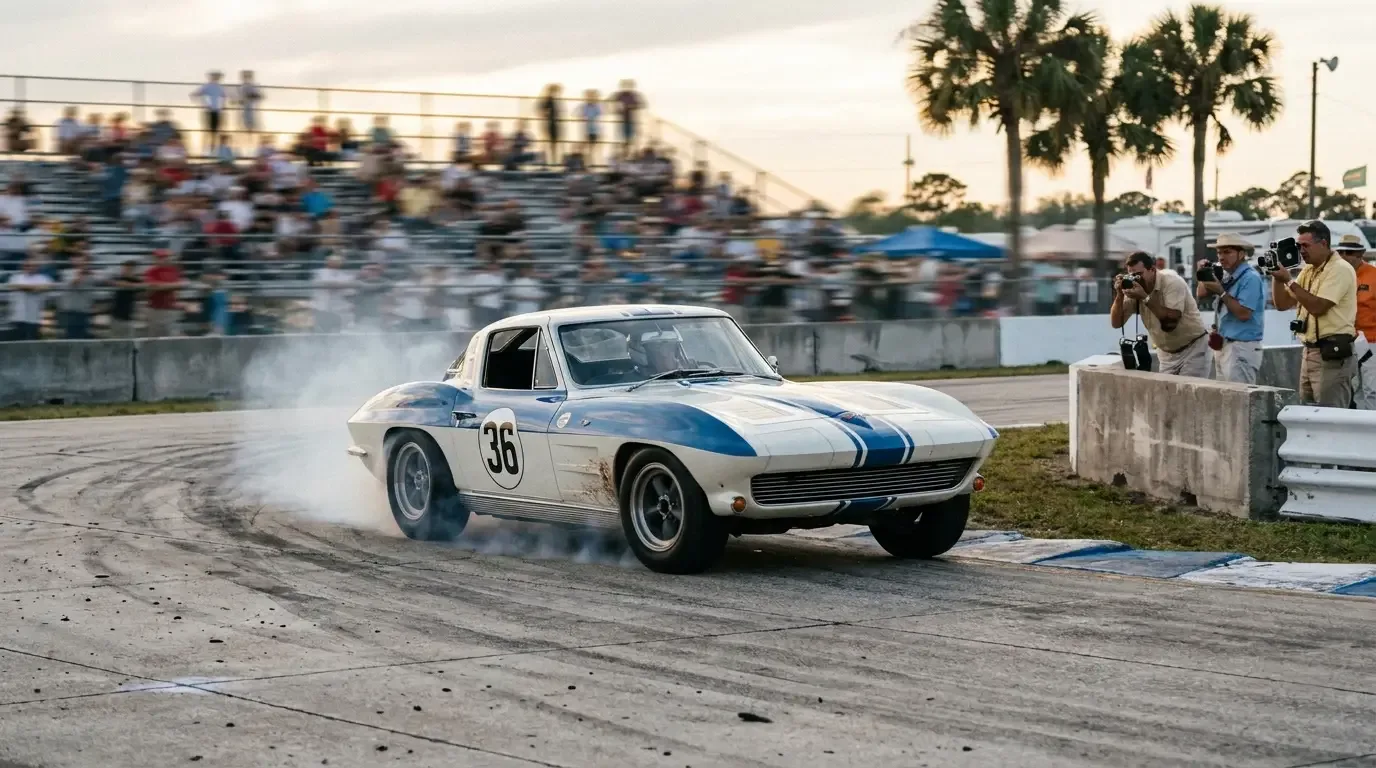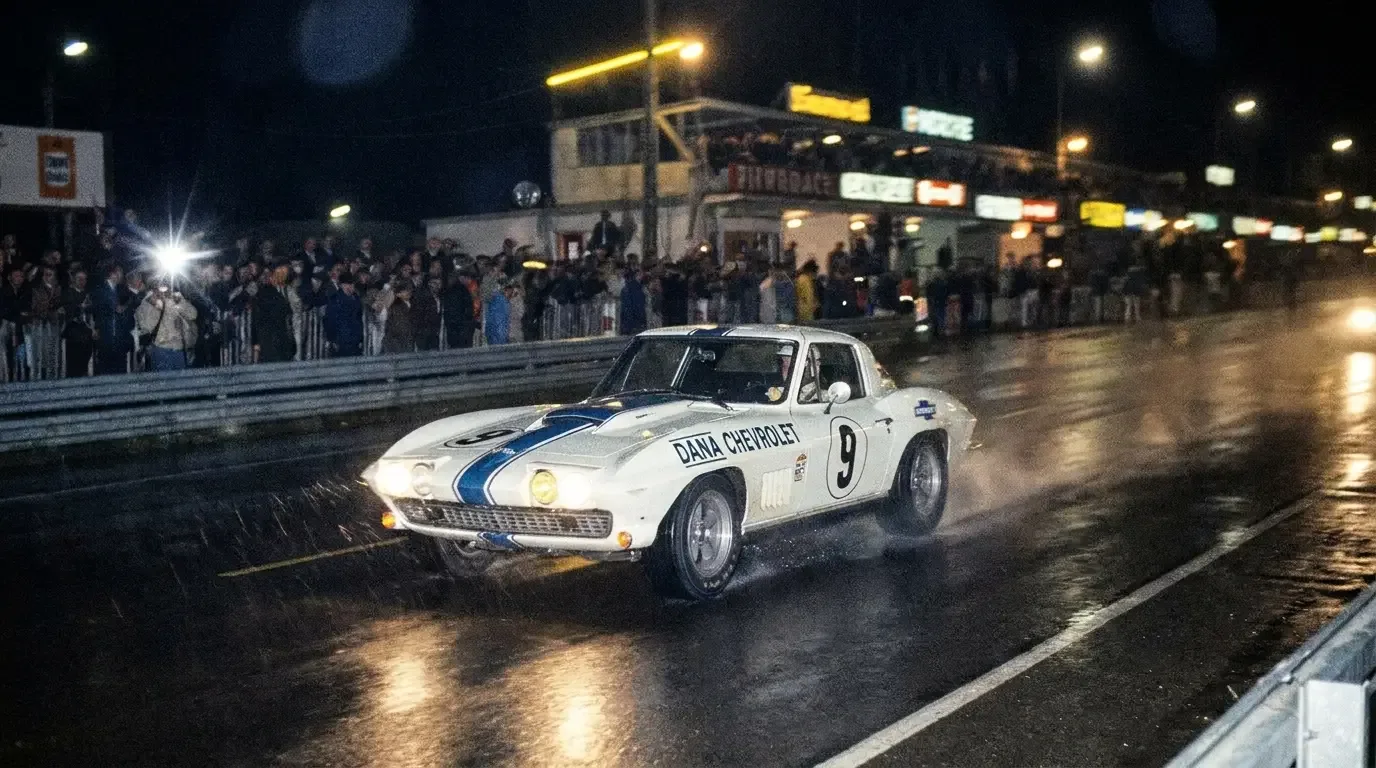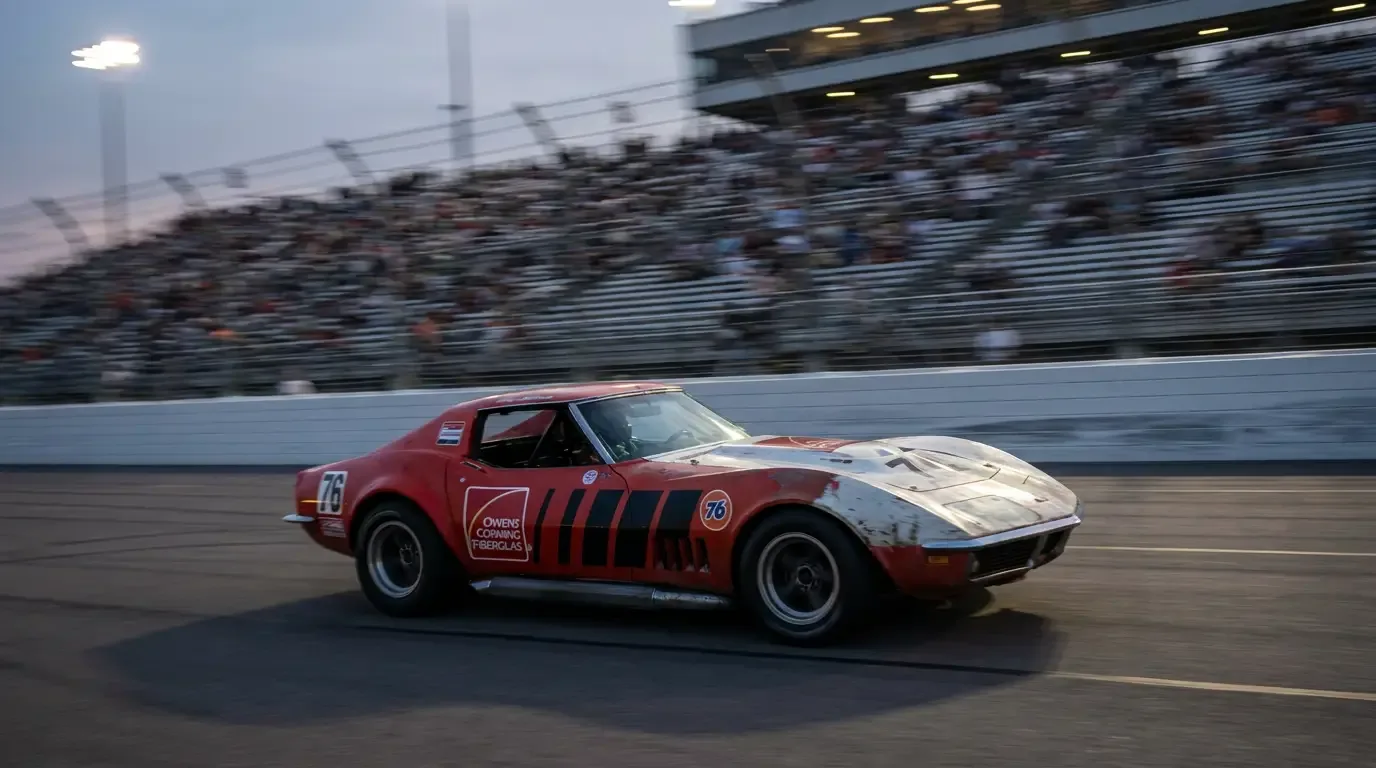
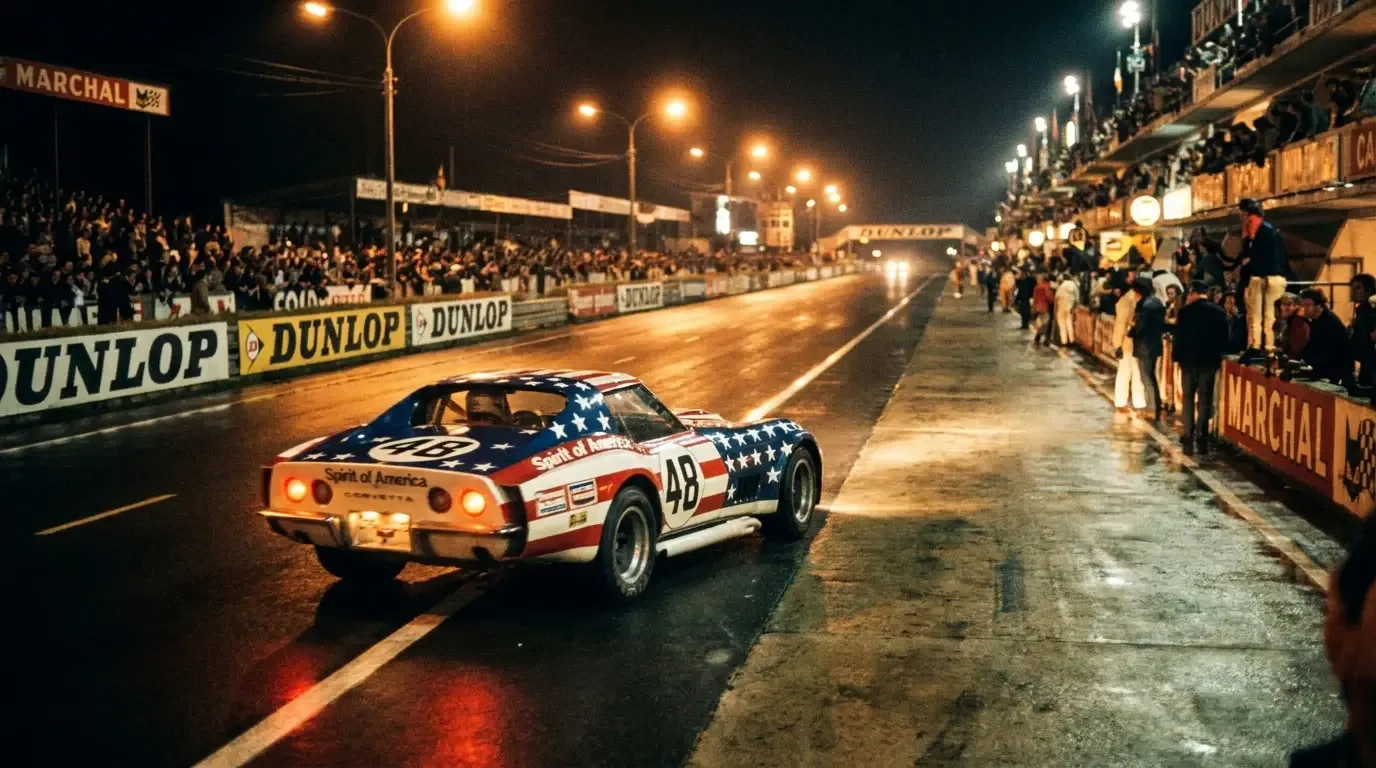
John Greenwood had a particular way of making a Corvette impossible to ignore. His cars were wide, loud, striped in red, white, and blue, and fast enough to run with the best Europe had to offer at Le Mans. The Spirit of America show cars he built in the early 1970s weren't racing machines in the traditional sense. They were something else: rolling arguments that American muscle could look as good as it ran, and that a guy from Michigan with a fabrication shop and a serious grudge against convention could build something the world would remember.
This article is part of our corvette racing history guide, which tracks the Corvette's competitive lineage from Sebring 1956 through the factory IMSA campaigns of the 1970s and beyond.
Who was John Greenwood, and what was he building?
John Greenwood began modifying and racing Corvettes alongside his brother Burt in the mid-1960s. The brothers opened their own engine-building company, Auto Research Engineering, in 1969, and by 1970 John had earned his first SCCA A-Production national championship. A second followed in 1971, along with a class win at the 12 Hours of Sebring. By that point his cars had already developed a visual identity that set them apart from anything else on the grid. The wide flares, the aggressive front splitters, the Stars-and-Stripes livery: all of it started before the Spirit of America name was attached to any specific car.
The Spirit of America concept emerged from the intersection of two things Greenwood was doing at once. He was building genuine racing cars for SCCA and eventually IMSA competition, and he was also producing show cars that drew enormous crowds at venues like the Detroit Auto Show. The show cars carried the Spirit of America name explicitly. The racing cars wore the same livery and the same philosophy, but they were built to go fast rather than to look beautiful under showroom lights.
The distinction matters when you're researching these cars, because the "Spirit of America" designation got applied loosely over the years to multiple Greenwood builds. Some were primarily show cars. Some were racers with the same visual treatment. A few were both at different points in their lives. Buyers and collectors who encounter these cars today need to know which version they're actually looking at.
The body work that defined the look
What made the Greenwood cars immediately recognizable was the bodywork. Starting with a C3 Corvette chassis, Greenwood's shop fabricated dramatically widened fender flares that added substantial track width over the standard body. The exact dimensions varied by build, but the effect was consistent: a C3 that looked factory-narrow next to a Greenwood car appeared almost tentative by comparison.
The fiberglass work was done in-house at the Greenwood shop in Michigan. The quality varied depending on the purpose of the build. Racing cars prioritized weight and function. Show cars prioritized finish and visual impact. The paint, when the cars were in their full patriotic livery, was a combination of red, white, and blue that covered a lot of surface area and required serious masking work to execute cleanly.
Greenwood also developed a front air dam and a rear spoiler arrangement that was genuinely functional at speed, not decorative. By the mid-1970s, the cars running in IMSA competition had developed significant aerodynamic aids beyond what the show-car versions wore. If you see a Greenwood car at auction and the aerodynamics look more aggressive than the show-car versions, it's likely a later racing evolution rather than an early Spirit of America build.
Underneath the custom fiberglass, the foundation was a standard C3 Corvette. If you're in the market for a genuine Greenwood build, or just want to experience the C3 platform that made all of this possible, C3 Corvettes for sale on the market today range from high-mileage drivers to documented show-quality examples, with prices varying widely based on engine, options, and condition.
What powered them
The engine choices in Greenwood's cars tracked the options available from Chevrolet during the C3 era, sometimes heavily modified and sometimes closer to stock depending on the car's intended use. The show cars generally ran big-block V8s from the Corvette options list, dressed up visually but not always built for competition power levels.
The racing cars were a different story. Greenwood and his team extracted serious power from big-block Chevrolet engines, with modifications that went well beyond anything a dealer could order. The competition versions used Kinsler cross-ram fuel injection and other improvements that pushed output to over 700 hp by the mid-1970s. Precise figures varied by build and season, as the cars were privately constructed without factory documentation. What's well-established is that the cars were competitive in SCCA A-Production and later in IMSA GT competition, which required real power and handling, not just show-car presence.
| Car type | Base chassis | Typical engine | Primary use |
|---|---|---|---|
| Spirit of America show cars | C3 Corvette (1972-1974 era) | Big-block V8, street-dressed | Auto shows, exhibition |
| Greenwood racing Corvettes | C3 Corvette | Modified big-block V8, 700+ hp | SCCA A-Production, IMSA GT |
| Le Mans entries (1972, 1973, 1976) | C3 Corvette | Competition-built big-block V8 | FIA endurance racing |
Racing results and what they meant
Greenwood's cars won races. They won SCCA A-Production national championships in 1970 and 1971. They competed at Le Mans during a period when the Corvette's factory motorsport program had gone quiet, which meant that Greenwood was essentially carrying the flag without factory support. The significance of that isn't lost on anyone who followed the Corvette's racing history through the 1970s.
The IMSA results in particular built Greenwood's reputation. By the mid-1970s, his cars were serious contenders rather than crowd-pleasing also-rans, and the wide-body treatment that started as a visual statement had evolved into a genuine aerodynamic and tire-contact solution. The racing program and the show-car program fed each other: the show cars generated publicity and income that helped fund the racing, and the racing results gave the show cars credibility.
The Le Mans appearances in 1972, 1973, and 1976 deserve their own mention. Running a privately built American car at Le Mans in that era was not a small undertaking. The logistics, the regulations, the competition from factory-backed European teams: Greenwood showed up anyway and ran hard. The 1972 car retired with engine failure; the 1973 entry also failed to finish. The 1976 car qualified on the IMSA class pole and reached 215.6 mph on the Mulsanne straight before retiring early. None of the three entries finished, but the attempt established something about the Corvette's potential that resonated with the American enthusiast community for years afterward.
"The Greenwood cars were what happened when someone decided that looking fast and being fast didn't have to be different goals. They pulled it off at the show and they pulled it off on the track, which is harder than it sounds."
— Patrick Walsh
Collecting Greenwood Corvettes today
Authentic Greenwood-built cars are rare and their provenance can be complicated. Greenwood Enterprises produced wide-body conversion kits during this period, which means that not every car wearing Greenwood-style bodywork was actually built or prepared by Greenwood's shop. Some are genuine builds. Others are customer cars that received the kit and the livery and were presented as something more significant.
Documentation is everything with these cars. A genuine Greenwood race car or show car should have a traceable history: build records, period photographs, racing logs if it competed, and ideally documentation from the Greenwood operation itself. The collector community for these cars is knowledgeable and the fakes, or the misrepresented conversions, tend to get identified quickly once the right people look at them.
Prices for documented examples have increased over the past decade as the Greenwood story has received more serious historical attention. A well-documented show car in good condition commands serious money; a racing car with verifiable competition history commands more. The wide-body conversion kits themselves, even without the Greenwood provenance, have become collectible on their own terms as the C3 market has matured.
For more on where the Corvette's racing lineage went after the Greenwood years, read next in the series, which covers the Owens/Corning Fiberglas-sponsored racing program that carried the flag through the late 1970s.
Sources and notes
- Wikipedia: John Greenwood (racing driver) — confirmed Le Mans appearances 1972, 1973, 1976; Trans-Am title 1975
- Motorsports Hall of Fame: John Greenwood biography — confirmed SCCA A-Production national championships 1970 and 1971
- Corvette Magazine Issue 103: Renaissance Racer — confirmed 1969 racing start, A-Production class, Le Mans years, 700+ hp engine figures
- Wikipedia: Greenwood Corvettes — confirmed Le Mans entries 1972, 1973, 1976; Burt and John Greenwood as co-founders
- CorvSport: Greenwood Corvette Stingray ZL1 — confirmed 1972 Le Mans engine failure retirement, 750 hp ZL1 race engine
- Racer: Greenwood Spirit of LM Corvette — confirmed 1976 Le Mans pole position, 215.6 mph Mulsanne speed, early retirement