Briggs Cunningham was not a man who went to Le Mans to finish respectably. He went to win. In 1960 he brought three Corvettes to France, entered them as a team under his own name, and handed the keys to some of the better drivers he could find. What happened over the next 24 hours said as much about the Corvette's potential as any factory racing program of the decade. For the background on how the Corvette arrived at that moment, the story stretches back to 1953 and a modest two-seat roadster that almost didn't survive its second model year.
Who Briggs Cunningham was, and why it mattered
Briggs Swift Cunningham II was a Connecticut-born sportsman with enough money to build his own race cars and enough nerve to actually race them. He had campaigned at Le Mans with American machines through the early 1950s, trying to put a U.S.-built car on the overall podium at the world's most important endurance race. The Cunningham C-4R and C-5R coupes were serious efforts, but the budget required to keep building bespoke machinery was enormous.
By 1960, Cunningham had shifted strategy. The Corvette was commercially available, relatively affordable compared to full custom construction, and the 283 cubic inch fuel-injected V8 had already proven itself in SCCA competition across the country. Running production-based cars opened the door to more drivers, lower costs, and a legitimate class competition at a race where outright victory against Ferrari and Aston Martin was always going to be difficult.
The team he assembled was not casual. Bob Grossman and John Fitch drove car number 3. Dick Thompson, one of the most accomplished Corvette racers of the era, shared car number 2 with Fred Windridge. Cunningham himself drove car number 1 with William Kimberly. These were experienced hands who understood what Le Mans demanded in terms of fuel economy, tire management, and the discipline to not push past a car's limits at three in the morning on the Mulsanne straight.
The cars themselves
The three Corvettes Cunningham entered were 1960 production cars, modified within the rules of the GT class. Each carried the 283 cubic inch V8 with Rochester fuel injection, rated at around 290 hp in the specification the team selected for Le Mans. In standard trim that engine was already competitive with the European GT machinery in its displacement class.
Cunningham's team prepared the cars with the kind of thoroughness that Le Mans demands. Larger fuel tanks to extend pit stop intervals. Upgraded brakes for the repeated heavy stopping from high speed at Maison Blanche and the Ford Chicanes. Minor aerodynamic work on the bodywork, though the production Corvette's shape was reasonably clean to begin with.
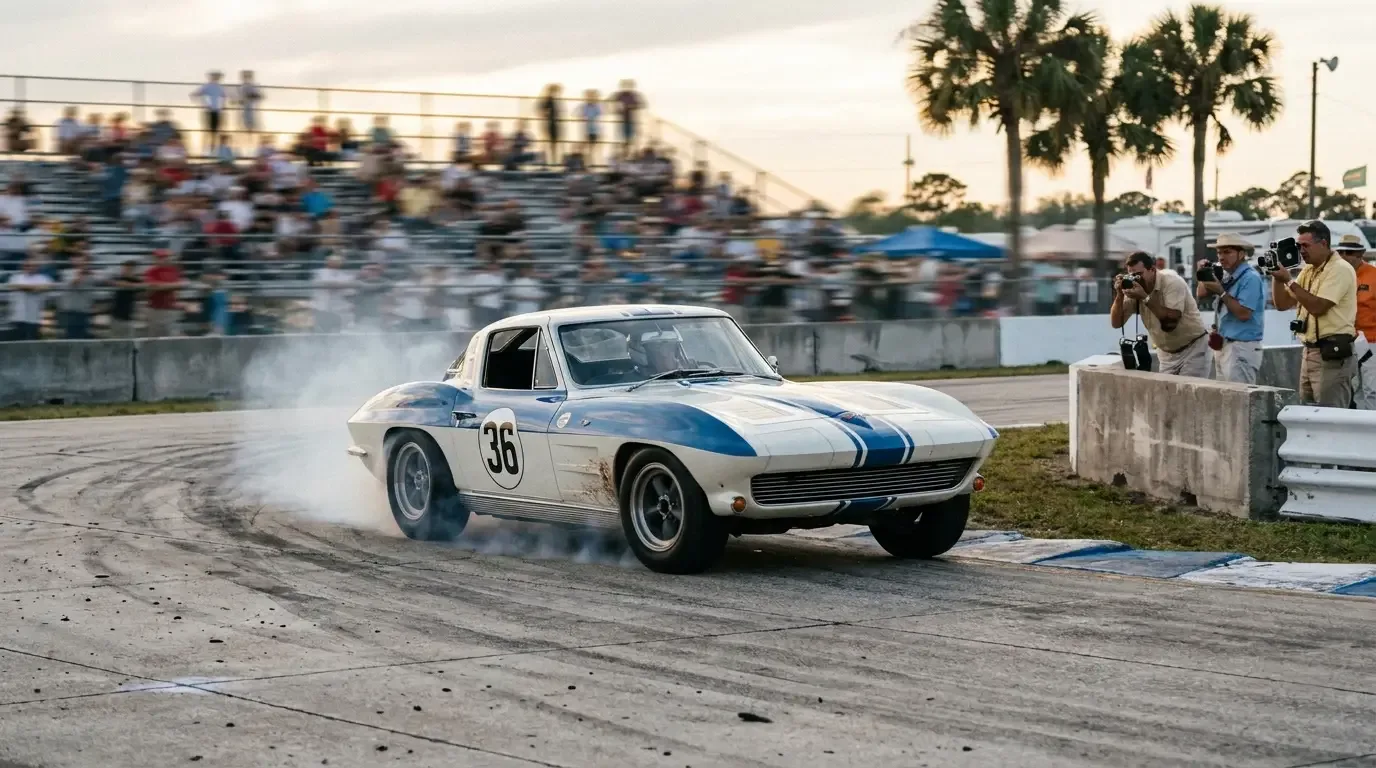
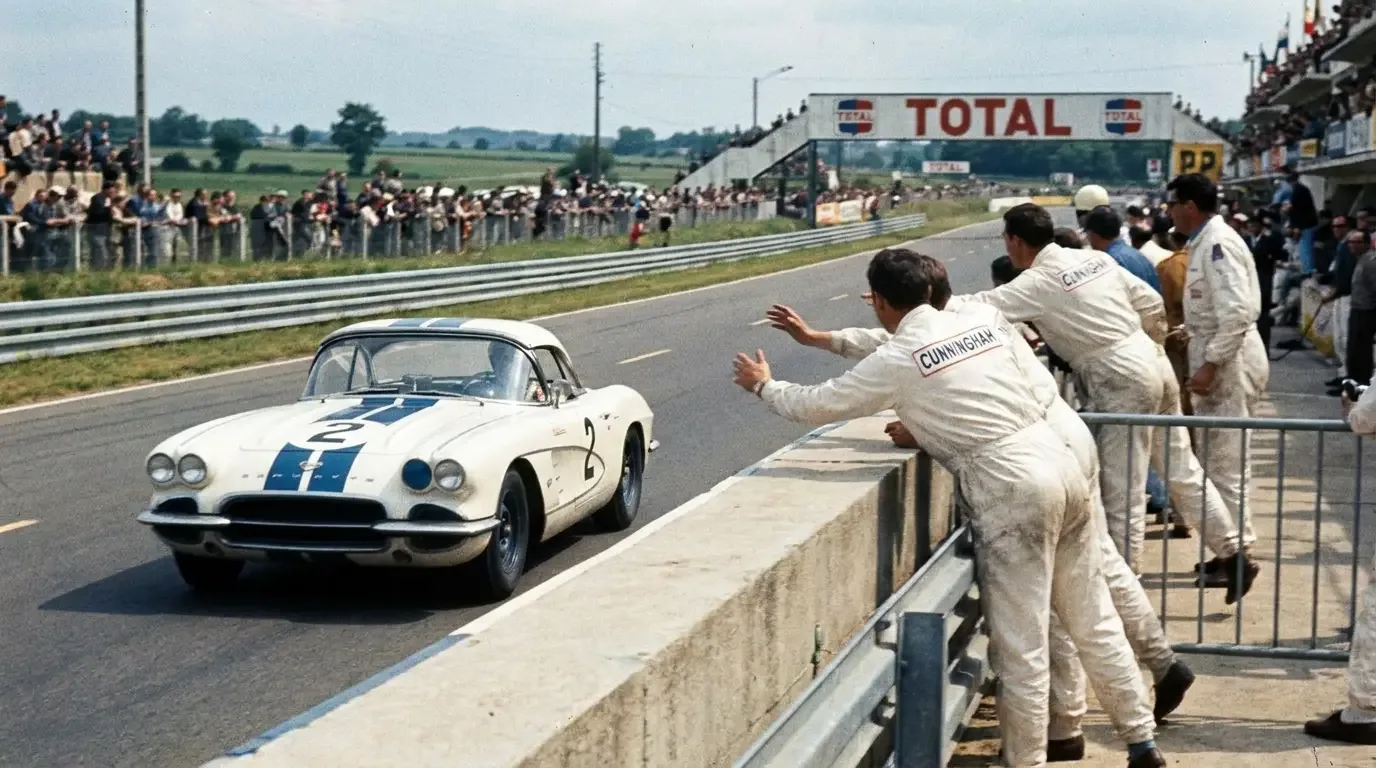
The cars ran on Firestone racing tires. They carried the characteristic Cunningham racing livery: white bodywork with two broad blue stripes running front to back, the same scheme Cunningham had used on his bespoke cars through the 1950s. At Le Mans, that combination made them instantly recognizable on the circuit.
| Specification | Detail |
|---|---|
| Base model | 1960 Chevrolet Corvette |
| Engine | 283 cu in V8, Rochester fuel injection |
| Rated output | ~290 hp |
| Transmission | 4-speed manual (close-ratio) |
| Class | GT 4000-5000cc |
| Livery | White with blue racing stripes (Cunningham colors) |
| Race | 24 Hours of Le Mans, 1960 |
| Best overall finish | 8th overall (Car #3, Fitch/Grossman) |
The race and what the Corvettes accomplished
The 1960 24 Hours of Le Mans ran from June 25 to June 26. The overall race was contested by much more powerful machinery: Ferrari Testa Rossas, the Aston Martin DBR1s, and various Maserati and Porsche prototypes. The Cunningham Corvettes were not competing for the outright win. They were after class honors and, with some fortune, a strong overall finish that would put American iron in the results sheet.
The three cars met very different fates. Car number 1, driven by Cunningham and Kimberly, went out in the third hour when Kimberly aquaplaned off the circuit at Maison Blanche in the rain and rolled the car, ending their race after just 32 laps. Car number 2, shared by Thompson and Windridge, ran strongly but caught fire at the 20-hour mark after completing 207 laps. That left only car number 3, the Grossman and Fitch entry, to carry the team through to the finish.
The surviving Corvette had its own drama. Overheating threatened in the final hours, and the crew improvised by packing ice from trackside coolers into the engine bay -- race regulations prevented receiving additional fluids other than fuel. The car made it through. By the finish, Grossman and Fitch had completed 281 laps to come home 8th overall, which was also first in the GT 4000-5000cc class -- the highest overall finish an American sports car had achieved at Le Mans up to that point in the modern era of the race.
In the GT class, the result was significant. The Corvette showed it could run for 24 hours at Le Mans pace without catastrophic failure, which was not something that could be assumed of an American V8 sports car in 1960. European machinery had years of endurance racing development behind it. The Corvette, still less than a decade old as a nameplate, had demonstrated it belonged in the conversation. For the deeper story of how these results connected to a longer arc of Corvette competition, the thread runs from the Cunningham entries straight through the Grand Sport program and beyond.
"Cunningham didn't go to France to make a point. He went to race. The fact that the Corvette could sustain 24 hours at Le Mans speed, with fuel injection, in 1960, told you more about where the car was headed than any press release from Detroit ever could."
— Patrick Walsh
Why this effort matters to Corvette history
The 1960 Le Mans entry is sometimes treated as a footnote because Cunningham didn't win. That reading misses the point. Endurance racing credibility is earned by finishing, and by finishing in a position that forces the competition to take you seriously. The Cunningham Corvettes did both.
Chevrolet engineering was paying attention. The fuel injection system on the 283 had already shown promise in shorter SCCA events; surviving 24 hours at Le Mans pace was a different kind of proof. The lessons from the Cunningham effort fed into subsequent development of the Corvette, particularly in thinking about durability and sustained high-speed performance. If you want to understand the ambitions behind the companion story of the 1963 Grand Sports, the 1960 Le Mans result is part of what made those ambitions plausible internally.
Cunningham himself continued to believe in the Corvette as a platform. His team's effort was private, without factory backing, which made the result even more notable. These weren't factory prototypes with unlimited engineering support. They were race-prepped versions of a car a civilian could order from a Chevrolet dealership.
The legacy in context
The 1960 Le Mans result didn't get Chevrolet into factory racing immediately. The AMA ban on manufacturer racing involvement, adopted in 1957, was still officially in effect, and GM was publicly adhering to it. Cunningham's effort was private, which was exactly the point. It let the Corvette prove itself in the world's hardest endurance race without Chevrolet having to acknowledge the program officially.
What the race established, in concrete terms, was that the Corvette could compete in the GT class at international level. The car was no longer just an American sports car that did well in domestic SCCA club racing. It had run at Le Mans, finished, and finished creditably. That changed how the Corvette was perceived among European enthusiasts and, more importantly, among the engineers and product planners at General Motors who were thinking about what the car should become in the decade ahead.
The Cunningham name carries weight in American sports car history precisely because Briggs ran the effort correctly: serious preparation, experienced drivers, the right car for the right class. The 1960 Le Mans Corvettes weren't there to make noise. They were there to race, and they did.
Sources and notes
- Wikipedia: 1960 24 Hours of Le Mans -- confirmed car numbers, driver pairings, DNF reasons (Car #1 accident 32 laps, Car #2 fire 207 laps), Car #3 8th overall 281 laps
- Corvette Central: 1960 Le Mans Retrospective -- confirmed class GT 4000-5000cc win, overheating drama in Car #3's final hours, 4-speed close-ratio transmission
- Sports Car Digest: Le Mans Corvette 1960 Profile -- confirmed Firestone racing tires (hand-cut Indy-spec), 4-speed close-ratio transmission, June 25 start date
- Silodrome: First Corvettes to Race at Le Mans -- confirmed 290 hp fuel-injected V8 specification for the Cunningham Le Mans entries
- CorvSport: 1960 C1 Corvette Guide -- confirmed 1960 fuel injection options: RPO 579 (275 hp) and RPO 579D (315 hp); 4-speed manual required with fuel injection
- 24 Heures du Mans official: Corvette's first class win at Le Mans 1960 -- confirmed Car #3 (Fitch/Grossman) 8th overall and GT class winner