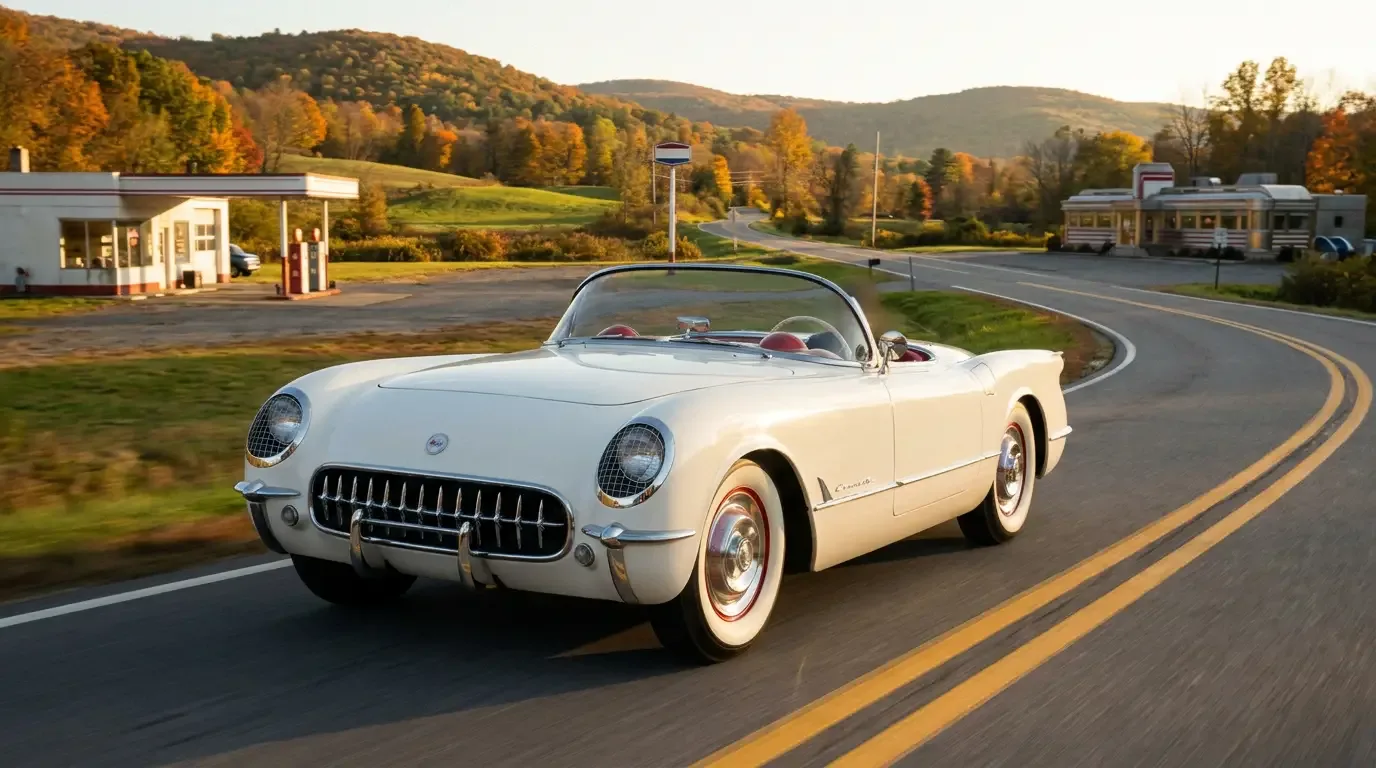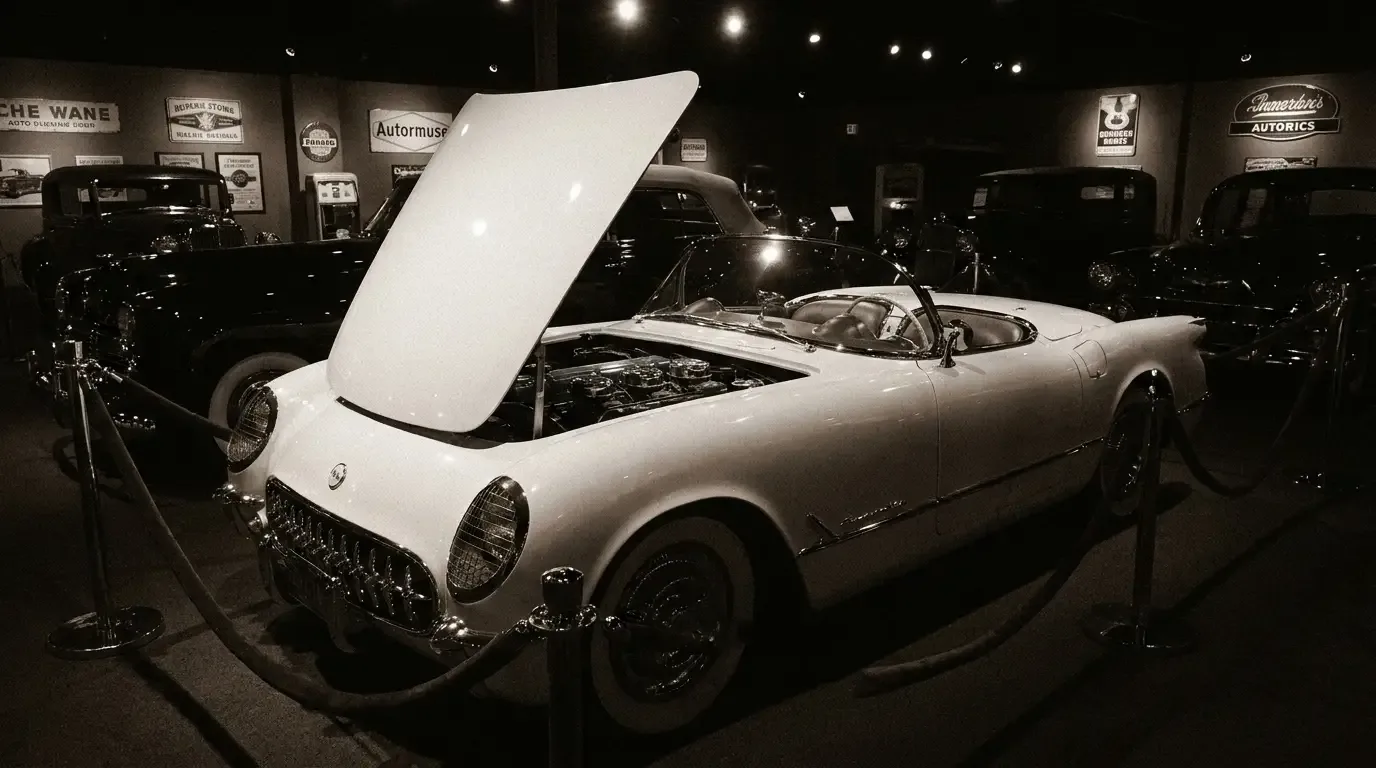

The 1955 Corvette should not exist. By the time the model year opened, Chevrolet's brass had already drafted the cancellation paperwork. Two years of weak sales and a single powerplant that buyers actively resisted had put the car on the chopping block. What reversed the decision was not a marketing campaign or a price adjustment. It was an engine. The small-block V8 that arrived for 1955 was the thing that turned a novelty into a sports car, and it came just in time.
If you want the full story of where the C1 started, our c1 corvette guide covers the birth of the platform from 1953 through those uncertain first years. This piece focuses on 1955 specifically: why that year mattered, what changed under the hood, and what the production record actually shows.
Why 1955 was a crisis year
The 1953 and 1954 Corvettes arrived with a 235 cubic inch inline six borrowed from Chevrolet's passenger car lineup. The engine made 150 horsepower in early Corvette tune (155 horsepower on late-production 1954 cars after a revised camshaft), running three carburetors and a modified cam. That was not nothing, but it was not what anyone calling themselves a sports car buyer wanted. The British competition at the time, cars like the Jaguar XK120 and the early Triumph TR2, offered real performance credentials. The Corvette offered a fiberglass body and a motor that came standard in taxicabs.
Total 1954 Corvette production came in at 3,640 units, a number that looked worse given that Chevrolet had expanded production capacity expecting stronger demand; roughly a third of that run remained unsold at year's end. Cars sat on lots. Ford was preparing its own two-seat sporty car, the Thunderbird, which went on sale as a 1955 model that October. The pressure was real.
The V8 arrives: what actually changed
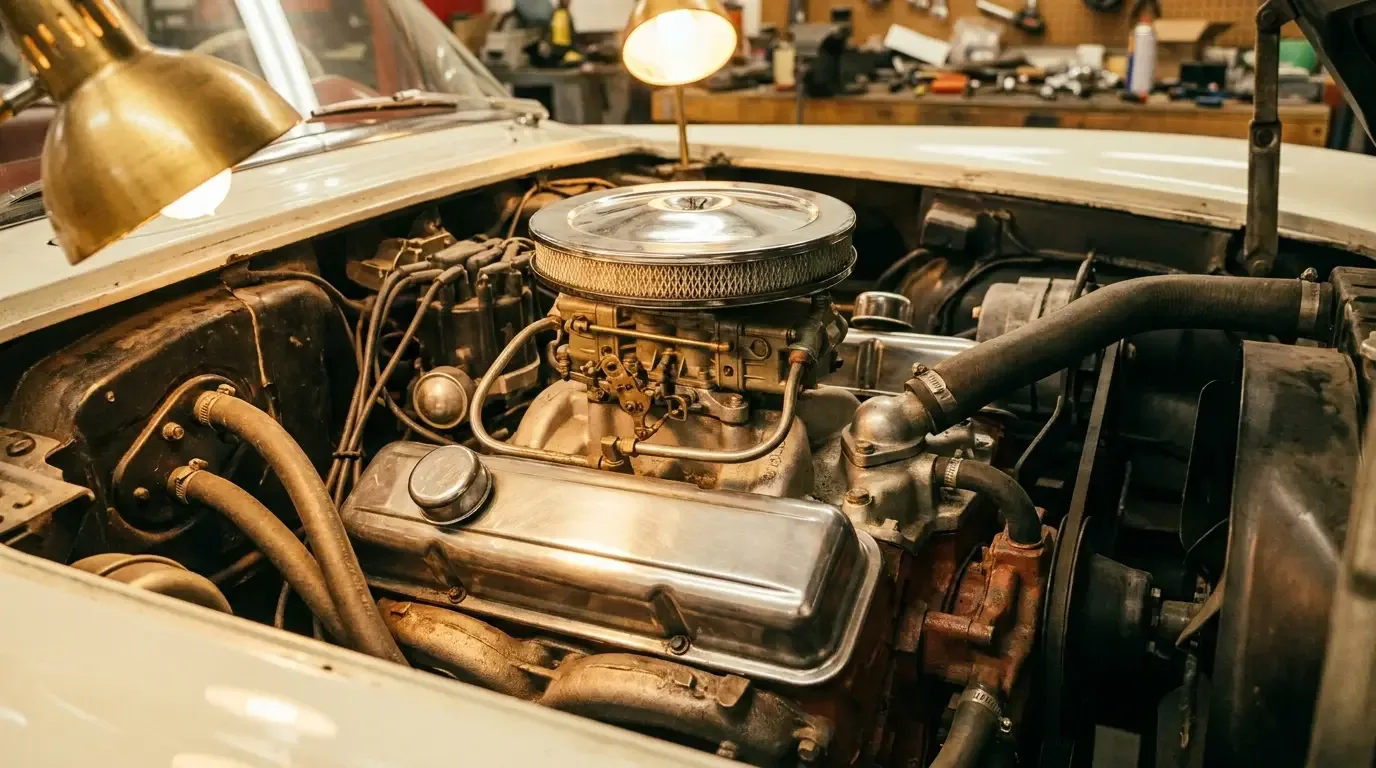
The engine that saved the Corvette was not designed specifically for it. The 265 cubic inch small-block V8 was a new Chevrolet architecture intended across the passenger car line, and it was a genuinely modern piece of engineering for 1955. Ed Cole's team had designed it to be compact, light, and producible in volume. The Corvette got it as a running change during the 1955 model year rather than as a clean start-of-year introduction, which partly explains the unusual production story for that year.
In Corvette application, the 265 V8 produced 195 horsepower at 5,000 rpm with a single four-barrel carburetor (a Rochester or Carter WCFB unit, depending on production timing). That was a meaningful jump over the six-cylinder's output, but more importantly, the character of the power delivery changed. The small-block pulled cleanly through the rev range in a way the old Blue Flame six simply did not. Period road tests noted the difference immediately.
| Engine | Displacement | Horsepower | Transmission | Years available |
|---|---|---|---|---|
| Blue Flame Six | 235 cu in inline-6 | 150-155 hp | 2-speed Powerglide (auto) | 1953-1955 |
| 265 Small-Block V8 | 265 cu in V8 | 195 hp @ 5,000 rpm | 3-speed manual (standard with V8) | 1955 (mid-year intro) |
The transmission pairing matters here. The six-cylinder Corvette had only been offered with the two-speed Powerglide automatic, a choice that drew consistent criticism. The V8 in 1955 came standard with a three-speed manual gearbox. That combination, V8 power with a stick shift, was what Zora Arkus-Duntov and the performance-minded faction inside Chevrolet had been pushing for from the start.
How to identify a genuine 1955 V8 car
The 1955 model year ran both engines simultaneously, which creates some interesting documentation questions for anyone looking at a car today. The six-cylinder 1955 Corvettes exist, though they are a minority of production. The V8 cars carry the new engine along with a handful of distinguishing details that factory records and NCRS documentation can confirm.
The VIN structure for 1955 Corvettes is worth understanding. The model identifier and the year coding appear in the serial number, but the engine type is not explicitly encoded in the VIN for this generation. The tank sticker, where it survives, is the primary factory record. For 1955 specifically, the mid-year introduction of the V8 means that build dates are relevant: a car built in the first part of the model year is far more likely to be a six-cylinder car than one built later.
"The tank sticker on a 1955 V8 car is not always present, and when it is, it needs to be read carefully. The build date matters as much as anything else on the car. A late-production 1955 with a V8 and a documented build date is a straightforward case. An early-production car claiming a V8 from the factory needs more scrutiny."
— Tom Ramirez
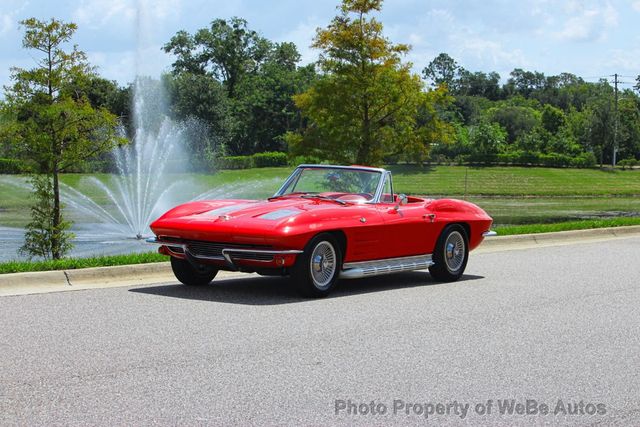
The external tells on a 1955 V8 car are subtle. The most commonly cited is the enlarged gold "V" worked into the "Chevrolet" script on the front fender, a detail used only on the V8-equipped cars that year (1953 and 1954 cars, all six-cylinder, carried a smaller script without it). Body color options and interior configurations for 1955 were similar across both engine choices, so the V emblem and the documentation trail are your primary authenticity markers.
What the production numbers tell you
Total 1955 Corvette production came in at 700 units, all convertibles. That breaks down into a small number of six-cylinder cars, commonly cited as around seven, built before the V8 became available, and then the roughly 693 V8 cars that made up the bulk of production through the rest of the model year. Chevrolet had reportedly planned for production north of 10,000 units that year; actual output landed nowhere close. The six-cylinder 1955 cars are rare to the point of being genuinely obscure; most people who discuss 1955 production are talking about the V8 variants.
The low total production number for 1955 is sometimes read as evidence of the car's continued struggles. That reading misses the context. Chevrolet was not pushing hard on 1955 Corvette production because the model's future was still being debated internally, and the mid-year engine change disrupted normal production rhythm. The cars that did leave the factory with V8 power sold to buyers who understood what they were getting. Documented 1955 V8 cars carry collector premiums today that reflect both the rarity and the historical significance of the year.
What came next, and why 1955 set the template
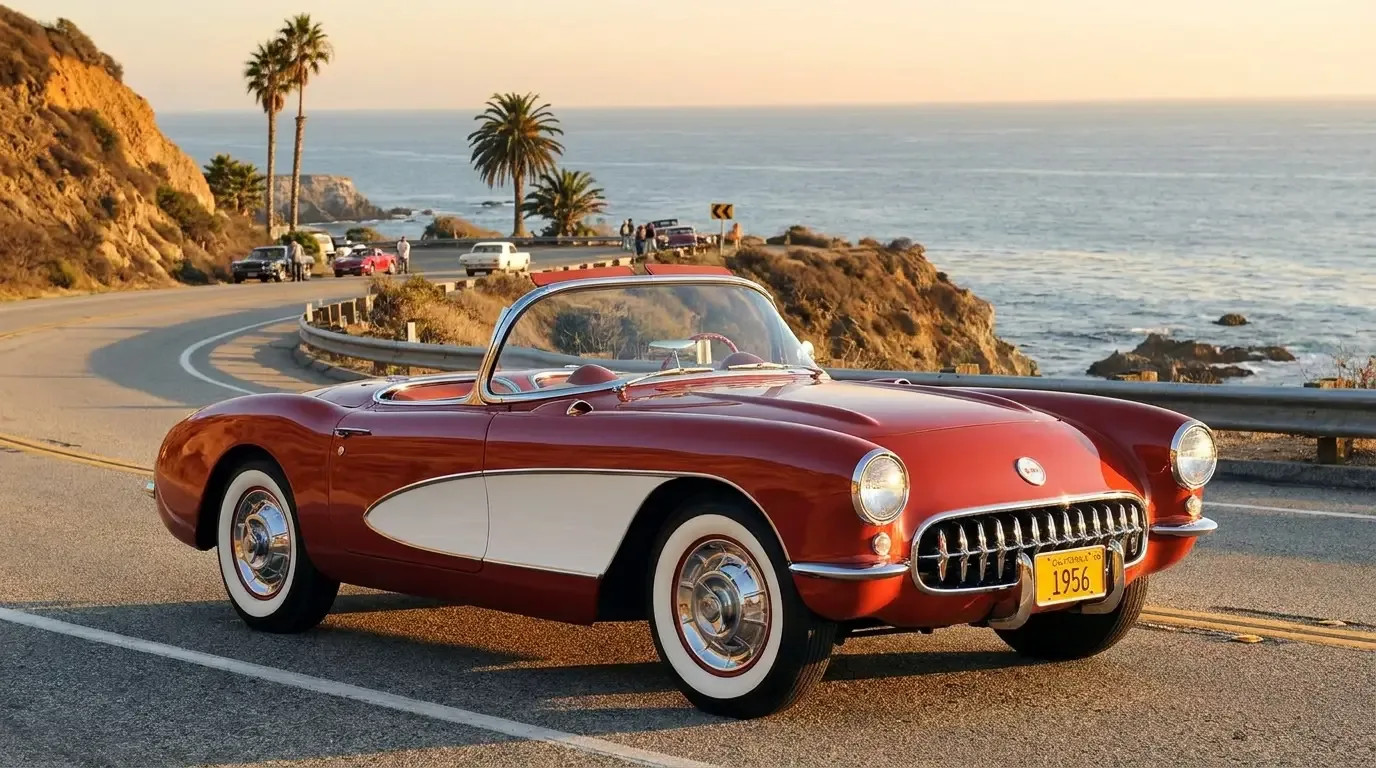
The 1955 season ended with the Corvette's future secured. The combination of V8 power and a manual transmission had demonstrated the car's potential clearly enough that Chevrolet committed to a proper redesign for 1956. That model year brought a revised body with exterior door handles, roll-up windows, and a more resolved aesthetic. The next in the series shows how rapidly the platform matured once the powertrain question was settled.
The 265 small-block itself continued to grow. By 1956 it gained more power options. By 1957 fuel injection arrived. The architecture Cole's team had engineered would anchor Corvette performance into the C2 generation and beyond. None of that trajectory happens if the V8 does not arrive for 1955 and give the Corvette a reason to exist.
The lesson the 1955 car teaches is straightforward: a sports car needs the right engine. The fiberglass body was an innovation, and the styling had its admirers, but a sports car that cannot perform is a fashion statement at best. The 265 V8 resolved the fundamental problem the original Corvette had from its first day.
For collectors researching the C1 generation, the 1955 year sits in its own category. It is not the rarest year by any absolute measure if you count all C1 production, but it represents a specific historical moment, and the documented V8 cars carry that weight. If you are looking at 1950s Corvettes for sale, understanding what separates the 1955 V8 cars from the rest of the early production run is worth the time before you make any offers.
Sources and notes
- CorvSport: 1955 Corvette Production Numbers — confirmed total 1955 production of 700 units, all convertibles, against a predicted run north of 10,000
- Corvette Action Center: 1955 Corvette Production and Performance Numbers — confirmed the 693 V8 / 7 six-cylinder production split
- Wikipedia: Chevrolet Corvette (C1) — confirmed 265 cu in V8 specs, 195 hp rating, and the mid-year 1955 engine introduction
- The Spokesman-Review: Collector Car Corner on the 1955 Chevy 265 V8 — confirmed the four-barrel carburetor and 195 hp output at 5,000 rpm
- Corvette Action Center: 1954 Corvette Production and Performance Numbers — confirmed 1954 total production of 3,640 units and Blue Flame six horsepower ratings
- Wikipedia: Ford Thunderbird (first generation) — confirmed October 1954 on-sale date for the 1955 Thunderbird as a competing two-seat model