The Indianapolis 500 has been run since 1911, and the pace car has been part of the show almost as long. But it was the Corvette that turned pace car duty into something else entirely: a marketing event, a collector's obsession, and a recurring chapter in American automotive culture. From 1978 forward, Chevrolet returned to Indianapolis again and again with the Corvette, and each time they brought the pace car back to the street in a limited replica edition that buyers lined up to own. To understand these cars properly, you need to know what the Indy connection actually meant, which years produced genuinely significant editions, and where the replica market stands today. If you want the full context of how Corvette special editions fit together, the corvette special editions era is the place to start.
How the Corvette earned the pace car role
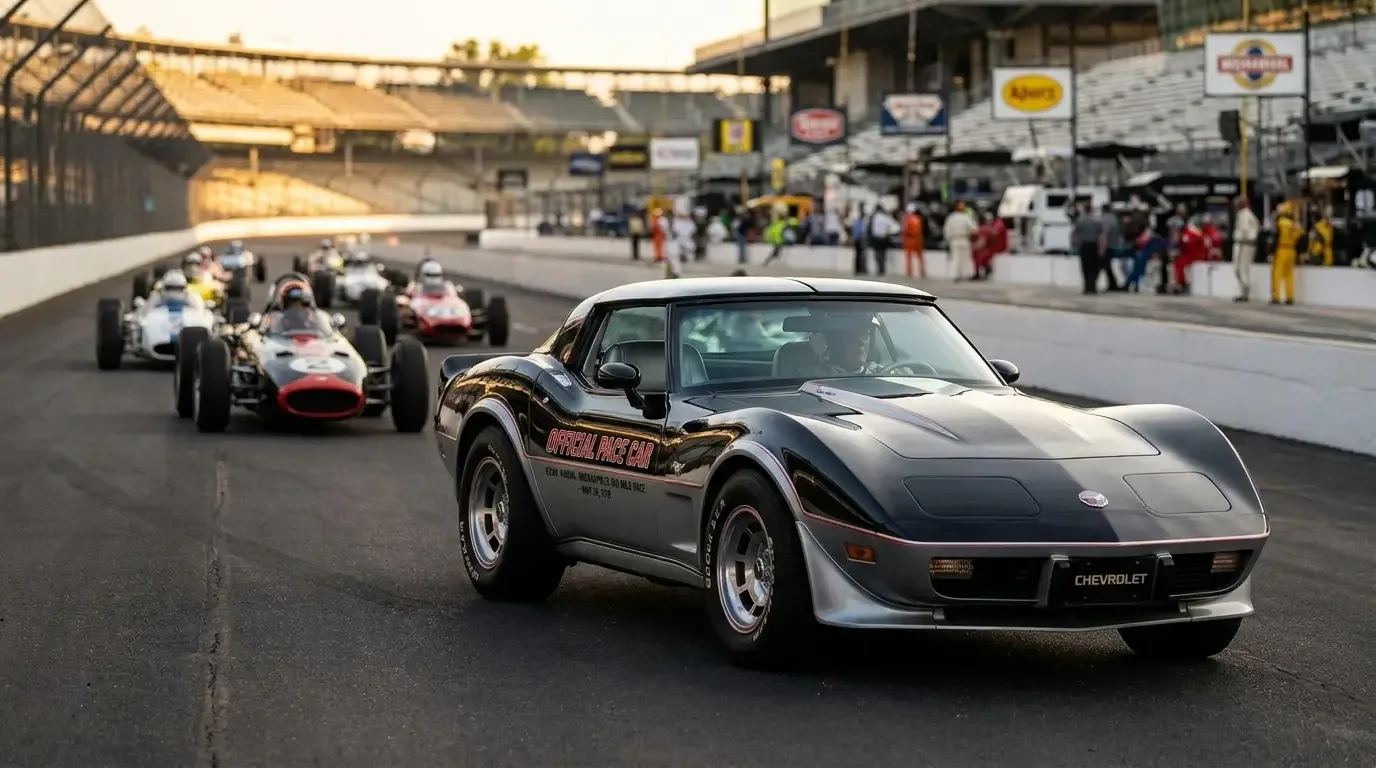
Chevrolet first sent a Corvette to pace the Indianapolis 500 in 1978 -- that was also where the story began. Earlier Indy pace cars from Chevrolet in the preceding decades used other models; no Corvette paced the Brickyard before 1978. What made that year significant was scale and timing. Chevrolet was celebrating the Corvette's 25th anniversary, the production line was running at volume, and someone made the call to build replica pace cars for the public. Around 6,502 examples were built that year, finished in black and silver with the pace car decals either applied at the dealer or included in the package for owners who preferred a cleaner look. The decals-in-the-trunk approach became a mild legend in itself.
The 1978 car carried the L48 350 small-block rated at 185 hp in most configurations, which is worth noting: this was not a performance special in the horsepower sense. The pace car look was the point. That distinction matters for understanding what these editions actually are. They are event-commemorative cars first. The performance credentials, when they exist, are usually tied to whatever engine was available in that model year rather than anything unique to the pace car package.
To understand where it all began helps explain why the pace car connection carried so much weight. By 1978, the Corvette was already 25 years into its identity as America's only true production sports car. Indianapolis gave that identity a racing legitimacy it otherwise had to work for.
The 1986 and 1995 editions: two very different cars
After 1978, the Corvette returned to pace car duty at Indianapolis in 1986 and again in 1995, and each produced a replica edition. The 1986 car matters for a reason that has nothing to do with the package itself: it was the first production Corvette convertible since 1975. Chevrolet had spent more than a decade without a ragtop, partly due to anticipated rollover regulations that never materialized. The 1986 pace car brought the convertible back, and the Indy connection gave it a debut that Chevrolet could not have staged better if they had planned it for years. Which, arguably, they had.
The 1986 pace car used the L98 350 small-block rated at approximately 230 hp, the same engine available across the C4 lineup. General Motors took an unusual approach with the 1986 replica: rather than creating a limited special-edition package, all 7,315 convertibles built that year were deemed street-going pace car replicas, with official decals available through dealers. The actual pace car driven at Indianapolis was a modified unit with considerably more power. The replica's significance is the convertible bodywork, not enhanced mechanicals.
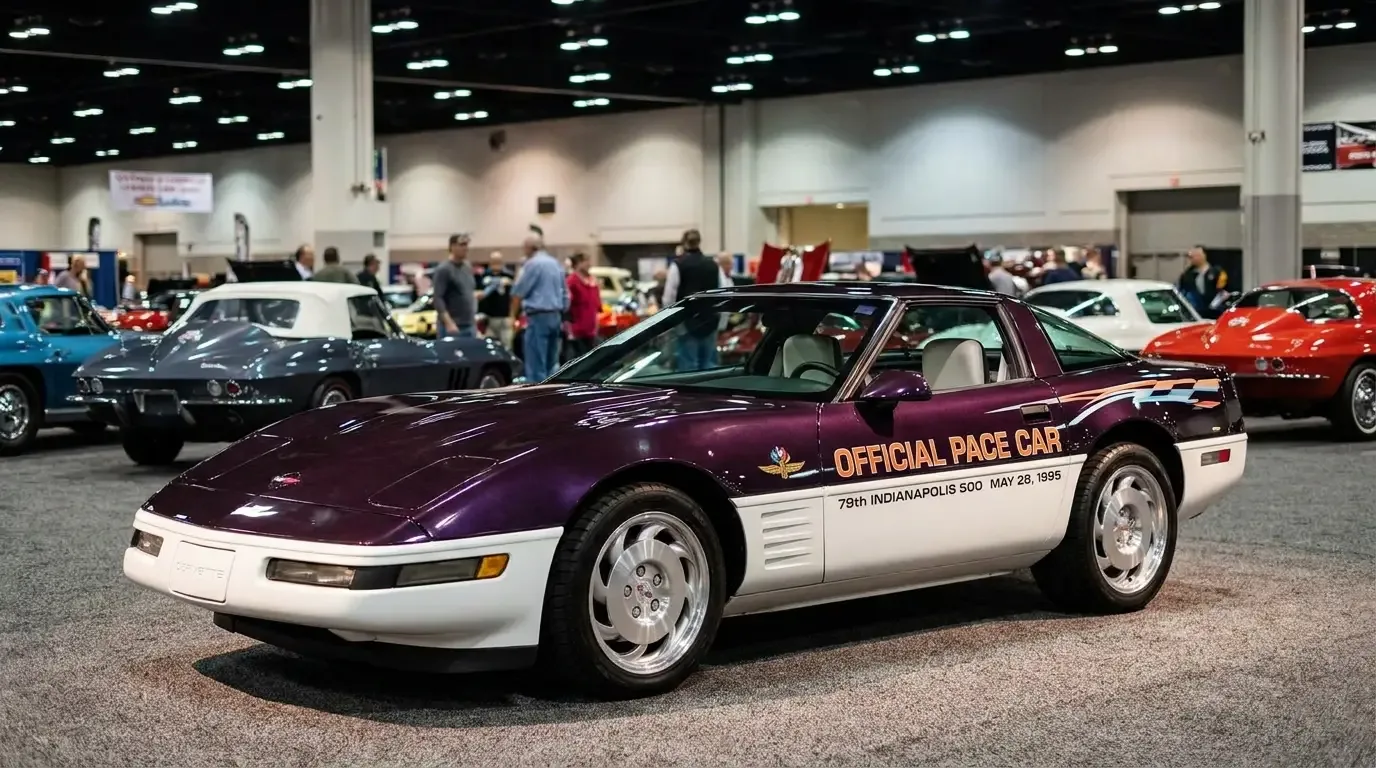
The 1995 pace car took a different approach. By then the C4 was in its final years, and Chevrolet built only 527 pace car replicas, making it the most limited Corvette pace car edition to that point. The 1995 car used the LT1 V8 producing 300 hp -- the LT4 was not introduced until the 1996 model year and was not part of the 1995 package. The distinctive two-tone Dark Purple Metallic over Arctic White finish made these cars instantly identifiable. Low production and a model-year-end context created a collector premium that the 1978 and 1986 cars, with their higher volumes, do not command to the same degree.
| Year | Generation | Engine (base) | Est. Replica Production |
|---|---|---|---|
| 1978 | C3 | L48 350 (185 hp) | ~6,502 |
| 1986 | C4 (convertible) | L98 350 (~230 hp) | ~7,315 (all convertibles) |
| 1995 | C4 | LT1 350 (300 hp) | ~527 |
| 1998 | C5 (convertible) | LS1 (~345 hp) | ~1,163 |
The C5 era: 1998
The C5 generation brought the Corvette back to Indianapolis in 1998, following a pattern Chevrolet had now used twice before: debut the new ragtop at Indy. The C5 convertible was new that year, and the 1998 pace car replicas used the LS1 V8, the aluminum small-block that defined the C5, rated at 345 hp. Production came to 1,163 units, finished in Radar Blue with yellow graphics that divided opinion sharply then and still does. The color combination photographs dramatically. In person, it is a committed choice.
The Corvette also returned to pace car duty in 2002 and 2004, but neither year produced official replica editions sold to the public. The 2004 car -- a convertible piloted by actor Morgan Freeman -- was finished in a patriotic red, white and blue motif and was largely identical to production convertibles of that year. Chevrolet offered a dealer-installed graphics package for buyers who wanted to reference the connection, but there was no factory-designated limited pace car edition. Buyers searching for a collectible C5 pace car have only the 1998 edition to consider.
"The pace car editions tell you a lot about what Chevrolet wanted to say about the Corvette at any given moment. In 1978 they wanted to say 'anniversary.' In 1986 they wanted to say 'the convertible is back.' By the C5 era they were comfortable letting the car speak for itself, and the 1998 edition did exactly that."
— Patrick Walsh
What makes a pace car edition actually valuable
Not all pace car replicas are created equal, and understanding the variables that move the market needle is more useful than treating the category as monolithic. Three factors matter most: production volume, condition with documentation, and whether the car has been modified.
Production volume is the most straightforward. The 1978 and 1986 cars were built in the thousands, which means supply is not scarce. Nice examples exist, they carry a modest premium over equivalent non-pace-car C3 and C4 Corvettes, but they are not rare objects. The 1995 edition, with its confirmed 527 units, is a different conversation entirely. A properly documented, unmodified 1995 in good condition commands significantly more than a comparable standard C4 convertible.
Documentation matters because pace car editions attract people who know what to look for. The original window sticker, any dealer paperwork confirming the pace car package, and for the 1978 cars specifically, the original un-installed decal set, all add measurable value. Cars that have been modified, even tastefully, lose a portion of their collector premium. The pace car buyer usually wants something original, which is what makes these editions different from standard performance Corvettes where a cold-air intake and headers are considered improvements.
For anyone actively searching, classic Corvette for sale listings are a useful reference point for current market conditions across all generations.
The pace car editions in context
Taken together, the Corvette pace car editions represent something the broader Corvette special edition calendar confirms: Chevrolet has been remarkably consistent about using the Corvette as a platform for commemorative and event-tied variants. The pace car editions sit alongside anniversary models, ZR1 performance packages, and dealer-special color runs as part of a longer story about how the car has been marketed across six decades. The related article on anniversary editions covers the overlap between these categories, since several years produced both an anniversary car and a pace car edition in close proximity.
For collectors, the pace car category rewards specificity. Knowing which year, which generation, and which production figure applies separates buyers who will overpay for a common example from those who recognize the genuinely limited ones. The 1978 car is a cultural artifact worth owning for what it represents. The 1995 car, with its confirmed 527 units and end-of-generation timing, is worth owning for what it is.
Sources and notes
- CorvSport -- Corvette Pace Cars Ultimate Guide: confirmed pace car years, 1978 as first Corvette Indy pacer, and 1998 replica production of 1,163
- Vette Vues -- 1978 Corvette Pace Car Overview: confirmed RPO Z78, production of 6,502, L48 at 185 hp, and decals-in-trunk detail
- CorvSport -- 1995 C4 Corvette Specifications: confirmed LT1 engine (not LT4) and 527-unit Z4Z pace car replica production
- Corvette Action Center -- 1998 Production Statistics: confirmed 1,163 pace car replicas and LS1 345 hp rating
- Wikipedia -- Indianapolis 500 Pace Cars: confirmed no Corvette paced Indy before 1978; 1955 pace car was a Chevrolet Bel Air
- Vette Vues -- 1995 Corvette Specs and Production: confirmed LT1 specification and pace car package details